
Isaac Cruikshank
Isaac Cruikshank (5 October 1764 1811) was a Scottish painter and caricaturist, known for his social and political satire.
Also recorded as Isaac Cruickshank
Isaac Cruikshank
Isaac Cruikshank · Wellcome Collection, London · Wellcome Collection · Public Domain Mark
- Name
- Isaac Cruikshank
- Born
- 5 October 1764
- Birthplace
- Edinburgh, Scotland
- Died
- 1811 (aged 46–47)
- Place of death
- London, England
- Occupation
- Artist, caricaturist
- Spouse
- Mary MacNaughton (17691853)
- Nationality
- United Kingdom and Scotland.
- Languages
- English.
VALÉORINE Encyclopedia
VALÉORINE documentary reading
Documentary summary
Isaac Cruikshank (5 October 1764 1811) was a Scottish painter and caricaturist, known for his social and political satire.
Admitted source layer · organised and presented by VALÉORINE
Note VALÉORINE
Isaac Cruikshank (1764–1811) was an artist, caricaturist and draftsperson, among other activities, of Scottish and British nationality. The artist was born in Edinburgh and died in London. Isaac Cruikshank worked in London.
Languages used include English. Works are held at Ackland Art Museum, Auckland Art Gallery and Australian National Maritime Museum, among others.
Composed from admitted, traceable facts · 26 September 2026
VALÉORINE
Reference Check
Propose documentary evidence for Isaac Cruikshank. A contribution is never written directly as fact: identity, source, rights and evidence gates still decide.
Sign in to contribute
World of VALÉORINE
Documentary connections
Only confirmed graph relationships appear here. Images are shown only when their identity and reuse rights both pass the documentary gate.

Documentary evidence
Documentary basis
Authority files
gnd · 1091455759 · wikidata · Q3154738 · wikipedia · Isaac Cruikshank
In this article
Biography
Biography
George Cruikshank is recorded as having studied under Isaac Cruikshank. The recorded working language is English. Places of work recorded in the authority are London. Work by Isaac Cruikshank is recorded in the collections of Nationalmuseum, Auckland Art Gallery, National Gallery of Victoria, Australian National Maritime Museum and Metropolitan Museum of Art.
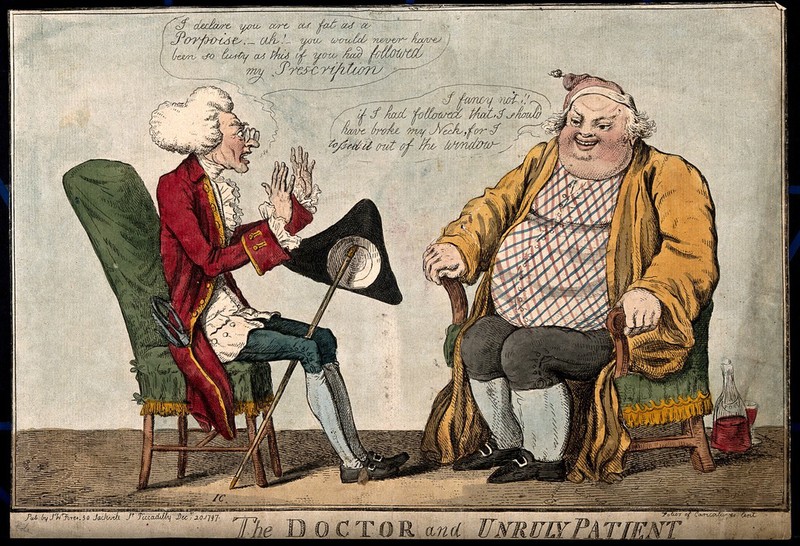
A doctor reprimanding an obese patient for not taking his medicine. Coloured etching by I. Cruikshank, 1797., 20 December 1797, by Isaac Cruikshank
Isaac Cruikshank · Wellcome Collection, London · Wellcome Collection
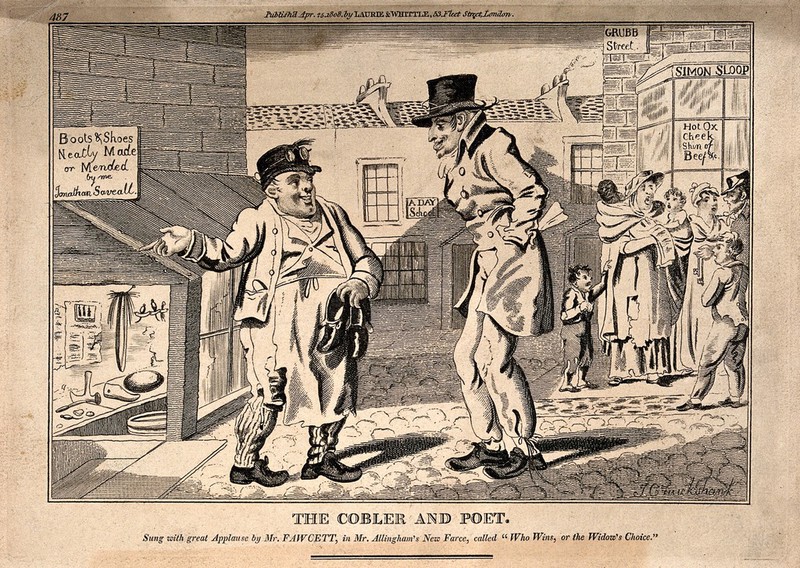
A prosperous cobbler in Grub Street recommends his shop to a hungry poet. Etching by I. Cruikshank, 1808., Apr. 25 1808, by Isaac Cruikshank
Isaac Cruikshank · Wellcome Collection, London · Wellcome Collection
Key facts
Key facts
• Name — Isaac Cruikshank • Born — 5 October 1764 • Birthplace — Edinburgh, Scotland • Baptised — 14 October 1764 • Died — 1811 (aged 46–47) • Place of death — London, England • Occupation — Artist, caricaturist • Spouse — Mary MacNaughton (17691853) • Children — Isaac Robert Cruikshank (17891856) George Cruikshank (1792–1878) Margaret Eliza (18081825) Mary (1795–1795)
Biography
Biography
Cruikshank was the son of Andrew Crookshanks (c. 1725 c. 1783), a former customs inspector, dispossessed for his role in the Jacobite rising of 1745 originally from Edinburgh, and Elizabeth Davidson (born c. 1725), the daughter of a gardener. He was born on 5 October 1764 in Edinburgh, where he was baptised on 14 October 1764. Isaac grew up in New North Kirk parish in Edinburgh after his family moved there. He was the youngest child, and was interested in all sorts of hobbies including sports and music. Isaac studied with a local artist, possibly John Kay (17421826). In 1783, Cruikshank left Scotland to travel to London with his master. There he married Mary MacNaughton (1769–1853) on 14 August 1788. The couple had five known children, two of whom died in infancy. A daughter, Margaret Eliza (18081825), a promising artist, died at the age of eighteen of tuberculosis. Their sons Isaac Robert Cruikshank (17891856), and George Cruikshank (17921878), also became artists. • Illustration — The Friends of the People, 15 November 1792, caricaturing Joseph Priestley and Thomas Paine, (Chemical Heritage Foundation Museum). Cruikshank's first known publications were etchings of Edinburgh "types", from 1784. His first caricature etching called Scotch Eloquence was of Edinburgh characters. He produced illustrations for books about the theatre, did the frontispiece for Witticisms and Jests of Dr. Johnson (1791), and illustrated George Shaw's extensive General Zoology (1800–26). His water colours were exhibited, but in order to make a living, he found it more lucrative to produce prints and caricatures. He was responsive to the marketplace but firm in his dislikes of Napoleon and Britain's home-grown political radicals, including, for example, the members of the London Corresponding Society and the Society of the Friends of the People. He and James Gillray developed the figure of John Bull, the nationalistic representation of a solid British yeoman. His Olympic games or John Bull introducing his new ambassador to the grand consul and Boney at Brussells (both from 1803) contrast an implied European capitulation and British defiance under the threat of invasion. Near the start of his fame in 1789, Cruikshank produced several watercolours adapted from his earlier drawings, and was on exhibition at the Royal Academy. Publisher John Roach was a friend and patron. Cruikshank later also worked with print dealer S. W. Fores and Johnny Fairburn. He also collaborated with G. M. Woodward, and later, with his son George. (See also G.S. Tregear.) He also etched and designed lottery tickets and the song-heads of musical scores. Cruikshank died of alcohol poisoning at the age of forty-six as a result of a drinking contest, of which he was declared the winner. He is buried near his home in London.
Caricature prominence
Caricature prominence
• Illustration — The Abolition of the Slave Trade (1792), Cruikshank's depiction of the alleged murder of a slave girl by John Kimber, published 10 April 1792 • Illustration — Isaac Cruikshank, Debating Society (Substitute for Hair Powder). London: Published by Laurie & Whittle, 5 May 1795. A reference to William Pitt the Younger's new tax on hair powder. During the late 18th century, there was propaganda due to political turbulence in Europe, in particular the French Revolution. The British monarchy was being criticized for debauchery during this time, as it was a period of economic hardship and debt. Political caricature and graphic satire became a prominent outlet for mass propaganda to express competing perspectives on political and economic issues. The revolution triggered feelings and expressions of patriotism towards artists' home countries which they depicted by shedding a grotesque light on their countries' enemies. Isaac Cruikshank, James Gillray, and Thomas Rowlandson were considered the leading caricaturists during this period, and they produced many popular sketches and graphics satirizing contemporary issues. These three prominent artists' distinct styles and subject matter became notable and widespread throughout Europe, although they also adapted and borrowed images from lesser-known artists. The three illustrators were sometimes considered rivals as their ideas often took opposing positions on important matters, despite sometimes collaborating on works. A common theme in all three artists' works was the portrayal of gluttony and cannibalism meant to represent the exploitation of the people by the monarchy, sparked by the effects on the economy of France of the Revolution. Their work, however, had to be published exclusively in Britain, as in France censorship laws were at an all-time high. In 1803 after France declared war on Britain, numerous patriotic prints resulted focused around support and strength for the British homefront. Cruikshank was one of the first to illustrate Napoleon as a negative caricature in his work Buonaparte at Rome Giving Audience in State (1797). In 1809, Cruikshank created French Generals Receiving an English Charge which largely attacked Prince Frederick, Duke of York for his scandalous affairs with Mary Anne Clarke during the time.
Examples of his work
Examples of his work
• Illustration — "The Humours of Belvoir Castle -- or the Morning After", a 1 March 1799 English caricature engraving showing the aftermath of a night of upper-class debauchery at a large country mansion, marking the celebration of the owner's coming of age.
Identity and origins
Identity and origins
The authorities additionally record the heading Isaac Cruickshank. His recorded language was English. 2 children are recorded: George Cruikshank and Isaac Robert Cruikshank.
Life and career
Dated record
Life and career
The full dated record · 2 entries
1764
Isaac Cruikshank was born in 1764 at Edinburgh.
1811
Isaac Cruikshank died in 1811 at London.
Places
Named by the record
Places
Only places the record itself states, plotted where the house gazetteer settles their coordinates. Nothing is inferred from a name or a nationality.
Edinburgh.
Birth place
London.
Death place
Legacy
A contemporary of James Gillray and Thomas Rowlandson, Cruikshank was part of what has been called "the Golden Age of British Caricature." Some have called his work "uneven" but at its best, it provided a vivid insight into the cultural and political preoccupations of the British during the decades at the turn of the nineteenth century. He was an avid and skilled water colourist, and had a "keen sense of humour", although his achievements during his shortened life suffered from the greater successes and "more prolonged career of his gifted son." There are believed to be at least 345 prints created by Isaac Cruikshank between 1793 and 1800 that are in the British Museum's collection. E.B. Crumbier created a catalogue of around 1350 images that Cruikshank produced in his lifetime. In the Huntington Library, California, there is also a collection of his watercolour drawings. Cruikshank, like his son Isaac Robert Cruikshank and more famous son George Cruikshank, was a pioneer in the history of comics through creating several cartoons which make use of narrative sequences and/or speech balloons.
Primary material
Documents and archives
reference work
- Wikidata, structured authority record Q3154738: Isaac Cruikshank
Reputable secondary · Wikimedia Foundation
- “Isaac Cruikshank”, English Wikipedia, consulted as further reading
Reputable secondary · Wikipedia
scholarly publication
- Cruikshank, Isaac, Benezit Dictionary of Artists, 2011
Scholarly · Crossref registry · 2011
authority file
- Gemeinsame Normdatei 1091455759, Isaac Cruikshank and the Politics of Parody (1994 : Los Angeles, CA).
General reference · Deutsche Nationalbibliothek
Literature
Literature
Literature
Cruikshank, Isaac, Benezit Dictionary of Artists, 2011
Cruikshank, Isaac, Oxford Art Online, 2003
Cruikshank, (Isaac) Robert, Oxford Art Online, 2003
ISAAC CRUIKSHANK, Isaac Cruikshank, 1966
Scholarly footprint
Literature
Scholarly footprint
A count of publications is evidence of attention, not of standing, and is given here only as a measure.
Notes from the source article
Cited by Wikipedia
Notes from the source article
These works are cited by the source article, in its own numbering. They are recorded as its citations, not as sources VALÉORINE has verified.
- 1.Isaac Cruikshank. lambiek.net.
- 2.Isaac Cruikshank. 2004. 10.1093/ref:odnb/6844.
- 3.Napoleonic and Georgian Social and Political Satire, Thursday 25 June 2015, Bloomsbury Auctions, London, 2015.
- 4.Boime, Albert. The Sketch and Caricature as Metaphors for the French Revolution. Zeitschrift für Kunstgeschichte. 55. 2. 256–267. 1992. 10.2307/1482613.
- 5.Goldstein, Robert Justin. Censorship of Political Caricature in Nineteenth-century France. Kent State University Press. 1 January 1989. 9780873383967.
- 6.Robert L. Patten, "Cruikshank, Isaac (1764–1811)," Oxford Dictionary of National Biography. Ed. H. C. G. Matthew and Brian Harrison. (Oxford: OUP, 2004. 11 May 2007.)
- 7.Oxford DNB article: Cruikshank, Isaac. 2004. 10.1093/ref:odnb/6844.
Bibliography printed in the source article · 7
- Broadley, Alexander Meyrick. Napoleon in Caricature 1795-1821. John Lane. 2. 1911.
- Krumbhaar, E. B. Isaac Cruikshank: A Catalogue Raisonné, with a Sketch of His Life and Work. University of Pennsylvania Press. 2017. 978-1-5128-1741-6.
- Morris, Marilyn. The British Monarchy and the French Revolution. Yale University Press. 1998. 9780300071443.
- The British Museum, the Huntington Library in California, and The Houghton Library at Harvard University all have significant holdings of Cruikshank's work.
- George, Mary Dorothy. Hogarth to Cruikshank: Social Change in Graphic Satire. 1967.
- Nygren, Edward J., ed. Isaac Cruikshank and the Politics of Parody: Watercolors in the Huntington Collection. University of California Press, 2005. ;
- Patten, Robert L.. "Cruikshank, Isaac (1764–1811)." Oxford Dictionary of National Biography. Ed. H. C. G. Matthew and Brian Harrison. Oxford: OUP, 2004. 11 May 2007.
References
Citations
References
Each reference names the institution holding it, so a reader may go to the document itself.
scholarly publication
Cruikshank, Isaac, Benezit Dictionary of Artists, 2011Crossref registry
Institutional witnessauthority file
Gemeinsame Normdatei 1091455759, Isaac Cruikshank and the Politics of Parody (1994 : Los Angeles, CA).Deutsche Nationalbibliothek
Secondary witnessreference work
Wikidata, structured authority record Q3154738: Isaac CruikshankWikimedia Foundation
Secondary witnessreference work
Secondary witness
Further particulars
Held on the record
Further particulars
Open the remaining particulars
Each of those relationships is stated by the authority record rather than inferred from style.
The Encyclopedia exists whether or not anything is for sale. Corrections are recorded rather than overwritten, and every version of this record is kept. Published 16 August 2026.
Elsewhere in Illustration
5,224 published records in this field, each with its sources named.
- Irene StrychalskiIllustrator
- Irmgard Sörensen-PopitzIllustrator
- Irvin BombIllustrator
- Iryna MorykvasIllustrator
- Isaac Robert CruikshankIllustrator
- Isaac Walton TaberIllustrator
- Isaack GilsemansIllustrator
- Isabel IbañezIllustrator
Best supported in this field
For owners
Own a work by Isaac Cruikshank?
A specialist will read what you send and tell you what the house can establish, what it cannot, and whether the object is suited to sale. There is no charge and no obligation. The object stays with you throughout; nothing is shipped to us unless it is arranged in writing beforehand.