
Charles West Cope
Illustration — Charles West Cope, self-portrait from 1879 • Illustration — Maiden Meditation (1847) Charles West Cope (28 July 1811– 21 August 1890) was an English, Victorian era painter of genre and history scenes, and an etcher. He was responsible for painting several frescos in the House of Lords in London.
Also recorded as Charles Cope · Charles West II Cope · C.W. Cope · Charles West Cope d. y.
Charles West Cope

Charles West Cope · Public domain
- Born
- 1811. · Leeds.
- Nationality
- United Kingdom of Great Britain and Ireland and United Kingdom.
- Occupation
- painter, illustrator, etcher and artist.
- Fields
- genre.
- Education
- Leeds Grammar School.
- Languages
- English.
VALÉORINE Encyclopedia
VALÉORINE documentary reading
Documentary summary
Illustration — Charles West Cope, self-portrait from 1879 • Illustration — Maiden Meditation (1847) Charles West Cope (28 July 1811– 21 August 1890) was an English, Victorian era painter of genre and history scenes, and an etcher. He was responsible for painting several frescos in the House of Lords in London.
Admitted source layer · organised and presented by VALÉORINE
Reference Check
Propose documentary evidence for Charles West Cope. A contribution is never written directly as fact: identity, source, rights and evidence gates still decide.
Sign in to contribute
World of VALÉORINE
Documentary connections
Only confirmed graph relationships appear here. Images are shown only when their identity and reuse rights both pass the documentary gate.
Documentary evidence
Documentary basis
Authority files
wikidata · Q2960442 · wikipedia · Charles West Cope
In this article
Early life and training
Early life and training
Cope worked between 1811 and 1890 across painter, illustrator, etcher and artist. The registers place that work in genre painting. Every statement below returns to a source shown in the evidence panel; where the record is silent or divided, the article says so instead of resolving it.
Charles West Cope studied at Leeds Grammar School. The recorded working language is English. Subjects and genres recorded for the work are genre. Residence is recorded at Maidenhead. Work by Charles West Cope is recorded in the collections of National Gallery of Victoria, Auckland Art Gallery, National Gallery of Canada, Yale Center for British Art and National Portrait Gallery.
Cope was born at Park Square in Leeds, the son of Charles Cope, a watercolour landscape painter and art teacher. He was given the name 'West' after that of a celebrated painter, Benjamin West, and his only sister Ellen, given the middle-name 'Turner', after J. M. W. Turner – both painters being friends of his father. His mother was "a gifted amateur" artist in watercolours who died shortly after Charles' birth. Charles was sent as a child to a boarding school in Camberwell, London, and afterwards to "Terry's school" (sic) at Great Marlow, where he was bullied and his elbow broken, which left him with a crooked arm for life. He then went to Leeds Grammar School, where he suffered from the attentions of a cruel teacher. In 1827, Cope's father was killed in a stage coach accident. That same year he entered Sass's Academy in Bloomsbury, London, and in 1828 became a student of the Royal Academy. He earned a silver medal from the Society of Arts in 1829, a second medal in the Royal Academy Life School, and therefore a life studentship. While at Sass's he established life-long friendship with Francis Cary and Charles Stonhouse. About 1830 he lived at lodgings in Great Russell Street, Bloomsbury close to the British Museum. In 1832 Cope went to Paris and practiced his art by copying Old Masters at the Louvre such as Titian, Rembrandt and others. In 1833 he exhibited at the Royal Academy for the first time – a picture called The Golden Age. In September of the same year he travelled to Italy, where he spent two years – earning a living for part of the time by painting pictures on commission. His painting The Firstborn was completed in Florence and exhibited at the British Institution.
Early career
Early career
• Illustration — Othello Relating His Adventures (etching, 1853), from The Works of Shakespere After returning to England, Cope took lodgings in Newman Street, London, then moved to 1 Russell Place, where his landlord and family became his artist's models. Here he painted Paolo and Franceses and Osteria di Campagna, which were exhibited at the Royal Academy in 1837 and 1838 respectively, and sold shortly thereafter for a considerable sum. In 1839–40 he painted a large altar-piece (16 feet by 10) for St George's Church, Leeds, which was exhibited at the Royal Academy in 1840. Cope founded an artists' society called 'The Etching Club' which included artists such as William Holman Hunt, Richard Redgrave and Samuel Palmer. The club published several books of etchings illustrating various themes by well-known authors such as Goldsmith's The Deserted Village, Sonnets by Shakespeare and Milton's "L'Allegro" and "Il ponseroso". On 1 September 1840, Cope married Charlotte Benning, the daughter of a surgeon with a large country practice. They lived first in rented furnished lodgings in Lisson Grove, London, then moved to a house in Kensington (which Cope himself had commissioned) in 1841. In that same year his painting Poor Law Guardians: Board-day application for bread was exhibited at the Royal Academy.
Painting frescos for the Houses of Parliament
Painting frescos for the Houses of Parliament
• Illustration — Oliver Cromwell and His Secretary John Milton, Receiving a Deputation Seeking Aid for the Swiss Protestants (1872) Cope submitted designs for a competition to decorate the interior of the Houses of Parliament. In 1843, his drawing The First Trial by Jury earned him a prize of 300 pounds. In 1844 he submitted a further design called 'Meeting of Jacob and Rachel,' and was one of the six painters commissioned in July of that year to prepare preliminary drawings, coloured sketches, and specimens of fresco painting for the decoration of the House of Lords. He also received 400 pounds for his design of Prince Henry Acknowledging the Authority of Judge Gascoigne. Cope received a commission to execute this design in fresco, and also another of Edward the Black Prince receiving the Order of the Garter. These commissions, and others, engaged Cope in fresco painting in the House of Lords for several years. He was also elected an associate of the Royal Academy (ARA) in 1843. In 1848 he became a Royal Academician (RA) after exhibiting a large work Cardinal Wolsey's Reception at Leicester Abbey. In this year he was engaged on the frescos of Griselda and Lara on the wall of the upper waiting hall of the House of Lords. In 1849 he exhibited a painting The First-born which was subsequently engraved for the Art Union of London. In that year he travelled to Italy and Germany to improve his knowledge and technique of fresco painting. He visited Peter von Hess in Munich, who was working on a fresco in the Basilica of St. Boniface In 1850, Cope showed King Lear and Cordelia at the RA, and, in 1851, The Sisters, and Laurence Saunders's Martyrdom. In 1852, he painted the Marriage of Griselda and in 1853, Othello relating his Adventures to Dessdemona. In the same year he became seriously ill with an internal tumour. In 1854 he exhibited 'The Friends', and in 1855 Royal Prisoners. In 1856 he painted The Embarkation of a Puritan Family for New England for the peers' corridor in the House of Lords, for which a fresco was afterwards substituted. The main painting was sent to America, and Cope was made an honorary member of the Philadelphian Society of Arts. In 1857 Cope exhibited Affronted and executed a fresco of The Burial of Charles I in the peers' corridor (House of Lords). In 1858 came The Stepping Stones, and in 1859 a picture of Cordelia receiving the News of her father's Ill-treatment, and the fresco of The Parting of Lord and Lady William Russell in the peers' corridor. • Illustration — Photograph of Charles West Cope In 1861 the fresco of Raising the Standard was placed in the peers' corridor. In 1862 he painted (using the "water-glass method") the fresco of The Defence of Basing House, and in 1863–64 that of the Expulsion of Fellows from Oxford for refusing to sign the Covenant. In 1865 he exhibited a study of Fra Angelico in oil, afterwards executed in mosaic on a larger scale at the South Kensington Museum. In the year his large posthumous portrait of Prince Albert was hung in the large room of the Society of Arts. In 1865 and 1866 Cope finished his best frescoes in the House of Lords – Meeting of Train Bands to relieve the Siege of Gloucester and Speaker Lenthall asserting the Privileges of the Commons. In 1867 he was appointed professor of painting at the Royal Academy, and delivered six lectures a year till 1875. In 1867 also he painted a third scene (moonlight) from Othello (exhibited 1868). Cope's wife, Charlotte, died in 1868.
Final years
Final years
Cope continued to exhibit at the Royal Academy until 1882, his most important painting of that period being The Council of the Royal Academy selecting Pictures for the Exhibition, shown in 1876. In that same year he went to America as one of the representatives of the RA at the centennial exhibition in Philadelphia. In 1879 Cope married his second wife Eleanor Smart. They settled at Maidenhead in Berkshire (on the Thames). In 1883 he retired as a professional artist though he continued to paint for his own enjoyment and also took up boating and cycling. He wrote his autobiography, Reminiscences, which was completed in October 1889. Cope died in Bournemouth in 1890 after a brief illness. He has a memorial tablet in St Mary Abbots church in Kensington, London. The artist's son from his first marriage, Arthur Stockdale Cope RA (1857–1940), became a well-known and successful portrait painter.
Works
Works
There is a full date-order catalogue of Cope's works, which stretch over 50 years from 1832–1882, in Appendix II (p. 375 ff.) of his "Reminiscences" (see "further reading").
Gallery
Gallery
• Illustration — The Village Schoolmaster, 1842 • Illustration — Palpitation, 1844 • Illustration — Cardinal Wolsey at the Gate of Leicester Abbey, 1847 • Illustration — The Pilgrim Fathers Oil study. c.1856 • Illustration — The Thorn, 1866 • Illustration — A Night Alarm: The Advance!, 1871 • Illustration — Taming of the Shrew, 1874 • Illustration — The Council of the Royal Academy Selecting Pictures for the Exhibition, 1876 • Illustration — The Inquisition, 1880
Life and work
Life and work
Charles West Cope was born on 28 July 1811 in Leeds. Cope held the nationality of United Kingdom of Great Britain and Ireland and United Kingdom. Cope was educated at Leeds Grammar School. Recorded child: Arthur Stockdale Cope. Cope worked as painter, illustrator, etcher and artist. The fields Cope worked in include genre painting. Cope worked in English.
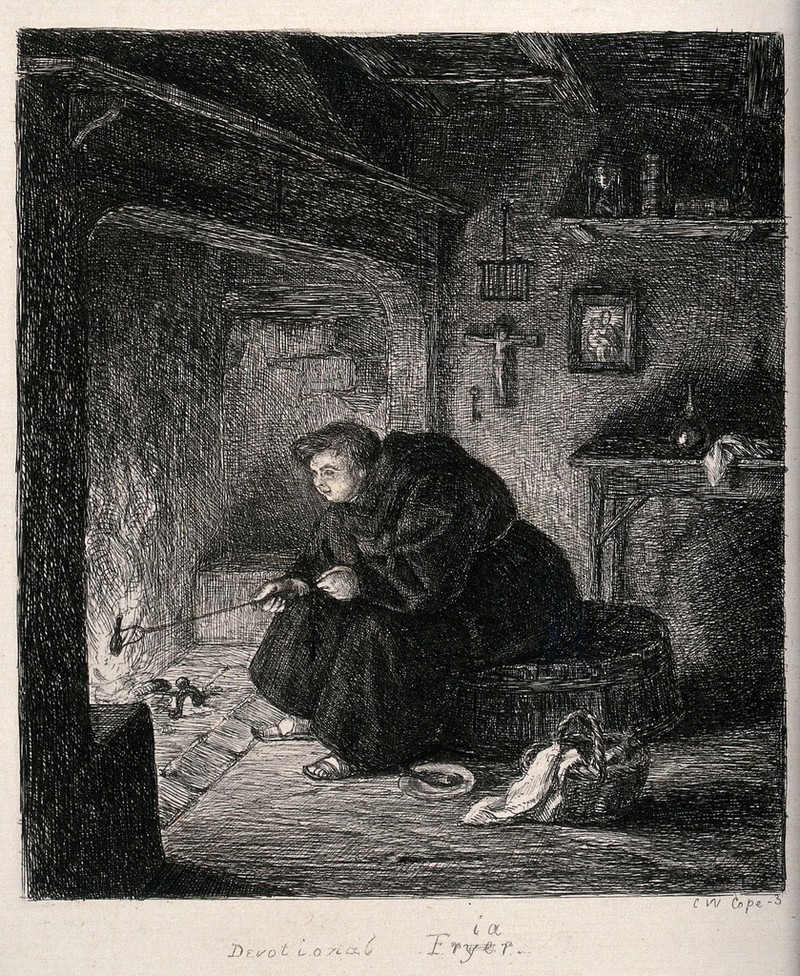
A fat friar sitting on an open fireplace and frying a drumstick. Etching by Charles West Cope., 1800-1899, by Charles West Cope
Charles West Cope · Wellcome Collection, London · Wellcome Collection
Life and career
Dated record
Life and career
Explore 1811–1890
The full dated record · 3 entries
1811
Charles West Cope born at Leeds.
1890
Dies at Bournemouth.
1890
Charles West Cope died at Bournemouth.
Places
Named by the record
Places
Only places the record itself states, plotted where the house gazetteer settles their coordinates. Nothing is inferred from a name or a nationality.
Maidenhead.
Residences
Leeds.
Birth place
Bournemouth.
Death place
Catalogued output
Works documented in more than one form
4 titles are catalogued under more than one form, which is to say the registers hold them both as a work and as a distinct object, score, recording or edition. Where a title is documented in several forms the evidence behind it is correspondingly wider, and the article treats those forms as separate records of the same work rather than as separate works.
The Wanderer
1844 — catalogued as print and etching print
Paintings, drawings and prints, 1837–1900
Catalogued output
Paintings, drawings and prints, 1837–1900
These are objects catalogued as visual works, each held or recorded by the institution named against it. 45 works carry dates between 1837 and 1900. The 1840s are the densest part of the run, with 14 titles, and that concentration is a fact about what the registers have catalogued rather than a judgement on the work itself. They belong to a run of 55 titles in all, from 1837 to 1900. A selection is set out below and the complete run may be opened beneath it.
The Council of the Royal Academy Selecting Pictures for the Exhibition, 1875
1876
The run opens with Joseph Mallord William Turner and closes with Young Woman at Her Toilet
Joseph Mallord William Turner
1837
An Italian Hostelry
1838
Almsgiving
1839
Beneficence
1840
The Hawthorn Bush
1842
The Village Schoolmaster
1842
Morning Prayer
1844
Judge Gascoigne Committing Prince Henry to Prison (original study for a fresco in House of Lords)
1844
Palpitation
1844
Edward, the Black Prince
1845
The Young Mother
1845
The complete catalogue · 41
The run opens with Joseph Mallord William Turner and closes with Young Woman at Her Toilet
Joseph Mallord William Turner
1837
An Italian Hostelry
1838
Almsgiving
1839
Beneficence
1840
The Hawthorn Bush
1842
The Village Schoolmaster
1842
Morning Prayer
1844
Judge Gascoigne Committing Prince Henry to Prison (original study for a fresco in House of Lords)
1844
Palpitation
1844
Edward, the Black Prince
1845
The Young Mother
1845
Cardinal Wolsey at the Gate of Leicester Abbey
1847
Maiden Meditation
1847
Edward III Conferring the Order of the Garter on Edward the Black Prince
1847
L'allegro
1848
Il penseroso
1848
Milton's Dream of his Deceased Wife
1850
The Martyrdom of Laurence Saunders at Coventry (right panel of triptych)
1851
The Martyrdom of Laurence Saunders at Coventry (left panel of triptych)
1851
The Martyrdom of Laurence Saunders at Coventry (centre panel of triptych)
1851
Mother and Child
1852
The Death of Lara
1854
The Royal Prisoners
1855
Departure of a Puritan family for New England
1856
Ruins of the Ancient Palace of the Archbishops of Canterbury at Oxford, Kent, September 24, 1856
1856
The Parting of Lord and Lady William Russell (1683)
1858
Domestic Interior with a Mother and Child Seated at a Piano
1860
Mulready RA
1863
Albert, Prince Consort, President of the Society of Arts (1843–1861), with the Charter of the Great Exhibition of 1851
1863
The Spring Flood
1865
Fra Angelico (c.1395–1455) (design for a mosaic in the Victoria and Albert Museum)
1865
Fra Beato Angelico
1865
The Life's Story, 'Othello', Act I Scene 3
1868
Home Dream
1869
The Advance!
1871
George Herbert and His Mother
1872
Yes or No?
1872
News from Sebastapol
1875
The Council of the Royal Academy Selecting Pictures for the Exhibition, 1875
1876
Young Woman at Her Toilet
1900
Paintings, drawings and prints without a settled date
Catalogued output
Paintings, drawings and prints without a settled date
10 further works are catalogued under Cope's name without a date the collections agree on, which is why they are set apart from the dated run rather than placed in it.
Woman Reading to a Child
Study of a Boy
Hope Deferred, and Hopes and Fears that Kindle Hope
The Burial of Charles I. Study for 'The Death of Lara'
The Reverend Temple Chevallier (1794–1873)
Genius between Tragedy and Comedy
Sketch for 'The Setting Out of the Train Bands from London to Raise the Siege of Gloucester'
Primary material
Documents and archives
reference work
- “Charles West Cope”, English Wikipedia, consulted as further reading
Reputable secondary · Wikipedia
authority record
- Wikidata, structured authority record Q2960442: Charles West Cope
General reference · Wikidata
Literature
Further cited scholarship
15 scholarly and reference publications are cited here, each one identified by title and by the publication, publisher or institution that carried it, with its year where the register states one. The cited literature runs from 1974 to 2018, which is a measure of how long Cope has been a subject of scholarship rather than of how much has been written. The publications represented include Oxford Dictionary of National Biography and The Letters of Samuel Palmer, Vol. The Encyclopedia cites this literature and does not summarise the arguments of works it has not read in full.
1880 (15) To Charles West Cope, The Letters of Samuel Palmer, Vol
2: 1860–1881, 1974
1880 (35) To Charles West Cope, The Letters of Samuel Palmer, Vol
1862 (9) To Charles West Cope, The Letters of Samuel Palmer, Vol
1880 (22) To Charles West Cope, The Letters of Samuel Palmer, Vol
1880 (18) To Charles West Cope, The Letters of Samuel Palmer, Vol
1862 (10) To Charles West Cope, The Letters of Samuel Palmer, Vol
1863 (3) To Charles West Cope, The Letters of Samuel Palmer, Vol
1880 (5) To Charles West Cope, The Letters of Samuel Palmer, Vol
1880 (37) To Charles West Cope, The Letters of Samuel Palmer, Vol
1880 (13) To Charles West Cope, The Letters of Samuel Palmer, Vol
1880 (36) To Charles West Cope, The Letters of Samuel Palmer, Vol
1880 (7) To Charles West Cope, The Letters of Samuel Palmer, Vol
1872 (14) To Charles West Cope, The Letters of Samuel Palmer, Vol
Authority records
References
Citations
References
Each reference names the institution holding it, so a reader may go to the document itself.
reference work
Secondary witnessauthority record
General reference
People, houses and institutions
Knowledge graph
People, houses and institutions
Teachers, collaborators, publishers and institutions recorded against this person, each on a stated basis.
Genre
1- genre paintingTerminology
Established from a fact already recorded on a verified source.
Further particulars
Held on the record
Further particulars
Open the remaining particulars
The authorities additionally record the headings Charles Cope, Charles West II Cope, C.W. Cope and Charles West Cope d. y. His recorded language was English. One child is recorded: Arthur Stockdale Cope.
Identity and origins
Recognition and collections
Work by Charles West Cope is
National Gallery of Victoria, Auckland Art Gallery, National Gallery of Canada and Yale Center for British Art
The Encyclopedia exists whether or not anything is for sale. Corrections are recorded rather than overwritten, and every version of this record is kept. Published 16 August 2026.
Elsewhere in Illustration
5,224 published records in this field, each with its sources named.
- Charles TochéIllustrator
- Charles TomlinsonIllustrator
- Charles TunnicliffeIllustrator
- Charles Walter SimpsonIllustrator
- Charles William JefferysIllustrator
- Charles-Nicolas CochinIllustrator
- Charley TooropIllustrator
- Charlotta BurešováIllustrator
Best supported in this field
For owners
Own a work by Charles West Cope?
A specialist will read what you send and tell you what the house can establish, what it cannot, and whether the object is suited to sale. There is no charge and no obligation. The object stays with you throughout; nothing is shipped to us unless it is arranged in writing beforehand.