
William Allan
William Allan (178223 February 1850) was a Scottish historical painter known for his scenes of Russian life. He became president of the Royal Scottish Academy and was made a Royal Academician.
Also recorded as Sir William Allan · A. R. A. William Allan · Allan of Edinbro' · Sir Allan
William Allan
William Allan · Wellcome Collection, London · Wellcome Collection · Public Domain Mark
- Name
- Sir William Allan
- Born
- 1782
- Birthplace
- Edinburgh, Scotland
- Died
- 23 February 1850 (aged 67–68)
- Field
- Painting Sir William Allan (178223 February 1850) was a Scottish historical painter known for his scenes of Russian life.
- Nationality
- Scotland
- Occupation
- painter
- Fields
- history · portrait
- Education
- Royal High School · Edinburgh College of Art
- Known for
- Sir Walter Scott
- Languages
- English
VALÉORINE Encyclopedia
VALÉORINE documentary reading
Documentary summary
William Allan (178223 February 1850) was a Scottish historical painter known for his scenes of Russian life. He became president of the Royal Scottish Academy and was made a Royal Academician.
Admitted source layer · organised and presented by VALÉORINE
Reference Check
Propose documentary evidence for William Allan. A contribution is never written directly as fact: identity, source, rights and evidence gates still decide.
Sign in to contribute
World of VALÉORINE
Documentary connections
Only confirmed graph relationships appear here. Images are shown only when their identity and reuse rights both pass the documentary gate.
Documentary evidence
Documentary basis
Authority files
wikidata · Q1969391
In this article
Biography
Biography
William Allan studied at Royal High School and Edinburgh College of Art. The recorded working language is English. Subjects and genres recorded for the work are history and portrait. Works named in the authority record are Sir Walter Scott. Work by William Allan is recorded in the collections of Tate, San Francisco Museum of Modern Art, National Portrait Gallery, National Galleries Scotland and Royal Collection Trust.
Key facts
Key facts
• Name — Sir William Allan • Born — 1782 • Birthplace — Edinburgh, Scotland • Died — 23 February 1850 (aged 67–68) • Place of death — Edinburgh, Scotland • Field — Painting Sir William Allan (178223 February 1850) was a Scottish historical painter known for his scenes of Russian life. He became president of the Royal Scottish Academy and was made a Royal Academician.
Life and work
Life and work
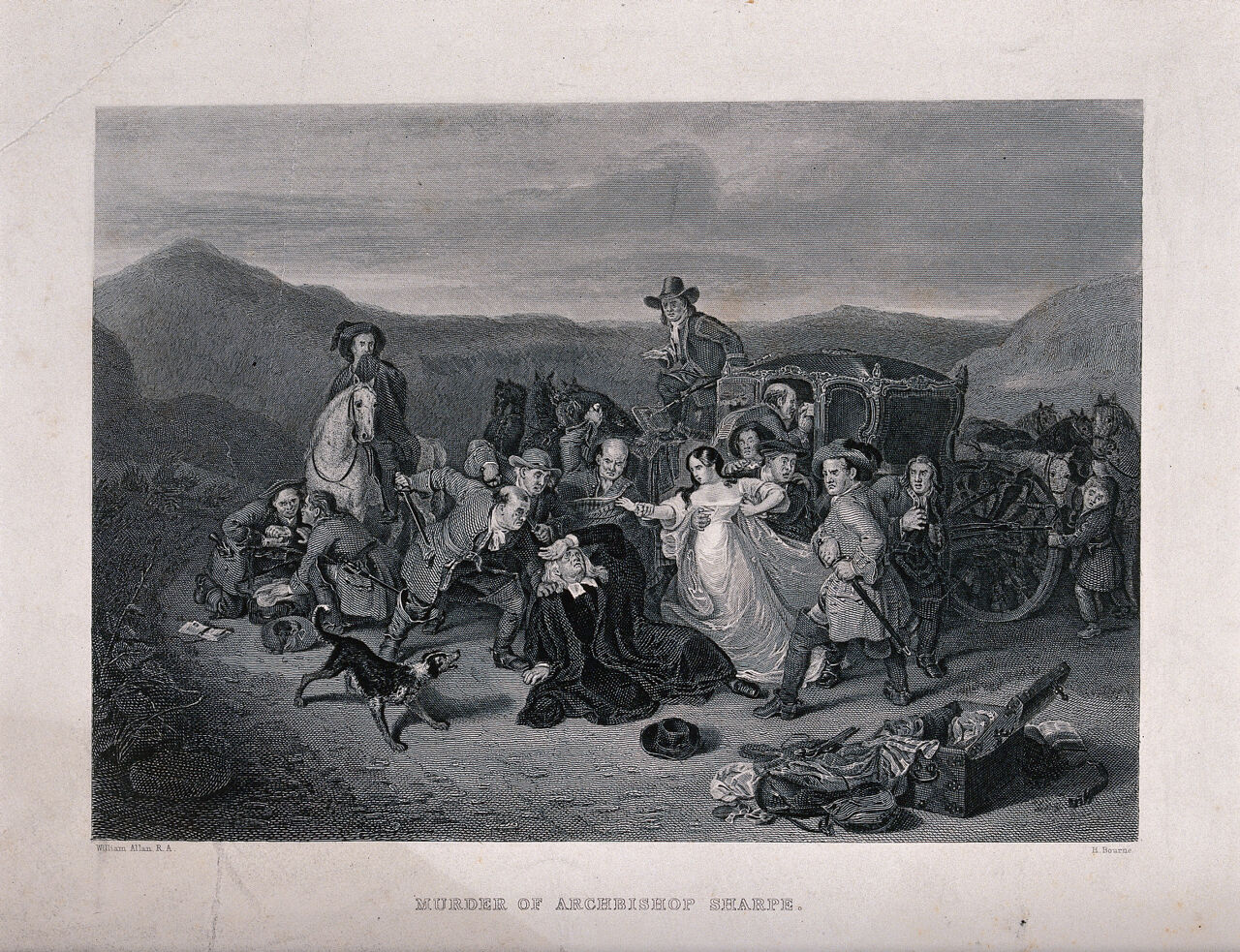
• Illustration — Sir Walter Scott, novelist and poet – painted by Sir William Allan Allan was born in Edinburgh, the son of William Allan Snr., macer, an officer of the Court of Session. He was educated at the High School, Edinburgh, under William Nicol (1744?-1797), the companion of Robert Burns. Showing an aptitude for art, he was apprenticed to a coach-painter, and studied under John Graham at the Trustees' Academy, with David Wilkie, John Burnet, and Alexander George Fraser. Here Allan and Wilkie were placed at the same table, studied the same designs, and contracted a lifelong friendship. After a few years he came to London, and entered the schools of the Royal Academy. His first exhibited picture was a Gipsy Boy with an Ass (1803), in the style of John Opie. Not finding success in London, in 1805 he travelled, by ship, to Russia, but was wrecked at Memel, where he raised funds for the remaining journey by painting portraits of the Dutch consul and others. He then proceeded overland to St. Petersburg, passing through a great portion of the Russian army on its way to Austerlitz. At the Russian capital he found friends, including Sir Alexander Crichton, physician to the imperial family. Having learned Russian, he travelled in the interior of the country, and spent several years in Ukraine, making excursions to Turkey, Tartary, and elsewhere, studying the culture of Cossacks, Circassians, and Tartars, and collecting arms and armour. In 1809 his picture Russian Peasants keeping their Holiday was exhibited at the Royal Academy. His wish to return home in 1812 had to be postponed due to the French invasion of Russia, many of the horrors of which he witnessed first-hand. • Illustration — Bashkirs (1814, Hermitage) • Illustration — Self-portrait of Sir William Allan steel-engraved by W.H. Lizars. 1819. Allan was able to return to Edinburgh in 1814, and, in 1815, his picture Circassian Captives attracted notice at the Royal Academy, though it did not find a purchaser. However, Sir Walter Scott, John Wilson (1785–1854) and his brother James (1795–1856), John Lockhart, and others, raised a lottery for it, with 100 subscribers at £10 10s. each, and the picture was won by Francis Wemyss-Charteris, 9th Earl of Wemyss. Allan remained in Edinburgh, and though his pictures (including Tartar Robbers dividing their Spoil) did not find purchasers amongst his countrymen, some of them were bought by the Grand Duke Nicholas when he visited Edinburgh, which resulted in a turn of fortune for the artist. Allan afterwards painted some scenes from Scottish history suggested by the novels of Sir Walter Scott, such as Death of Archbishop Sharpe and Knox admonishing Mary Queen of Scots (exhibited in 1823 and engraved by John Burnet). Also of note were Mary Queen of Scots signing her Abdication (1824) and Death of the Regent Murray (exhibited 1825), which was purchased by the Duke of Bedford for 800 guineas, and gained the artist his election as an associate of the Royal Academy. • Illustration — Circassian Chief (1843) In 1826 Allan was appointed master of the Trustees' School, Edinburgh, an office which he held until a few years before his death. Soon afterwards his health gave way, and he was threatened with blindness. To recuperate he went to Rome, and, after spending a winter there, proceeded to Naples, Constantinople, Asia Minor, and Greece. In 1826 he exhibited Auld Robin Gray and in 1829 Prophet Jonah. In 1830 he returned to Edinburgh, restored to health. His picture Slave Market, Constantinople was purchased by Alexander Hill, the publisher, and Byron in a Fisherman's Hut after swimming the Hellespont (exhibited 1831) by R. Nasmyth, who also bought Allan's portraits of Burns and Sir Walter Scott, which were engraved by John Burnet. In 1832 Allan was living at 8 Scotland Street in Edinburgh's New Town. In 1834 he visited Spain and Morocco, and in the same year he produced The Orphan, which represented Scott's daughter Anne seated near the chair of her deceased father. In 1835 he was elected a Royal Academician, and in 1838, on the death of Sir George Watson, was made president of the Royal Scottish Academy. In 1841 he went to St. Petersburg, and in the same year succeeded Wilkie as limner to the queen in Scotland, an office which was, as usual, followed (in 1842) by a knighthood. Sir William's later years were occupied with battle-pieces. In 1843 he exhibited Battle of Waterloo from the English side, which was purchased by the Duke of Wellington. The next year he went again to St. Petersburg, where he painted, for the Czar, Peter the Great teaching his Subjects the Art of Shipbuilding, which was later exhibited in London. The last large work which he finished was a second view of the battle of Waterloo, this time from the French side. It was exhibited at Westminster Hall in 1846, in competition for the decorations of the Houses of Parliament, but was unsuccessful. He visited Germany and France in 1847. In his final years Sir William lived at 72 Great King Street, a substantial Georgian townhouse over five storeys, in Edinburgh's Second New Town. He died of Bronchitis at his Edinburgh home on 23 February 1850. At the time of his death Sir William was engaged on a large picture of the Battle of Bannockburn. He is buried in Dean Cemetery in Edinburgh against the north wall of the original cemetery backing onto the late Victorian extension.
Works
Works
• Illustration — The Murder of David Rizzio (1833) depicts the killing of Queen Mary's secretary David Rizzio in her presence, an event which took place at Holyroodhouse in 1566. • Illustration — The Orphan, 1834 • Illustration — The Battle of Waterloo, 1843 • Illustration — The Battle of Cape St Vincent, 1845 • Illustration — Sir William Allan's grave, Dean Cemetery • Russian Peasants keeping their Holiday (1809) • Bashkirs (1814, Hermitage) • Frontier Guard (1814, Hermitage) • The Sale of Circassian Captives to a Turkish Bashaw (1816) • Tartar Robbers dividing Spoil (1817, Tate Gallery) • John Knox admonishing Mary, Queen of Scots (1823) • The Regent Murray shot by Hamilton of Bothwellhaugh (1825, Woburn Abbey) • The Black Dwarf (1827, National Gallery of Scotland) • Lord Byron in a Turkish Fisherman's House after swimming across the Hellespont (1831) • Slave Market (1838, National Gallery of Scotland) • The Signing of the National Covenant in Greyfriars Kirkyard (Edinburgh City Arts Centre) • Heroism and Humanity (Robert the Bruce with soldiers) (1840 Kelvingrove Museum) • The Recovery of the stolen Child (1841, Aberdeen, art gallery) • Battle of Prestonpans (1842, private collection) • Peter the Great teaching his Subjects the Art of Shipbuilding (1845, formerly in the Winter Palace of the Hermitage, now lost) • Waterloo, 18 June 1815 (1843, His Grace Valerian Wellesley, 8th Duke of Wellington, Apsley House) • The Duke of Wellington – en route to Quatre Bras (1844, private collection) • The Battle of Waterloo (1845, Royal Military Academy Sandhurst) • Battle of Bannockburn (Royal Scottish Academy, on loan to the Wallace Monument, Stirling)
Life and career
Dated record
Life and career
The full dated record · 2 entries
1782
William Allan born at Edinburgh.
1850
William Allan died at Edinburgh.
Notes from the source article
Cited by Wikipedia
Notes from the source article
These works are cited by the source article, in its own numbering. They are recorded as its citations, not as sources VALÉORINE has verified.
- 1.Edinburgh Post Office annual directory, 1832–1833. National Library of Scotland. 4.
- 2.London Gazette, 3 June 1842, page 1504.
- 3.Edinburgh and Leith Post Office Directory, 1849
- 4.Tait's Edinburgh Magazine March 1850
Bibliography printed in the source article · 6
- A Century of British Painters. 1981. 978-0-8014-9217-4.
- Allan, William. Sir William Allan. Connoisseur. 186. 748. June 1974.
- Gordon, Esme. The Royal Scottish Academy of Painting, Sculpture & Architecture 1826–1976. 1976.
- Lewis, Frank. A dictionary of British historical painters. 1979.
- Kennedy, Roisin A. The subject paintings of Sir William Allan (1782–1850). 1994.
- Howard, Jeremy. William Allan: artist adventurer. City of Edinburgh Museums and Galleries. 2001.
References
Citations
References
Each reference names the institution holding it, so a reader may go to the document itself.
Institutional database
Wikidata, structured authority record Q1969391: William AllanWikimedia Foundation
Institutional witness
Further particulars
Held on the record
Further particulars
Open the remaining particulars
Recognition and collections
Work by William Allan is
Tate, San Francisco Museum of Modern Art, National Portrait Gallery and National Galleries Scotland
The Encyclopedia exists whether or not anything is for sale. Corrections are recorded rather than overwritten, and every version of this record is kept. Published 17 August 2026.
Elsewhere in Paintings
19,183 published records in this field, each with its sources named.
- William Aiken WalkerArtist
- William AikmanArtist
- William Alexander GriffithArtist
- William Alexander SuttonArtist
- William AlwynArtist
- William AnastasiArtist
- William AndersonArtist
- William Anderson CoffinArtist
Best supported in this field
For owners
Own a work by William Allan?
A specialist will read what you send and tell you what the house can establish, what it cannot, and whether the object is suited to sale. There is no charge and no obligation. The object stays with you throughout; nothing is shipped to us unless it is arranged in writing beforehand.