
Cosme de Acuña
Illustration — Abraham and Isaac on Their Way to the Sacrifice Cosme de Acuña y Troncoso (c.1758/1760, La Coruña - after 1814, place unknown) was a Spanish painter in the Neoclassical style.
Cosme de Acuña

Cosme de Acuña · [2] · Public domain
- Born
- 1758
- Died
- 1814
- Nationality
- Spain
- Occupation
- painter
- Movements
- Neoclassicism
- Languages
- Spanish
VALÉORINE Encyclopedia
VALÉORINE documentary reading
Documentary summary
Illustration — Abraham and Isaac on Their Way to the Sacrifice Cosme de Acuña y Troncoso (c.1758/1760, La Coruña - after 1814, place unknown) was a Spanish painter in the Neoclassical style.
Admitted source layer · organised and presented by VALÉORINE
Reference Check
Propose documentary evidence for Cosme de Acuña. A contribution is never written directly as fact: identity, source, rights and evidence gates still decide.
Sign in to contribute
World of VALÉORINE
Documentary connections
Only confirmed graph relationships appear here. Images are shown only when their identity and reuse rights both pass the documentary gate.

Documentary evidence
Documentary basis
Authority files
wikidata · Q15710728 · wikipedia · Cosme de Acuña
In this article
Biography
He studied at the Real Academia de Bellas Artes de San Fernando. In 1781, he won second prize in a painting competition where the contestants were required to create an allegory of the birth of the Infante. In 1785, he presented a painting of Abraham and Isaac, as part of his application to be named an "Academician of Merit". This was unanimously approved. The following year José de Gálvez, whose family portraits he had recently painted, suggested that he accept a position at the newly created Academia de San Carlos in New Spain (Mexico). He decided to go, accompanied by Ginés Andrés de Aguirre, who had also been chosen for a position there. Acuña and Aguirre both clashed with Jerónimo Antonio Gil, the General Director, who was known for his authoritarianism. Aguirre, who complained of feeling "imprisoned", quit his position and left Acuña with a double work load. Overwhelmed, he wrote a letter of complaint to Antonio Ponz, Secretary of the Academia in Madrid. In 1790, he requested permission to return to Spain, going so far as to threaten suicide. He returned to Madrid in 1791. Shortly after, he was entrusted with the supervision of students from San Carlos who had been sent to complete their studies in Spain. When Francisco de Goya was appointed Director of Painting at the Academia in 1795, Acuña was promoted to the position that he had vacated. A year later, at his request, he was appointed to serve as a court painter. In 1799, he was forced to request a leave of absence due to a "flux of the eyes". In 1806, at a meeting of the Academia's board, he became engaged in a heated argument with Mariano Salvador Maella, who he attacked with a stick. As a result, he was dismissed from the Academia and sentenced to two years of exile from Madrid. His pleas to return were futile, so he crossed the Spanish border to settle in Bayonne. From there, he wrote a long letter to Manuel Godoy, the Secretary of State, describing a "nervous illness" that had been plaguing him since his eye troubles. He also asked for permission to go to Paris and measure some famous statues. In 1807, the Spanish Embassy in Rome reported that he had arrived there in a "state of madness". They were attempting to find a place for him to live, in a priest's house, when he disappeared. In 1814 his wife, Francisca Reggio, living in extreme poverty, asked King Ferdinand VII for help. She had heard that he was in London, always upset and denying that he was Spanish. Nothing more is known of him. • Illustration — Allegory on the Birth of the Infante Carlos Eusebio
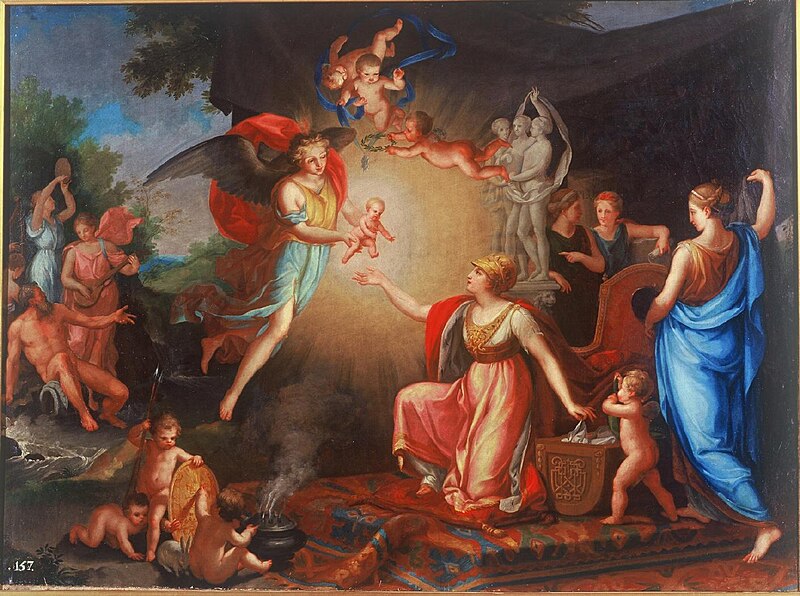
La obra es una alegoría del nacimiento del infante Carlos Eusebio de Borbón (1780-1783), que fue hijo del rey Carlos IV de España.
Cosme de Acuña · [2]
Primary material
Documents and archives
reference work
- “Cosme de Acuña”, English Wikipedia, consulted as further reading
Reputable secondary · Wikipedia
authority record
- Wikidata, structured authority record Q15710728: Cosme de Acuña
General reference · Wikidata
Notes from the source article
Cited by Wikipedia
Notes from the source article
These works are cited by the source article, in its own numbering. They are recorded as its citations, not as sources VALÉORINE has verified.
- 1.Notice de l'œuvre Alegoría del nacimiento del infante Carlos Eusebio. academiacolecciones.com.
- 2.Notice de l'œuvre Abraham e Isaac camino del sacrificio. academiacolecciones.com.
- 3.article es prénom1=J. M. nom1=Arnaiz Cosme Acuña y la influencia de la escuela madrileña de finales del siglo xviii en América Academia Madrid 73 1991 135-177 .
- 4.article es prénom1=F. J. nom1=Sánchez Cantón Los pintores de Cámara de los Reyes de España Boletín de la Sociedad Española de Excursiones Madrid XXIV 1916 216-217 .
Bibliography printed in the source article · 5
- José Manuel. Arnáiz. Cosme de Acuña y la influencia de la escuela madrileña de finales del siglo XVIII en América. Academia. Boletín de la Real Academia de Bellas Artes de San Fernando. 1991. 73. 135-178. oui.
- L’Academie des Beaux Arts de Madrid (1744-1808). Universidad. 1974.
- Obras completas. Siglo XXI. 1988. 96-8231-440-2.
- González Zymla. Herbert. Cosme Acuña Troncoso. Diccionario biográfico español. Académie royale d'histoire. oui.
- Galería biográfica de artistas españoles del siglo xix. Moreno y Rojas. 1883-1884.
References
Citations
References
Each reference names the institution holding it, so a reader may go to the document itself.
reference work
Secondary witnessauthority record
General reference
The Encyclopedia exists whether or not anything is for sale. Corrections are recorded rather than overwritten, and every version of this record is kept. Published 18 August 2026.
Elsewhere in Paintings
18,623 published records in this field, each with its sources named.
- Cosimo DaddiArtist
- Cosimo GamberucciArtist
- Cosimo RosselliArtist
- Cosimo TuraArtist
- Cosme San MartínArtist
- Cosmo AlexanderArtist
- Cosroe DusiArtist
- Costantino CediniArtist
Best supported in this field
For owners
Own a work by Cosme de Acuña?
A specialist will read what you send and tell you what the house can establish, what it cannot, and whether the object is suited to sale. There is no charge and no obligation. The object stays with you throughout; nothing is shipped to us unless it is arranged in writing beforehand.