
Cosimo Tura
Cosmè Tura (Italian pronunciation: [koˈzmɛ tˈtuːra]; c. 1430 – 1495), also known as Il Cosmè or Cosimo Tura, was an Italian early-Renaissance (or Quattrocento) painter and considered one of the founders of the School of Ferrara. He provided a great contribution to the Renaissance in Ferrara.
Also recorded as Il Cosmè · Cosmè Tura · Cosme Tura · Cosme da Ferrara
Cosimo Tura
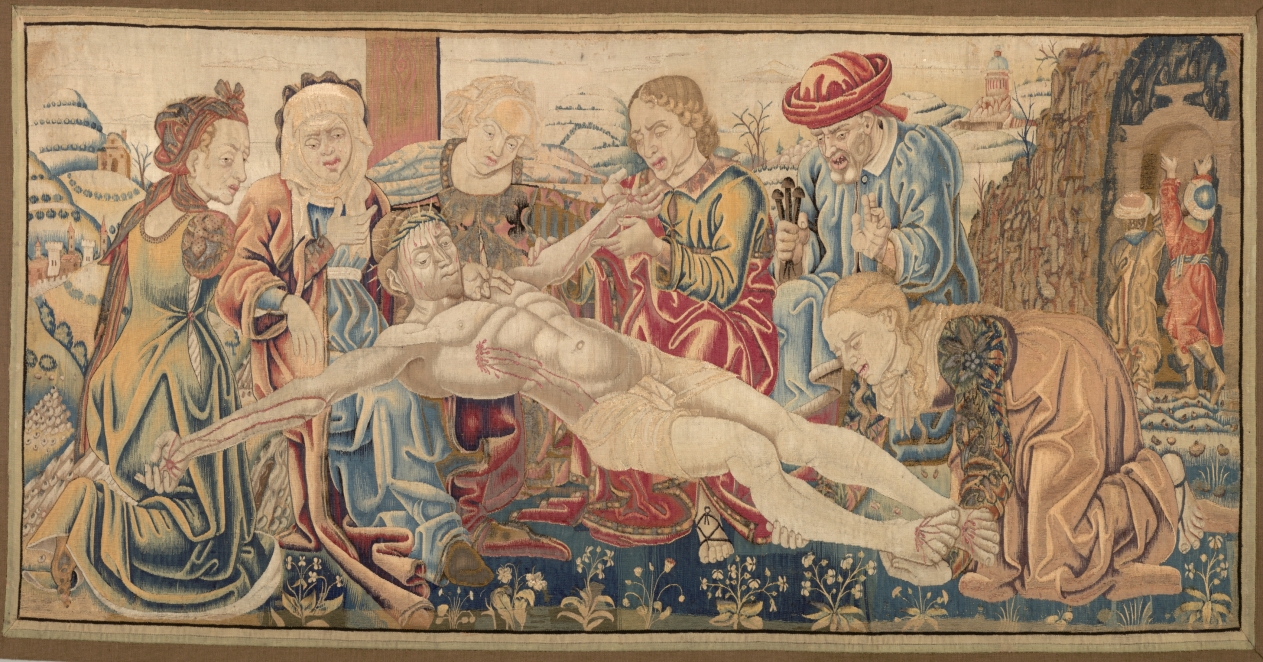
Cosimo Tura · The Cleveland Museum of Art · John L. Severance Fund · CC0
- Born
- about 1430.
- Died
- 1495.
- Occupation
- painter, carpets designer, court painter and artist.
- Movements
- Quattrocento.
- Known for
- A Muse (Calliope?), Christ Crucified, The Trial of Saint Maurelius, Saint John the Evangelist in Patmos, Manuscript Illumination with All Saints in an Initial V, from an Antiphonary, Manuscript Illumination with the Assumption of the Virgin in an Initial A and from an Antiphonary.
VALÉORINE Encyclopedia
VALÉORINE documentary reading
Documentary summary
Cosmè Tura (Italian pronunciation: [koˈzmɛ tˈtuːra]; c. 1430 – 1495), also known as Il Cosmè or Cosimo Tura, was an Italian early-Renaissance (or Quattrocento) painter and considered one of the founders of the School of Ferrara. He provided a great contribution to the Renaissance in Ferrara.
Admitted source layer · organised and presented by VALÉORINE
Note VALÉORINE
Cosimo Tura (died 1495) was an artist, carpets designer and court painter, among other activities. The artist was born and died in Ferrara.
Cosimo Tura worked in Ferrara. The artist was active in painting. Cosimo Tura was associated with Quattrocento.
Works include Christ Crucified, Muse Erato, Pietà and Saint John the Evangelist in Patmos, among others. Languages used include Italian.
Composed from admitted, traceable facts · 27 September 2026
VALÉORINE
Reference Check
Propose documentary evidence for Cosimo Tura. A contribution is never written directly as fact: identity, source, rights and evidence gates still decide.
Sign in to contribute
Documentary evidence
Evidence Panel
not yet certified
- Identity
- resolved
- Independent source families
- 0
- Admitted assertions
- 0
- Open conflicts
- 0
Authority files
wikidata · Q7129 · wikipedia · Cosmè Tura
In this article
Formation
Formation
Born in Ferrara, of humble origins, he was the son of a shoemaker named Domenico. There is no record of Cosmè's apprenticeship, which Vasari linked to the mysterious artist Galasso Galassi of Ferrara, an elusive and thinly documented figure, linked by friendship to Piero della Francesca. The first historical documents concerning him are dated to the years 1451–1452, when he decorated some objects for the court of the ruling Este family, Dukes of Ferrara, such as flags bearing coats of arms of the family destined for display at the Castle, or a helmet to be awarded as a tournament prize. Such works as these were a staple among the commissions received by an artist's workshop in the day and represented a major source of income. It may also be that Tura was able to find work among the court illuminators. From mid-1452 to April 1456, no other documents attest to Tura's presence in Ferrara, which has led to the suggestion that he may have undertaken a journey, perhaps spending time in Venice or in Padua. In fact, numerous elements in his works seem to suggest a local stylistic influence from Padua in particular. It may have been that the Este themselves sponsored his apprenticeship journey, in the light of his precocious artistic skills. A notable feature of the scene in Padua was the thriving workshop of Francesco Squarcione, an important seedbed of talent in northern Italy, one from which emerged many masters, such as Carlo Crivelli, Michael Pacher and above all Andrea Mantegna, all of them contributors to diffusion of the Renaissance style. It might have been from such an experience in Padua that Tura drew his taste for clear and sharp signs and for decorative exuberance, with citations of the antique, which he then took to extreme levels. Moreover, Squarcione served to introduce and disseminate some of the Tuscan innovations brought to Padua by Donatello, such as the use of linear perspective, the strong, squared lines of the forms and the skilful rendering of expression given to human figures. Another fundamental master for Tura was Piero della Francesca, whom he may have met in person in Ferrara in 1458–1459. From Piero he borrowed a sense for the geometric spatial construction, a monumental spirit and a use of sharp and clear lighting, which he used above all in his backgrounds. A third fundamental element of input was the work of Flemish artists, also represented in Ferrara among the collections maintained by the Marquis. From these, Tura acquired a taste for minute observation of detail and for the use of oil paint to render the differing textures of materials depicted, from the glitter of gems to the soft reflections of velvet.
Under Borso d'Este
Under Borso d'Este
In 1456, Tura returned to Ferrara, where he became a painter in the full sense, appearing on the court salary rolls, even with residence in the Castle. This testifies to his occupying a post as court painter, replacing Angelo di Pietro da Siena (also called Angelo Maccagnino or Angelo Parrasio), who had died on August 5 of that year. In Ferrara Tura worked for the rest of his active life for Borso d'Este and Ercole I d'Este. With a lively personality and a variety of skills, he was present in all the artistic manifestations of the Este court. Throughout the fifty years of Tura's artistic life, the various successive Dukes made use of his talents in the most disparate works: this swas the norm for court artists of the time, who experienced no rigid compartmentalization of tasks. In addition to practising his art as a skilled painter, Tura was also a set designer for parties and tournaments, a decorator and designer of furniture, clothes, blankets, pottery, and a draftsman of tapestry cartoons. Among his earliest works, we hear of a lost lunette for the door of the cathedral. Works usually attributed to this period include the Madonna and Child with Saints (the Fesch Museum in Ajaccio) and a Madonna and Child (National Gallery of Art, in Washington, D.C.). In 1458, records place Tura at work in the Studiolo of the Palace Belfiore, where he continued Maccagnino's work, probably also repainting some of the works he started (Terpsichore of the Poldi Pezzoli Museum in Milan and the Calliope of the National Gallery in London). By 1460, Tura was given a stipend by the court. His known pupils include Francesco del Cossa and Francesco Bianchi. In the years following he worked on frescoes, such as in the chapel of Francesco Sacrati in San Domenico (1467) and the Tales of the Virgin in the so-called "Delight" of Belriguardo (in 1469-1472) for Borso d'Este, cycles now both lost but known from the sources. Although these were years of feverish activity, only the grandiose doors of the organ of Ferrara Cathedral now remain, paid for on 2 June 1469. Here Tura painted the Annunciation on one side and St. George and the princess on the other. He collaborated in the painting of a series of "muses" for the Belfiore "studiolo", of Leonello d'Este in Ferrara, including the allegorical figure of Calliope, already mentioned, now at London's National Gallery. While the individual attributions are often debated, among the artists thought to have contributed to the series were Angelo di Pietro da Siena and Michele Pannonio. One of houses occupied by Tura during his time as painter in Ferrara was certainly located in the "Via delle Vecchie", which for a long time was named "Strada del Tura" after him for this reason. It is possibly a sign that he also died there.
Under Ercole I
Under Ercole I
With the rise to power of Ercole I d'Este (1471), Tura was appointed court portraitist, a role he devoted himself to until 1486 when he was replaced by the younger Ercole de' Roberti. The Roverella Altarpiece or Roverella Polyptych was commissioned by Cardinal Bartolomeo Roverella for the San Giorgio fuori le mura (St George outside the Walls) in Ferrara in memory of his brother, the Bishop of Ferrara, Lorenzo Roverella, it was executed by Tura in 1470–1474 using oil and egg-tempera on poplar panel work. The original painted by Tura was later dismembered and the panels split up between several museums. The central part is in the National Gallery in London, and depicts the Madonna and Child seated on an elaborate throne and surrounded by musician angels. Tura also worked on the decorations of rooms, studies and the library of Giovanni Pico della Mirandola. In Ferrara, he is well represented by frescoes in the Palazzo Schifanoia (1469–71). This pleasure palace, with facade and architecture of little note, belonged to the d'Este family and is located just outside the medieval town walls. Along with Francesco del Cossa and Ercole de' Roberti, Tura helped produce an intricately conceived allegorical series about the months of the year and symbols of the zodiac The series contains contemporary portraits of musicians, laborers, and carnival floats in idyllic parades. As in Piero della Francesca's world, the unemotive figures mill about in classical serenity. This is considered the greatest collective essay of the Ferrara school as well as one of the most singular pictorial cycles of the European Renaissance. Despite his attachment to the Este family, to whom he gave virtually the whole of his life's work, and despite having been the leader of a group of Emilian artists, Cosmè Tura died poor and weary. This is attested by a letter he wrote in 1490 to Duke Ercole, asking for payment of one of his works, perhaps the marvelous depiction of the Franciscan St Anthony of Padua which is currently in the Galleria Estense in Modena, stating "I do not know how to live and survive in this way, not finding work or opportunity to support my family and myself". The events of the history of Ferrara, with the ruinous trajectory of decline of the dukes at the end of the 16th century, led to the destruction of most of Tura's works.
Style
Style
Tura's painting is endowed with great originality in the Italian panorama of the time, featuring lavishly decorated compositions and an almost sculptural plasticity of the figures, in an apparent realism that belongs more to fantasy rather than reality. The colors are bright and unreal, which often make the subjects seem like metal or stone, immersed in a tense and surreal atmosphere, with a dreamlike feeling. The experiences derived from the courtly art of international Gothic, aimed at celebration, are blended and transformed through the influence of the Paduan Renaissance, Piero della Francesca and Flemish painting. The meticulous search for details and impossible landscapes is found again later in painters of the Danube school.
Life and career
Dated record
Life and career
The full dated record · 2 entries
1430
Cosimo Tura born at Ferrara.
1495
Cosimo Tura died at Ferrara.
Primary material
Documents and archives
scholarly publication
- Tura, Cosimo or Cosmè, Benezit Dictionary of Artists, 2011
Scholarly · Crossref registry · 2011
Institutional database
- Wikidata, structured authority record Q7129: Cosimo Tura
Scholarly · Wikimedia Foundation
Notes from the source article
Cited by Wikipedia
Notes from the source article
These works are cited by the source article, in its own numbering. They are recorded as its citations, not as sources VALÉORINE has verified.
- 1.Cosmè Tura at the Encyclopaedia Britannica
- 2.Piero Bianconi, Tutta la pittura di Cosmè Tura, Milan, Rizzoli, 1963 (Italian)
- 3.Este Court Archives , project entry on Palace Schifanoia.
- 4.http://www.gardnermuseum.org/2002_exhibitions/ctura_ex.asp
- 5.Circumcision Gardner Museum.
- 6.Abcgallery.com. Cosme Tura. Spring - Olga's Gallery.
- 7.Abcgallery.com. Cosme Tura. The Princess - Olga's Gallery.
- 8.Saint John the Evangelist in Patmos. Museo Nacional Thyssen-Bornemisza.
- 9.Abcgallery.com. Cosme Tura. St. George and the Dragon - Olga's Gallery.
- 10.Abcgallery.com. Cosme Tura. Madonna Enthroned - Olga's Gallery.
- 11.Abcgallery.com. Cosme Tura. St. Sebastian - Olga's Gallery.
- 12.Abcgallery.com. Cosme Tura. St. Dominic - Olga's Gallery.
- 13.Abcgallery.com. Cosme Tura. Pietà - Olga's Gallery.
- 14.Strehlke, Carl Brandon. Panels from a Small Altarpiece Showing Saints Peter and John the Baptist (left to right) by Cosmè Tura (cat. 241a,b). The John G. Johnson Collection: A History and Selected Works. A Philadelphia Museum of Art free digital publication. March 2022.
- 15.Abcgallery.com. Cosme Tura. St. Anthony of Padua Reading - Olga's Gallery.
- 16.http://www.metmuseum.org/toah/hd/iman/hob_11.50.1.htm
Bibliography printed in the source article · 1
- Haldane Macfall, History of Painting: The Renaissance in Venice Part Two, page 34, .
References
Citations
References
Each reference names the institution holding it, so a reader may go to the document itself.
scholarly publication
Tura, Cosimo or Cosmè, Benezit Dictionary of Artists, 2011Crossref registry
VerifiedInstitutional database
Wikidata, structured authority record Q7129: Cosimo TuraWikimedia Foundation
Verified
A further 1 witness is held back from this article because the person or object named in it is not yet resolved to this record. They are kept, not discarded, and return once the identity is established.
The Encyclopedia exists whether or not anything is for sale. Corrections are recorded rather than overwritten, and every version of this record is kept. Published 14 August 2026.
Elsewhere in Paintings
18,705 published records in this field, each with its sources named.
- Cory TrépanierArtist
- Cosimo DaddiArtist
- Cosimo GamberucciArtist
- Cosimo RosselliArtist
- Cosme de AcuñaArtist
- Cosme San MartínArtist
- Cosmo AlexanderArtist
- Cosroe DusiArtist
Best supported in this field
For owners
Own a work by Cosimo Tura?
A specialist will read what you send and tell you what the house can establish, what it cannot, and whether the object is suited to sale. There is no charge and no obligation. The object stays with you throughout; nothing is shipped to us unless it is arranged in writing beforehand.