
Guillaume Guillon-Lethière
Guillaume Guillon-Lethière (10 January 1760 – 21 April 1832) was a French painter. Lethière was an artist of the neoclassical style specializing in history paintings and one of the first notable artist of colour in France at the time.
Also recorded as Guillon Lethiere · G. Guillon le Thiere · Guillaume Letiers · Guillaume Le Thierre
Guillaume Guillon-Lethière
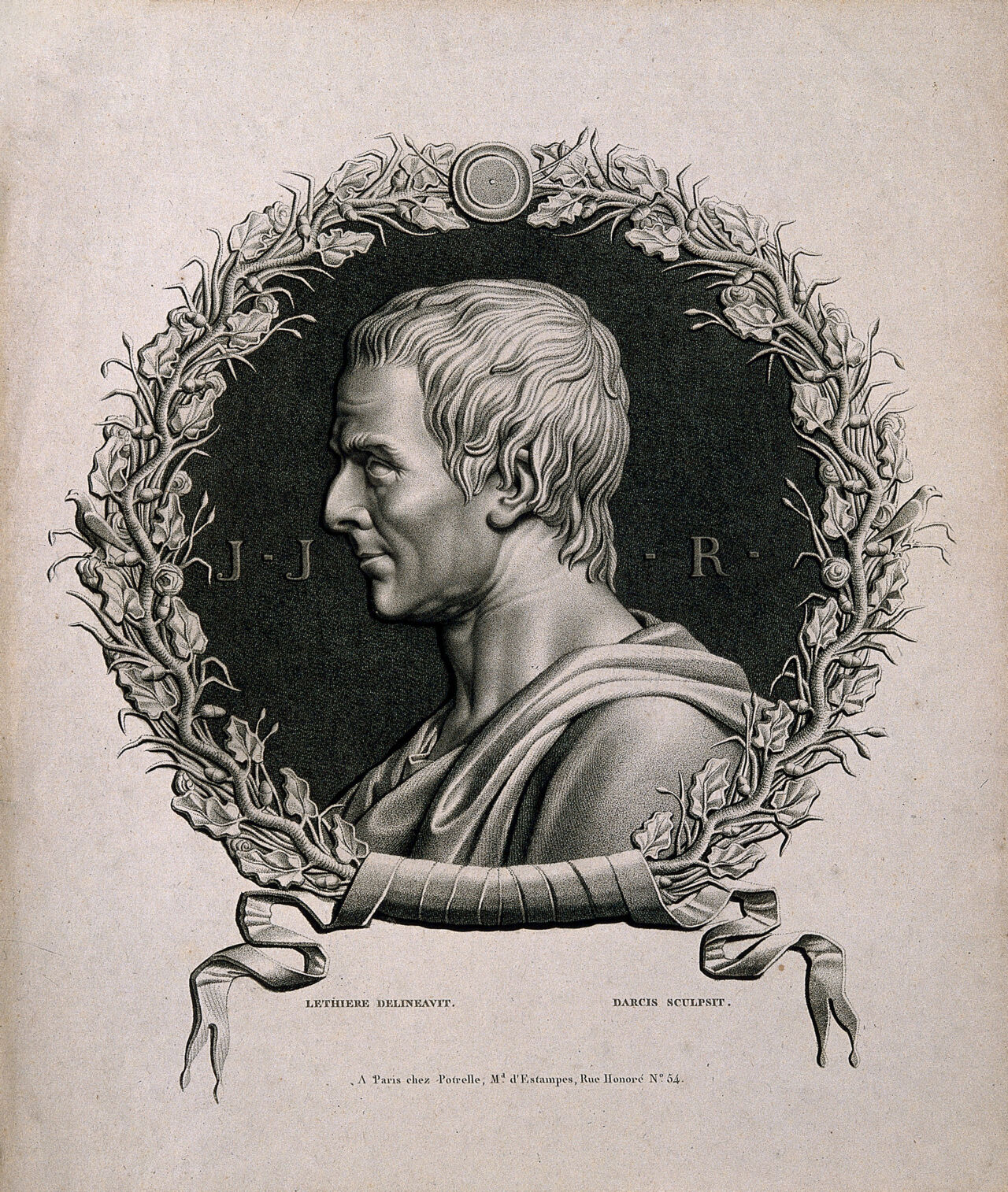
Guillaume Guillon-Lethière · Wellcome Collection, London · Wellcome Collection · Public Domain Mark
- Name
- Guillaume Guillon-Lethière
- Born
- 10 January 1760
- Birthplace
- Sainte-Anne, Guadeloupe
- Died
- 21 April 1832
- Place of death
- Paris, France
- Movement
- Neoclassicism
- Awards
- Prix de Rome, Second Grand Prize
- Nationality
- France.
- Occupation
- painter and professor.
- Fields
- portrait and history.
- Movements
- Neoclassicism.
- Education
- Beaux-Arts de Paris.
VALÉORINE Encyclopedia
VALÉORINE documentary reading
Documentary summary
Guillaume Guillon-Lethière (10 January 1760 – 21 April 1832) was a French painter. Lethière was an artist of the neoclassical style specializing in history paintings and one of the first notable artist of colour in France at the time.
Admitted source layer · organised and presented by VALÉORINE
Reference Check
Propose documentary evidence for Guillaume Guillon-Lethière. A contribution is never written directly as fact: identity, source, rights and evidence gates still decide.
Sign in to contribute
World of VALÉORINE
Documentary connections
Only confirmed graph relationships appear here. Images are shown only when their identity and reuse rights both pass the documentary gate.


Documentary evidence
Documentary basis
Authority files
wikidata · Q2703817 · wikipedia · Guillaume Guillon-Lethière
In this article
Biography
Biography
Guillon-Lethière worked between 1760 and 1832 across painter and professor. The registers place that work in portrait and history painting. Every statement below returns to a source shown in the evidence panel; where the record is silent or divided, the article says so instead of resolving it.
Guillaume Guillon-Lethière studied at Beaux-Arts de Paris. Training under Jean-Baptiste Descamps is recorded. Horace Lecoq de Boisbaudran, Ignace-François Bonhommé and Isidore Pils are recorded as having studied under Guillaume Guillon-Lethière. The recorded working language is French. Subjects and genres recorded for the work are portrait and history. Places of work recorded in the authority are Paris. Employment is recorded with Beaux-Arts de Paris. Positions recorded include director. Work by Guillaume Guillon-Lethière is recorded in the collections of Musée de l'Histoire de France, Dallas Museum of Art, Tokyo Fuji Art Museum, Clark Art Institute and Los Angeles County Museum of Art. Distinctions recorded are Knight of the Legion of Honour.
Key facts
Key facts
• Name — Guillaume Guillon-Lethière • Born — 10 January 1760 • Birthplace — Sainte-Anne, Guadeloupe • Died — 21 April 1832 • Place of death — Paris, France • Movement — Neoclassicism • Patrons — Jean-Baptiste Descamps, Gabriel-François Doyen • Awards — Prix de Rome, Second Grand Prize
Youth
Youth
He was born in Sainte-Anne, Guadeloupe, out of wedlock, to Marie-Françoise Dupepaye, a free person of color, and Pierre Guillon, a colonial Royal Notary. He was the third child in the family which is reflected in his name, Lethière, a corruption of “le tiers,” or “the third”. He and his sister, Andrèze, could not be legally recognized as Guillon's children until 1794, when the Code Noir was abolished. In 1774, after displaying an early aptitude for art, his father took him to France, where he was placed with the painter Jean-Baptiste Descamps, at the new free drawing school in Rouen. It was there that he adopted the name "Lethière", derived from "letier" (third, as in "third son"). He remained there for three years, then went to Paris and became a student of Gabriel François Doyen at the Académie royale de peinture et de sculpture. Those studies lasted until 1786. During that time, he paid frequent visits to the studio of Jacques-Louis David.
Adulthood
Adulthood
He won second place in the Prix de Rome of 1784. Two years later, he entered again and won receiving support to travel to Rome, where he further developed his Neoclassical style and stayed from 1786 to 1791. In 1787, he too had a son out of wedlock, with a woman named Marie-Agathe Lapôtre. In 1792, he returned to Paris and opened his own painting studio in the Saint-Germain-des-Prés district. He held his first exhibit at the Salon in 1795, with paintings he had created in Rome.
Later years
Later years
In 1799, he married the widow Marie-Joseph-Honorée Vanzenne. She can be seen in his portraiture Woman Leaning on a Portfolio. A daughter from her first marriage, Eugénie, would also become a painter. The following year, he accompanied the newly appointed Ambassador, Lucien Bonaparte, to Spain, where he helped him build an art collection. Through Bonaparte's recommendation, he was appointed Director of the French Academy in Rome in 1807.
Return to France
Return to France
• Illustration — Woman Leaning on a Portfolio, Guillaume Lethière, 1799, Worcester Art Museum Lethière returned to Paris in 1792, where he undertook artistic production for a decade – a critical success. However, there were many societal transformations that came with this period, notably the execution of the king and queen of France, and the abolition of the monarchy. Despite the political turmoil, Lethière established a studio in Paris and became one of the most renowned artists of the time. He created Erminia and the Shepherds (Dallas Museum of Art), a love story during the Renaissance and the Middle Ages. There was also the Frieze Representing the Neuf Thermidor (Musée d’art et d’histoire), which was exhibited at the Salon of 1798, and Woman Leaning on a Portfolio (Worcester Art Museum), which was exhibited at the Salon of 1799. The latter is more personal, depicting his stepdaughter Eugénie, whom he personally trained. The prominence of the artist is depicted in Louis-Léopold Boilly’s portrait Meeting of Artists in Isabey’s Studio (Musée du Louvre), where Lethière can be seen wearing a red cloak near the center. Along with his artistic success, he was legally recognized by his father in 1799. • Illustration — Meeting of Artists in Isabey's Studio, Louis-Léopold Boilly, 1798, Louvre Museum
Tenure at the Villa Medici
Tenure at the Villa Medici
• Illustration — Homer Singing His Iliad at the Gates of Athens, 1811, Nottingham Castle Museum, England Lethière had finally arrived at the Académie de France in Rome, though contrary to his expectations, the campus had moved from the Palazzo Mancini to the Villa Medici, where conditions seemed desperate. Under Lethière’s influence, students were no longer underfunded, the building was renovated, and the academy gained order. During this time, Lethière created three of the most technically difficult paintings in his career. The first was the Judgment of Paris (1812, private collection), which marked his turn to grand-scale paintings. The latter were the lyrical Homer Singing His Iliad at the Gates of Athens (1814, Nottingham City Museums and Galleries), and the monumental version of Brutus Condemning his Sons to Death (1811, Musée du Louvre), which were both showcased in London from 1816 to 1819. He served as the Director of the Académie de France in Rome up until 1816, when he was replaced, by order of Louis XVIII. In 1818 he was elected to the Académie des Beaux-Arts. That same year, he also became a Knight in the Legion of Honor. A year later, he became a professor at the École des Beaux-Arts. He ended his career as a member of the Institut de France. • Illustration — The Wedding Trip (Le Voyage de Noces), 1825, Clark Art Institute, Williamstown
Death
Death
In 1830, there was an uprising that led to the deposition of King Charles X, and the ascent of his cousin Louis Philippe. Lethière was commissioned to depict this event, more commonly known as the July Revolution, on a large-scale painting. However, he shortly passed away the following year and the canvas was left unfinished in his studio. Though Lethière has been overshadowed by his many peers in France, he is remembered and revered by those in Guadeloupe.
Selected works
Selected works
• Illustration — Joséphine, Empress of France, 1807 • Illustration — Brutus Condemning His Sons to Death, 1788 (Clark Art Institute) • Illustration — The Oath of the Ancestors, 1822 • Illustration — The Death of Cato of Utica, 1795 (Hermitage Museum) • Illustration — Philoctetes on the Island of Lemnos, 1798 (Louvre) • Illustration — The Sleep of Venus, 1802 • Illustration — The Death of Virginia, c.1800 (LACMA) • Illustration — Death of Camilla, 1785 (RISD) • Illustration — Judgment of Paris, 1812 • Illustration — The Death of Virginia, 1828 • Illustration — Landscape Album: Ramparts (Clark Art Institute) • Illustration — Introducing Louis-Philippe to the People of Paris, 1830-31 (Tokyo Fuji Art Museum) • Illustration — Frieze Representing the Neuf Thermidor (July 27, 1794), 1795 (Musée d'Art et d'Histoire (Geneva)) • Illustration — Erminia and the Shepherds, 1795 (Dallas Museum of Art)
Identity and origins
Identity and origins
The authorities additionally record the headings Guillon Lethiere, G. Guillon le Thiere, Guillaume Letiers, Guillaume Le Thierre and G. Other recorded relations include Mélanie Hahnemann, Jean-Joseph-Xavier Bidauld and Eugénie Servières.
Identity
Identity
Guillaume Guillon-Lethière is established in Bibliothèque nationale de France under 12274344n. Established in Library of Congress under n96072591. Established in RKDartists under 49638. Recorded as painter and professor. Established in FAST under 378295.
Life and career
Dated record
Life and career
Explore 1760–1832
The full dated record · 6 entries
1760
Guillaume Guillon-Lethière was born in 1760 at Sainte-Anne.
1807
Recorded as position held: director.
1818
Recorded as member of: Académie des beaux-arts.
1818
Receives Knight of the Legion of Honour.
1832
Dies at Paris.
1832
Guillaume Guillon-Lethière died 21 April 1832.
Places
Named by the record
Places
Only places the record itself states, plotted where the house gazetteer settles their coordinates. Nothing is inferred from a name or a nationality.
Sainte-Anne.
Birth place
Paris.
Death place
Students
As a head of a studio, a director, and a professor, Lethière dedicated a lot of his time to mentoring the future generation. His students included Horace Lecoq de Boisbaudran, Jean-Louis Gintrac, François Bouchot, Louis Boulanger, Jean-Auguste-Dominique Ingres, Eugène Devéria, Louis Joseph César Ducornet, Isidore Pils, Théodore Rousseau, Kanuty Rusiecki, Octave Tassaert, and his stepdaughter, Eugénie. Many of his students were successful, frequently winning the highly renowned Grand Prix de Rome for historical and historical landscape painting. Lethière was specially known for giving opportunities to young women, many of whom had family connections to the Caribbean. His pupils include genre painter and portraitist Hortense Haudebourt-Lescot (1784–1845), who painted The Wedding Trip (1825, Clark Art Institute) – a painting that reflects her time in Italy.
Context
Primary material
Context
The circumstances in which Guillaume Guillon-Lethière stands.
Holdings and surviving copies
Where the work is held
Holdings and surviving copies
Descriptive Synopsis of the Roman Gallery, (in the Egyptian Hall, Piccadilly) with Its.
Documents and archives
Primary material
Documents and archives
scholarly publication
- Portrait of Guillaume Guillon-Lethière, 1815, City of the Soul, 2016
Scholarly · Crossref registry · 2016
institutional register
- Wikidata, structured authority record Q2703817: Guillaume Guillon-Lethière
General reference · Wikimedia Foundation
reference work
- “Guillaume Guillon-Lethière”, English Wikipedia, consulted as further reading
Reputable secondary · Wikipedia
Notes from the source article
Cited by Wikipedia
Notes from the source article
These works are cited by the source article, in its own numbering. They are recorded as its citations, not as sources VALÉORINE has verified.
- 1.Getty Images. Guillaume Guillon Lethière. Getty Museum Collection.
- 2.Guadeloupe-fr.com. Guillaume Guillon-Lethière (1760-1832), peintre oublié.
- 3.Mongan, Agnes; Naef, Dr. Hans (1967). Ingres Centennial Exhibition 1867–1967: Drawings, Watercolors, and Oil Sketches from American Collections. Greenwich, Conn.: Distributed by New York Graphic Society. #30.
- 4.France TV. Guillaume Guillon Lethière (1760-1832), born a slave in Guadeloupe and a renowned painter of his time, emerges from oblivion. Franceinfo.
- 5.Simon Lee, "Lethière [Lethiers; Letiers], Guillaume [Guillon]", Grove Art Online , Oxford University Press, [14-02-2007]
- 6.Clark Art Institute. Léthière: A Revolutionary Artist. Clark Art Institute, 2024, https://www.clarkart.edu/About/Press-Room/Press-Room-Archives/2024-Archives/Lethiere-Exhibition.
- 7.Homer Singing His Iliad at the Gate of Athens | Art UK. artuk.org.
- 8.François Fossier, Les directeurs de la Villa Médicis au 19th century. Correspondance de Guillaume Guillon-Lethière (1807-1816), Paris, L'Harmattan, 2018, 466 p.
- 9.Base Léonore. Certificate of the Legion of Honor.
- 10.Image Gallery.
Bibliography printed in the source article · 3
- Bruno Foucart and Geneviève Capy, and G. Flrent Laballe, G. Guillon Lethière: peintre d'histoire; 1760 - 1832, Association des amis de Guillaume Guillon Lethière, 1991
- Darcy Grimaldo Grigsby, "Revolutionary Sons, White Fathers and Creole Difference: Guillaume Guillon Lethière's Oath of the Ancestors of 1822", Yale French Studies 101 (2002): pp. 201–226.
- T. Oriol (Ed.), Les Hommes célèbres de La Guadeloupe, Imprimerie catholique, 1935, pp. 39–47.
References
Citations
References
Each reference names the institution holding it, so a reader may go to the document itself.
scholarly publication
Portrait of Guillaume Guillon-Lethière, 1815, City of the Soul, 2016Crossref registry
Institutional witnessinstitutional register
Wikidata, structured authority record Q2703817: Guillaume Guillon-LethièreWikimedia Foundation
Secondary witnessreference work
Secondary witness
People, houses and institutions
Knowledge graph
People, houses and institutions
Teachers, collaborators, publishers and institutions recorded against this person, each on a stated basis.
Died at
1- ParisPlace
Established from a fact already recorded on a verified source.
Further particulars
Held on the record
Further particulars
Open the remaining particulars
Guillaume Guillon-Lethière studied at Beaux-Arts de Paris. He trained under Jean-Baptiste Descamps. Each of those relationships is stated by the authority record rather than inferred from style.
His work is associated with Neoclassicism. He was employed by Beaux-Arts de Paris. Recorded position is director. He belonged to Institut de France and Académie des beaux-arts. He worked at Paris. Guillon-Lethière received Knight of the Legion of Honour. Connected to 2 other published records in the VALÉORINE Encyclopedia.
Career and activity
Recognition and collections
Work by Guillaume Guillon-Lethière is
Musée de l'Histoire de France, Dallas Museum of Art, Tokyo Fuji Art Museum and Clark Art Institute
Within the Encyclopedia
The Encyclopedia exists whether or not anything is for sale. Corrections are recorded rather than overwritten, and every version of this record is kept. Published 18 August 2026.
Elsewhere in Paintings
19,183 published records in this field, each with its sources named.
- Guillaume Coustou the ElderArtist
- Guillaume CureauArtist
- Guillaume de MarcillatArtist
- Guillaume EberhardArtist
- Guillaume HoorickxArtist
- Guillaume SeignacArtist
- Guillaume TaravalArtist
- Guillaume Van der HechtArtist
Best supported in this field
For owners
Own a work by Guillaume Guillon-Lethière?
A specialist will read what you send and tell you what the house can establish, what it cannot, and whether the object is suited to sale. There is no charge and no obligation. The object stays with you throughout; nothing is shipped to us unless it is arranged in writing beforehand.