
Vera C. Rubin Observatory
The Vera C. Rubin Observatory, formerly the Large Synoptic Survey Telescope (LSST), is an astronomical observatory in Coquimbo Region, Chile. Its main task is to conduct an astronomical survey of the southern sky every few nights, creating a ten-year time-lapse record, termed the Legacy Survey of Space and Time (also abbreviated LSST). The observatory is located on the El Peñón peak of Cerro Pachón, a 2682 m mountain in northern Chile, alongside the existing Gemini South and Southern Astrophysical Research Telescopes.
Also recorded as Rubin · LSST · Large Synoptic Survey Telescope · Rubin Observatory
Vera C. Rubin Observatory

LSST Project Office · CC BY-SA 4.0
- Region
- Chile
VALÉORINE Encyclopedia
VALÉORINE documentary reading
Documentary summary
The Vera C. Rubin Observatory, formerly the Large Synoptic Survey Telescope (LSST), is an astronomical observatory in Coquimbo Region, Chile. Its main task is to conduct an astronomical survey of the southern sky every few nights, creating a ten-year time-lapse record, termed the Legacy Survey of Space and Time (also abbreviated LSST). The observatory is located on the El Peñón peak of Cerro Pachón, a 2682 m mountain in northern Chile, alongside the existing Gemini South and Southern Astrophysical Research Telescopes.
Admitted source layer · organised and presented by VALÉORINE
Reference Check
Propose documentary evidence for Vera C. Rubin Observatory. A contribution is never written directly as fact: identity, source, rights and evidence gates still decide.
Sign in to contribute
Documentary evidence
Documentary basis
Authority files
wikidata · Q672021 · wikipedia · Vera C. Rubin Observatory
In this article
Overview
Overview
The base facility is located about 100 km away from the observatory by road, in La Serena. The observatory is named for Vera Rubin, an American astronomer who pioneered discoveries about galactic rotation rates. It is a joint initiative of the U.S. National Science Foundation (NSF) and the U.S. Department of Energy's (DOE) Office of Science and is operated jointly by NSF NOIRLab and SLAC National Accelerator Laboratory. The Rubin Observatory houses the Simonyi Survey Telescope, a wide-field reflecting telescope with an 8.4-meter primary mirror. It uses a variant of three-mirror anastigmat to deliver sharp images over a 3.5-degree-diameter field of view. Images are recorded by a 3.2-gigapixel charge-coupled device imaging (CCD) camera, the largest camera yet constructed. Rubin saw first light in June 2025 and started full survey operations in July 2026, taking an image of the night sky every 40 seconds in order to complete a full scan of the southern sky every few days for the next ten years. The observatory is expected to catalog millions of supernovae, more than five million asteroids (including ~100,000 near-Earth objects), and image approximately 17 billion stars and 20 billion galaxies.
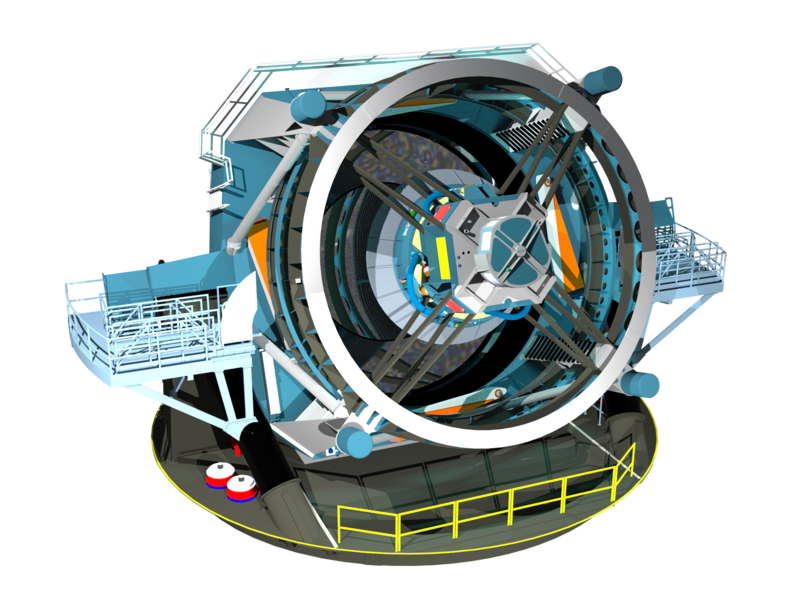
3/4 view rendering of Large Synoptic Survey Telescope
LSST Project Office
Key facts
Key facts
• Angular Resolution — 0.7 median seeing limit 0.2 pixel size • Code — X05 • Website — https: rubinobservatory.org/
Name
Name
• Illustration — Vera C. Rubin Observatory and the Milky Way Galaxy • Illustration — Vera C. Rubin Observatory on Cerro Pachón mountain in Central Chile The telescope was originally named the Large Synoptic Survey Telescope, where the word synoptic—derived from the Greek words σύν (syn 'together') and ὄψις (opsis 'view')—describes observations that give a broad view of a subject. In June 2019, the observatory was renamed the Vera C. Rubin Observatory as proposed by United States Representative Eddie Bernice Johnson and Resident Commissioner of Puerto Rico Jenniffer González-Colón. The renaming was enacted as United States law on 20 December 2019, and announced at the 2020 American Astronomical Society winter meeting. The name honors Rubin and her colleagues' probes of the nature of dark matter by mapping and cataloging billions of galaxies through space and time. The telescope itself is named the Simonyi Survey Telescope, in recognition of private donors Charles and Lisa Simonyi. The LSST acronym was repurposed to refer to the survey that the observatory will perform as the "Legacy Survey of Space and Time", with the camera as the "LSST Camera".
History
History
The Rubin Observatory was proposed in 2001 as the LSST. Construction of the mirror began in 2007 with private funds. The LSST then became the top-ranked large ground-based project in the 2010 Astrophysics Decadal Survey, and officially began construction on 1 August 2014. Funding came from the NSF, DOE, and private funding raised by the private LSST Discovery Alliance. Operations are managed by the Association of Universities for Research in Astronomy (AURA). Construction cost was expected to be about $680 million. Site construction began in April 2015. The first pixel with the engineering camera came in October 2024, while system first light images were released 23 June 2025. Full survey operations began on 30 June 2026, having been delayed by COVID-related issues. The Rubin Observatory is the successor to a tradition of sky surveys. These started as visually-compiled catalogs in the 18th century, such as the Messier catalog. This was replaced by photographic surveys, starting with the 1885 Harvard Plate Collection, the National Geographic Society – Palomar Observatory Sky Survey, and others. By about 2000, the first digital surveys, such as the Sloan Digital Sky Survey (SDSS), began to replace the earlier photographic plate surveys. The Rubin Observatory evolved from the Dark Matter Telescope, mentioned as early as 1996. The fifth decadal report, Astronomy and Astrophysics in the New Millennium, was released in 2001, and recommended the "Large-Aperture Synoptic Survey Telescope" as a major initiative. Even at this early stage the basic design and objectives were set: The Large-aperture Synoptic Survey Telescope (LSST) is a 6.5-m-class optical telescope designed to survey the visible sky every week down to a much fainter level than that reached by existing surveys. It will catalog 90 percent of the near-Earth objects larger than 300 m and assess the threat they pose to life on Earth. It will find some 10,000 primitive objects in the Kuiper Belt, which contains a fossil record of the formation of the solar system. It will also contribute to the study of the structure of the universe by observing thousands of supernovae, both nearby and at large redshift, and by measuring the distribution of dark matter through gravitational lensing. All the data will be available through the National Virtual Observatory, providing access for astronomers and the public to very deep images of the changing night sky. Early development was funded by small grants, with major contributions in January 2008 by software billionaires Charles and Lisa Simonyi and Bill Gates, of $20 million and $10 million, respectively. $7.5 million was included in the U.S. President's FY2013 NSF budget request. DOE funded the digital camera component built by the SLAC National Accelerator Laboratory, as part of its mission to understand dark energy. NSF funding for the rest of construction was authorized on 1 August 2014. The lead organizations are: • The SLAC National Accelerator Laboratory to design and construct the LSST camera • The National Optical Astronomy Observatory to provide the telescope and site team • The National Center for Supercomputing Applications to construct and test the archive and data access center • The Association of Universities for Research in Astronomy to oversee construction In May 2018, the United States appropriated more funding for the telescope than had been requested, to speed construction and operation. Telescope management was unsure this would help, since at that stage of construction they were not cash-limited. • Illustration — First released image: the Trifid and Lagoon nebulae • Illustration — Virgo Cluster taken by Vera C. Rubin Observatory The first photons resolved by the complete instrument were detected on 15 April 2025, appearing as rings before the instrument was adjusted to focus them as dots. Images from the first light of the full telescope and camera combination were released on 23 June 2025. The first teasers were a composite image of the Trifid and Lagoon nebulae and extracts from a wide-field view of galaxies in the Virgo Cluster. The image of the Virgo Cluster was taken in early May over four nights. The early images showed over 2,000 new asteroids. Watch parties for the release were held across six continents as people from 28 countries had been involved. An early discovery was the unusually large and quickly rotating asteroid in the Main Belt.
Simonyi Survey Telescope
Simonyi Survey Telescope
The Simonyi Survey Telescope design is unique among large telescopes (8-meter-class primary mirrors) for its wide field of view: in diameter, or. For comparison, both the Sun and the Moon, as seen from Earth, are about in apparent diameter and each covers an apparent area of about. Combined with its large aperture (and thus light-collecting ability), this gives Rubin a large etendue of 319 m 2 ⋅deg 2. This is more than three times the etendue of other large-entendue telescopes, the Subaru Telescope with its Hyper Suprime Camera and Pan-STARRS, and more than an order of magnitude larger than most large telescopes.
Optics
Optics
• Illustration — Optics The earliest reflecting telescopes used spherical mirrors that were easy to fabricate and test. However, because they suffer from spherical aberration; a long focal length was needed to achieve a tolerable level of spherical aberration. Making the primary mirror parabolic removes spherical aberration on-axis, but the field of view is then limited by off-axis coma. Such a parabolic primary, with either a prime or Cassegrain focus, was the most common optical design up through the Hale Telescope in 1949. After that, telescopes mostly used the Ritchey–Chrétien design, using two hyperbolic mirrors to remove both spherical aberration and coma, increasing the useful field of view, limited by astigmatism and higher-order aberrations. Most later large telescopes used this design—for example, the Hubble and Keck telescopes. LSST instead uses a three-mirror anastigmat to cancel astigmatism by employing three non-spherical mirrors. The result is sharp images over a wide field of view, at the expense of some light-gathering power due to the large tertiary mirror obscuring part of the optical path. The telescope's primary mirror (M1) is 8.4 m in diameter, the secondary mirror (M2) is 3.4 m in diameter, and the tertiary mirror (M3), inside the ring-like primary, is 5.0 m in diameter. The secondary mirror is the largest convex mirror in any operating telescope. (It will be surpassed by the Extremely Large Telescope's 4.2-meter secondary when complete). The second and third mirrors reduce the primary mirror's light-collecting area to 35 m2, with an effective aperture equivalent to a 6.42 m diameter single mirror. Multiplying the collecting area by the field of view produces an étendue of 336 m 2 ⋅deg 2; the actual figure is reduced by vignetting. The primary and tertiary mirrors (M1 and M3) are formed from a single piece of glass, the M1M3 monolith. Placing the two mirrors in the same location minimizes the overall length of the telescope, making it easier to quickly reorient. Making them from the same piece of glass results in a stiffer structure than two separate mirrors, contributing to rapid settling after motion. • Illustration — L1 lens, 2018 The optics includes three corrector lenses to reduce aberrations. These lenses, and the telescope's filters, are built into the camera assembly. The first lens, at 1.55 m in diameter, is the largest non-compound lens ever built, and the third lens forms the vacuum window in front of the focal plane. Unlike many telescopes, Rubin does not attempt to compensate for atmospheric dispersion. Such correction, which requires adjusting an additional element in the optical train, would be difficult to achieve in the 5 seconds available between pointings. It is also a technical challenge due to the short focal length. As a result, shorter wavelength bands away from the zenith have reduced image quality. • Illustration — Diagram of the Active Optics sensors
Wavefront sensing
Wavefront sensing
The telescope uses an active optics system, with wavefront sensors at the corners of the camera, to keep the mirrors accurately figured and in focus. The field of view is too large to use adaptive optics to correct for atmospheric seeing. Sensing occurs in three stages: • Laser trackers make sure the components are centered and are close to the intended positions. • Open-loop corrections are applied to correct for intrinsic mirror aberrations, component sag as a function of elevation and temperature, and filter selection. • Focus and figure measurements are made by sensors at the corners of the field of view to correct the optics. The precise shape and focus of the mirror assembly is estimated, and then corrected, by comparing the images on four sets of deliberately defocused CCDs (one in front of the focal plane and one behind, see figure). One correction method proceeds analytically, estimating a Zernike polynomial description of the current shape of the mirror, and from this computing a set of corrections to restore figure and focus. Another method, considerably faster, uses machine learning for this task. • Illustration — Camera sensor
Camera
Camera
• Illustration — Life-size model of the focal plane array – the array's diameter is 64 cm, and will provide 3.2 gigapixels per image. The image of the Moon (30 arcminutes) is present to show the scale of the field of view. The model is held by Suzanne Jacoby, the Rubin Observatory communications director. The 3.2-gigapixel digital camera takes 30-second exposures. The camera is at the tertiary focus, not the prime focus. Located at a "trapped focus" in front of the primary mirror, the associated technical problems are similar to those of a conventional prime-focus survey camera. Repointing such a large telescope (including settling time) within 5 seconds requires a short and stiff structure. This in turn implies a small f-number, which requires precise focusing. Using two 15-second exposures is a compromise to allow spotting both faint and moving sources. The single 30-second exposure recommendation reduces the overhead of camera readout and telescope re-positioning, allowing deeper imaging. Cosmic ray hits on the CCDs ultimately became detected reliably in a single 30-second image. The camera focal plane is flat and 64 cm in diameter. The main imaging is performed by a mosaic of 189 16-megapixel CCD detectors. They are grouped into a 5×5 grid of "rafts". The central 21 rafts contain 3×3 imaging sensors, while the four corner rafts contain three each, for guiding and focus control. The CCDs provide better than 0.2-arcsecond sampling, and are cooled to approximately −100 C to reduce noise. The camera includes a filter located between the second and third lenses, and an automatic filter-changing mechanism. Although the camera has six filters (ugrizy) covering 330–1080 nm wavelengths, the camera's position between the secondary and tertiary mirrors limits the size of its filter changer. It can hold five filters at a time, so one of the six is omitted each night.
Scientific goals
Scientific goals
• Illustration — Comparison of primary mirrors of several optical telescopes – the Rubin Observatory, in green, with its very large central hole, is near the center of the diagram. The Observatory will image about of the southern sky with six filters in its main survey, with about 825 visits to each spot over 10 years. The 5σ (SNR greater than 5) magnitude limits are expected to be r 2, respectively). The basic design is conventional: an altitude over azimuth mount made of steel, with hydrostatic bearings on both axes, mounted on a pier that is isolated from the dome foundations. The Observatory pier is unusually large (16 m diameter), robust (1.25-meter-thick walls) and mounted directly to virgin bedrock, where care was taken during site excavation to avoid using explosives that would crack it. Other unusual design features are linear motors on the main axes and a recessed floor on the mount. This allows the telescope to extend slightly below the azimuth bearings, lowering its center of gravity. The contract for the assembly was signed in August 2014. It passed its acceptance tests in 2018 and arrived at the site in September 2019. By April 2023, the mount was declared "essentially complete" and turned over to the Observatory.
Camera
Camera
In August 2015, the LSST Camera project, separately funded by the U.S. Department of Energy (DoE), passed its "critical decision 3" design review. On 31 August, construction began at SLAC. By September 2018, the cryostat was complete, the lenses ground, and 12 of the 21 CCD rafts had been delivered. As of September 2020, the entire focal plane was undergoing testing. By October 2021, the last of the six filters had been finished and delivered. By November 2021, the entire camera had been cooled to its required operating temperature, allowing final testing. • Illustration — Rendering of the Rubin Observatory camera • Illustration — Color-coded cutaway drawing of the Rubin Observatory camera • Illustration — Exploded view of the optical components of the Rubin Observatory camera • Illustration — Vera C. Rubin Observatory Commissioning Camera install Before the final camera installation, a smaller and simpler version (the Commissioning Camera, or ComCam) was used "to perform early telescope alignment and commissioning tasks, complete engineering first light, and possibly produce early usable science data". The camera was reported complete in early 2024. The camera arrived at the observatory in May 2024, and was installed in March 2025.
Data transport and redaction
Data transport and redaction
The data must be transported from the camera at the summit, to the base facilities, and then to the Rubin Observatory United States Data Facility (USDF) at SLAC. Data is routed via a $5 million dedicated encrypted network to a United States Intelligence Community facility in California. An automated system detects events, filters events containing sensitive objects, and releases imagery covering the remaining events to the scientific community after one minute. Complete images are released 80 hours later, after the satellites' orbits change, avoiding the permanent redaction done to images from the Pan-STARRS survey. This transfer must be 100 Gbit/s or better and reliable, since the USDF is where the data is processed into scientific data products, including real-time alerts of transient events. This transfer uses multiple fiber optic cables to reach Santiago, Chile, then via redundant routes to Miami, Florida, where it connects to existing high speed conduits. These links were activated in March 2018 by the AmLight consortium. Since the data crosses international borders, many groups are involved. These include the Association of Universities for Research in Astronomy (AURA, Chile, and the US), REUNA (Chile), Florida International University (US), AmLightExP (US), RNP (Brazil), and USDF (US), all of which participate in the Rubin Observatory Network Engineering Team (NET). This collaboration designs and delivers end-to-end network performance across network domains and providers.
Satellite constellations
Satellite constellations
• Illustration — 333 second-exposure image of the night sky containing 19 or more streaks due to Starlink satellite's light pollution – image from CTIO's Dark Energy Camera that has a similar field of view to the Rubin Observatory camera While taking a long exposure, a satellite can cross the field of view, leaving a streak on the image. While it is possible to model and remove a streak, the residual Poisson noise lowers the signal-to-noise ratio of the corrected pixels too much to be of scientific value. The issue came to prominence when a satellite train crossed an image taken by Cerro Tololo Inter-American Observatory (CTIO). Starlink has launched 7,000 satellites to low Earth orbit (LEO), with plans to expand to 12,000 and then to 34,400. Even if the Starlink constellation does not reach its planned size, the Project Kuiper and OneWeb LEO satellite constellations led to concern about how satellites could affect astronomical images. Estimates suggested that 30–40% of the images taken early and late at night could be compromised. This will impact science missions such as the observation of near-Earth objects. These must be observed in the same time frame as satellites as both need illumination by the Sun near twilight before they are obscured by the Earth's shadow. The Observatory has simulated altering their observing strategy to avoid satellite streaks. They found that this would increase slew times, sacrificing around 10% of observing time, to decrease the number of satellite streaks by a factor of two. Studies reported that even in the regime of very large satellite constellations (30,000 satellites), 8% of all science images would have a satellite streak, costing around 0.04% of the total number of science pixels.
Observations
Observations
• Illustration — Video beginning with two galaxies and zooming out to reveal about 10 million galaxies combining over 1100 images (0m58s) • Illustration — Trifid Nebula (top) and the Lagoon Nebula in a video combining 678 images (1min) • Illustration — A small section of the Virgo Cluster • Illustration — NGC 4261 is the large elliptical galaxy at the top of the image. • Illustration — Four examples of objects found in the Trifid Nebula and Lagoon Nebula • Illustration — The spiral galaxies NGC 4411B (left) and NGC 4411 (right) taken from "The Cosmic Treasure Chest" • Illustration — NGC 4326 • Illustration — NGC 4410
Observatory
Observatory
• Illustration — Clear skies at Cerro Pachón • Illustration — Construction • Illustration — Telescope mount assembly, taken from the dome during bridge crane installation • Illustration — Focal plane of Cam – wide, with 189 sensors to produce 3200-megapixel images • Illustration — Optical engineers Justin Wolfe (left) and Simon Cohen with the r filter • Illustration — Cam chilled to subzero temperatures • Illustration — Comet Leonard, the Observatory, the planet Venus, and various stars • Illustration — Night light with sky brightening due to the artificial light that can be seen as clusters of bright lights on the horizon • Illustration — From inside the observatory at night, during commissioning
Operations
Operations
• Illustration — Artist's illustration of the Rubin Observatory alert stream, launched on 24 February 2026. Icons represent individual alert types, including asteroids, supernovae, active galactic nuclei, and variable stars.
Chronology
Dated record
Chronology
The full dated record · 1 entries
2025
The Cosmic Treasure Chest - First Images from the Vera C. Rubin Observatory, 5 June, 2025 (2025) is digitised and catalogued by Internet Archive.
Image data processing
• Illustration — Examples of alerts generated by the Rubin Observatory's image-differencing pipeline during LSST Camera commissioning. Each row shows a triplet: the template image (left), the new image (center), and the difference image (right), which isolates changes in brightness or position. Alert types shown include supernovae, variable stars, active galactic nuclei, and solar system objects. • Illustration — Scan of Flammarion engraving taken with the Rubin Observatory in September 2020 Allowing for maintenance, bad weather and other contingencies, the camera is expected to take more than 200,000 images (1.28 petabytes uncompressed) per year. Managing and effectively analyzing the images is expected to be the most technically difficult part of the project. An estimated 250 teraflops and 100 petabytes of storage are required to keep up with the data flow. Images are processed according to three different timescales, prompt (within 60 seconds), daily, and annually. Prompt products are alerts, issued within 60 seconds of observation, about objects that have changed brightness or position relative to archived images of that sky position. Transferring, processing, and differencing such large images within 60 seconds (previous methods took hours, on smaller images) is itself a significant software engineering problem. This processing is performed at a classified US government facility in California so events that would reveal secret assets can be identified; they are temporarily redacted for three days, by which time the data are less sensitive. The first alerts were generated in February 2026. Up to 10 million alerts will be generated per night. Each alert includes: • Alert and database ID that uniquely identifies an alert • Photometric, astrometric, and shape characterization of the detected source • 30×30 pixel (on average) cut-outs of the template and difference images (in FITS format) • Time series (up to one year) of previous detections of this source • Summary statistics ("features") computed for the time series No proprietary period is associated with alerts—they are immediately available to the public, since the goal is to quickly transmit nearly everything the Observatory knows about any given event, enabling classification and decision making. Since most observers are interested in only a fraction of the events, alerts are fed to "event brokers" that forward selections to interested parties. The Observatory will provide a simple broker, and provide the full alert stream to external event brokers. The Zwicky Transient Facility serves as a prototype of the system, generating 1 million alerts per night. Daily products, released within 24 hours of observation, comprise the images from that night, and the source catalogs derived from difference images. This includes orbital parameters for Solar System objects. Images will be available in two forms: Raw Snaps, or data straight from the camera, and Single Visit Images, which have been processed and include instrumental signature removal (ISR), background estimation, source detection, deblending and measurements, point spread function estimation, and astrometric and photometric calibration. Annual release data products will be made available once a year, by re-processing the entire science data set to date. These include: • Calibrated images • Measurements of positions, fluxes, and shapes • Variability information • A description of light curves • A uniform reprocessing of the difference-imaging-based prompt data products • A catalog of roughly 6 million Solar System objects, with their orbits • A catalog of approximately 37 billion sky objects (20 billion galaxies and 17 billion stars), each with more than 200 attributes The annual release will be computed partially by the National Center for Supercomputing Applications, and partially by IN2P3 in France. The Observatory reserves 10% of its computing power and storage for user-generated data products. These are produced by custom algorithms for specialized purposes, using application programming interfaces (APIs) to access the data and store the results. This avoids the need to transfer huge quantities of data by allowing users to use Observatory storage and compute directly. It also allows academic groups to define custom release policies. An early version of the image processing software is used by the Subaru Telescope's Hyper Suprime-Cam instrument, a wide-field survey instrument with sensitivity similar to the Observatory but one-fifth the field of view: 1.8 square degrees (versus 9.6 for the Observatory). HelioLinc3D software was developed specifically for the Observatory, to detect moving objects. LSST software pipelines are available as open source software on GitHub. Future data releases include Data Preview 2 (DP2), planned for October–December 2026, and Data Release 1 (DR1), planned for two years after the start of the survey.
Context
Primary material
Context
The circumstances in which Vera C. Rubin Observatory stands. Rubin Observatory is recorded at coordinates -30.2446, -70.7494. Rubin Observatory is recorded as astronomical observatory. Rubin Observatory is recorded at an elevation of 2672.75. Rubin Observatory lies within Elqui Province. Rubin Observatory is situated in Chile.
Documents and archives
Primary material
Documents and archives
reference work
- “Vera C. Rubin Observatory”, English Wikipedia, consulted as further reading
Reputable secondary · Wikipedia
authority record
- Wikidata, structured authority record Q672021: Vera C. Rubin Observatory
General reference · Wikidata
Notes from the source article
Cited by Wikipedia
Notes from the source article
These works are cited by the source article, in its own numbering. They are recorded as its citations, not as sources VALÉORINE has verified.
- 1.Klesman, Alison. Here are the first-ever images released by the Vera C. Rubin Observatory. Astronomy Magazine. 2025-06-23.
- 2.Wattles, Jackie. ‘The greatest cosmic movie ever made’: Historic telescope kicks off an unprecedented survey CNN. CNN. 2026-07-01.
- 3.Heliolinc3D: enabling asteroid discovery for the Legacy Survey of Space and Time (LSST).
- 4.Overbye, Dennis. Vera Rubin Gets a Telescope of Her Own – The astronomer missed her Nobel Prize. But she now has a whole new observatory to her name. The New York Times. 11 January 2020.
- 5.NSF-supported observatory renamed for astronomer Vera C. Rubin. www.nsf.gov. 7 January 2020.
- 6.Survey Cadence Optimization Committee's Phase 3 Recommendations. pstn-056.lsst.io. 6 January 2025.
- 7.LSST. Press Release LSSTC-04: Site in Northern Chile Selected for Large Synoptic Survey Telescope. 17 May 2006.
- 8.Funding Information. rubinobservatory.org.
- 9.Telescope, Large Synoptic Survey. LSST General Public FAQs. Rubin Observatory. 12 June 2015.
- 10.Camera. LSST. 26 March 2013.
- 11.Walsh, Bryan. How the largest digital camera ever made is revolutionizing our view of space. Vox. 2025-06-28.
- 12.Rhee, George. Cosmic Dawn: The Search for the First Stars and Galaxies. Springer Science & Business Media. 237. 13 August 2013. 978-1-4614-7813-3.
- 13.H.R. 3196, the Vera C. Rubin Observatory Designation Act House Committee on Science, Space and Technology. science.house.gov.
- 14.Johnson, Eddie Bernice. H.R.3196 – 116th Congress (2019–2020): Vera C. Rubin Observatory Designation Act. www.congress.gov. 20 December 2019.
- 15.About Rubin Observatory. 2 April 2013.
- 16.FAQ Vera Rubin Observatory. www.vro.org.
- 17.Simonyi Survey Telescope. noirlab.edu.
- 18.Vera C. Rubin Observatory. NSF–DOE Vera C. Rubin Observatory Name guidelines.
- 19.Kahn, Steven. LSST Construction Authorization. Lsst Corp. August 2014.
- 20.LSST-DA Supporters LSST Discovery Alliance. lsstdiscoveryalliance.org. 6 November 2023.
- 21.Telescope, Large Synoptic Survey. Rubin Observatory.
- 22.LSST Corporation. LSST First Stone. 14 April 2015.
- 23.The Large Synoptic Survey Telescope: Unlocking the secrets of dark matter and dark energy. Phys.org. 29 May 2015.
- 24.Locations of Target Fields Observed during On-sky Commissioning Campaign with ComCam. LSST Corporation. 3 November 2024.
- 25.NSF NOIRLab. Action! NSF–DOE Vera C. Rubin Observatory Begins Capturing the Greatest Cosmic Movie Ever Made. Vera C. Rubin Observatory website. 30 June 2026.
- 26.Monthly updates. LSST Corporation. 10 December 2024.
- 27.Djorgovski, S. George. Planets, Stars and Stellar Systems. Springer Netherlands. 223–281. 2013. 978-94-007-5617-5.
- 28.Tyson, A. The Large-aperture Synoptic Survey Telescope. Astronomical Society of the Pacific. 232. 347. 1-58381-065-X.
- 29.Kluwer Academic Publishers; Dordrecht, W. H. Prognosticating The Future Of Gravitational Lenses. Kluwer Academic Publishers; Dordrecht. 173. 407. 9–14 July 1995.
- 30.National Academy Press. Astronomy and astrophysics in the new millennium. 11–12. 2001. 978-0-309-07312-7.
- 31.Donors Bring Big Telescope a Step Closer. The New York Times. 3 January 2008.
- 32.LSST Project Office Update. March 2012.
- 33.World's largest digital camera gets green light. 8 November 2011.
- 34.AAAS, Jeffrey. Surprise! House spending panel gives NSF far more money for telescope than it requested. AAAS. 21 May 2018.
- 35.Chang, Kenneth. Vera Rubin Scientists Reveal Telescope's First Images. The New York Times. 23 June 2025. 0362-4331.
- 36.Wells, Ione. First celestial image unveiled from revolutionary telescope. BBC. 23 June 2025.
- 37.Welcome to your First Look at the cosmos from NSF–DOE Rubin Observatory. Vera C. Rubin Observatory. 23 June 2025.
- 38.Greenfieldboyce, Nell. The Vera C. Rubin Observatory's first images are stunning — and just the start. NPR. 23 June 2025.
- 39.Klesman, Alison. Here are the first-ever images released by the Vera C. Rubin Observatory. Astronomy Magazine. 23 June 2025.
- 40.Bartels, Meghan. Majestic First Images from Rubin Observatory Show Universe in More Detail Than Ever Before. Scientific American. 23 June 2025.
- 41.Vera C Rubin Observatory first images. BBC Sky at Night Magazine. 23 June 2025.
- 42.The Hyper Suprime-Cam SSP Survey: Overview and survey design. Publications of the Astronomical Society of Japan. 70. SP1. 2018. 10.1093/pasj/psx066.
- 43.LSST. Community Science Input and Participation. 18 June 2013.
- 44.Vera C. Rubin Observatory. Key numbers.
- 45.Rubin Observatory. Rubin Observatory Optical Design. 3 April 2013.
- 46.Overton, Gail. LLNL ships world's largest optical lens to SLAC for the LSST telescope. Laser Focus World. 13 September 2019.
- 47.Miyazaki, S. Hyper Suprime-Cam: System design and verification of image quality. Publications of the Astronomical Society of Japan. 70. SP1. S1. 2018. 10.1093/pasj/psx063.
- 48.Seppala, Lynn G. Survey and Other Telescope Technologies and Discoveries. 4836. 111. 2002. 10.1117/12.461389.
- 49.Thomas, S. Rubin Observatory Simonyi Survey Telescope Active Optics. Adaptive Optics for Extremely Large Telescopes (AO4ELT7). June 2023. 10.13009/AO4ELT7-2023-069.
- 50.Megias Homar, Guillem. Ground-based and Airborne Telescopes X. 205. 11 September 2024. 978-1-5106-7511-7.
- 51.Crenshaw, John Franklin. Using AI for Wave-front Estimation with the Rubin Observatory Active Optics System. The Astronomical Journal. 167. 2. 86. 2024-01-30. 10.3847/1538-3881/ad1661.
- 52.The Large Synoptic Survey Telescope. 2014.
- 53.LSST. LSST Tour.
- 54.LSST: From Science Drivers to Reference Design and Anticipated Data Products (v1.0). The Astrophysical Journal. 873. 2. 111. 29 August 2014. 10.3847/1538-4357/ab042c.
- 55.Technical Details. Large Synoptic Survey Telescope. 11 June 2013.
- 56.LSST Camera Focal Plane Rubin Observatory. www.lsst.org. 11 June 2013.
- 57.LSST filters vs. SDSS. community.lsst.org. 27 November 2017.
- 58.LSST Camera filter changer. gallery.lsst.org.
- 59.NSF–DOE Vera C. Rubin Observatory/NOIRLab/SLAC/AURA. Capturing the Changing Cosmos: Examples of Alerts from NSF–DOE Rubin Observatory. 25 February 2026.
- 60.Sensors of world's largest digital camera snap first 3,200-megapixel images at SLAC. SLAC National Accelerator Laboratory.
- 61.Mapping the universe at 30 Terabytes a night: Jeff Kantor, on building and managing a 150 Petabyte database. The Register. 3 October 2008.
- 62.Petabyte-chomping big sky telescope sucks down baby code. The Register. 26 November 2010.
- 63.LSST. Data Management Technology Innovation. 19 June 2013.
- 64.LSST. Data Products. 11 June 2013.
- 65.Morganson, Eric. From DES to LSST: Transient Processing Goes from Hours to Seconds. 22 May 2017.
- 66.NSF–DOE Vera C. Rubin Observatory Launches Real-Time Discovery Machine for Monitoring the Night Sky.
- 67.Bellm, Eric. Alert Streams in the LSST Era: Challenges and Opportunities. 26 February 2018.
- 68.Large Synoptic Survey Telescope. Alert Brokers. Rubin Observatory. 19 November 2019.
- 69.Bellm, Eric. Time Domain Alerts from LSST & ZTF. 22 May 2017.
- 70.Jurić, M. Data Products Definition Document. LSST Corporation. 9 February 2018.
- 71.LSST-French Connection. April 2015.
- 72.Future data products. rubinobservatory.org.
- 73.Bosch, J. The Hyper Suprime-Cam software pipeline. Publications of the Astronomical Society of Japan. 70. 8 May 2017. 10.1093/pasj/psx080.
- 74.Andrews, Robin George. Killer Asteroid-Spotting Software Could Help Save the World. The New York Times. 5 August 2023.
- 75.LSST Science Pipelines Software. GitHub.
- 76.Vera C. Rubin Observatory. LSST Science Pipelines documentation.
- 77.Kahn, Steven M. Chapter 3: LSST System Performance. LSST.
- 78.Large Synoptic Survey Telescope. LSST Science Goals. www.lsst.org. The Large Synoptic Survey Telescope. 9 September 2014.
- 79.Heinze, Aren. HelioLinc3D: advances and challenges in multi-night asteroid linking. 55. 8. 405—03. 2023.
- 80.Jones, R. Lynne. Asteroid Discovery and Characterization with the Large Synoptic Survey Telescope (LSST). 10 November 2015.
- 81.FirstPost. The search for Pluto's successor continues with Rubin Observatory, could Planet X be the answer?. 29 June 2020.
- 82.Siraj, Amir. Searching for Black Holes in the Outer Solar System with LSST. The Astrophysical Journal Letters. 898. 1. L4. July 2020. 10.3847/2041-8213/aba119.
- 83.Siraj, Amir. Orbit of a Possible Planet X. The Astrophysical Journal. 978. 2. 139. 10 January 2025. 0004-637X.
- 84.LSST Detection of Optical Counterparts of Gravitational Waves 2019. markalab.github.io.
- 85.National Academies Press. Defending Planet Earth: Near-Earth-Object Surveys andHazard Mitigation Strategies. 29–30. 2010. 978-0-309-14968-6.
- 86.Grav, Tommy. Modeling the performance of the LSST in surveying the near-Earth object population. The Astronomical Journal. 151. 6. 172. June 2016. 10.3847/0004-6256/151/6/172.
- 87.National Academies Press. Defending Planet Earth: Near-Earth-Object Surveys and Hazard Mitigation Strategies. 2010. 978-0-309-14968-6.
- 88.LSST. Education & Public Outreach. 11 May 2015.
- 89.LSST Corporation. Large Synoptic Survey Telescope (LSST) EPO Design. 29 November 2017.
- 90.LSST. Project & Science News for Tuesday, May 8, 2018. 8 May 2018.
- 91.Doane, Allison. DASCH to Measure (and preserve) the Harvard Plates: Opening the ∼100-year Time Domain Astronomy Window. Preserving Astronomy's Photographic Legacy: Current State and the Future of North American Astronomical Plates. 410. 104–105. 1–3 November 2007.
- 92.StarGlass. starglass.cfa.harvard.edu.
- 93.Lasker, Barry M. The Second-Generation Guide Star Catalog: Description and Properties. The Astronomical Journal. American Astronomical Society. 136. 2. 735–766. 11 July 2008. 0004-6256.
- 94.OGLE survey.
- 95.SDSS DR12 Scope.
- 96.The Pan-STARRS data archive home page.
- 97.Legacy Survey. Index. 8 November 2012.
- 98.Similarities and differences between DES and LSST. 24 March 2014.
- 99.Collaboration, Gaia. Gaia Data Release 3. The extragalactic content. Astronomy and Astrophysics. 674. A41. June 2023. 0004-6361.
- 100.Bellm, Eric C. The Zwicky Transient Facility: System Overview, Performance, and First Results. Publications of the Astronomical Society of the Pacific. 131. 995. 018002. December 2018. 1538-3873.
- 101.Space Surveillance Telescope (SST). www.darpa.mil.
- 102.Feder, Toni. Chilean Site Chosen for LSST. Physics Today. 59. 7. 23. 2006. 10.1063/1.2337821.
- 103.LSST. Site in Northern Chile Selected for Large Synoptic Survey Telescope. 17 May 2006.
- 104.LSST. COVID-19 Construction Shutdown. 14 April 2020.
- 105.LSST. Rubin Commissioning Camera Installed on the Telescope Mount. 30 August 2022.
- 106.Steward Observatory Mirror Lab Awarded Contract for Large Synoptic Survey Telescope Mirror. University of Arizona News. 29 October 2004.
- 107.Mirror Fabrication Rubin Observatory. www.lsst.org.
- 108.LSST High Fire Event. www.lsst.org.
- 109.LSST Corporation. Giant Furnace Opens to Reveal 'Perfect' LSST Mirror Blank. 2 September 2009.
- 110.M1M3 Milestone Achieved. LSST E-News. 8. 1. April 2015.
- 111.Sebag, Jacques. LSST primary/tertiary monolithic mirror. International Society for Optics and Photonics. 9906. 99063E. 2016.
- 112.Beal, Tom. Big mirror about to move from UA lab. Arizona Daily Star. 28 February 2015.
- 113.LSST. Bon Voyage (Buen Viaje) M1M3!. 13 March 2019.
- 114.LSST. M1M3 Sails for Chile. 11 April 2019.
- 115.Rubin Observatory (@VRubinObs) on X.
- 116.Rubin Observatory Achieves Another Major Milestone: Reflective Coating of the 8.4-Meter Primary/Tertiary Mirror. 30 April 2024.
- 117.LSST M2 Substrate Complete and Shipped. LSST E-News. 2. 4. January 2010.
- 118.LSST M2 Substrate Received by Exelis. LSST E-News. 7. 4. December 2014.
- 119.News Vera C. Rubin Observatory Project. project.lsst.org.
- 120.LSST. M2 Coating Completed. 30 July 2019.
- 121.LSST Corporation. Kaboom! Life's a Blast on Cerro Pachón. April 2011.
- 122.Krabbendam, Victor. Developments in Telescope and Site. American Astronomical Society 219th Meeting. 9 January 2012.
- 123.Excavation Activities on Cerro Pachón. LSST E-News. 8. 2. August 2015.
- 124.Barr, Jeffrey D. Ground-based and Airborne Telescopes VI. 9906. 99060P. 2016. 978-1-5106-0191-8.
- 125.A Key Event. 23 March 2018.
- 126.LSST Astronomy. 1 November 2019.
- 127.LSST, Victor L. The Large Synoptic Survey Telescope (LSST) Construction Status – 2018. LSST. 12 June 2018.
- 128.Neill, Douglas R. LSST Telescope mount and pier design overview. International Society for Optics and Photonics. 7733. 77330F. 2010. 10.1117/12.857414.
- 129.LSST: TMA Contract Officially Signed. LSST E-News. 7. 4. December 2014.
- 130.Vera Rubin Observatory. The TMA Arrives at the Summit. 24 September 2019.
- 131.TMA Achieves Substantial Completion. 18 April 2023.
- 132.LSST Camera Team Passes DOE CD-3 Review. 10 August 2015.
- 133.SLAC. World's Most Powerful Digital Camera Sees Construction Green Light. 31 August 2015.
- 134.LSST, Victor L. The Large Synoptic Survey Telescope (LSST) Construction Status. LSST. 20 September 2018.
- 135.LLNL engineers deliver final optical components for world's newest telescope: the Vera C. Rubin Observatory. 19 October 2021.
- 136.Rubin Observatory. Camera Cooldown. 12 November 2021.
- 137.Haupt, J. The Large Synoptic Survey Telescope Commissioning Camera. Brookhaven National Laboratory. 24 November 2014.
- 138.2024-12-13 On-sky Commissioning Update. 13 December 2024.
- 139.The world's largest digital camera is ready to investigate the dark universe. Space.com. 3 April 2024.
- 140.LSST Camera arrives at Rubin Observatory in Chile symmetry magazine. www.symmetrymagazine.org. 22 May 2024.
- 141.NSF–DOE Vera C. Rubin Observatory Installs LSST Camera on Telescope | Rubin Observatory. rubinobservatory.org. 12 March 2025.
- 142.Rubin Observatory US Data Facility. April 2021.
- 143.LSST Project Office. Lighting up the LSST Fiber Optic Network: From Summit to Base to Archive. 10 April 2018.
- 144.Andersen, Ross. When a Telescope Is a National-Security Risk. The Atlantic. 2 December 2024.
- 145.O'Mullane, William. Rubin Data and Information Security Plan. Vera C. Rubin Observatory Rubin Observatory Operations. 9 July 2024.
- 146.Florida International University. Amlight-Exp Activates two new 100 Gbps Points-of-Presence Enhancing Infrastructure for Research and Education. 29 March 2018.
- 147.Red Universitaria Nacional. Chile inaugura primer tramo de Red Óptica de alta velocidad. 16 April 2018.
- 148.Rede Nacional de Ensino e Pesquisa. Brazilian scientists to partake in International Astronomy project.
- 149.Lu, Donna. SpaceX's Starlink satellites are interfering with astronomy again. New Scientist. 19 November 2019.
- 150.Astronomers Despair As SpaceX Starlink Train Ruins Observation Of Nearby Galaxies. Forbes. 18 November 2019.
- 151.China's 'Thousand Sails' joins Starlink as the latest mega-satellite constellation in orbit. Phys.org. 23 October 2024.
- 152.Boyle, Rebecca. Satellite Constellations Are an Existential Threat for Astronomy. Scientific American. 1 February 2023.
- 153.Hainaut, Olivier R. On the Impact of Satellite Constellations on Astronomical Observations with ESO telescopes in the Visible and Infrared Domains. Astronomy & Astrophysics. A121. 636. 5 March 2020. 0004-6361.
- 154.Tyson, J. Anthony. Mitigation of LEO Satellite Brightness and Trail Effects on the Rubin Observatory LSS. The Astronomical Journal. 160. 5. 226. October 2020. 10.3847/1538-3881/abba3e.
- 155.Satellite Constellation Avoidance with the Rubin Observatory Legacy Survey of Space and Time. The Astrophysical Journal. 941. 1. L15. 2022. 10.3847/2041-8213/aca592.
- 156.Yoachim, Peter. lsst-sims/smtn-018: Initial Release. 1 February 2025. 10.5281/zenodo.14783622.
- 157.The Cosmic Treasure Chest (Video-EN). NSF–DOE Vera C. Rubin Observatory. 12 June 2025.
- 158.Trifid and Lagoon Nebulae (Video-EN). NSF–DOE Vera C. Rubin Observatory. 13 June 2025.
- 159.Clear Skies at Cerro Pachón. noirlab.edu.
- 160.New Initiative to Help Unravel Cosmic Mysteries with Big Data. noirlab.edu.
- 161.The Rubin Observatory Telescope Mount Awakens.
- 162.Rubin Observatory Receives Two Guinness World Records for Its Camera and Lenses.
- 163.Final Filters Delivered for Rubin Observatory Camera. noirlab.edu.
- 164.Rubin Camera Chills Out. noirlab.edu.
- 165.NSF–DOE Vera C. Rubin Observatory/NOIRLab/SLAC/AURA. NSF–DOE Rubin Observatory Launches Real-Time Monitoring of the Night Sky. 25 February 2026.
- 166.LSST Telescope and Optics Status. American Astronomical Society 217th Meeting. 11 January 2011.
- 167.LSST Corporation. LSST System & Survey Key Numbers. 3 April 2013.
- 168.Gressler, William. LSST Optical Design Summary. 2 June 2009.
- 169.Tuell, Michael T. Modern Technologies in Space- and Ground-based Telescopes and Instrumentation. 7739. 77392V. 22 July 2010. 10.1117/12.857358.
- 170.NSF NOIRLab. NSF–DOE Vera C. Rubin Observatory Will Detect Millions of Exploding Stars. Vera C. Rubin Observatory website. 22 January 2025.
- 171.Guy, Leanne P. RTN-011: Rubin Observatory Plans for an Early Science Program. NSF-Doe Vera C. Rubin Observatory Technical Report. 79. 2026. 10.71929/RUBIN/2584021.
References
Citations
References
Each reference names the institution holding it, so a reader may go to the document itself.
reference work
Secondary witnessauthority record
General reference
Further particulars
Held on the record
Further particulars
Open the remaining particulars
The identifiers under which Vera C. Rubin Observatory may be traced in institutional catalogues.
The Encyclopedia exists whether or not anything is for sale. Corrections are recorded rather than overwritten, and every version of this record is kept. Published 16 August 2026.
Elsewhere in Scientific instruments
736 published records in this field, each with its sources named.
- Uppsala Southern Schmidt TelescopeTerminology
- Vacuum Tower TelescopeTerminology
- Vatican Advanced Technology TelescopeTerminology
- Venera 4V-2Terminology
- VersoriumTerminology
- vertical wind tunnelTerminology
- Very Long Baseline ArrayTerminology
- Very Small ArrayTerminology
Best supported in this field
For owners
Own an object connected with Vera C. Rubin Observatory?
A specialist will read what you send and tell you what the house can establish, what it cannot, and whether the object is suited to sale. There is no charge and no obligation. The object stays with you throughout; nothing is shipped to us unless it is arranged in writing beforehand.