
New Technology Telescope
The New Technology Telescope or NTT is a 3.58-metre Ritchey–Chrétien telescope operated by the European Southern Observatory. It began operations in 1989. It is located in Chile at the La Silla Observatory and was an early pioneer in the use of active optics.
Also recorded as NTT · The ESO New Technology Telescope · ESO-NTT
New Technology Telescope
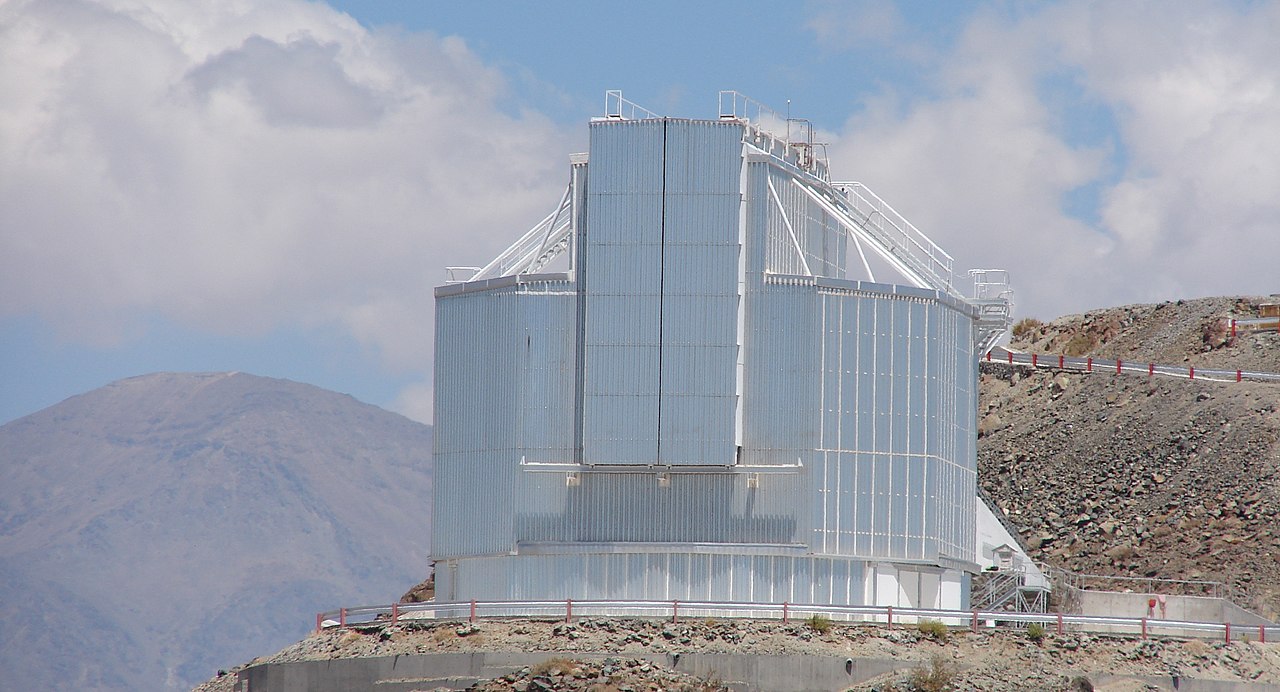
Masteruk · CC BY-SA 3.0
- Region
- Chile
VALÉORINE Encyclopedia
VALÉORINE documentary reading
Documentary summary
The New Technology Telescope or NTT is a 3.58-metre Ritchey–Chrétien telescope operated by the European Southern Observatory. It began operations in 1989. It is located in Chile at the La Silla Observatory and was an early pioneer in the use of active optics.
Admitted source layer · organised and presented by VALÉORINE
Reference Check
Propose documentary evidence for New Technology Telescope. A contribution is never written directly as fact: identity, source, rights and evidence gates still decide.
Sign in to contribute
Documentary evidence
Documentary basis
Authority files
gnd · 5212079-X · wikidata · Q1982969 · wikipedia · New Technology Telescope
In this article
Characteristics
Characteristics
The telescope and its enclosure were built to a revolutionary design for optimal image quality.
• Illustration — ESO's New Technology Telescope at La Silla The main mirror of NTT is flexible and its shape is actively adjusted during observations by actuators to preserve the optimal image quality. The secondary mirror position is also actively controlled in three directions. This technology, developed by ESO, known as active optics, is now applied to all major modern telescopes, such as the Very Large Telescope at Cerro Paranal and the future European Extremely Large Telescope. The design of the octagonal enclosure housing the NTT is another technological breakthrough. The telescope dome is relatively small, and is ventilated by a system of flaps that makes air flow smoothly across the mirror, reducing turbulence and leading to sharper images. The NTT was the first telescope using what is now known as active optics: a feedback loop that actively keeps the (comparatively thin) monolithic mirror in shape, using numerous actuators on which the mirror is mounted. Its design as well as the design of its enclosure (the building protecting it) included many revolutionary features, from whence it was named. In particular, great care was taken to ensure a good ventilation of the telescope, and to avoid heat sources in around the telescope. Since its construction, the NTT has undergone several upgrades which continued to improve its quality. It was used as a real-life test bench for the engineering concepts and software used for the Very Large Telescope. The New Technology Telescope initially had the same problem as the Hubble Space Telescope – the mirror was ground to the wrong shape due to a mis-calibrated null corrector. However, the active optics system of the NTT was able to correct that error without refiguring the mirror.
Instruments
Instruments
Currently, the NTT is equipped with 2 instruments: • SofI ("Son of ISAAC", a VLT instrument), a near infrared camera and low-resolution spectrograph, with polarimetric and high-time resolution modes • EFOSC2 (ESO Faint Object Spectrograph and Camera, v.2), a visible light camera and low-resolution spectrograph, with multi-object spectroscopy, polarimetry and coronography modes
Science with the NTT
Science with the NTT
The NTT and its instrument have contributed for important discoveries since the telescope started working at La Silla. These include unravelling the mysterious Galactic centre, contributing to the observations of the first solar-like oscillations in another star, and breaking many distance records by finding new galaxies in the far-away Universe. Most recently, the NTT helped detect a disc around a massive young star, solving the mystery of star formation in massive stars, and its observations were crucial to determine how asteroids are modified by solar wind. NTT observations of stars orbiting the centre of our Milky Way helped determine the mass and the radius of its supermassive black hole, effectively helping to confirm the existence of such a massive and compact object.
Context
Primary material
Context
The circumstances in which New Technology Telescope stands. Recorded at coordinates -29.2589, -70.7338. Recorded as Ritchey–Chrétien telescope. Recorded at an elevation of 2375. Located at Atacama Desert. Situated in Chile.
Documents and archives
Primary material
Documents and archives
reference work
- “New Technology Telescope”, English Wikipedia, consulted as further reading
Reputable secondary · Wikipedia
authority file
- Gemeinsame Normdatei 5212079-X, National New Technology Telescope (Tucson, Ariz.).
General reference · Deutsche Nationalbibliothek
authority record
- Wikidata, structured authority record Q1982969: New Technology Telescope
General reference · Wikidata
Citations
References
Each reference names the institution holding it, so a reader may go to the document itself.
reference work
Secondary witnessauthority file
Gemeinsame Normdatei 5212079-X, National New Technology Telescope (Tucson, Ariz.).Deutsche Nationalbibliothek
Secondary witnessauthority record
Secondary witness
The Encyclopedia exists whether or not anything is for sale. Corrections are recorded rather than overwritten, and every version of this record is kept. Published 16 August 2026.
Elsewhere in Scientific instruments
736 published records in this field, each with its sources named.
- Near Infrared Camera and Multi-Object SpectrometerTerminology
- NEO SurveyorTerminology
- Neutron Star Interior Composition ExplorerTerminology
- New Mexico Exoplanet Spectroscopic Survey InstrumentTerminology
- Newton telescopeTerminology
- Next-Generation Transit SurveyTerminology
- Nicholas U. Mayall TelescopeTerminology
- nocturnalTerminology
Best supported in this field
For owners
Own an object connected with New Technology Telescope?
A specialist will read what you send and tell you what the house can establish, what it cannot, and whether the object is suited to sale. There is no charge and no obligation. The object stays with you throughout; nothing is shipped to us unless it is arranged in writing beforehand.