
Vacuum Tower Telescope
The Vacuum Tower Telescope (VTT) is an evacuated-optics solar telescope located at the Teide Observatory on Tenerife in the Canary Islands. It is operated by the Kiepenheuer-Institut für Sonnenphysik (KIS). It was built between 1983 and 1986, with first light in 1988.
Vacuum Tower Telescope
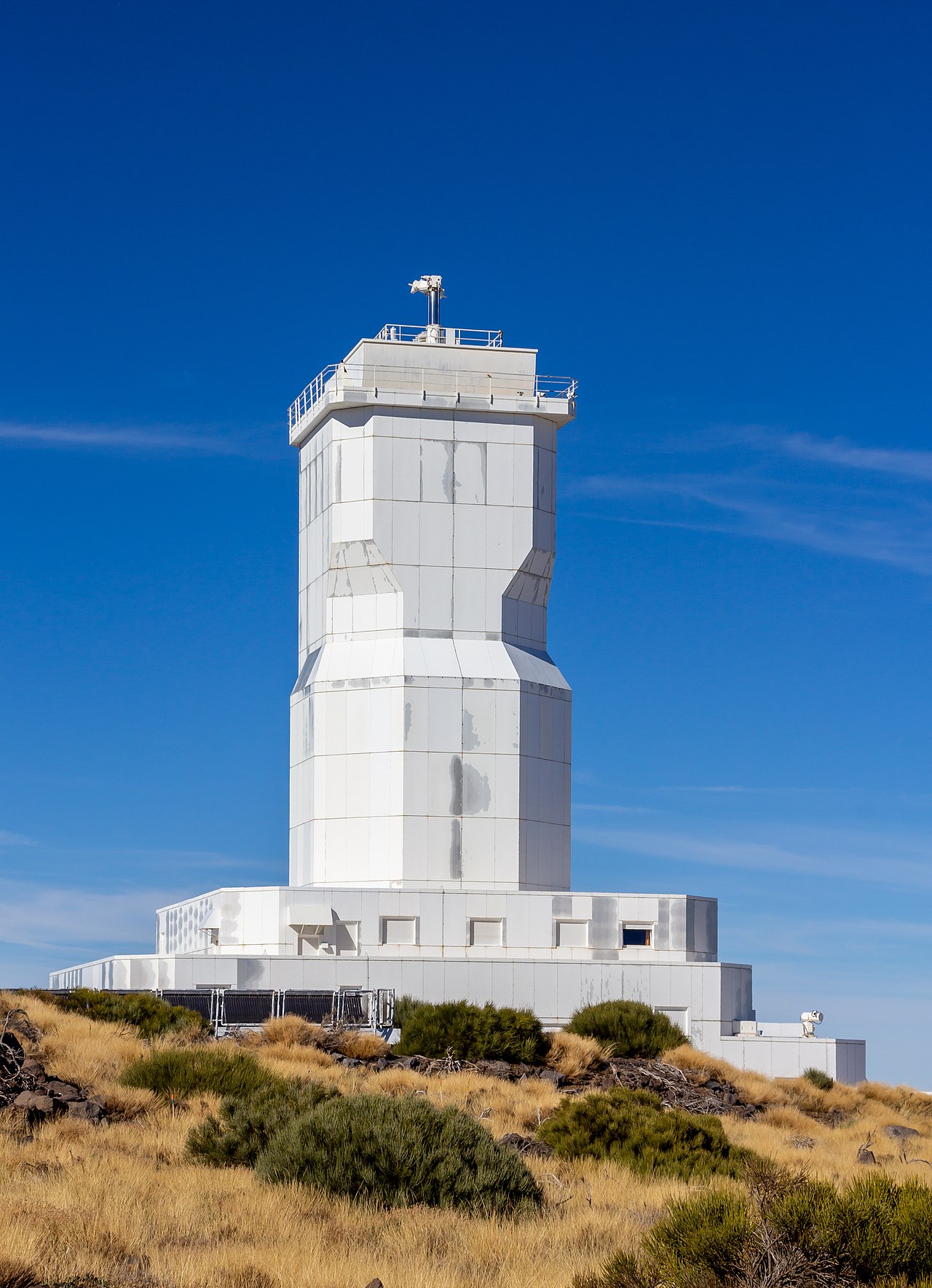
Photograph by Mike Peel ( · CC BY-SA 4.0
- Region
- Spain.
VALÉORINE Encyclopedia
VALÉORINE documentary reading
Documentary summary
The Vacuum Tower Telescope (VTT) is an evacuated-optics solar telescope located at the Teide Observatory on Tenerife in the Canary Islands. It is operated by the Kiepenheuer-Institut für Sonnenphysik (KIS). It was built between 1983 and 1986, with first light in 1988.
Admitted source layer · organised and presented by VALÉORINE
Reference Check
Propose documentary evidence for Vacuum Tower Telescope. A contribution is never written directly as fact: identity, source, rights and evidence gates still decide.
Sign in to contribute
World of VALÉORINE
Documentary connections
Only confirmed graph relationships appear here. Images are shown only when their identity and reuse rights both pass the documentary gate.
Documentary evidence
Documentary basis
Authority files
wikidata · Q3553152 · wikipedia · Vacuum Tower Telescope
In this article
Overview
Overview
It has a 70 cm primary mirror and a focal length of 46 m. Thanks to an adaptive optics system KAOS (KKiepenheuer-institute ADaptive OOptic SSystem), in operation since spring 2000, it is able to resolve details down to 0.2 arc seconds (150 km) on the Sun's surface.
Key facts
Key facts
• Illustration — Vacuum Tower Telescope • Illustration — Close view of VTT
History
History
In the early seventies, the 40-centimetre Newton telescope, built at the Kiepenheuer-Institut, was installed at the Observatorio del Teide. In 1982, the Federal Republic of Germany joined the international Agreement on the Cooperation in Astrophysical Research between Spain, Great Britain, Sweden and Denmark. Construction work for the German solar telescopes started in 1983, including the Vacuum Tower Telescope (VTT), and the Gregory-Coudé-Telescope (GCT) of the Universitäts-Sternwarte Göttingen. The VTT was developed at the Kiepenheuer-Institut in Freiburg during the mid-seventies. The telescope was installed in 1986 and the scientific operations started in 1988. Since then, the VTT has been constantly improved and has been the workhorse for our researchers. The GCT was put into operation in 1985 and dismantled in 2002, in order to make room for the new 1.5-metre GREGOR telescope.
Results
Results
The VTT instrumentation is designed for high-quality measurements of plasma flows and magnetic fields. Some instruments can be combined for simultaneous observations in different parts of the solar spectrum, from the near-infrared to the near-UV. This possibility is a unique feature for a solar telescope and allows it to reveal the three-dimensional structure of the solar atmosphere. With the help of adaptive optics and suitable image-reconstruction techniques, it is now possible to observe physical properties of small-scale objects on the solar surface with sizes of only 150 km, at the theoretical limit of the telescope.
Description
The VTT and the GREGOR are operated by four German institutes: the Astrophysikalisches Institut Potsdam, the Kiepenheuer-Institut für Sonnenphysik (Freiburg, chair), the Max-Planck-Institut für Sonnensystemforschung (Lindau), and the Universitäts-Sternwarte Göttingen. The telescope is used for scientific observations from mid-April through mid-December. Typically 30 to 40 observing campaigns are carried out every year.
Literature
Literature
High-resolution observations with the German Vacuum Tower Telescope on Tenerife, New Astronomy Reviews, 1998
Notes from the source article
Cited by Wikipedia
Notes from the source article
These works are cited by the source article, in its own numbering. They are recorded as its citations, not as sources VALÉORINE has verified.
- 1.Kiepenheuer-Institut für Sonnenphysik (KIS)
- 2.Kiepenheuer-Institut für Sonnenphysik. Vacuum Tower Telescope. KIS website.
- 3.Instituto de Astrofísica de Canarias. Vacuum Tower Telescope (VTT). IAC website.
- 4.KAOS- The Kiepenheuer-institute Adaptive Optic System.
- 5.Solar observations of highest resolution obtained with Adaptive Optics and Speckle-Interferometry at the VTT.
- 6.Van Der Luehe, Oskar. Innovative Telescopes and Instrumentation for Solar Astrophysics. 4853. 187. 2003. 10.1117/12.498659.
- 7.Berkefeld, Thomas. KAOS - a flexible control system for AO and MCAO. ESO. 2. December 2012.
- 8.Rimmele, Thomas R. Solar Adaptive Optics. Living Reviews in Solar Physics. 8. 2. 2011. 10.12942/lrsp-2011-2.
References
Citations
References
Each reference names the institution holding it, so a reader may go to the document itself.
reference work
Secondary witnessreference work
Secondary witness
Further particulars
Held on the record
Further particulars
Open the remaining particulars
A count of publications is evidence of attention, not of standing, and is given here only as a measure.
The European Solar Telescope (2022) — DataCite (Les Ulis: EDP Sciences)
The Encyclopedia exists whether or not anything is for sale. Corrections are recorded rather than overwritten, and every version of this record is kept. Published 16 August 2026.
Elsewhere in Scientific instruments
736 published records in this field, each with its sources named.
- Ultraviolet ExplorerTerminology
- UniBRITETerminology
- United Kingdom Infrared TelescopeTerminology
- Uppsala Southern Schmidt TelescopeTerminology
- Vatican Advanced Technology TelescopeTerminology
- Venera 4V-2Terminology
- Vera C. Rubin ObservatoryTerminology
- VersoriumTerminology
Best supported in this field
For owners
Own an object connected with Vacuum Tower Telescope?
A specialist will read what you send and tell you what the house can establish, what it cannot, and whether the object is suited to sale. There is no charge and no obligation. The object stays with you throughout; nothing is shipped to us unless it is arranged in writing beforehand.