
Thomas Phillips
Thomas Phillips (18 October 1770 – 20 April 1845) was an English painter who specialised in portrait painting. He painted many of the notable men of the day including scientists, artists, writers, poets and explorers.
Also recorded as R.A. Thomas Phillips · Phillips · R. A. T. Phillips · T. Phillips
Thomas Phillips
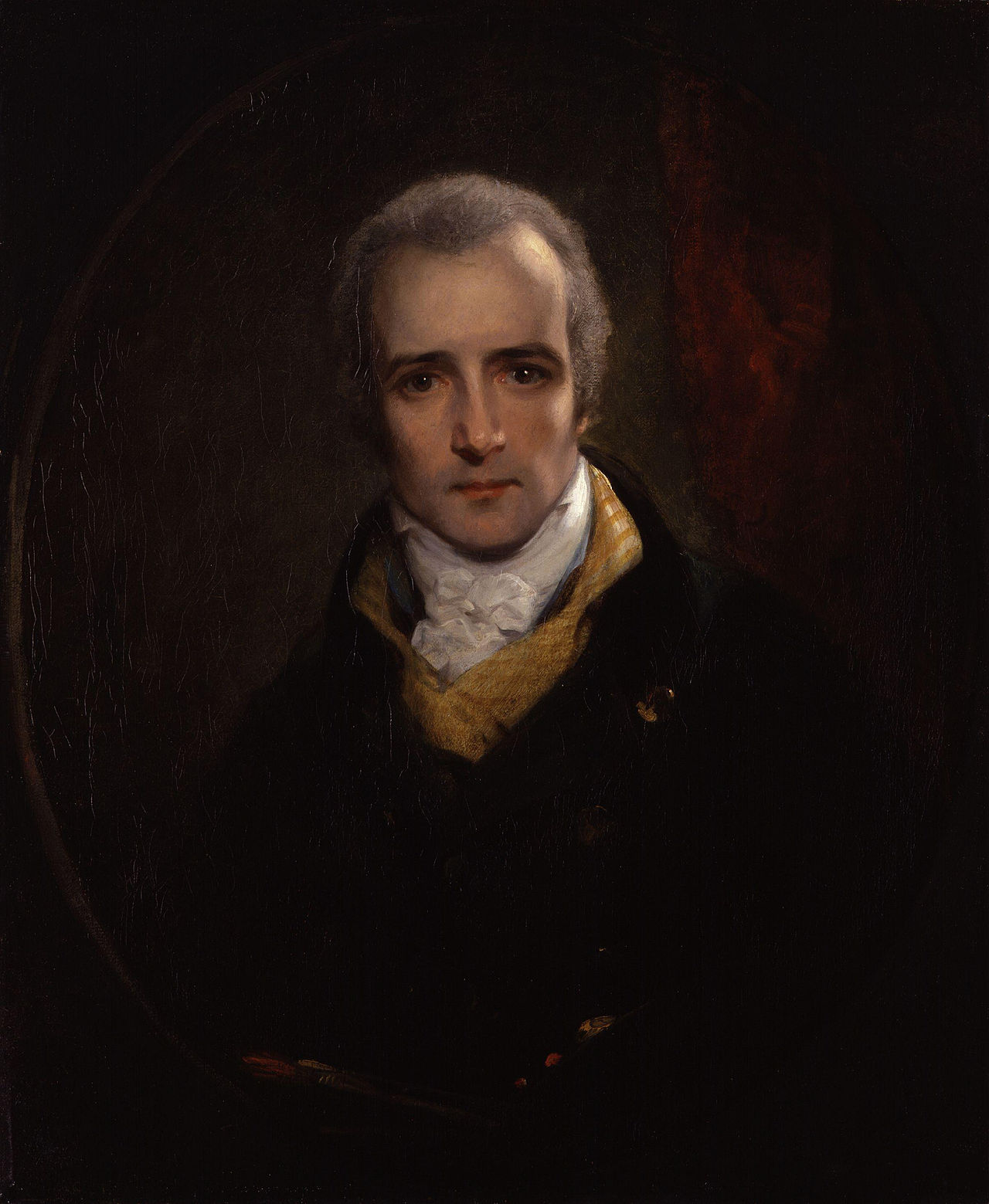
Thomas Phillips · Public domain
- Name
- Thomas Phillips
- Born
- 18 October 1770
- Birthplace
- Dudley, Worcestershire, England
- Died
- 20 April 1845
- Place of death
- London, England
- Field
- Painting
- Movement
- Romanticism
- Nationality
- Kingdom of Great Britain · United Kingdom of Great Britain and Ireland
- Occupation
- painter · portraitist
- Fields
- portrait
- Education
- Royal Academy of Arts
- Honours
- Fellow of the Royal Society
VALÉORINE Encyclopedia
VALÉORINE documentary reading
Documentary summary
Thomas Phillips (18 October 1770 – 20 April 1845) was an English painter who specialised in portrait painting. He painted many of the notable men of the day including scientists, artists, writers, poets and explorers.
Admitted source layer · organised and presented by VALÉORINE
Note VALÉORINE
No house-authored Note is published until its assertions and sources pass the VALÉORINE evidence contract. The documentary article remains available in full while that enrichment is being consolidated.
Documentary enrichment in progress · no unsupported statement published
Reference Check
Propose documentary evidence for Thomas Phillips. A contribution is never written directly as fact: identity, source, rights and evidence gates still decide.
Sign in to contribute
Documentary evidence
Evidence Panel
not yet certified
- Identity
- resolved
- Independent source families
- 0
- Admitted assertions
- 0
- Open conflicts
- 0
Authority files
gnd · 17299795X · wikidata · Q422726 · wikipedia · Thomas Phillips
In this article
Biography
Biography
Thomas Phillips studied at Royal Academy of Arts. The recorded working language is English. Subjects and genres recorded for the work are portrait. Places of work recorded in the authority are Birmingham, London and Italy. Work by Thomas Phillips is recorded in the collections of Auckland Art Gallery, Tate, Australian National Maritime Museum, Philadelphia Museum of Art and Musée de la Vie romantique. Distinctions recorded are Fellow of the Royal Society.

Thomas Phillips, Elizabeth Mary Anne Massingberd
Thomas Phillips

Portrait of Robert George Duff (1817–1890), British Army officer.
Artist Thomas Phillips (attribution)
Key facts
Key facts
• Name — Thomas Phillips • Born — 18 October 1770 • Birthplace — Dudley, Worcestershire, England • Died — 20 April 1845 • Place of death — London, England • Field — Painting • Movement — Romanticism
Life and work
Life and work
• Illustration — Self-portrait (1820s) Phillips was born at Dudley, then in Worcestershire. Having learnt glass-painting in Birmingham under Francis Eginton, he visited London in 1790 with an introduction to Benjamin West, who found him employment on the painted-glass windows of St George's Chapel at Windsor. In 1791 he became a student at the Royal Academy, where, in 1792 he exhibited a view of Windsor Castle, followed in the next two years by the Death of Talbot, Earl of Shrewsbury, at the Battle of Castillon, Ruth and Naomi, Elijah restoring the Widow's Son, Cupid disarmed by Euphrosyne, and other pictures. After 1796, he concentrated on portrait-painting. However, the field was very crowded with the likes of John Hoppner, William Owen, Thomas Lawrence and Martin Archer Shee competing for business; consequently, from 1796 to 1800, his exhibited works were chiefly portraits of gentlemen and ladies, often nameless in the catalogue and of no great importance, historically speaking. In 1804 he was elected an associate of the Royal Academy, together with his rival, William Owen. About the same time he moved to 8 George Street, Hanover Square, London, formerly the residence of Henry Tresham, R.A., where he lived for the rest of his life. He became a royal academician in 1808, and presented as his diploma work Venus and Adonis (exhibited the same year), perhaps the best of his creative subjects, apart from Expulsion from Paradise. Meanwhile, he rose steadily in public favour, and in 1806, painted the Prince of Wales, the Marchioness of Stafford, the Marquess of Stafford's Family, and Lord Thurlow. In 1807 he sent to the Royal Academy the well-known portrait of William Blake, now in the National Portrait Gallery, London, which was engraved in line by Luigi Schiavonetti, and later etched by William Bell Scott. His contributions to the academy exhibition of 1809 included a portrait of Sir Joseph Banks (engraved by Niccolo Schiavonetti), and to that of 1814, two portraits of Lord Byron (engraved by Robert Graves). In 1818 he exhibited a portrait of Sir Francis Chantrey, and, in 1819, one of the poet George Crabbe. His 1822 portrait of Sir Charles Asgill was exhibited at the Royal Academy that same year. In 1825 he was elected professor of painting at the Royal Academy, succeeding Henry Fuseli, and, in order to qualify himself for his duties, visited Italy and Rome in company with William Hilton, and also Sir David Wilkie, whom they met in Florence. He resigned the professorship in 1832, and in 1833 published his "Lectures on the History and Principles of Painting". Phillips also painted portraits of Walter Scott, Robert Southey, George Anthony Legh Keck (1830), Thomas Campbell (poet), Joseph Henry Green, Samuel Taylor Coleridge, Henry Hallam, Mary Somerville, Sir Edward Parry, Sir John Franklin, Dixon Denham, the African traveller, and Hugh Clapperton. Besides these he painted two portraits of Sir David Wilkie, the Duke of York (for the town-hall, Liverpool), Dean William Buckland, Sir Humphry Davy, Samuel Rogers, Michael Faraday (engraved in mezzotint by Henry Cousins), John Dalton, and a head of Napoleon, painted in Paris in 1802, not from actual sittings, but with Empress Joséphine's consent, who afforded him opportunities of observing the First Consul while at dinner. Years later in Paris, he was to portray his younger colleague Ary Scheffer (c. 1835, Musée de la Vie romantique, Paris). A self-portrait, exhibited in 1844, was one of his last works. Phillips wrote many occasional essays on the fine arts, especially for Rees's "Cyclopaedia", and also a memoir of William Hogarth for John Nichols's edition of that artist's "Works", 1808–17. He was a fellow of the Royal Society and of the Society of Antiquaries. He was also, with Chantrey, Turner, Robertson, and others, one of the founders of the Artists' General Benevolent Institution. Phillips died at 8 George Street, Hanover Square, London, on 20 April 1845, and was interred in the burial-ground of St. John's Wood chapel. He married Elizabeth Fraser of Fairfield, near Inverness. They had two daughters and two sons, the elder of whom, Joseph Scott Phillips, became a major in the Bengal artillery, and died at Wimbledon, Surrey, on 18 December 1884, aged 72. His younger son, Henry Wyndham Phillips (1820–1868) was a portrait painter, secretary of the "Artists General Benevolent Institution", and captain in the Artists' volunteer corps. Artist and illustrator John William Wright (1802–1848) was his pupil.
Gallery
Gallery
• Illustration — Countess of Egremont, 1797 • Illustration — Earl of Egremont, 1799 • Illustration — Charles Dibdin, 1799 • Illustration — Portrait of William Blake, 1807 • Illustration — Venus and Adonis, 1808 • Illustration — Joseph Banks, 1810 • Illustration — Portrait of David Wilkie, c. 1811 • Illustration — John Hely-Hutchinson, 2nd Earl of Donoughmore, 1811 • Illustration — Portrait of Lady Caroline Lamb, 1813 • Illustration — Lord Byron in Albanian Dress, 1813 • Illustration — The Prince Regent and Charles Wyndham, 1813 • Illustration — Portrait of Lord Byron, 1814 • Illustration — Portrait of the Duke of Wellington, 1814 • Illustration — Matvei Platov, 1814 • Illustration — Joshua Brookes, 1815 • Illustration — The Allied Sovereigns at Petworth, 1817 • Illustration — Robert Southey, 1818 • Illustration — Portrait of Francis Leggatt Chantrey, 1818 • Illustration — Lord Grenville, 1819 • Illustration — Portrait of Earl Grey, c. 1820 • Illustration — Portrait of the Earl of Durham, 1820 • Illustration — Thomas James, 1821 • Illustration — Humphry Davy, 1821 • Illustration — David Ricardo, c. 1821 • Illustration — Portrait of John Franklin, 1828 • Illustration — Portrait of Mary Somerville, 1834 • Illustration — Sir Francis Burdett, 1834 • Illustration — John Dalton, 1835 • Illustration — John Lothrop Motley, c. 1835 • Illustration — Prince Augustus Frederick, Duke of Sussex, c. 1838 • Illustration — Portrait of Thomas Arnold, 1839 • Illustration — Portrait of the Earl of Egremont, 1839 • Illustration — Portrait of Michael Faraday, 1842
Identity and origins
Identity and origins
The authorities additionally record the headings R.A. Thomas Phillips, Phillips, R. Phillips and phillips t. His recorded language was English. 2 children are recorded: Henry Wyndham Phillips and Susanna Fraser.
Identity
Identity
Thomas Phillips is recorded as painter and portraitist.
Life and career
Dated record
Life and career
The full dated record · 2 entries
1770
Thomas Phillips born at Dudley.
1845
Thomas Phillips died at London.
Places
Named by the record
Places
Only places the record itself states, plotted where the house gazetteer settles their coordinates. Nothing is inferred from a name or a nationality.
Dudley.
Birth place
London.
Death place
Primary material
Documents and archives
reference work
- “Thomas Phillips”, English Wikipedia, consulted as further reading
Reputable secondary · Wikipedia
- Wikidata, structured authority record Q422726: Thomas Phillips
Reputable secondary · Wikimedia Foundation
authority file
- Gemeinsame Normdatei 17299795X, Thompson, Thomas Phillips.
Unverified · Deutsche Nationalbibliothek
Literature
Literature
Literature
Phillips, Thomas, Benezit Dictionary of Artists, 2011
Phillips, Thomas, Oxford Art Online, 2003
Scholarly footprint
Literature
Scholarly footprint
A count of publications is evidence of attention, not of standing, and is given here only as a measure.
Notes from the source article
Cited by Wikipedia
Notes from the source article
These works are cited by the source article, in its own numbering. They are recorded as its citations, not as sources VALÉORINE has verified.
- 1.Phillips, Thomas (1770–1845). 45. 216-7.
- 2.Phillips, Thomas. 21. 407.
References
Citations
References
Each reference names the institution holding it, so a reader may go to the document itself.
reference work
Partially resolvedauthority file
Gemeinsame Normdatei 17299795X, Thompson, Thomas Phillips.Deutsche Nationalbibliothek
Partially resolvedreference work
Wikidata, structured authority record Q422726: Thomas PhillipsWikimedia Foundation
Partially resolved
People, houses and institutions
Knowledge graph
People, houses and institutions
Teachers, collaborators, publishers and institutions recorded against this person, each on a stated basis.
Studied at
1- Royal Academy of ArtsOrganisation
Established from a fact already recorded on a verified source.
The Encyclopedia exists whether or not anything is for sale. Corrections are recorded rather than overwritten, and every version of this record is kept. Published 14 August 2026.
Elsewhere in Paintings
18,875 published records in this field, each with its sources named.
- Thomas MulvanyArtist
- Thomas MurrayArtist
- Thomas Musgrave JoyArtist
- Thomas P. BarnettArtist
- Thomas PradzynskiArtist
- Thomas Prichard RossiterArtist
- Thomas RanftArtist
- Thomas RestoutArtist
Best supported in this field
For owners
Own a work by Thomas Phillips?
A specialist will read what you send and tell you what the house can establish, what it cannot, and whether the object is suited to sale. There is no charge and no obligation. The object stays with you throughout; nothing is shipped to us unless it is arranged in writing beforehand.