
punt gun
A punt gun is a type of extremely large shotgun used in the 19th and early 20th centuries for shooting large numbers of waterfowl for commercial harvesting operations. These weapons are characteristically too large for an individual to fire from the shoulder or often carry alone, but unlike artillery pieces, punt guns are able to be aimed and fired by a single person from a mount. In this case, the mount is typically a small watercraft (e.g, a punt).
punt gun

Sydney Harold Smith (or collaborators on his behalf) · This file has been provided by York Museums Trust as part of a GLAMwiki partnership. This tag does not indicate the copyright status of the attached work. A normal copyright tag is still required. See · Public domain
- Name
- Punt gun
- Field
- shotgun · hunting weapon
VALÉORINE Encyclopedia
VALÉORINE documentary reading
Documentary summary
A punt gun is a type of extremely large shotgun used in the 19th and early 20th centuries for shooting large numbers of waterfowl for commercial harvesting operations. These weapons are characteristically too large for an individual to fire from the shoulder or often carry alone, but unlike artillery pieces, punt guns are able to be aimed and fired by a single person from a mount. In this case, the mount is typically a small watercraft (e.g, a punt).
Admitted source layer · organised and presented by VALÉORINE
Note VALÉORINE
No house-authored Note is published until its assertions and sources pass the VALÉORINE evidence contract. The documentary article remains available in full while that enrichment is being consolidated.
Documentary enrichment in progress · no unsupported statement published
Reference Check
Propose documentary evidence for punt gun. A contribution is never written directly as fact: identity, source, rights and evidence gates still decide.
Sign in to contribute
World of VALÉORINE
Documentary connections
Only confirmed graph relationships appear here. Images are shown only when their identity and reuse rights both pass the documentary gate.

Documentary evidence
Evidence Panel
not yet certified
- Identity
- resolved
- Independent source families
- 0
- Admitted assertions
- 0
- Open conflicts
- 0
Authority files
wikidata · Q1834809 · wikipedia · Punt gun
In this article
Overview
Overview
Many early models appear similar to over-sized versions of shoulder weapons of the time with full-length wooden stocks with a normal-sized shoulder stock. Most later variations do away with the full-length stock – especially more modern models – and have mounting hardware fixed to the gun to allow them to be fitted to a pintle.
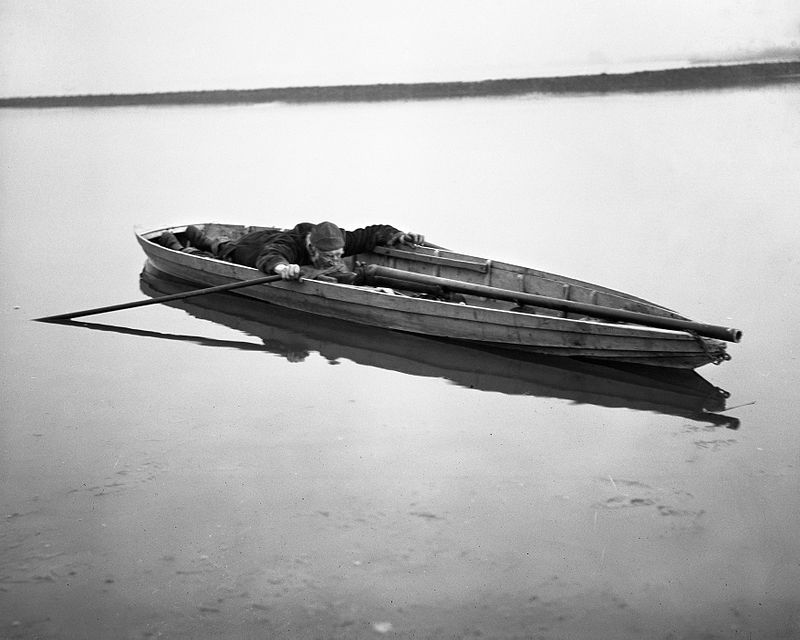
punt gun, Side view of punt and ducks YORYM-S385
Sydney Harold Smith (or collaborators on his behalf) · This file has been provided by York Museums Trust as part of a GLAMwiki partnership. This tag does not indicate the copyright status of the attached work. A normal copyright tag is still required. See

A very large flintlock shotgun--called a punt gun because it was mounted to a punt, or small boat--used for hunting flocks of waterfowl. This early one, with a lock marked "J.J. Henry / Boulton," was used on the Mississippi Flyway.
J.J. Henry · Missouri History Museum URL: http: Gallery
Key facts
Key facts
• Name — Punt gun • Type — Shotgun, Hunting • Is Ranged — yes
Operation and usage
Operation and usage
• Illustration — Sighting a punt gun Punt guns were usually custom-designed and varied widely, but could have bore diameters exceeding 2 in and fire over a pound (≈ 0.45 kg) of shot at a time. With an effective range of about 50 yards (46 meters) a single shot could kill over 50 waterfowl resting on the water's surface. They were too big to hold and the recoil was so large that they had to be mounted directly on punts used for hunting, hence their name. Hunters would maneuver their punts quietly into line and range of the flock using poles or oars to avoid startling them. Generally, the gun was fixed to the punt; thus the hunter would manoeuvre the entire boat in order to aim the gun. The guns were sufficiently powerful, and the punts sufficiently small, that firing the gun often propelled the punt backwards several inches or more. The powerful recoil of punt guns frequently caused injury to the hunter who lay behind the gun to discharge the weapon; broken teeth and powder burns to the face were not uncommon. To improve efficiency, hunters could work in fleets of up to around ten punts. • Illustration — Flintlock punt gun compared to a standard muzzleloading rifle Punt guns are usually muzzle-loaded with a lock similar to muskets or rifles of the day including flintlock, percussion, and more modern types. Holland & Holland offered models using breech loading and standardized shotgun shells in both brass and combined paper and brass base in the 1890s via custom order. Double-barrelled models also existed, typically in the smaller 8-gauge loadings. In most cases, these guns were work-guns with little additional adornment in surviving examples. Many appearing in modern auctions have signs of being repaired or upgraded in some fashion, such as upgrading a flintlock action to a more modern percussion system or refinishing by rebluing the piece. • Illustration — Size comparison of a man and punt gun In the United States, this practice depleted stocks of wild waterfowl and by the 1860s most states had banned the practice. The Lacey Act of 1900 banned the transport of wild game across state lines, and the practice of market hunting was outlawed by a series of federal laws in 1918. While use and possession of punt guns is still legal in the United States, Federal regulations prohibit their use in migratory waterfowl hunting. According to Eunan O'Halpin's book Defending Ireland, a Local Defence Force unit of the Irish Army in Co. Louth was equipped in 1941 with a number of flintlock weapons that had been given to them. Among these guns was a weapon described as being a "nine-foot (9 ft) [long] blunderbuss", which could be more commonly understood to be a punt gun. In the United Kingdom, a 1995 survey showed fewer than 50 active punt guns still in use. The Wildlife and Countryside Act 1981 limits punt guns in England and Wales, and in Scotland, to a bore diameter of 1.75 in that fired a load of projectiles weighing 1.125 lb. Since Queen Victoria's Diamond Jubilee in 1897 there has been a punt gun salute every Coronation and Jubilee over Cowbit Wash in Cowbit, Lincolnshire, England. During the Diamond Jubilee of Elizabeth II, 21 punt gun rounds were fired separately, followed by the guns all being fired simultaneously.
Punt gun bans and enforcement on the Chesapeake Bay
Punt gun bans and enforcement on the Chesapeake Bay
Not until the late 19th century were efforts made to restrict the use of punt guns and other market hunting devices on the Chesapeake Bay. State and county legislation was prompted by a decline in waterfowl stocks and the rise of shooting clubs that attracted wealthy recreational hunting enthusiasts. In 1872 Virginia banned punt guns, but enforcement by local sheriffs, game wardens, and judges was lax. In 1882, Maryland legislators, under pressure from the sport hunting lobby, passed a sweeping ban on night hunting and all forms of improvised subsistence or “pot hunting” devices: punt guns, swivel guns, and sinkboxes. The law imposed a $300 fine on violators, and authorities were empowered to take the accused to outside jurisdictions for prosecution.
Sting operation on Spesutie Island, 1882
Sting operation on Spesutie Island, 1882
• Illustration — George Lawyer, chief game warden for the Bureau of Biological Survey exhibiting a punt gun confiscated from the Chesapeake Bay. Despite legal efforts to stop the practice, night hunting with punt and swivel guns continued largely unrestrained on the upper Chesapeake Bay south of Harve de Grace in the 1880s. Local sport hunting clubs and bayside property owners attributed the decline in waterfowl populations to these unregulated commercial hunting practices and determined to suppress them. Particularly offensive to exclusive gun clubs were the “Spesutie Island gang,” local hunters who reportedly cruised the ducking grounds during the day, infuriating sport hunters by scaring off flocks of waterfowl, then returning at night to poach the birds with punt guns. The suspected ringleader of the gang was George Washington “Uncle Wash” Barnes, a prosperous and politically well-connected commercial fisherman who moonlighted in marketing the poached ducks. Members of the Carroll’s Island Ducking Club and the wealthy business establishment engaged the Pinkerton National Detective Agency to target Barnes and the illegal night hunting activity around Spesutie Island. In 1882, a male and female duo of Pinkerton detectives arrived in Harve de Grace and proceeded to infiltrate the community of commercial hunters, posing as a married couple. Appearing to be an eccentric waterfowling enthusiast, Lindsay and his “wife” purchased an expensive ducking platform and established friendly relationships with the locals, as well as Barnes and his spouse. The detectives discovered that the gang members were highly effective in concealing their activities from game wardens. Despite Lindsay’s risky nighttime surveillance, his early efforts failed to detect any poaching. On a night patrol, Detective Lindsay observed a skiff land on a marsh. He saw a man retrieve a loaded punt gun and followed the skiff to a flock of sleeping Canvasbacks. The gun was discharged and the hunter collected his kill. Lindsay approached the boat and arrested the poacher: “Uncle Wash” Barnes. The punt gun and poached ducks were transported to Baltimore where Barnes was prosecuted and fined. Upon his return to Spesutia Island, he resumed his practice of marketing illegally killed birds. Undeterred, the lawyer for the Carroll’s Island Club, supported by Baltimore detectives and local police, descended on Spesutia with a warrant to search for big guns. They were met by a dozen armed poachers, including Barnes, who declared they would defend themselves with deadly force rather then submit to arrest. When Semmes pointed out that to commit a capital crime to avoid arrest for a mere misdemeanor would be absurd, the poachers relented. They were tried in the local county court after relinquishing two punt guns so as not to be prosecuted in Baltimore. At trial, locals who had grown close to the Pinkerton spy Lindsay were dismayed to discover the depth of his perfidy; some swore to murder him if he returned to Maryland. Historian James H. McCommons reports that clandestine big gun hunting persisted for decades, only partially checked by state and federal authorities. Not until the 1940s were the last of the punt guns seized or surrendered and donated to local museums in Maryland and Virginia.
Fictional usage
Fictional usage
Desmond Bagley's 1973 thriller, The Tightrope Men, features a percussion-fired punt gun. Although the book is set in northern Finland, punt guns were never used in the country. In his 1978 novel Chesapeake, author James A. Michener details the historical use of various punt guns (described by him as "long guns") and their impact on waterfowl numbers. One, called "The Twombly", was described as 11.6 ft, 110 lb (with a load of 0.75 lb of black powder and over 1.5 lb of #6 shot (0.11 in), which was used to hunt geese and ducks by the highlighted watermen of the Chesapeake Bay. The 2004 film Tremors 4: The Legend Begins featured a punt gun used in combat. This punt gun was custom-built for the film and was 8 ft long, weighed 94 lbs, and had a 2 in bore (classified as "A" gauge by the Gun Barrel Proof Act of 1868 in Schedule B). The weapon was not actually of this bore, instead being a large prop shell concealing a 12 gauge shotgun firing triple-loaded black powder blanks, with the barrel sprayed with WD-40 water displacer to produce a large smoke cloud on firing. In the novel Outer Dark, by Cormac McCarthy, the use of a four-gauge punt gun for hunting ducks is described. In the Discworld novel Pyramids, mention is made of a "Puntbow", essentially a combination of this weapon and a crossbow. In the TV show Peacemaker one is used by the character Red St. Wild to hunt down the main character's pet eagle.
Modern Demonstration
Modern Demonstration
In June 2026, the outdoor media company "MeatEater" published a video featuring "Steven Rinella" and Spencer Neuharth firing an 1885 "Holland & Holland" punt gun. The approximately seven-foot, two-gauge firearm had been purchased at auction for $20,000 and was believed not to have been fired for about a century. Custom ammunition and a mounting system were made to allow the gun to be fired safely. Testing demonstrated the wide shot pattern and long range that made punt guns effective for commercial waterfowl hunting. Later in 2026, MeatEater sold the gun through Rock Island Auction Company for $117,500. According to MeatEater, the sale set a record for the highest price ever paid for a punt gun. Seller waived the fees and all funds went to MeatEater's land access initiative.
Primary material
Documents and archives
reference work
- “Punt gun”, English Wikipedia, consulted as further reading
Reputable secondary · Wikipedia
institutional register
- Wikidata, structured authority record Q1834809: punt gun
Unverified · Wikimedia Foundation
Literature
Scholarly footprint
A count of publications is evidence of attention, not of standing, and is given here only as a measure.
Notes from the source article
Cited by Wikipedia
Notes from the source article
These works are cited by the source article, in its own numbering. They are recorded as its citations, not as sources VALÉORINE has verified.
- 1."Irish Tom" historic punt gun to be put on permanent display. BASC.
- 2.McCommons, 2026 p. 31: “They were never mass produced, and many were crude, with barrels of seamless boiler pipe that were fitted into hand-carved stocks and fired by striking a hammer on a percussion cap.”
- 3.McCommons, 2026 p. 32: “With a killing range of 50 yards” the gun could bring down “thirty ducks or ten geese…if the birds were tightly packed…might kill a hundred at one blast.”
- 4.McCommons, 2026 p. 31: “Punts guns were legendary and notorious weapons, absurdly oversized likenesses of standard, ordinary muskets. Weighing up to two hundred pounds with ten-foot barrels, three-foot wooden stocks, and two-inch muzzles, they looked like weapons for a race of giants…”
- 5.McCommons, 2026 p. 32
- 6.McCommons, 2026 p. 31: “At the height of market hunting” in the Chesapeake Bay of the 1890s, “perhaps one hundred big guns strafed the bay’s waters, killing hundreds of thousands of ducks, swans, and geese.”
- 7.McCommons, 2026 p. 31: “Punt guns were muzzle-loaded with copious amounts of black powder, shot, and wadding to hold it all in. Loading by ramrodding took place on shore; a hunter had only one shot before having to beach” and reload.
- 8.untitled.
- 9.Bonhams : A fine 1½in. bore 'London' punt gun by Holland & Holland, no. 20118. www.bonhams.com.
- 10.Bonhams : A 1¼-bore double-barrelled punt gun by Townsend And Owens The false-breech and screw-plugs contained within a fitted timber box, along with a wrench and striker-disc keys for the screw-plugs and hammers, the lid with a brass plaque engraved Townsend & Owens, Braintree, Anno 1981. www.bonhams.com.
- 11.Rock Island Auction: C.S. Shattuck American 8 Gauge Punt Gun. www.rockislandauction.com.
- 12.Bonhams : A Massive 2-Bore Tube-Lock Punt Gun. www.bonhams.com.
- 13.Bonhams : A Massive Percussion Punt Gun. www.bonhams.com.
- 14.Office of Law Enforcement - Waterfowl Hunting and Baiting. www.fws.gov. 29 October 2024.
- 15.O'Halpin, Eunan. Defending Ireland; The Irish State and its Enemies Since 1922. Oxford University Press. 165. 1999.
- 16.PUNTGUNNING - An Introduction to the Sport and Code of Practice. wildfowling.com.
- 17.Wildfowlers bring out the big guns for celebration. spaldingtoday.co.uk.
- 18.JUBILEE VIDEO: 21 gun punt salute at Cowbit. spaldingtoday.co.uk.
- 19.McCommons, 2026 p. 32-33
- 20.McCommons, 2026 p. 27: “pot hunting,” And p. 33
- 21.McCommons, 2026 p. 276: See photo, National Conservation Training Center Museum. "CEO" on stock stands for Chief Enforcement Officer.
- 22.McCommons, 2026 p. 33-34
- 23.McCommons, 2026 p. 35
- 24.McCommons, 2026 p. 37
- 25.McCommons, 2026 p. 35-36
- 26.McCommons, 2026 p. 36-37
- 27.The Weapons of Tremors 4: The Legend Begins. stampede-entertainment.com.
- 28.Firing a 140-Year-Old Punt Gun | MeatEater's 12 in '26. 25 June 2026.
- 29.Wild Horse (Mis)Management, Dr. Randall Hunts Austria, and More | The News Show Ep. 923. 27 August 2026.
Bibliography printed in the source article · 1
- McCommons, James H. 2026. The Feather Wars: And the Great Crusade to Save America’s Birds. St. Martin’s Press, New York.
References
Citations
References
Each reference names the institution holding it, so a reader may go to the document itself.
reference work
Partially resolvedinstitutional register
Wikidata, structured authority record Q1834809: punt gunWikimedia Foundation
Unverified
Connections
Knowledge graph
Connections
Each connection was recorded deliberately, with the basis for it kept on the internal record.
Broader subject
1- hunting weaponTerminology
Established from a fact already recorded on a verified source.
The Encyclopedia exists whether or not anything is for sale. Corrections are recorded rather than overwritten, and every version of this record is kept. Published 14 August 2026.
Elsewhere in Militaria
6,095 published records in this field, each with its sources named.
- Pukguksong-5Terminology
- Pumhart von SteyrTerminology
- Pumpkin bombTerminology
- punji stickTerminology
- PuputovTerminology
- Pure fusion weaponTerminology
- Pușcă Automată model 1986Terminology
- push daggerTerminology
Best supported in this field
For owners
Own an object connected with punt gun?
A specialist will read what you send and tell you what the house can establish, what it cannot, and whether the object is suited to sale. There is no charge and no obligation. The object stays with you throughout; nothing is shipped to us unless it is arranged in writing beforehand.