
KS-23
The KS-23 (Russian: Карабин Специальный-23, romanized: Karabin Spetsialniy-23, lit. 'Special Carbine-23') is a pump action shotgun manufactured by Russian company Tula Arms Plant. The KS-23 was developed by TsNIITochMash in the Soviet Union for use by the Ministry of Internal Affairs.
KS-23
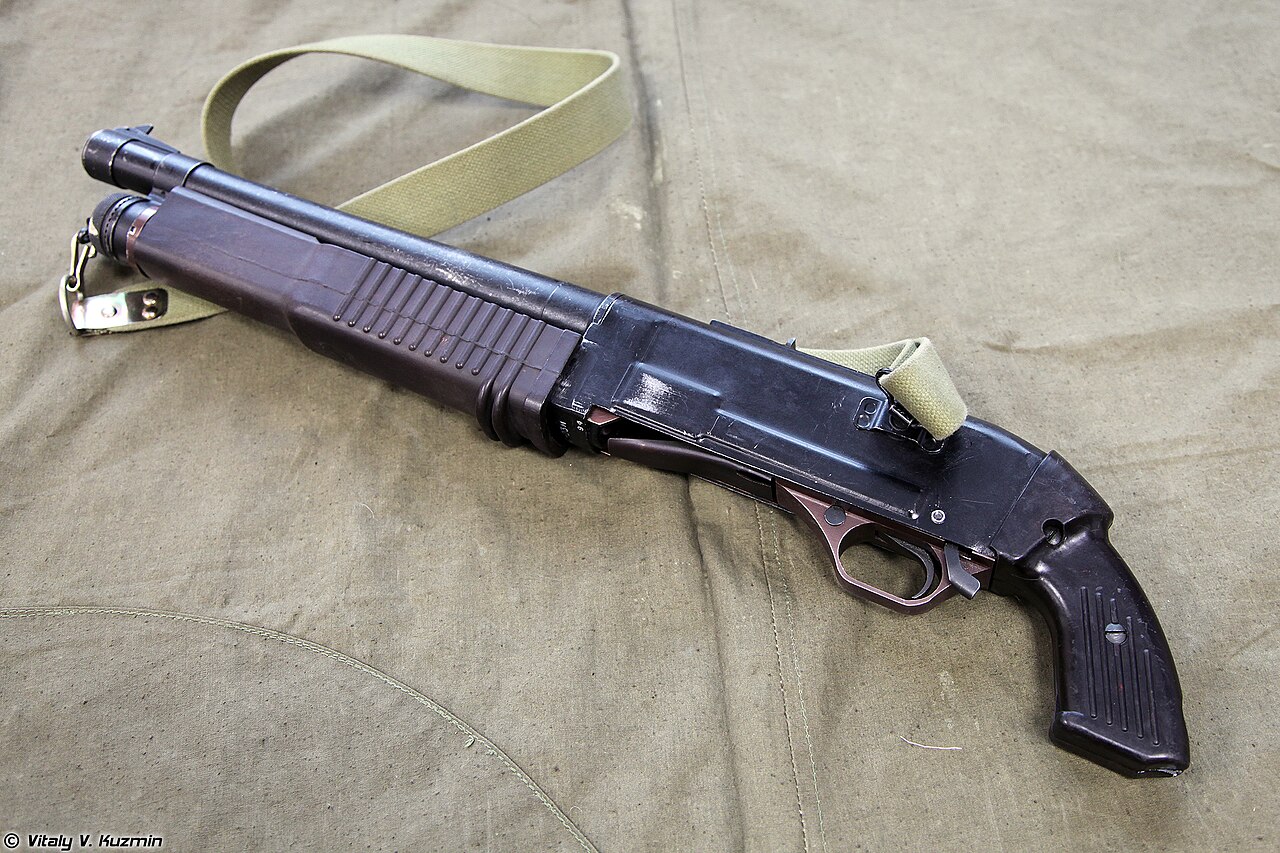
Vitaly V. Kuzmin · Vitalykuzmin.net · CC BY-SA 4.0
- Field
- shotgun.
- Region
- Soviet Union.
VALÉORINE Encyclopedia
VALÉORINE documentary reading
Documentary summary
The KS-23 (Russian: Карабин Специальный-23, romanized: Karabin Spetsialniy-23, lit. 'Special Carbine-23') is a pump action shotgun manufactured by Russian company Tula Arms Plant. The KS-23 was developed by TsNIITochMash in the Soviet Union for use by the Ministry of Internal Affairs.
Admitted source layer · organised and presented by VALÉORINE
Note VALÉORINE
No house-authored Note is published until its assertions and sources pass the VALÉORINE evidence contract. The documentary article remains available in full while that enrichment is being consolidated.
Documentary enrichment in progress · no unsupported statement published
Reference Check
Propose documentary evidence for KS-23. A contribution is never written directly as fact: identity, source, rights and evidence gates still decide.
Sign in to contribute
World of VALÉORINE
Documentary connections
Only confirmed graph relationships appear here. Images are shown only when their identity and reuse rights both pass the documentary gate.
Documentary evidence
Evidence Panel
original value insufficient · checked 25 September 2026
- Identity
- resolved
- Independent source families
- 0
- Admitted assertions
- 0
- Open conflicts
- 0
Authority files
wikidata · Q1137650 · wikipedia · KS-23
In this article
History
History
It is officially designated as a carbine in Russia because it uses a rifled barrel. The KS-23 is renowned for its large caliber, firing a 23 mm shotgun shell, equating to 6.278 gauge using the British and American standards of shotgun gauges and approximately 4 gauge using the current European standards (based on the metric CIP tables), making it the largest-bore shotgun in modern use.
The KS-23 was designed in the 1970s by TsNIITochMash, a key weapons developer in the Soviet Union, as a shotgun for the Ministry of Internal Affairs (MVD) with the purpose of suppressing prison riots. The design implemented barrels produced for the Gryazev-Shipunov GSh-23, an autocannon that fires 23×115mm rounds fitted to Soviet military aircraft. These GSh-23 barrels were rejected by quality control due to manufacturing flaws, but were deemed to be acceptable for the lower stress of firing slugs and less-lethal rounds. These barrels were then cut down in length for the KS-23, reducing production costs, and a 23x75mm shell was developed. As a result of reusing GSh-23 barrels, the KS-23 has the unique features of being a shotgun with a rifled barrel. The KS-23 began to see use during the mid-1980s by several MVD forces, including the Militsiya and the Internal Troops. During the 1990s, research was made into improving the original design to make it usable in confined indoor areas. Two prototypes were proposed, the KS-23M and KS-23K, although only the M version saw use.
Ammunition
Ammunition
The KS-23 was created with the capability to fire several different types of ammunition, listed below: "Shrapnel-10" («Шрапнель-10»): buckshot round with 10-meter effective range "Shrapnel-25" («Шрапнель-25»): buckshot round with 25-meter effective range "Barrikada" («Баррикада», "Barricade"): cartridge with solid steel projectile able to destroy the engine block of a car at up to 100 meters "Volna" («Волна», "Wave"): inert version of cartridge used for education and practice during training "Volna-R" («Волна-Р», "Wave"): cartridge with less-lethal rubber bullet "Strela-3" («Стрела-3», "Arrow"): cartridge with less-lethal plastic bullet "Cheremukha-7" («Черёмуха-7», "Bird Cherry"-7): tear gas grenade with CN agent "Siren-7" («Сирень-7», "Lilac"): tear gas grenade with CS agent "Zvezda" («Звезда», "Star"): flash-bang round PV-23 (ПВ-23): blank (grenade launching) cartridge Later, two add-on muzzle mortars were produced, the 36 mm Nasadka-6 and 82 mm Nasadka-12, bringing with them several new ammunition types: Blank grenade launching cartridge to be used with muzzle mortars 36 mm "Cheremukha-6" tear gas grenade 82 mm "Cheremukha-12" "high-efficiency" tear gas grenade for use on open areas
KS-23
KS-23
The original KS-23 was developed jointly by NIISpetstekhniki (MVD) and TsNIITochMash in 1971 and was accepted for use by Soviet police in 1985. The gun has a barrel length of 510 mm and an overall length of 1040 mm. The KS-23 has an underbarrel tubular magazine capable of holding three rounds, with one in the chamber, giving the gun a maximum round capacity of four. The gun's effective range is 150 m.
KS-23-1
KS-23-1
It is a short-barreled version of the KS-23.
KS-23M
KS-23M
The KS-23M Drozd (Carbine, Special, 23 mm, modernized Drozd "Thrush") was developed on the base of the KS-23. Development for it was started in October 1990. Twenty-five carbines were submitted for testing on December 10, 1991, after which the winner, then designated S-3, became the KS-23M "Drozd" and was accepted for use by police and the Internal Troops of Russia. The KS-23M includes a detachable wire buttstock and shortened barrel, as opposed to the fixed wooden stock on standard KS-23s. The gun is chambered in 23 mm, like the original. It's overall length with the buttstock is 875 mm, without 650 mm, and the barrel is 410 mm long. The gun's effective range is 150 m.
KS-23K
KS-23K
The KS-23K is a redesigned KS-23 that features a bullpup layout. The KS-23K was accepted in 1998 for use by the Russian Ministry of Internal Affairs (MVD). Development and adoption of this carbine was motivated by the fact that in the earlier accepted configurations of the KS-23 and KS-23M, a major noted deficiency was that the tubular magazine did not make it possible to rapidly reload or change the type of ammunition being used. Because of this, a major design change for the KS-23K is that it has an extended box magazine that holds seven shells instead of the three shells seen on other models. The gun has a mechanical safety located on the left side, above the pistol handle and open, non-adjustable sights. The gun's effective range is 100 m.
TOZ-123
TOZ-123
The civilian version of the KS-23 is the ТОZ-123 Selezen'-4 ("Drake-4") (ТОЗ-123 «Селезень-4»). It is manufactured by Tulsky Oruzheiny Zavod and features a smoothbore barrel design, making it more similar to a traditional shotgun. A large part of its popularity among most media stems from the fact that it is chambered in standard 4 gauge. The first TOZ-123 was made in 1995. It has been legal to purchase and own as a civilian hunting shotgun in Russia since August 1996. The gun maker's website has this as the description for the shotgun: The shotgun is multicharged, with a tubular underbarrel magazine of 3-cartridge capacity. Reloading is provided with a removable fore-end. The presence of the special barrel rear projection on the frame combined with the rear sight gives the possibility of mounting an optical sight. The shotgun is intended for amateur hunting with shot cartridges. The TOZ-123 was banned from import into the United States during the Clinton administration.
Users
Users
Armenia: Used as service firearm by Police Kazakhstan: Used by prison guards North Korea Russia: Used by FSB Border Guard Service Soviet Union Ukraine Uzbekistan: Used by Customs Service
Places
Named by the record
Places
Only places the record itself states, plotted where the house gazetteer settles their coordinates. Nothing is inferred from a name or a nationality.
Soviet Union.
Country
KS-23 is associated with Soviet Union.
Country
Primary material
Documents and archives
institutional register
- Internet Archive holdings naming KS-23
Unverified · Internet Archive
- Wikidata, structured authority record Q1137650: KS-23
Unverified · Wikimedia Foundation
reference work
- “KS-23”, English Wikipedia, consulted as further reading
Reputable secondary · Wikipedia
Notes from the source article
Cited by Wikipedia
Notes from the source article
These works are cited by the source article, in its own numbering. They are recorded as its citations, not as sources VALÉORINE has verified.
- 1.Gander, Terry J. Jane's Infantry Weapons 2002–2003. Jane's Information Group. 2002
- 2.KS-23m description in Russian.
- 3.KS-23 description in Russian.
- 4.KS-23K description in Russian.
- 5."Селезень-4" // В. Н. Трофимов. Отечественные охотничьи ружья гладкоствольные. М., ДАИРС, 2000. стр.110-111
- 6."2.3.2. Охотничье огнестрельное оружие гладкоствольное... Ружье гладкоствольное "Селезень-4"" Распоряжение Правительства РФ № 1207-р от 3 августа 1996 г. "Перечень служебного и гражданского оружия и боеприпасов к нему, вносимых в Государственный кадастр служебного и гражданского оружия"
- 7.TOZ-123 product page
- 8.eCFR — Code of Federal Regulations.
- 9."По закупкам вооружений Армения уступает не только Азербайджану, но и Грузии. Эксперты жалуются на то, что эта сфера покрыта в Ереване завесой секретности. Известно лишь, что в прошлом году Армения получила из России 35 танков Т-72 и 110 ББМ (БМП-2 и/или БТР-80), а несколько лет назад - 480 автоматов АК-105, 36 пулеметов РПК-74М, несколько снайперских винтовок ВСС и 52 СВ-98, 32 специальных карабина КС-23" Е. Тесемникова. Как обеспечивается баланс сил в Закавказье // "Вестник Кавказа" от 14 июля 2014
- 10.«23 մմ հատուկ կարաբին ԿՍ-23, ԿՍ-23Մ » Հավելված N 1 ՀՀ կառավարության 2011 թվականի հունիսի 23-ի N 867 - Ն որոշման
- 11."2. Перечень специальных средств... карабин специальный (КС-23)" Приказ Министра юстиции Республики Казахстан № 146 от 11 декабря 2001 года "Об утверждении Инструкции по применению сотрудниками исправительных учреждений Комитета уголовно-исполнительной системы Министерства юстиции Республики Казахстан специальных средств"
- 12.China exports shotgun ammo to North Korea without notifying UN | NK News. 4 December 2014.
- 13.Перечень специальных средств, состоящих на вооружении органов и войск Федеральной пограничной службы Российской Федерации (утв. постановлением Правительства РФ № 634 от 24 июня 1998 года)
- 14.Bilenko, О. І. Підвищення стабільності дульної швидкості поражаючих елементів кінетичної зброї несмертельної дії. Збірник наукових праць Національної академії Національної гвардії України. National Academy of the National Guard of Ukraine. 2. 16. 5–10. 2010. 2409-7470.
- 15."К специальным средствам относятся: ...карабин специальный («КС-23»)" Инструкция о порядке применения таможенными органами специальных средств (зарегистрирована Министерством юстиции Республики Узбекистан от 9 ноября 1999 года. Регистрационный № 835, 06.08.1999)
Bibliography printed in the source article · 3
- Игорь Скрылев. КС-23 - наш полицейский карабин // журнал "Мастер-ружьё", No. 1, 1997. стр.48-51
- Карабины КС-23, КС-23М "Дрозд" // А. И. Благовестов. То, из чего стреляют в СНГ: Справочник стрелкового оружия. / под общ.ред. А. Е. Тараса. Минск, «Харвест», 2000. стр.420-424
- Southby-Tailyour, Ewen. Jane's Special Forces Recognition Guide. Collins. 2005. 0-00-718329-1.
References
Citations
References
Each reference names the institution holding it, so a reader may go to the document itself.
institutional register
Internet Archive holdings naming KS-23Internet Archive
Partially resolvedreference work
Partially resolvedinstitutional register
Wikidata, structured authority record Q1137650: KS-23Wikimedia Foundation
Unverified
The Encyclopedia exists whether or not anything is for sale. Corrections are recorded rather than overwritten, and every version of this record is kept. Published 14 August 2026.
Elsewhere in Militaria
6,095 published records in this field, each with its sources named.
- Krupp 7.5 cm Model 1903Terminology
- KS-1 KometTerminology
- KS-1 rifleTerminology
- KS-19Terminology
- Ksp 58Terminology
- Ksp m/39 machine gunTerminology
- Ksp m/42 machine gunTerminology
- KSP-76Terminology
Best supported in this field
For owners
Own an object connected with KS-23?
A specialist will read what you send and tell you what the house can establish, what it cannot, and whether the object is suited to sale. There is no charge and no obligation. The object stays with you throughout; nothing is shipped to us unless it is arranged in writing beforehand.