
Pumpkin bomb
Pumpkin bombs were conventional aerial bombs developed by the Manhattan Project and used by the United States Army Air Forces against Japan during World War II. Its physical characteristics closely replicated those of the Fat Man plutonium bomb, with the same ballistic and handling characteristics, but it used non-nuclear conventional high explosives. While its main purpose was for testing and training in preparation for the 509th Composite Group potentially delivering a Fat Man on a target, post-war analysis deemed the pumpkin bomb to have been an effective weapon when included in combat missions flown by the 509th. The name "pumpkin bomb" was the term used in official documents from the large, fat ellipsoidal shape of the munition casing instead of the more usual cylindrical shape of other bombs, required to enclose the Fat Man's spherical "physics package" (the plutonium implosion nuclear weapon core).
Pumpkin bomb

Hk28224431 · CC BY-SA 4.0
- Field
- aerial bomb.
- Region
- United States.
VALÉORINE Encyclopedia
VALÉORINE documentary reading
Documentary summary
Pumpkin bombs were conventional aerial bombs developed by the Manhattan Project and used by the United States Army Air Forces against Japan during World War II. Its physical characteristics closely replicated those of the Fat Man plutonium bomb, with the same ballistic and handling characteristics, but it used non-nuclear conventional high explosives. While its main purpose was for testing and training in preparation for the 509th Composite Group potentially delivering a Fat Man on a target, post-war analysis deemed the pumpkin bomb to have been an effective weapon when included in combat missions flown by the 509th. The name "pumpkin bomb" was the term used in official documents from the large, fat ellipsoidal shape of the munition casing instead of the more usual cylindrical shape of other bombs, required to enclose the Fat Man's spherical "physics package" (the plutonium implosion nuclear weapon core).
Admitted source layer · organised and presented by VALÉORINE
Note VALÉORINE
No house-authored Note is published until its assertions and sources pass the VALÉORINE evidence contract. The documentary article remains available in full while that enrichment is being consolidated.
Documentary enrichment in progress · no unsupported statement published
Reference Check
Propose documentary evidence for Pumpkin bomb. A contribution is never written directly as fact: identity, source, rights and evidence gates still decide.
Sign in to contribute
World of VALÉORINE
Documentary connections
Only confirmed graph relationships appear here. Images are shown only when their identity and reuse rights both pass the documentary gate.

Documentary evidence
Evidence Panel
wikipedia incomplete · checked 25 September 2026
- Identity
- resolved
- Independent source families
- 0
- Admitted assertions
- 0
- Open conflicts
- 0
Authority files
wikidata · Q7259856 · wikipedia · Pumpkin bomb
In this article
Development
Development
Pumpkin bombs were a means of providing realistic training with non-nuclear bombs for the 509th Composite Group's Boeing B-29 Superfortress crews assigned to drop the atomic bomb. The pumpkin bomb had a similar size and weight distribution as a Fat Man plutonium bomb, giving it the same ballistic and handling characteristics. Specifications for the bomb required that it be carried in the forward bomb bay of a Silverplate (nuclear-enabled) B-29 bomber and be fuzed to be effective against actual targets. Pumpkin bombs were produced in both inert and high-explosive variants. The inert versions were filled with a cement-plaster-sand mixture that was combined with water to 1.67 to 1.68 grams per cubic centimetre (0.060 to 0.061 lb/cu in), the density of the Composition B high-explosive versions. The filler of both variants had the same weight and weight distribution as the inner spherical "physics package" of the Fat Man plutonium bomb. The concept for the high-explosive pumpkin bomb was originated in December 1944 by United States Navy Captain William S. Parsons, the head of the Ordnance Division at Manhattan Project's Los Alamos Laboratory, and United States Army Air Forces Lieutenant Colonel Paul W. Tibbets, commander of the 509th Composite Group. Prior testing was carried out with an inert version. The name "pumpkin bomb" originated with Parsons and Dr. Charles C. Lauritsen of the California Institute of Technology, who managed the development team. The name was used for the training bombs in official meetings and documents, and probably derived from its large ellipsoidal shape. On the other hand, anecdotal sources attribute the naming of the bombs to a pumpkin color: While the bombs were painted olive drab or khaki in the field, photographs show that at least the units delivered to Tinian were shipped in the same yellow zinc chromate primer color worn by Fat Man. While many Manhattan scientists expected that the development of the means of delivery of the atomic bomb would be straightforward, Parsons, with his experience of the proximity fuze program, expected that it would involve considerable effort. The test program was initiated on 13 August 1943 at the Naval Proving Ground in Dahlgren, Virginia, where a scale model of the Fat Man plutonium bomb was developed. On 3 March 1944, testing moved to Muroc Army Air Field, California. Initial tests found that the Fat Man assembly was unstable in flight, and that its fuzes did not work properly.
Production
Production
The shells of the pumpkin bomb were manufactured by two Los Angeles firms, Consolidated Steel Corporation and Western Pipe and Steel Company, while the 'California Parachute' tail assembly was produced by Centerline Company of Detroit. After initial development, management of the program was turned over to the U.S. Navy Bureau of Ordnance in May 1945. A total of 486 live and inert training bombs were eventually delivered, at a cost of between US$1,000 and $2,000 apiece. All of the inert versions went from the manufacturers directly to Wendover Army Air Field, Utah, by rail, where they were used by the 216th Base Unit in flight testing of the bomb. Some test drop missions were flown by the 509th Composite Group's 393d Bombardment Squadron as training exercises. The bombs intended as live ordnance were shipped to the Naval Ammunition Depot, McAlester, Oklahoma, for filling with explosives. The Composition B was poured as a slurry, solidified in a drying facility for 36 hours, sealed, and shipped by railroad to the Port Chicago Naval Magazine, California, for shipment by sea to Tinian.
Combat missions
Combat missions
Combat missions were flown by the 509th Composite Group on 20, 23, 26 and 29 July and 8 and 14 August 1945, using the bombs against individual targets in Japanese cities. A total of 49 bombs were dropped on 14 targets, one bomb was jettisoned into the ocean, and two were aboard aircraft that aborted their missions. Mission parameters and protocols were similar to those of the actual atomic bomb missions, and all targets were located in the vicinity of the cities designated for atomic attack. The bombs were released at an altitude of 30,000 feet (9,100 m) and the aircraft then went into the sharp turn required on a nuclear mission. After the war, the Strategic Bombing Survey concluded that the pumpkin bombs were "a reasonably effective weapon against Japanese plants when direct hits were scored on vital areas, or when the near miss was sufficiently close to important buildings to cause severe structural damage."
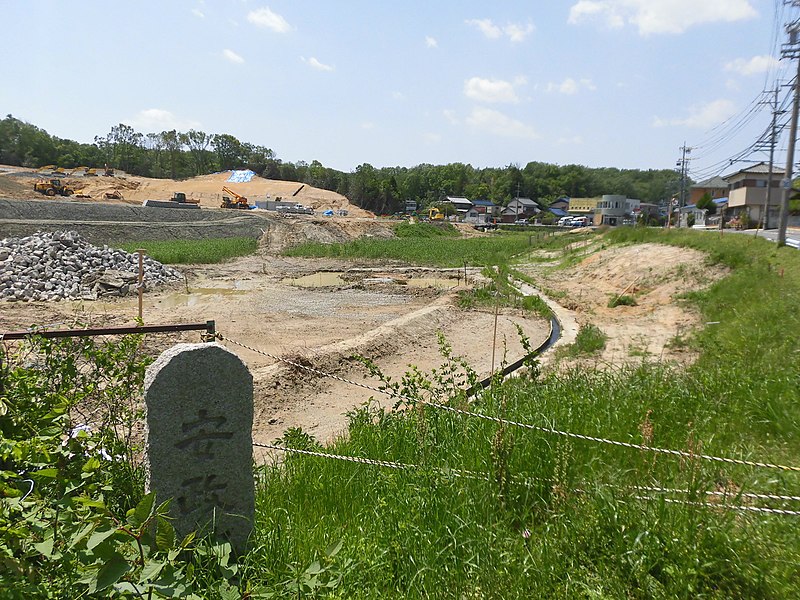
1945年7月24日 四日市 安政池 模擬原爆着弾地
Hk28224431

1945年8月8日模擬原爆着弾地 塩浜小学校の東約500m
Hk28224431
Description
The pumpkin bombs were externally similar to the Fat Man bomb in size and shape, and both had the same 52-inch (130 cm) California Parachute square tail assembly and single-point attachment lug. The pumpkin bomb had three contact fuzes arranged in an equilateral triangle around the nose of the bomb, while the atomic bomb had four fuse housings. The atomic bomb had its shell sections bolted together and sealed with externally-applied, sprayed-on liquid asphalt, but most if not all of the pumpkin bombs were welded, with a four-inch hole used for filling the shell. The Fat Man also had four external mounting points for radar antennas which the pumpkin bombs did not have. The pumpkin bombs were 10 feet 8 inches (3.25 m) in length and 60 inches (152 cm) in maximum diameter. They weighed 5.26 long tons (5,340 kg), consisting of 3,800 pounds (1,700 kg) for the shell, 425 pounds (193 kg) for the tail assembly, and 6,300 pounds (2,900 kg) of Composition B filler. The shells were made of.375-inch (9.5 mm) steel plate and the tail assemblies from.200-inch (5.1 mm) aluminum plate.
Notes from the source article
Cited by Wikipedia
Notes from the source article
These works are cited by the source article, in its own numbering. They are recorded as its citations, not as sources VALÉORINE has verified.
Bibliography printed in the source article · 3
- Campbell, Richard H. The Silverplate Bombers: A History and Registry of the Enola Gay and Other B-29s Configured to Carry Atomic Bombs. McFarland & Company. 2005. 0-7864-2139-8.
- Coster-Mullen, John. Atom Bombs: The Top Secret Inside Story of Little Boy and Fat Man. (self published). 2012. 298514167.
- Hoddeson, Lillian. Critical Assembly: A Technical History of Los Alamos During the Oppenheimer Years, 1943–1945. Cambridge University Press. 1993. 0-521-44132-3.
References
Citations
References
Each reference names the institution holding it, so a reader may go to the document itself.
reference work
Partially resolvedreference work
Partially resolved
The Encyclopedia exists whether or not anything is for sale. Corrections are recorded rather than overwritten, and every version of this record is kept. Published 14 August 2026.
Elsewhere in Militaria
6,095 published records in this field, each with its sources named.
- Pukguksong-3Terminology
- Pukguksong-4Terminology
- Pukguksong-5Terminology
- Pumhart von SteyrTerminology
- punji stickTerminology
- punt gunTerminology
- PuputovTerminology
- Pure fusion weaponTerminology
Best supported in this field
For owners
Own an object connected with Pumpkin bomb?
A specialist will read what you send and tell you what the house can establish, what it cannot, and whether the object is suited to sale. There is no charge and no obligation. The object stays with you throughout; nothing is shipped to us unless it is arranged in writing beforehand.