
Winchester Model 1897
The Winchester Model 1897, also known as the Model 97, M97, Riot Gun, or Trench Gun, is a pump-action shotgun with an external hammer and tube magazine manufactured by the Winchester Repeating Arms Company. The Model 1897 was an evolution of the Winchester Model 1893 designed by John Browning. From 1897 until 1957, over one million of these shotguns were produced.
Also recorded as Model 97 · M97 · Trench Gun · Winchester pump gun
Winchester Model 1897
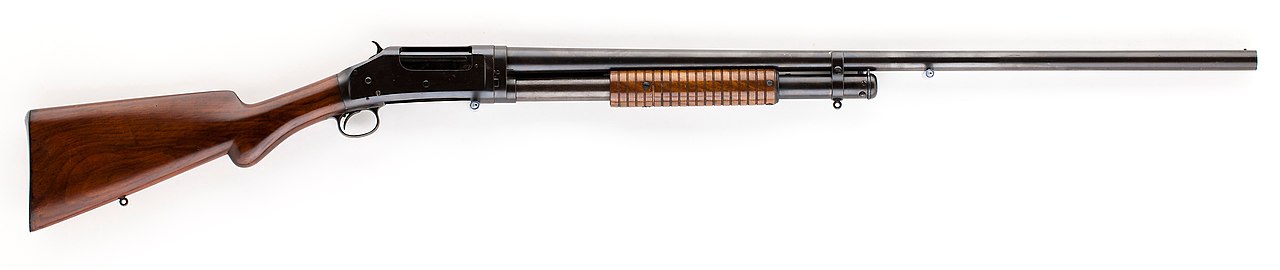
Jens Mohr · LSH 98434 (lm_dig13081) · Public domain
- Name
- Winchester Model 1897
- Field
- shotgun
- Region
- United States
VALÉORINE Encyclopedia
VALÉORINE documentary reading
Documentary summary
The Winchester Model 1897, also known as the Model 97, M97, Riot Gun, or Trench Gun, is a pump-action shotgun with an external hammer and tube magazine manufactured by the Winchester Repeating Arms Company. The Model 1897 was an evolution of the Winchester Model 1893 designed by John Browning. From 1897 until 1957, over one million of these shotguns were produced.
Admitted source layer · organised and presented by VALÉORINE
Note VALÉORINE
No house-authored Note is published until its assertions and sources pass the VALÉORINE evidence contract. The documentary article remains available in full while that enrichment is being consolidated.
Documentary enrichment in progress · no unsupported statement published
Reference Check
Propose documentary evidence for Winchester Model 1897. A contribution is never written directly as fact: identity, source, rights and evidence gates still decide.
Sign in to contribute
World of VALÉORINE
Documentary connections
Only confirmed graph relationships appear here. Images are shown only when their identity and reuse rights both pass the documentary gate.
Documentary evidence
Evidence Panel
not yet certified
- Identity
- resolved
- Independent source families
- 0
- Admitted assertions
- 0
- Open conflicts
- 0
Authority files
wikidata · Q1085180 · wikipedia · Winchester Model 1897
In this article
Overview
Overview
The Model 1897 was offered in numerous barrel lengths and grades, chambered in 12 and 16 gauge, and as a solid frame or takedown. The 16-gauge guns had a standard barrel length of 28 in, while 12-gauge guns were furnished with 30 in barrels. Special length barrels could be ordered in lengths as short as 20 in or as long as 36 in. Since the time the Model 1897 was first manufactured, it has been used to great effect by American military personnel, law enforcement officers, and hunters.
Key facts
Key facts
• Name — Winchester Model 1897 • Origin — United States • Type — Pump-action combat shotgun • Is Ranged — yes • Service — 1897–present • Used By — See Users • Wars — * Spanish-American War • Philippine–American War • Banana Wars • Mexican–American Border War • World War I • Irish War of Independence • World War II • Intercommunal violence in Mandatory Palestine (limited) • 1947-1949 Palestine war (limited) • Korean War • Vietnam War • Designer — John Browning, Matthew Browning • Manufacturer — * Winchester Repeating Arms Company • Norinco • Cimarron Firearms • Production Date — 1897–1957 • Number — 1,024,700 • Weight — 8 lb • Length — 39.25 in • Part Length — 20 in • Caliber — 12 gauge, 16 gauge • Action — Pump-action • Feed — 5 rounds tubular magazine +1 in battery (total 6 rounds) • Breech — Linear bolt travel, tilting locking block
History
History
The Winchester Model 1897 was designed by American firearms inventor John Moses Browning. The Model 1897 was first listed for sale in the November 1897 Winchester catalog as a 12 gauge solid frame. The 12 gauge takedown model was added in October 1898, and the 16 gauge takedown model in February 1900. Originally produced as a tougher, stronger and more improved version of the Winchester Model 1893, itself an improvement on the early Spencer 1882 pump-action shotgun, the 1897 was identical to its forerunner, except that the receiver was thicker and allowed for use of smokeless powder shells, which were not common at the time. The 1897 introduced a "take down" design, where the barrel and magazine tube could easily be separated from the receiver for cleaning or transportation, the ease of removal of the barrel becoming a standard in pump shotguns made today, like the Remington 870 and Mossberg 500 series. Over time, "the model 97 became the most popular shotgun on the American market and established a standard of performance by which other kinds and makes of shotguns were judged, including the most expensive imported articles". The Winchester Model 1897 was in production from 1897 until 1957. It was in this time frame that the "modern" hammerless designs became common, like the Winchester Model 1912, the Ithaca Model 1937, and the Remington 870. The Model 1897 was superseded by the Winchester Model 1912. However, the gun can still be found today in regular use.
Improvements from the 1893
Improvements from the 1893
While designing the new Model 1897, many of the weaknesses present in the earlier Model 1893 were taken into account and remedied. These improvements included: • The frame was strengthened and made longer to handle the newer smokeless powder 12 gauge inch shell, as well as the older and shorter black powder inch shell. • The top of the frame was covered so that the ejection of the fired shell was entirely from the side. This added a lot of strength to the frame of the gun and it allowed the use of a inch shell without the danger of the gun constantly jamming. • The action could not be opened until a slight forward movement of the slide handle released the action slide lock. In firing, the recoil of the shotgun gave a slight forward motion to the slide handle and released the action slide lock which enabled the immediate opening of the action. In the absence of any recoil, the slide handle had to be pushed forward manually in order to release the action slide lock. • A movable cartridge guide was placed on the right side of the carrier block to prevent the escape of the shell when the shotgun was turned sideways in the act of loading. • The stock was made longer and with less drop. Of these improvements, the slide lock is the one that made the Model 1897 into a safe firearm. This improved slide lock kept the shotgun locked until actual firing occurred which prevented it from jamming in the case of a misfire. The slide lock "stands in such a relation to the body of the firing pin as will prevent the firing pin reaching the primer until the pin has moved forward a sufficient distance to insure locking of the breech bolt". This prevents the action sleeve "from being retracted by the hand of the gunner until after firing, and hence rendering the firearm more safe".
Grades of the Model 97
Grades of the Model 97
• Illustration — Model 1897 (trench grade) and the reproduced Norinco (riot grade) Grades of the Model 1897 • Grade — Gauge — Barrel (inches) — Production dates — Remarks • Standard — 12,16 — 30 in, 28 in — 1897–1957 — Plain walnut stock with steel buttplate • Trap — 12,16 — 30 in, 28 in — 1897–1931 — Fancy walnut with checkering • Pigeon — 12,16 — 28 in — 1897–1939 — Same as Trap, but hand-engraved receiver • Tournament — 12 — 30 in — 1910–1931 — Select walnut; receiver top matte to reduce glare • Brush — 12,16 — 26 in — 1897–1931 — Shorter magazine, plain walnut without checkering, solid frame • Brush Takedown — 12,16 — 26 in — 1897–1931 — Same as above, but with takedown frame • Riot — 12 — 20 in — 1898–1935 — Plain walnut, solid or with takedown frame • Trench — 12 — 20 in — 1917–1945 — Same as riot gun but with heat shield, bayonet lug, and sling swivels
Original prices
Original prices
When the Model 1897 was first introduced, the price depended upon what grade was being purchased and what features were being added to that specific shotgun. To purchase a plain finished shotgun would cost the buyer $25, whereas an engraved receiver with checkered and finer wood included cost $100. The more expensive grades of the Model 1897 were the standard, trap, pigeon, and tournament grades. These were the grades that were normally equipped with an engraved receiver and with checkered, finer wood. The less expensive and plainer grades were the Brush, Brush Takedown, Riot, and Trench. These grades were not given the higher valued wood or special designs. This is because these guns were designed and built for hard abuse. These grades stood a higher chance of being badly damaged so there was no need to put extra money into them for appearance purposes. As the functions that were performed with these grades required them to be lightweight, it was not beneficial to use heavy and expensive wood when designing them. Most often, when these grades were purchased, they were purchased in high numbers. By designing these grades with standard wood and finish, it kept the prices at a lower level. They were also sold in German catalogues for prices comparable to luxury double-barreled shotguns.
Military use
Military use
• Illustration — Winchester Model 1897 trench gun The Model 1897 was issued to American soldiers during the Philippine–American War of 1899. This first major use of issued shotguns by the United States military involved 200 weapons procured and sent to the Philippines in 1900. They were employed in countering Moro tribesmen who engaged the Americans in close-quarter combat using knives and swords. (See: juramentado) • Illustration — Winchester M97 and M12 trench guns During the punitive expedition in Mexico, some US soldiers were also equipped with M97s. When the United States entered World War I, there was a need for more service weapons to be issued to the troops. It became clear to the United States just how brutal trench warfare was, and how great the need was for a large amount of close-range firepower while fighting in a trench, after they had observed the war for the first three years. The Model 1897 Trench grade was an evolution of this idea. The pre-existing Winchester Model 1897 was modified by adding a perforated steel heat shield over the barrel which kept the soldier's hands off a hot barrel, and an adapter with bayonet lug for affixing an M1917 bayonet. • Illustration — Model 1897 adapter that allowed the attachment of the M1917 bayonet This model was ideal for close combat and was efficient in trench warfare due to its 20-inch cylinder bore barrel. Buckshot ammunition was issued with the trench grade during the war. Each round of this ammunition contained nine 00 (.33-caliber) buckshot pellets. This gave considerable firepower to the individual soldier by each round that was fired. It has been said that American soldiers who were skilled at trap shooting were armed with these guns and stationed where they could fire at enemy hand grenades in midair. Unlike most modern pump-action shotguns, the Winchester Model 1897 (versions of which were type classified as the Model 97 or M97 for short) fired each time the action closed with the trigger depressed (that is, it lacks a trigger disconnector). Coupled with its five-shot capacity, this characteristic allowed troops to fire the whole magazine with great speed by simply keeping the trigger held and running the action as quickly as possible, known as "slam-firing". This made it extremely effective in close combat, such that troops referred to it as the "trench-sweeper" or "trench broom". Shortly before the end of the war, the German government protested the use of shotguns in combat, claiming it to cause unnecessary suffering. The Model 1897 was used again in World War II by the United States Army and Marine Corps, where it was used alongside the similarly militarized version of the hammerless Model 1912. Some were still in service during the Korean War and the Vietnam War.
World War I protests
World War I protests
• Illustration — American caricature showing Paul von Hindenburg criticising the short-barrelled shotgun, which Uncle Sam and Teddy mock him for considering German war crimes. The Winchester Model 1897 shotgun was widely used by American forces during World War I, particularly in trench warfare. Its effectiveness in close-quarters combat led to a formal protest by the German government on 19 September 1918. Germany claimed that the use of shotguns violated the laws of war, specifically citing Article 23(e) of the 1907 Hague Convention, which prohibits weapons causing unnecessary suffering. The protest threatened that any U.S. soldier captured with a shotgun or its ammunition would be subject to execution. In response, the U.S. government, through Secretary of State Robert Lansing and Acting Judge Advocate General Brigadier General Samuel T. Ansell, rejected the German protest. They argued that the shotgun was a lawful weapon of war, comparable to other accepted weapons like shrapnel shells and machine guns. The U.S. warned that any execution of American prisoners would result in reprisals. Despite the controversy, there are no known instances of German forces executing American soldiers for possessing shotguns. However, the U.S. military reportedly censored photographs of trench guns in combat to avoid further diplomatic issues and to prevent negative perceptions among Allied nations. During the First World War, both the French and British high commands evaluated shotguns for trench warfare but declined to adopt them, chiefly because ammunition performance was unreliable in damp conditions and reload rates were slower than those of rifles.
Other uses
Other uses
After the war, a shorter-barrelled version of the Model 1897 was marketed by Winchester as a riot gun. Messengers of The American Express Company were armed with this weapon as were various police departments throughout the US. The differences between this riot version and the trench version were that the riot version lacked the heat shield and bayonet lug, and all trench guns were equipped with sling swivels, whereas most riot guns were not.
Users
Users
• Canada: Used by Royal Canadian Navy Beach Commandos, and other RCN boarding parties in WWII. • Iran • Ireland: 698 reported in service in late 1940. • Philippines • South Korea: Used by UDT/SEAL. • United States: • US Armed Forces • Texas Rangers • Detroit Police Department • Illinois State Police • U.S. Border Patrol • United Kingdom: Used by the Royal Irish Constabulary.
Chronology
Dated record
Chronology
Explore 1897
The full dated record · 3 entries
1897
Winchester Model 1897 is associated with United States.
1897
Winchester Model 1897 is classified as a shotgun.
1897
A comprehensive guide to the Winchester model 1897 (2016) is digitised and catalogued by Open Library.
Places
Named by the record
Places
Only places the record itself states, plotted where the house gazetteer settles their coordinates. Nothing is inferred from a name or a nationality.
- United States
Named but not plotted · 1
Winchester Model 1897 is associated with United States.
Country
Description
• Illustration — Open action on an 1897 portraying the long slide that projects from the receiver. The Winchester Model 1897 and the Winchester Model 1893 were both designed by John Browning. The Model 1897 is an external hammer shotgun that is lacking a trigger disconnector. This means that the user can hold the trigger down while cycling the shotgun and once the action is returned to battery the shotgun fires. The firearm itself is classified as a slide action pump shotgun. It was the first truly successful pump-action shotgun produced. Throughout the time period the Model 1897 was in production, over a million of the type were produced in various grades and barrel lengths. 16-gauge guns had a standard barrel length of 28 in, while 12-gauge guns were furnished with 30 in length barrels. Special length barrels could be ordered in lengths as short as 20 in, and as long as 36 in. Along with various grades and barrel lengths, the Model 1897 came in two different chamberings. One was the 12 gauge and the other was the 16 gauge. The shells should be of the inch or inch models. Any shells larger are not recommended. An average Model 1897 can hold 5 or 6 shotgun shells in the magazine tube. When working the action of the Model 1897 the forend (fore grip) is pulled back, forcing the breech bolt to the rear which extracts and then ejects the spent shell while simultaneously cocking the external hammer by pushing it to the rear. When the forend is slid forward again, the breech bolt pushes a fresh shell into the gun's chamber and locks into place. The Chinese company Norinco has made an effort to reproduce this firearm. The Norinco 97 is an almost exact copy of the Winchester 1897, produced in both Trench and Riot grades, yet lacking in the fit and finish of the originals.
General and cited references
General and cited references
* * * * * * * * * * * * * * *
References
Citations
References
Each reference names the institution holding it, so a reader may go to the document itself.
reference work
Partially resolvedreference work
Partially resolved
Further particulars
Held on the record
Further particulars
Open the remaining particulars
Winchester Model 1897 is connected to 1 other published record in the VALÉORINE Encyclopedia.
The Encyclopedia exists whether or not anything is for sale. Corrections are recorded rather than overwritten, and every version of this record is kept. Published 14 August 2026.
Elsewhere in Militaria
6,095 published records in this field, each with its sources named.
- Winchester Model 1886Terminology
- Winchester Model 1887/1901Terminology
- Winchester Model 1890Terminology
- Winchester Model 1894Terminology
- Winchester Model 1903Terminology
- Winchester Model 1905Terminology
- Winchester Model 1907Terminology
- Winchester Model 1910Terminology
Best supported in this field
For owners
Own an object connected with Winchester Model 1897?
A specialist will read what you send and tell you what the house can establish, what it cannot, and whether the object is suited to sale. There is no charge and no obligation. The object stays with you throughout; nothing is shipped to us unless it is arranged in writing beforehand.