
Liang Kai
Liang Kai (c. 1140 - c. 1210) was a Chinese painter of the Southern Song Dynasty.
Also recorded as Bailiang
Liang Kai

Liang Kai · http: Chinese Mainting Gallery] by Pei Minglong (Chinese: 裴明龍) · Public domain
- Nationality
- Southern Song dynasty · Song dynasty
- Occupation
- painter · artist
- Fields
- painting
- Known for
- Li Bo in Stroll · Poet strolling by a marshy bank
Encyclopédie VALÉORINE
Le dossier documentaire
Chaque énoncé est lu dans les notices d’autorité des institutions nommées. Choisissez « Preuve » à côté d’un énoncé pour voir la notice d’où il est tiré, l’endroit précis et la date de lecture.
Liang Kai apparaît dans les notices d'autorité de la Deutsche Nationalbibliothek comme artiste et peintre.
Institutions citées
Deutsche Nationalbibliothek
Non précisé par les sources citées: nationalité
Chaîne de lecture complète (JSON)Reference Check
Propose documentary evidence for Liang Kai. A contribution is never written directly as fact: identity, source, rights and evidence gates still decide.
Sign in to contribute
World of VALÉORINE
Documentary connections
Only confirmed graph relationships appear here. Images are shown only when their identity and reuse rights both pass the documentary gate.
Documentary evidence
Documentary basis
Authority files
wikidata · Q740332 · wikipedia · Liang Kai
In this article
Painting style
He was also known as Madman Liang because of his very informal pictures. He was born in Shandong and worked in Lin An (later Hangzhou). He is known to have studied with the master Jia Shigu. He was awarded the rank of Painter-in-Attendance at the court of Jia Tai (1201-1204 CE, Southern Song Dynasty) where he was known for mastery in painting figures, landscapes, and other minor subjects. He was also awarded the Golden Belt, however he left it behind when he left his position at court to practise Chan Buddhism. • Illustration — Sixth Chan Patriarch Chopping Bamboo, early 13th century. Hanging scroll, Tokyo National Museum.
The field of work recorded is painting. Works named in the authority record are Li Bo in Stroll and Poet strolling by a marshy bank. Work by Liang Kai is recorded in the collections of Tokyo National Museum, National Palace Museum, The Palace Museum, Kosetsu Museum of Art and Metropolitan Museum of Art.
Liang Kai is most famous for originating or developing the "Xie Yi" (sometimes translated as "sketch style") of painting, where the objective is to evoke the subject or atmosphere with minimal use of detail; it requires a profound mastery of painting technique and perfect concentration, but also allows for the beauty of accidental effects. The Xie Yi style is closely associated with the "sudden enlightenment", "mindfulness", and "spontaneity" aspects of this school of Buddhism. Works generally attributed to Liáng Kǎi include: painting of the poet Li Bai, the Drunken Celestial (A Sage), The Sixth Patriarch Cutting Bamboo, and in a more academic style, a series called the Eight Eminent Monks paintings. The Sixth Chan Patriarch in particular exemplifies Chan Buddhism. It depicts Huineng, a Chan master, crouching as he chops bamboo. This follows the idea of mundane tasks taking on spiritual value in accordance with the philosophy. The painted scene shows the patriarch's "Chan moment" in which he finally attains enlightenment through the resonating sound of the blade. The holy figure is drawn scruffy and almost caricature-like. This was meant to suggest that he is free from worldly concerns like appearance and social status/expectation. In this deceptively simple painting, Liang uses pale and wet brushstrokes. However, several dark lines are scattered throughout, as seen in the vine growing around the tree on the left side of the image, and accents on Huineng's clothing. Liang's style of abbreviated, expressive painting, along with his ability to casually create compelling images is what made him famous among Chan monks. • Illustration — Li Bai Strolling • Illustration — Drunken Celestial • Illustration — Shakyamuni Emerging from the Mountains • Illustration — Poet strolling by a marshy bank • Illustration — Gentleman of the Eastern Fence

Sericulture (The Process of Making Silk), early 1200s, by Liang Kai
Liang Kai · The Cleveland Museum of Art · John L. Severance Collection
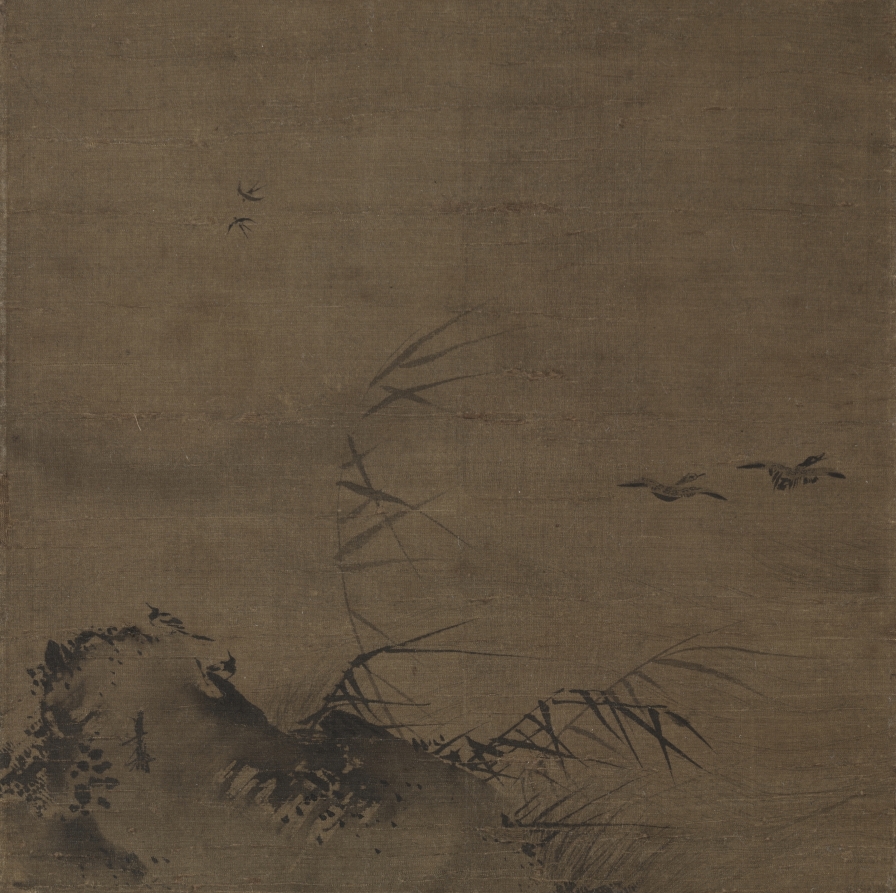
Waterfowl and Reeds, early 1200s, by Liang Kai
Liang Kai · The Cleveland Museum of Art · Leonard C. Hanna Jr. Fund
Text attribution
Licensing
Text attribution
Part of the biographical narrative on this page reuses licensed material. Its origin, revision and licence are recorded here.
The biographical narrative on this page is based on the Wikipedia article Liang Kai, revision 1360945392 (EN edition), by its contributors. VALÉORINE has edited that text and built its own documentary record around it. The reused material is available under CC BY-SA 4.0, and this page's reuse of it is offered under the same licence. Everything else on this page — the chronology, the holdings, the evidence, the plates and the connections — is VALÉORINE's own record. Sources and licences.
References
Citations
References
Each reference names the institution holding it, so a reader may go to the document itself.
reference work
Secondary witnessreference work
Secondary witness
The Encyclopedia exists whether or not anything is for sale. Corrections are recorded rather than overwritten, and every version of this record is kept. Published 29 August 2026.
Elsewhere in Paintings
19,456 published records in this field, each with its sources named.
- Li XiongcaiArtist
- Li YinArtist
- Lia OstrovaArtist
- Liam SpencerArtist
- Liberale da VeronaArtist
- Libuše JarcovjákováArtist
- Lida AbdulArtist
- Lidija MeškaitytėArtist
Best supported in this field
For owners
Own a work by Liang Kai?
A specialist will read what you send and tell you what the house can establish, what it cannot, and whether the object is suited to sale. There is no charge and no obligation. The object stays with you throughout; nothing is shipped to us unless it is arranged in writing beforehand.