
Su Hanchen
Illustration — One Hundred Children in the Long Spring (長春百子圖). A native of Bianjing (present-day Kaifeng, Henan), he was renowned for his figure paintings and was appointed as a "Painter-in-Attendance" by Emperor Huizong. For most of his career, Su was based in Zhejiang.
Also recorded as Su Han-ch'en
Su Hanchen
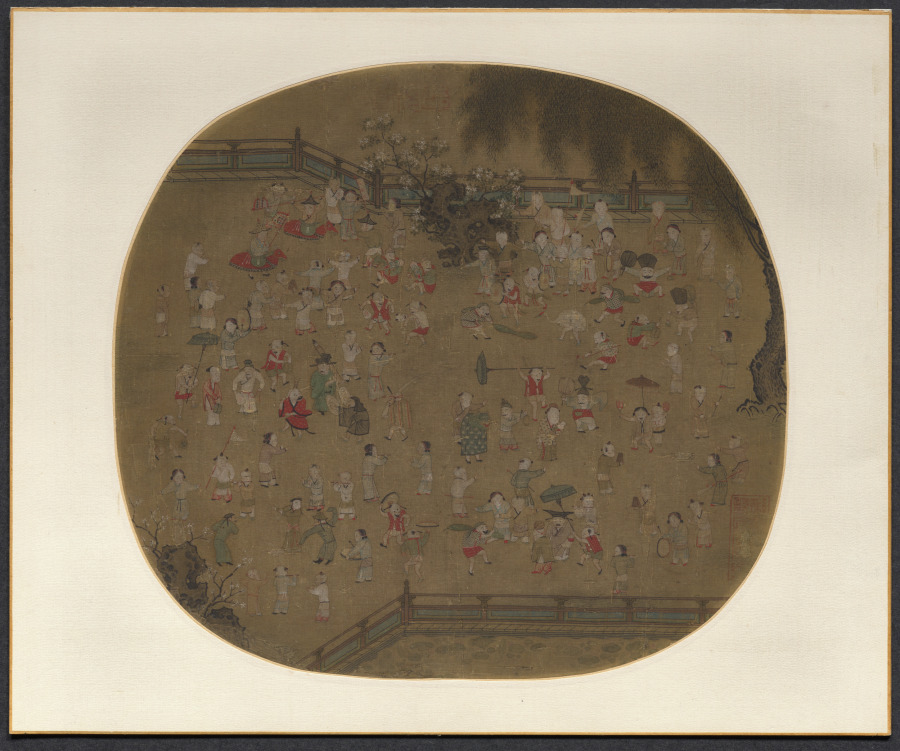
Su Hanchen · The Cleveland Museum of Art · Purchase from the J. H. Wade Fund · CC0
- Nationality
- Song dynasty
- Occupation
- painter
VALÉORINE Encyclopedia
VALÉORINE documentary reading
Documentary summary
Illustration — One Hundred Children in the Long Spring (長春百子圖). A native of Bianjing (present-day Kaifeng, Henan), he was renowned for his figure paintings and was appointed as a "Painter-in-Attendance" by Emperor Huizong. For most of his career, Su was based in Zhejiang.
Admitted source layer · organised and presented by VALÉORINE
Note VALÉORINE
Su Hanchen (1101–1161) was a painter and a national of Song dynasty. Born in Kaifeng, the painter died in Hangzhou. Works by Su Hanchen are held at Cleveland Museum of Art, National Palace Museum and Tianjin Museum.
Composed from admitted, traceable facts · 26 September 2026
VALÉORINE
Reference Check
Propose documentary evidence for Su Hanchen. A contribution is never written directly as fact: identity, source, rights and evidence gates still decide.
Sign in to contribute
World of VALÉORINE
Documentary connections
Only confirmed graph relationships appear here. Images are shown only when their identity and reuse rights both pass the documentary gate.
Documentary evidence
Documentary basis
Authority files
wikidata · Q12158485 · wikipedia · Su Hanchen
In this article
Career
Career
• Illustration — "One Hundred Children Playing in the Spring" by Su Hanchen Su was born in 1094 in Bianjing (present-day Kaifeng, Henan). He was employed by the Northern Song court's Academy of Painting "solely for his skills at painting", and subsequently designated as a "Painter-in-Attendance" by Emperor Huizong. He was known for his figure paintings, especially those of women and children. In Su's seminal baizi (百子) or "hundred-boys" paintings, "generic but appealing" children are usually depicted in gardens, and can be seen engaging in various leisurely activities, from dancing to kite-flying. Su also painted Buddhist and Taoist figures, although most of these paintings are now considered lost. Su spent most of his career in Zhejiang. He died in 1172.
Places
Named by the record
Places
Only places the record itself states, plotted where the house gazetteer settles their coordinates. Nothing is inferred from a name or a nationality.
Kaifeng.
Birth place
Hangzhou.
Death place
Legacy
• Illustration — "Pair of Cats and Baby at Play" by Su Hanchen According to Gu Bing (顾炳), who included Su's Woman Bathing Child in his 1603 Master Gu's Painting Manual (Gushi huapu; 顧氏畫譜), Su's application of colour was "fresh" and he depicted figures "as though alive". Art historian James Cahill remarked that Su's paintings "have an immediate appeal that has made them popular everywhere". Two of his most celebrated works, Children Playing in an Autumn Garden and Children at Play on a Winter Day, are on display at the National Palace Museum in Taipei. According to the Shanghai Daily, these two paintings are "usually regarded as the best example of Song paintings themed on children playing in a private garden".
Primary material
Documents and archives
reference work
- “Su Hanchen”, English Wikipedia, consulted as further reading
Reputable secondary · Wikipedia
authority record
- Wikidata, structured authority record Q12158485: Su Hanchen
General reference · Wikidata
Notes from the source article
Cited by Wikipedia
Notes from the source article
These works are cited by the source article, in its own numbering. They are recorded as its citations, not as sources VALÉORINE has verified.
Bibliography printed in the source article · 10
- Caswell, James O. Lines of Communication: Some "Secrets of the Trade" in Chinese Painters' Use of "Perspectives". Res: Anthropology and Aesthetics. 40. 1. 188–210. 2001. 10.1086/RESv40n1ms20167546.
- Finnane, Antonia. A Companion to Chinese Art. Wiley. 392–409. 2022. 9781119121695.
- Huang, Kunfeng. Illustrated Guide to 50 Masterpieces of Chinese Paintings. Shanghai Press. 2021. 9781938368714.
- Kleutghen, Kristina. Imperial Illusions: Crossing Pictorial Boundaries in the Qing Palaces. University of Washington Press. 2015. 9780295805528.
- Laureillard, Marie. Regret of Spring: The Child According to Feng Zikai. Oriens Extremus. 53. 47–60. 2014. 26372423.
- Li, Xifan. A General History of Chinese Art: From the Five Dynasties to the Yuan Dynasty. De Gruyter. 2022. 9783110790948.
- Tajima, Tatsuya. Images of Familial Intimacy in Eastern and Western Art. Brill. 185–217. 2014. 9789004261945.
- Watson, William. Art of Dynastic China. Harry N. Abrams. 1981. 9780810906273.
- Wong, Aida Yuen. Visualizing Beauty: Gender and Ideology in Modern East Asia. Hong Kong University Press. 2012. 9789888083893.
- Zhang, Peter. The Knickknack Peddler. Shanghai Daily. 16 June 2019.
References
Citations
References
Each reference names the institution holding it, so a reader may go to the document itself.
reference work
Secondary witnessauthority record
General reference
The Encyclopedia exists whether or not anything is for sale. Corrections are recorded rather than overwritten, and every version of this record is kept. Published 17 August 2026.
Elsewhere in Paintings
19,183 published records in this field, each with its sources named.
- Stina WollterArtist
- Stuart DavisArtist
- Stuart SempleArtist
- Stylianos SchichoArtist
- Su ManshuArtist
- Su ShiArtist
- Su'ad SalimArtist
- Suad al-AttarArtist
Best supported in this field
For owners
Own a work by Su Hanchen?
A specialist will read what you send and tell you what the house can establish, what it cannot, and whether the object is suited to sale. There is no charge and no obligation. The object stays with you throughout; nothing is shipped to us unless it is arranged in writing beforehand.