
Fan Kuan
Fan Kuan, was a Chinese landscape painter of the Song dynasty. He was both a Daoist and a Neo-Confucianist. Travelers among Mountains and Streams, a large hanging scroll, is Fan Kuan's best known work, possibly his only surviving one, and a seminal painting of the Northern Song school.
Also recorded as zi Zhongli · Chung-li Fan · Fan K'uan · Zhongli Fan
Fan Kuan
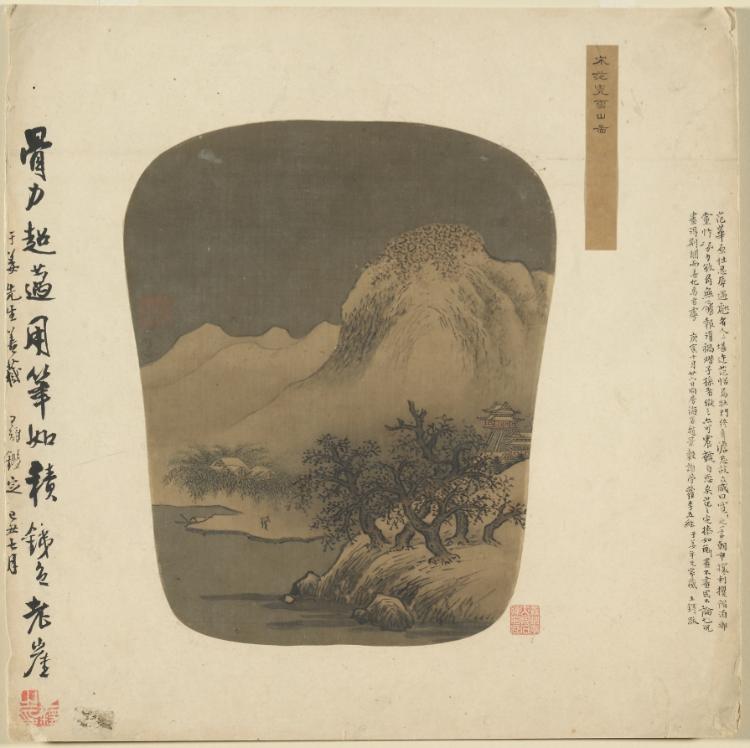
Fan Kuan · The Cleveland Museum of Art · John L. Severance Fund · CC0
- Name
- Fan Kuan
- Born
- c. 960
- Birthplace
- Hua-yuan (Today: Yaozhou District), Shaanxi Province
- Died
- c. 1030
- Known for
- Landscapes
- Movement
- Northern Landscape style Fan Zhongzheng (c. 960 – c. 1030), courtesy name Zhongli, better known by his pseudonym Fan Kuan, was a Chinese landscape painter of the Song dynasty.
- Nationality
- Northern Song dynasty · Song dynasty
- Occupation
- painter
- Fields
- landscape painting
- Movements
- Northern Landscape style
VALÉORINE Encyclopedia
VALÉORINE documentary reading
Documentary summary
Fan Kuan, was a Chinese landscape painter of the Song dynasty. He was both a Daoist and a Neo-Confucianist. Travelers among Mountains and Streams, a large hanging scroll, is Fan Kuan's best known work, possibly his only surviving one, and a seminal painting of the Northern Song school.
Admitted source layer · organised and presented by VALÉORINE
Note VALÉORINE
Fan Kuan (956–1026) was a painter, a national of Northern Song dynasty and Song dynasty.
Activity centred on landscape painting. Fan Kuan was associated with Northern Landscape style.
The work spans landscape. Works are held at National Palace Museum and Tianjin Museum.
Composed from admitted, traceable facts · 26 September 2026
VALÉORINE
Reference Check
Propose documentary evidence for Fan Kuan. A contribution is never written directly as fact: identity, source, rights and evidence gates still decide.
Sign in to contribute
World of VALÉORINE
Documentary connections
Only confirmed graph relationships appear here. Images are shown only when their identity and reuse rights both pass the documentary gate.
Documentary evidence
Documentary basis
Authority files
getty · 500125750 · gnd · 1115218484 · wikidata · Q1278559 · wikipedia · Fan Kuan
In this article
Biography
Biography
It establishes an ideal in monumental landscape painting to which later painters were to return time and again for inspiration. The classic Chinese perspective of three planes is evident - near, middle (represented by water and mist), and far. Unlike earlier examples of Chinese landscape art, the grandeur of nature is the main theme, rather than merely providing a backdrop. A packhorse train can barely be seen emerging from a wood at the base of a towering precipice. The painting's style encompasses archaic conventions dating back to the Tang dynasty. The historian Patricia Ebrey explains her view on the painting that the:..foreground, presented at eye level, is executed in crisp, well-defined brush strokes. Jutting boulders, tough scrub trees, a mule train on the road, and a temple in the forest on the cliff are all vividly depicted. There is a suitable break between the foreground and the towering central peak behind, which is treated as if it were a backdrop, suspended and fitted into a slot behind the foreground. There are human figures in this scene, but it is easy to imagine them overpowered by the magnitude and mystery of their surroundings. Fan's masterpiece Travellers among Mountains and Streams bears a lost half-hidden signature rediscovered only in 1958.
The field of work recorded is landscape painting. Subjects and genres recorded for the work are landscape. Li Cheng is recorded as an influence. Work by Fan Kuan is recorded in the collections of National Palace Museum and Tianjin Museum.
Key facts
Key facts
• Name — Fan Kuan • Born — c. 960 • Birthplace — Hua-yuan (Today: Yaozhou District), Shaanxi Province • Died — c. 1030 • Known for — Landscapes • Movement — Northern Landscape style Fan Zhongzheng (c. 960 – c. 1030), courtesy name Zhongli, better known by his pseudonym Fan Kuan, was a Chinese landscape painter of the Song dynasty. He was both a Daoist and a Neo-Confucianist. Travelers among Mountains and Streams, a large hanging scroll, is Fan Kuan's best known work, possibly his only surviving one, and a seminal painting of the Northern Song school. It establishes an ideal in monumental landscape painting to which later painters were to return time and again for inspiration. The classic Chinese perspective of three planes is evident - near, middle (represented by water and mist), and far. Unlike earlier examples of Chinese landscape art, the grandeur of nature is the main theme, rather than merely providing a backdrop. A packhorse train can barely be seen emerging from a wood at the base of a towering precipice. The painting's style encompasses archaic conventions dating back to the Tang dynasty. The historian Patricia Ebrey explains her view on the painting that the:...foreground, presented at eye level, is executed in crisp, well-defined brush strokes. Jutting boulders, tough scrub trees, a mule train on the road, and a temple in the forest on the cliff are all vividly depicted. There is a suitable break between the foreground and the towering central peak behind, which is treated as if it were a backdrop, suspended and fitted into a slot behind the foreground. There are human figures in this scene, but it is easy to imagine them overpowered by the magnitude and mystery of their surroundings. Fan's masterpiece Travellers among Mountains and Streams bears a lost half-hidden signature rediscovered only in 1958.
Identity
Identity
Fan Kuan is recorded as painter.
Life and career
Dated record
Life and career
The full dated record · 2 entries
956
Fan Kuan born.
1026
Fan Kuan died.
Primary material
Documents and archives
authority file
- Gemeinsame Normdatei 1115218484, Fan, Kuan.
General reference · Deutsche Nationalbibliothek
- Getty Union List of Artist Names 500125750, Fan Kuan.
General reference · The Getty Research Institute
reference work
- Wikidata, structured authority record Q1278559: Fan Kuan
Reputable secondary · Wikimedia Foundation
- “Fan Kuan”, English Wikipedia, consulted as further reading
Reputable secondary · Wikipedia
Literature
Scholarly footprint
A count of publications is evidence of attention, not of standing, and is given here only as a measure.
Notes from the source article
Cited by Wikipedia
Notes from the source article
These works are cited by the source article, in its own numbering. They are recorded as its citations, not as sources VALÉORINE has verified.
- 1.Ebrey, Cambridge Illustrated History of China, 162.
- 2.Liu, 50.
- 3.McIntire, Jennifer Noering. Neo-Confucianism & Fan Kuan, Travelers by Streams and Mountains. Khan Academy.
- 4.Sullivan, The Arts of China, 179.
- 5.Cengage Learning. A Brief History of Chinese and Japanese Civilizations. 223. 1 January 2012. 0-495-91322-7.
- 6.Sullivan, The Arts of China, 180.
- 7.Ebrey, Cambridge Illustrated History of China, 162–163.
References
Citations
References
Each reference names the institution holding it, so a reader may go to the document itself.
authority file
Gemeinsame Normdatei 1115218484, Fan, Kuan.Deutsche Nationalbibliothek
Secondary witnessauthority file
Getty Union List of Artist Names 500125750, Fan Kuan.The Getty Research Institute
Secondary witnessreference work
Wikidata, structured authority record Q1278559: Fan KuanWikimedia Foundation
Secondary witnessreference work
Secondary witness
The Encyclopedia exists whether or not anything is for sale. Corrections are recorded rather than overwritten, and every version of this record is kept. Published 16 August 2026.
Elsewhere in Paintings
19,183 published records in this field, each with its sources named.
- Fadil HadžićArtist
- Fahda bint SaudArtist
- Faig AhmedArtist
- Fairlie HarmarArtist
- Fan QiArtist
- Fan TchunpiArtist
- Fang CongyiArtist
- Fang GanminArtist
Best supported in this field
For owners
Own a work by Fan Kuan?
A specialist will read what you send and tell you what the house can establish, what it cannot, and whether the object is suited to sale. There is no charge and no obligation. The object stays with you throughout; nothing is shipped to us unless it is arranged in writing beforehand.