
Jacopo Bassano
1510 – 14 February 1592) was an Italian Renaissance painter of the Venetian school. He was born and died in Bassano del Grappa, and took the village as his surname. Having trained in the workshop of his father, Francesco the Elder, he painted mostly religious paintings, landscapes, and genre scenes.
Also recorded as Giaccoms Bassan · Jacopo Bassa Vecchio · Gio. Bassano · Il Bassan Vecchio
Jacopo Bassano
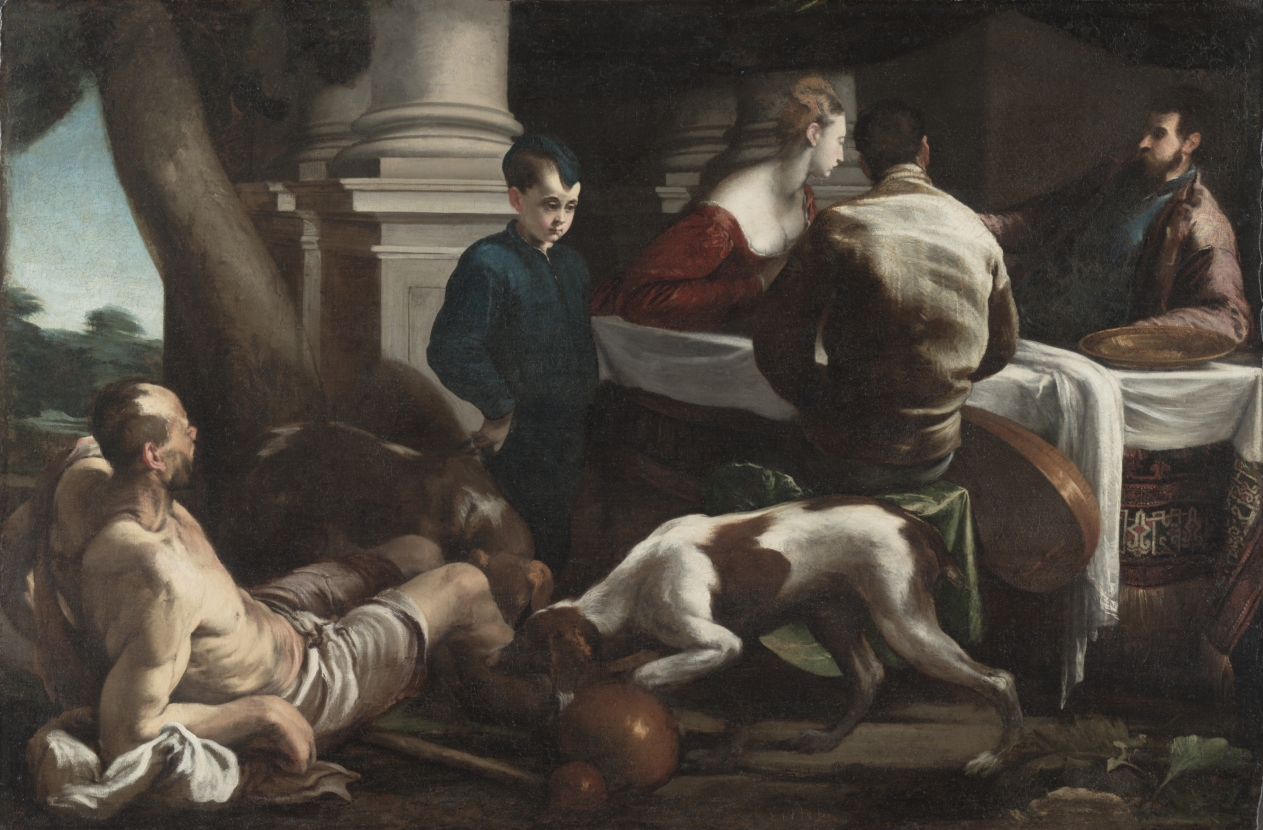
Jacopo Bassano · The Cleveland Museum of Art · Delia E. Holden and L. E. Holden Funds · CC0
- Born
- 1510.
- Died
- 1592.
- Nationality
- Republic of Venice.
- Occupation
- painter.
- Fields
- portrait.
- Movements
- Venetian school.
- Known for
- Lazarus and the Rich Man, The Deposition, Two Hounds, Saint Jerome Meditating and Return of Jacob with His Family.
VALÉORINE Encyclopedia
VALÉORINE documentary reading
Documentary summary
1510 – 14 February 1592) was an Italian Renaissance painter of the Venetian school. He was born and died in Bassano del Grappa, and took the village as his surname. Having trained in the workshop of his father, Francesco the Elder, he painted mostly religious paintings, landscapes, and genre scenes.
Admitted source layer · organised and presented by VALÉORINE
Note VALÉORINE
Jacopo Bassano (1510–1592) was a painter and a national of the Republic of Venice. The painter was born and died in Bassano del Grappa.
Jacopo Bassano worked in Bassano del Grappa. The painter was active in painting and visual arts. Jacopo Bassano was associated with Venetian school.
Works include Lazarus and the Rich Man, Return of Jacob with His Family, Saint Jerome Meditating and The Deposition, among others. Genres include portrait. Languages used include Italian.
Composed from admitted, traceable facts · 27 September 2026
VALÉORINE
Reference Check
Propose documentary evidence for Jacopo Bassano. A contribution is never written directly as fact: identity, source, rights and evidence gates still decide.
Sign in to contribute
Documentary evidence
Documentary basis
Authority files
gnd · 1334316309 · wikidata · Q346502 · wikipedia · Jacopo Bassano
In this article
Life
Life
Indeed, he often treated biblical themes in the manner of rural genre scenes, representing peasants, animals, and the agrarian landscape with great accuity. Bassano's pictures were very popular in Venice and, eventually, throughout Europe. His four sons – Francesco Bassano the Younger, Giovanni Battista da Ponte, Leandro Bassano, and Girolamo da Ponte – also became artists and followed him closely in style and subject matter.
Jacopo Bassano was born around 1510 in the town of Bassano del Grappa, located about 65 km from the city of Venice. His father, Francesco the Elder, was a locally successful painter who had established a family workshop that produced mostly religious works. During his youth, Bassano was an apprentice in his father's workshop, where learned the rudiments of painting while also gaining experience in surveying, mapmaking, and engineering. His skill in these more practical disciplines helps to explain why the representation of the dynamic landscape of the Veneto would come to occupy such an important role in some many of his paintings. Bassano eventually made his way to Venice in the 1530s, where he may have studied under Bonifazio de Pitati (also known as Bonifazio Veronese) and certainly was exposed to the works of artists as Titian and il Pordenone. After his father's death in 1539 he returned to Bassano del Grappa and permanently set up residence there, even marrying a local woman, Elisabetta Merzari, in 1546. He took over the management of his family workshop, which would eventually come to include his four sons, Leandro Bassano, Francesco Bassano the Younger, Giovanni Battista da Ponte, and Girolamo da Ponte. After his death in 1592, his sons continued to produce numerous works in his style, making it difficult for later art historians to establish which pieces were created by Jacopo himself and which works were created at the hands of his progeny.
Works
Works
Bassano's ability to experiment and absorb stylistic qualities from other contemporary artists is evident in the four distinct periods seen in his artistic legacy. Each period shows the artist's work in reconciling his own aesthetics with the styles of his peers.
Early works
Early works
Bonifazio de Pitati imparted upon his young pupil a lasting appreciation of Titian's work, the influence of which is clearly seen in his early pieces. Bassano's earliest paintings exhibit his lifelong obsession with brilliant colours that he had seen in Titian's beginning works, particularly in Bassano's Supper at Emmaus (1538). In this commission for a local church, Bassano fills the canvas with rich, luminous colours that help distinguish the figures from their surrounding environment. He breaks away from the practices of his contemporaries by placing the figure of Christ towards the back of the scene and allowing the lay people around him to play a more significant part in the composition of the piece. They are also unique in their dress. Instead of clothing his figures in the draping, shapeless fabrics many Renaissance artists equated with Classical Roman fashion, Bassano chose to feature figures in 16th-century clothing. The details of this piece are the most often discussed aspect of it. To many art historians his inclusion of various food on the tables, a dog lying down and a cat slinking around the chairs, as well as numerous secondary characters is a testament to Bassano's practice of drawing from life instead of relying on stylistic conventions of the age. Bassano's paintings from the 1530-50s betray a range of artistic influences, including Dürer, Parmigianino, Tintoretto, and Raphael, whose compositions he would have known through prints, of which he must have been an avid collector.
Later Works
Later Works
From the late 1550s onwards, Bassano's work was characterized by an interest in rustic subjects. Drawing upon pastoral paintings and prints by Titian and others, he created compositions which show shepherds and animals moving through the countryside. Rather than placing religious scenes in Classical Roman settings (as his Renaissance counterparts did), he placed figures in a more natural landscape, where the trees and the flowers were as carefully rendered as his figures. Many of his paintings are set in the landscape around his hometown of Bassano del Grappa. Frequently showing scenes of agricultural labor, these paintings reflect the ongoing effort to transform the Venetian mainland in to a more agriculturally productive region, but some of his works also seem to hint at the dangers of environmental mismanagement. Indeed, Bassano's altarpiece The Flood of the Colmeda, painted for the church of Santa Maria degli Angeli in Feltre in 1576, addresses the dangerous unintended consequences of aggressive human intervention into the landscape. The painting represents a devastating 1564 inundation that was widely understood to have been the result of deforestation and agricultural expansion. Bassano also experimented with the representation of light in his later works. In the final decades of his career, he became one of the first artists to paint a "nocturne", or a painting in a nighttime landscape with artificial lighting. This type of painting was extremely popular with local audiences and made Bassano paintings highly valued.
Life and career
Dated record
Life and career
The full dated record · 2 entries
1510
Jacopo Bassano born at Bassano del Grappa.
1592
Jacopo Bassano died at Bassano del Grappa.
Primary material
Documents and archives
reference work
- Wikidata, structured authority record Q346502: Jacopo Bassano
Reputable secondary · Wikimedia Foundation
- “Jacopo Bassano”, English Wikipedia, consulted as further reading
Reputable secondary · Wikipedia
authority file
- Gemeinsame Normdatei 1334316309, Jacopo Bassano, i figli, la scuola, l'eredità (Veranstaltung : 2011 : Bassano del Grappa; Padua).
General reference · Deutsche Nationalbibliothek
Notes from the source article
Cited by Wikipedia
Notes from the source article
These works are cited by the source article, in its own numbering. They are recorded as its citations, not as sources VALÉORINE has verified.
- 1.Berenson, Bernard. The Venetian Painters of the Renaissance with an Index to their Works. G.P. Putnam's Sons. 1894.
- 2.Christiansen, Keith. Jacopo dal Ponte, called Bassano (ca. 1510–1592). Heilbrunn Timeline of Art History. The Metropolitan Museum of Art.
- 3.Pilgrim, James. Jacopo Bassano and the Flood of Feltre. The Art Bulletin. 105. 3. 115-137. 2023.
- 4.Pilgrim, James. Jacopo Bassano and the Flood of Feltre. The Art Bulletin. 105. 3. 120-121. 2023.
- 5.Pilgrim, James. Jacopo Bassano and the Flood of Feltre. The Art Bulletin. 105. 3. 115-137. 2023.
Bibliography printed in the source article · 4
- Aikema, Bernard (1996), Jacopo Bassano and His Public: Moralizing Pictures in an Age of Reform, ca. 1535-1600 (translated by Andrew P. McCormick), Princeton, N.J.: Princeton University Press.
- Pilgrim, James (2023), "Jacopo Bassano and the Flood of Feltre." The Art Bulletin 105:3 (2023): 115-137.
- Pilgrim, James (2026), Pastoral's End: Art, Ecology, and Catastrophe in Renaissance Italy, Chicago: University of Chicago Press.
- Rearick, W. R. (1993), Jacopo Bassano, 1510-1592, Fort Worth, Texas: Kimbell Art Museum.
References
Citations
References
Each reference names the institution holding it, so a reader may go to the document itself.
authority file
Gemeinsame Normdatei 1334316309, Jacopo Bassano, i figli, la scuola, l'eredità (Veranstaltung : 2011 : Bassano del Grappa; Padua).Deutsche Nationalbibliothek
Secondary witnessreference work
Wikidata, structured authority record Q346502: Jacopo BassanoWikimedia Foundation
Secondary witnessreference work
Secondary witness
The Encyclopedia exists whether or not anything is for sale. Corrections are recorded rather than overwritten, and every version of this record is kept. Published 14 August 2026.
Elsewhere in Paintings
19,183 published records in this field, each with its sources named.
- JacomartArtist
- Jacometto VenezianoArtist
- Jacopino ScipioniArtist
- Jacopo AmigoniArtist
- Jacopo BelliniArtist
- Jacopo BertoiaArtist
- Jacopo BorboneArtist
- Jacopo ChiavistelliArtist
Best supported in this field
For owners
Own a work by Jacopo Bassano?
A specialist will read what you send and tell you what the house can establish, what it cannot, and whether the object is suited to sale. There is no charge and no obligation. The object stays with you throughout; nothing is shipped to us unless it is arranged in writing beforehand.