
Jacopo Amigoni
Jacopo Amigoni (born Giacomo Amiconi; 1682 – September 1752), was an Italian painter of the late-Baroque or Rococo period, who began his career in Venice, but traveled and was prolific throughout Europe, where his sumptuous portraits were much in demand.
Also recorded as Jacopo Arniconi · Jacopo Amaconi · Iacopo Amigoni · Jacopo Amicone
Jacopo Amigoni

Daderot · Public domain
- Born
- 1682. · Naples.
- Died
- 1752. · Madrid.
- Occupation
- painter and printmaker.
- Fields
- painting.
- Movements
- Rococo.
- Known for
- Peter I and Emperor of Russia.
- Languages
- Italian.
VALÉORINE Encyclopedia
VALÉORINE documentary reading
Documentary summary
Jacopo Amigoni (born Giacomo Amiconi; 1682 – September 1752), was an Italian painter of the late-Baroque or Rococo period, who began his career in Venice, but traveled and was prolific throughout Europe, where his sumptuous portraits were much in demand.
Admitted source layer · organised and presented by VALÉORINE
Reference Check
Propose documentary evidence for Jacopo Amigoni. A contribution is never written directly as fact: identity, source, rights and evidence gates still decide.
Sign in to contribute
World of VALÉORINE
Documentary connections
Only confirmed graph relationships appear here. Images are shown only when their identity and reuse rights both pass the documentary gate.
Documentary evidence
Documentary basis
Authority files
wikidata · Q380897 · wikipedia · Jacopo Amigoni
In this article
Biography
Biography
Giuseppe Becchetti is recorded as having studied under Jacopo Amigoni. The recorded working language is Italian. The field of work recorded is painting. Positions recorded include court painter. Works named in the authority record are Peter I, Emperor of Russia. Work by Jacopo Amigoni is recorded in the collections of Museum Boijmans Van Beuningen, Minneapolis Institute of Art, Museo del Prado, Auckland Art Gallery and Tate.
He was born in Naples in 1682, despite superseded claims that he was born in Venice in 1675. Amigoni initially painted both mythological and religious scenes; but as the panoply of his patrons expanded northward, he began producing many parlour works depicting gods in sensuous languor or games. His style influenced Giuseppe Nogari. Among his pupils were Charles Joseph Flipart, Michelangelo Morlaiter, Pietro Antonio Novelli, Joseph Wagner, and Antonio Zucchi. Starting in 1717, he is documented as working in Bavaria in the Castle of Nymphenburg (1719); in the castle of Schleissheim (1725–1729); and in the Benedictine abbey of Ottobeuren. He returned to Venice in 1726. His Arraignment of Paris hangs in the Villa Pisani at Stra. From 1730 to 1739, he worked in England, including at Moor Park, Wolterton Hall, and in London at Powis House and the Theatre Royal, Covent Garden. From there, he helped convince Canaletto to travel to England by telling him of the ample patronage available. In London or during a trip to Paris in 1736, he met the celebrated castrato Farinelli, whose portrait he painted twice in 1735 and again in 1752. Amigoni also encountered the painting of François Lemoyne and François Boucher. In London, he also became a flashpoint in the newspaper press. In 1734, James Ralph's The Weekly Register ran a five-week series on history painting that targeted Amigoni’s recent work—his frescoes for Lord Tankerville's house in St James’s Square (Palamedes detecting Ulysses's madness; The Prophecy of Tiresias; Ulysses with Deidamia), the ceiling at the Theatre Royal, Covent Garden (The Muses presenting Shakespeare to Apollo), and scenes at Powis House—faulting them for obscurity, over-ornament, and confused narratives. The Grub Street Journal replied point-by-point, at one stage pronouncing Amigoni’s genius superior to that of all English painters. In 1739, he returned to Italy, perhaps to Naples and surely to Montecassino, in whose abbey existed two canvases (destroyed during World War II). He travelled to Venice to paint for Sigismund Streit, for the House of Savoy and for various buildings of the city. In 1747, he left Italy for Madrid, encouraged by Farinelli, who held a court appointment there. He became court painter to Ferdinand VI of Spain and director of the Royal Academy of Saint Fernando. He painted a group portrait that included himself, Farinelli, Metastasio, Teresa Castellini, and an unidentified young man. The young man may have been the Austrian Archduke Joseph, the Habsburg heir to the throne. Amigoni died in Madrid. Amigoni was the father of the pastellist Caterina Amigoni Castellini, and the brother of the artist Carlotta Amigoni.
Partial anthology
Partial anthology
Consul Marcus Curius Dentatus prefers turnips to the Samnites' gifts Caroline Wilhelmina of Brandenburg-Ansbach Archived 2008-09-14 at the Wayback Machine Print after Amigoni of Princess Amelia Sophia Eleanora Archived 2008-09-14 at the Wayback Machine Prints after portraits by Amigoni. Archived 2008-11-19 at the Wayback Machine Venus disarming cupid. Archived 2007-10-04 at the Wayback Machine Venus and Adonis
![The sudarium of Saint Veronica presented by weeping angels. Engraving by J. Wagner after J. Amigoni., [not after 1780], by Jacopo Amigoni](https://iiif.wellcomecollection.org/image/V0035579/full/800,/0/default.jpg)
The sudarium of Saint Veronica presented by weeping angels. Engraving by J. Wagner after J. Amigoni., [not after 1780], by Jacopo Amigoni
Jacopo Amigoni · Wellcome Collection, London · Wellcome Collection
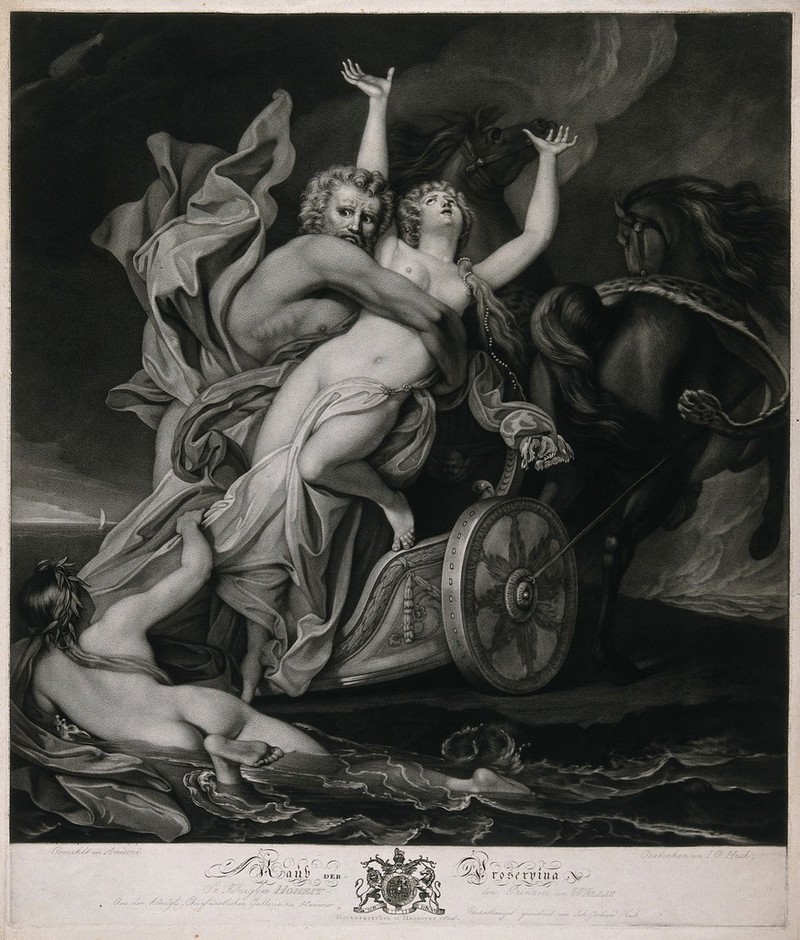
Pluto in a chariot snatches Proserpine away from her companions. Mezzotint by J.G. Huck, 1804, after J. Amigoni., 1804, by Jacopo Amigoni
Jacopo Amigoni · Wellcome Collection, London · Wellcome Collection
Life and career
Dated record
Life and career
The full dated record · 2 entries
1682
Jacopo Amigoni was born in 1682 at Naples.
1752
Jacopo Amigoni died in 1752 at Madrid.
Places
Named by the record
Places
Only places the record itself states, plotted where the house gazetteer settles their coordinates. Nothing is inferred from a name or a nationality.
Naples.
Birth place
Madrid.
Death place
Primary material
Documents and archives
Institutional database
- Wikidata, structured authority record Q380897: Jacopo Amigoni
Scholarly · Wikimedia Foundation
reference work
- “Jacopo Amigoni”, English Wikipedia, consulted as further reading
Reputable secondary · Wikipedia
Notes from the source article
Cited by Wikipedia
Notes from the source article
These works are cited by the source article, in its own numbering. They are recorded as its citations, not as sources VALÉORINE has verified.
- 1.Thompson Cooper. A New Biographical Dictionary: Containing Concise Notices of Eminent Persons of All Ages and Countries: and More Particularly of Distinguished Natives of Great Britain and Ireland. Macmillan. 48–. 1874.
- 2.AMIGONI, Iacopo in "Dizionario Biografico".
- 3.Getty Museum Biography
- 4.Shipley, John B. Ralph, Ellys, Hogarth, and Fielding: The Cabal Against Jacopo Amigoni. Eighteenth-Century Studies. 1. 4. 324–327. 1968. 2737854.
- 5.National Gallery of Victoria, "Farinelli and Friends"
- 6.Daniel Heartz, Artists and Musicians: Portrait Studies from the Rococo to the Revolution, Steglein Publishing, 2014, pp. 35-42
- 7.Profile of Caterina Amigoni Castellini in the Dictionary of Pastellists Before 1800.
- 8.Jeffares, Neil. Dictionary of pastellists before 1800. Unicorn Press. 2006. 0906290864.
References
Citations
References
Each reference names the institution holding it, so a reader may go to the document itself.
Institutional database
Wikidata, structured authority record Q380897: Jacopo AmigoniWikimedia Foundation
Institutional witnessreference work
Secondary witness
The Encyclopedia exists whether or not anything is for sale. Corrections are recorded rather than overwritten, and every version of this record is kept. Published 14 August 2026.
Elsewhere in Paintings
19,261 published records in this field, each with its sources named.
- Jacobus ZaffiusArtist
- JacomartArtist
- Jacometto VenezianoArtist
- Jacopino ScipioniArtist
- Jacopo BassanoArtist
- Jacopo BelliniArtist
- Jacopo BertoiaArtist
- Jacopo BorboneArtist
Best supported in this field
For owners
Own a work by Jacopo Amigoni?
A specialist will read what you send and tell you what the house can establish, what it cannot, and whether the object is suited to sale. There is no charge and no obligation. The object stays with you throughout; nothing is shipped to us unless it is arranged in writing beforehand.