
Franz Ittenbach
Illustration — Self Portrait (1857) Franz Ittenbach (18 April 1813 – 1 December 1879) was a German religious painter, in the Nazarene style, associated with the Düsseldorfer Malerschule.
Also recorded as franz ittenbach · f. ittenbach · Ittenbach
Franz Ittenbach

Franz Ittenbach · first upload to de.wp Aug 1, 2005 by Tohma · Public domain
- Born
- 1813 · Königswinter.
- Died
- 1879 · Düsseldorf.
- Nationality
- Kingdom of Prussia
- Occupation
- painter
- Fields
- painting
- Education
- Kunstakademie Düsseldorf
- Languages
- German
VALÉORINE Encyclopedia
VALÉORINE documentary reading
Documentary summary
Illustration — Self Portrait (1857) Franz Ittenbach (18 April 1813 – 1 December 1879) was a German religious painter, in the Nazarene style, associated with the Düsseldorfer Malerschule.
Admitted source layer · organised and presented by VALÉORINE
Reference Check
Propose documentary evidence for Franz Ittenbach. A contribution is never written directly as fact: identity, source, rights and evidence gates still decide.
Sign in to contribute
World of VALÉORINE
Documentary connections
Only confirmed graph relationships appear here. Images are shown only when their identity and reuse rights both pass the documentary gate.
Documentary evidence
Documentary basis
Authority files
wikidata · Q185302 · wikipedia · Franz Ittenbach
In this article
Life and work
Life and work
Franz Ittenbach studied at Kunstakademie Düsseldorf. The recorded working language is German. The field of work recorded is painting. Subjects and genres recorded for the work are portrait. Places of work recorded in the authority are Düsseldorf, Rome and Munich. Work by Franz Ittenbach is recorded in the collections of Minneapolis Institute of Art, Elisabeth Orphanage Museum, Alte Nationalgalerie, Milwaukee Art Museum and Wallraf–Richartz Museum.
• Illustration — Madonna and Child (1855) Ittenbach was born in Königswinter. He began his art education as a student of Kaufmann, then left to study under Franz Katz in Cologne. In 1832, Ittenbach became a pupil, at the age of 19, of the Düsseldorf Academy, where he also received private lessons from its president, Friedrich Wilhelm Schadow. He is associated with the Düsseldorf school of painting. He was a member of the Nazarene movement and associated himself mainly with three of his friends and fellow-students: Karl Müller and Andreas Müller, and Ernst Deger. The four men travelled about in Germany, studying and painting together. From 1839 to 1842, Ittenbach lived in Italy. On his return, he stayed in Munich for some time. In 1849, he returned to Düsseldorf. He died there in 1879. From 1859 until his death, he was a member of the artists' club "Malkasten". Ittenbach was exceedingly religious and persistently declined any commissions for mythological or pagan subjects. As a rule, he devoted his energies exclusively to church decoration. He would precede the execution of his greatest works with devout religious exercises, including confession and communion. His finest paintings are said to be found at Bonn, in the St. Remigius, and in Breslau in a church dedicated to the same saint. There is also a remarkable "Holy Family" dated 1861, painted for Prince Liechtenstein in his private chapel near Vienna. Most of his other works can be found in various Catholic churches in Germany. His only important fresco was painted in 1844 in a church at Remagen. Ittenbach was a popular painter in court circles, a member of most of the European academies, and the recipient of many medals and decorations. He painted a few portraits, although his main work was his altar-pieces.
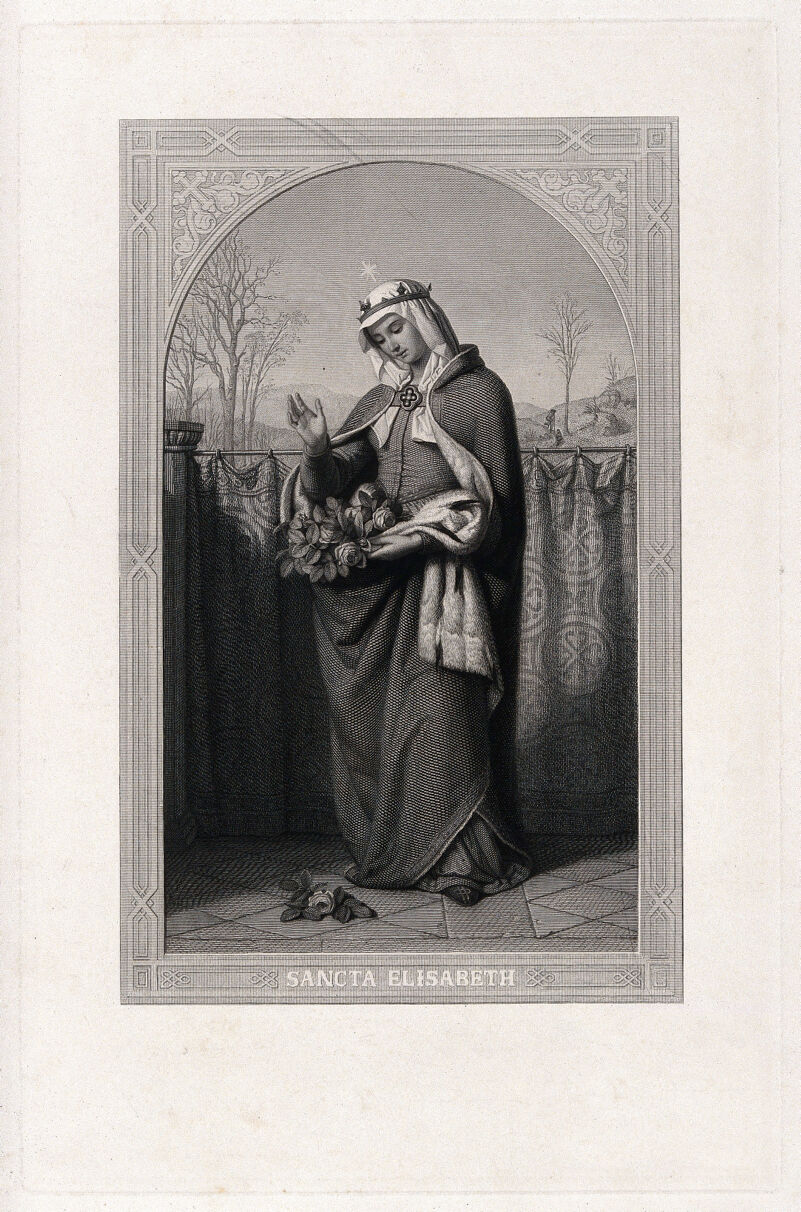
Saint Elizabeth of Hungary. Engraving by A. Rordorf after F. Ittenbach., by Franz Ittenbach
Franz Ittenbach · Wellcome Collection, London · Wellcome Collection
Places
Named by the record
Places
Only places the record itself states, plotted where the house gazetteer settles their coordinates. Nothing is inferred from a name or a nationality.
Königswinter.
Birth place
Düsseldorf.
Death place
Notes from the source article
Cited by Wikipedia
Notes from the source article
These works are cited by the source article, in its own numbering. They are recorded as its citations, not as sources VALÉORINE has verified.
- 1.Marmor-Gedenktafel am Geburts-Haus von Franz Ittenbach, gefertigt vom Bildhauer Clemens Rechmann, im Artikel des Düsseldorfer Volksblatt (Nr. 263) vom 1. Oktober 1885 als Heisterbachstr. Nr. 259 benannt (ub.uni-duesseldorf.de)
- 2.Maler Franz Ittenbach, auf general-anzeiger-bonn.de, vom 24. Juli 2012
- 3.Friedrich Noack: Das Deutschtum in Rom seit dem Ausgang des Mittelalters. Deutsche Verlags-Anstalt, Stuttgart 1927, Band 2, S. 295
- 4.Todesanzeige Frau Prof. Franz Ittenbach, geb. Elise Kurz: im Alter von 58 Jahren, Sterbehaus Klosterstraße 47, am 22. März 1886. In: Düsseldorfer Volksblatt (Nr. 79) vom 23. März 1886 (ub.uni-duesseldorf.de)
- 5.Briefe von Franz Ittenbach an seinen Sohn. Fußnote 1: Ittenbach hatte zwei Töchter: Wilhelmine (geb. 1852, gest. 1891 zu Düsseldorf) und Franziska (geb. 1853, gest. 1886 zu Düsseldorf). In: Düsseldorfer Sonntagsblatt (Nr. 15) vom 13. April 1913 (ub.uni-duesseldorf.de)
- 6.Briefe von Franz Ittenbach an seinen Sohn. Fußnote 2: Theodor, geb. am 18. Mai 1855, besuchte das Realgymnasium zu Münster und starb als cand. archit. zu Detmold am 22. Januar 1882. In: Düsseldorfer Sonntagsblatt (Nr. 15) vom 13. April 1913 ub.uni-duesseldorf.de
- 7.Ittenbach, Franz, Maler u. Prof., Hohenzollernstraße 15. In: Adreßbuch der Oberbürgermeisterei Düsseldorf 1879 (ub.uni-duesseldorf.de)
- 8.Civilstand der Oberbürgermeisterei Düsseldorf. Gestorben. Den 30. November, Franz Ittenbach, Professor, 66 J. a., Ehemann, Hohenzollernstraße. In: Düsseldorfer Volksblatt (Nr. 327) vom 3. Dezember 1879 (ub.uni-duesseldorf.de)
- 9.Franz Ittenbach. In: The American Art Review, Boston/Massachusetts 1880, S. 180 (Google Books)
- 10.Westfälischer Telegraf, 9. Dezember 1879, S. 2 (zeitpunkt.nrw)
- 11.Echo des Siebengebirges, 9. Februar 1932, S. 2 (zeitpunkt.nrw)
- 12.Echo des Siebengebirges, 24. Juni 1933, S. 2 (zeitpunkt.nrw)
- 13.Aus dem Fond zur Verwendung öffentlicher Zwecke von 1849–1850 des Kunstvereins für die Rheinlande und Westfalen: c) dem Maler F. Ittenbach 50 Thlr. als erste Rate des Honorars von 180 Thlr. für das in der kath. Kirche zu Allendorf, Kreises Arnsberg zu stiftende Altarbild die heilig. Agatha darstellend. In: Düsseldorfer Journal und Kreisblatt (Nr. 67) vom 19. März 1851 (ub.uni-duesseldorf.de)
- 14.Die Heilige Familie in Ägypten, Objektdatenblatt im Portal recherche.smb.museum, abgerufen am 19. Mai 2023
- 15.Alison McQueen: Empress Eugénie and the Arts. Politics and Visual Culture in the Nineteenth Century. Routledge, London 2011, ISBN 978-1-4094-0585-6, S. 179 (Google Books)
- 16.Elias H. Füllenbach: St. Andreas in der Düsseldorfer Altstadt. In: Orte der Düsseldorfer Malerschule. Spuren der Künstler in Düsseldorf. Hrsg. vom Rheinischen Verein für Denkmalpflege und Landschaftsschutz, Neuss 2011 (= Rheinische Kunststätten, Heft 528), S. 68–69.
- 17.. Artikel vom 26. September 2014 im Portal churchtimes.co.uk, abgerufen am 2. Oktober 2014
References
Citations
References
Each reference names the institution holding it, so a reader may go to the document itself.
reference work
Secondary witnessreference work
Secondary witness
People, houses and institutions
Knowledge graph
People, houses and institutions
Teachers, collaborators, publishers and institutions recorded against this person, each on a stated basis.
Studied at
1- Kunstakademie DüsseldorfOrganisation
Established from a fact already recorded on a verified source.
The Encyclopedia exists whether or not anything is for sale. Corrections are recorded rather than overwritten, and every version of this record is kept. Published 17 August 2026.
Elsewhere in Paintings
19,126 published records in this field, each with its sources named.
- Franz Gregor Ignaz EcksteinArtist
- Franz Gustav ArndtArtist
- Franz HeckendorfArtist
- Franz Innocenz Josef KobellArtist
- Franz Joseph SpieglerArtist
- Franz KlineArtist
- Franz Ludwig CatelArtist
- Franz MarcArtist
Best supported in this field
For owners
Own a work by Franz Ittenbach?
A specialist will read what you send and tell you what the house can establish, what it cannot, and whether the object is suited to sale. There is no charge and no obligation. The object stays with you throughout; nothing is shipped to us unless it is arranged in writing beforehand.