
Austen Henry Layard
Sir Austen Henry Layard (5 March 18175 July 1894) was a British Assyriologist, traveller, cuneiformist, art historian, draughtsman, collector, politician and diplomat. He was born to a mostly English family in Paris and largely raised in Italy. He is best known as the excavator of Nimrud and of Nineveh, where he uncovered a large proportion of the Assyrian palace reliefs known, and in 1851 the library of Ashurbanipal.
Also recorded as Sir Austen Henry Layard · Austen Henry Layard Sir · Austen Henry, Sir Layard
Austen Henry Layard
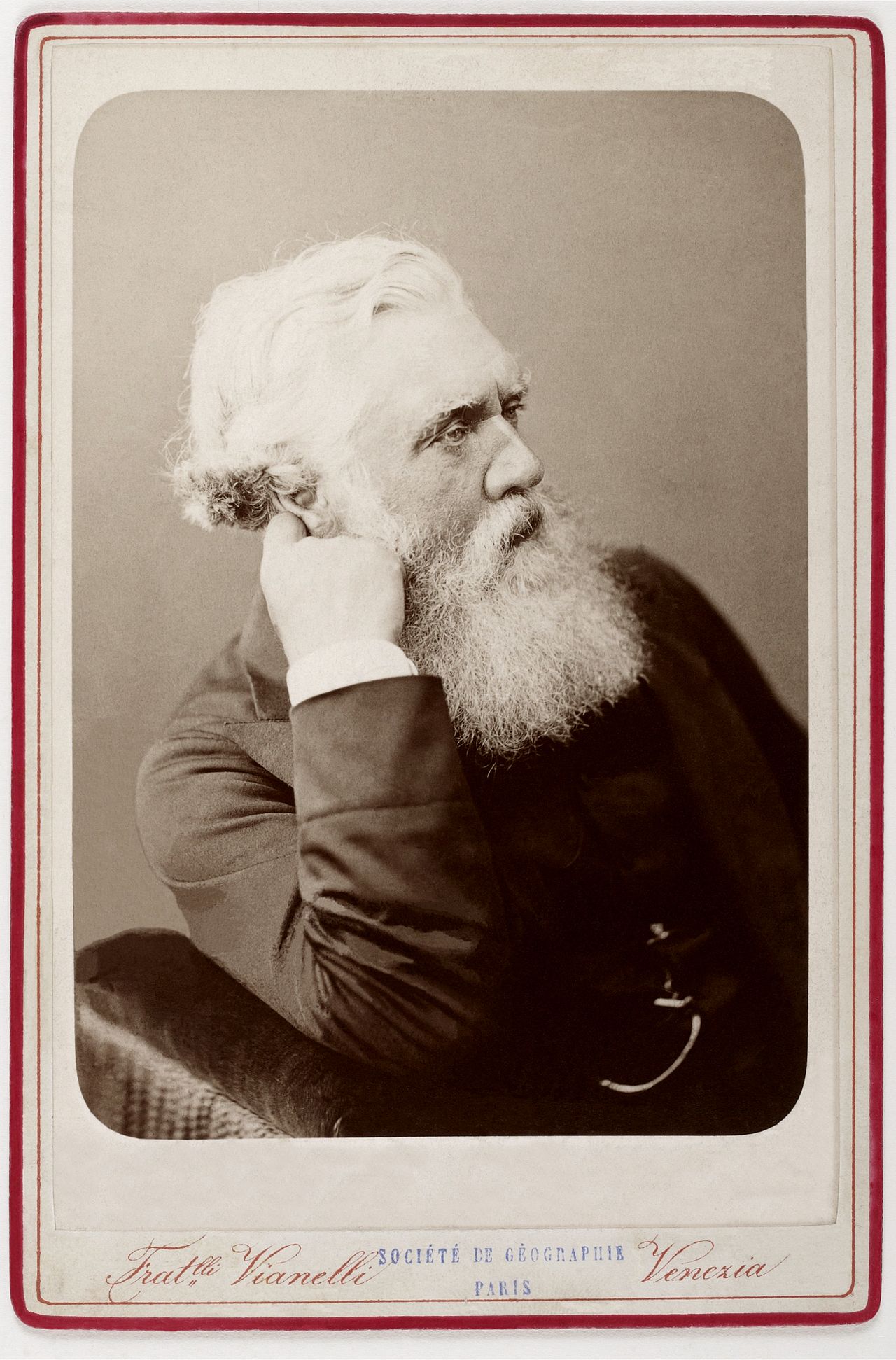
Fratelli Vianelli, Venezia Upload, stitch and restoration by Jebulon · Bibliothèque nationale de France · Public domain
- Name
- Austen Henry Layard
- Born
- 5 March 1817
- Birthplace
- Paris, France
- Died
- 5 July 1894 5 March 1817
- Place of death
- London, England
- Spouse
- Mary Enid Evelyn Guest
- Nationality
- France · United Kingdom of Great Britain and Ireland
- Occupation
- anthropologist · diplomat · archaeologist · politician · assyriologist · writer · historian · painter
- Fields
- archaeology
- Honours
- Knight Grand Cross of the Order of the Bath · Royal Gold Medal · Pour le Mérite for Sciences and Arts order · Founder’s Medal
- Languages
- English
VALÉORINE Encyclopedia
VALÉORINE documentary reading
Documentary summary
Sir Austen Henry Layard (5 March 18175 July 1894) was a British Assyriologist, traveller, cuneiformist, art historian, draughtsman, collector, politician and diplomat. He was born to a mostly English family in Paris and largely raised in Italy. He is best known as the excavator of Nimrud and of Nineveh, where he uncovered a large proportion of the Assyrian palace reliefs known, and in 1851 the library of Ashurbanipal.
Admitted source layer · organised and presented by VALÉORINE
Reference Check
Propose documentary evidence for Austen Henry Layard. A contribution is never written directly as fact: identity, source, rights and evidence gates still decide.
Sign in to contribute
World of VALÉORINE
Documentary connections
Only confirmed graph relationships appear here. Images are shown only when their identity and reuse rights both pass the documentary gate.
Documentary evidence
Documentary basis
Authority files
wikidata · Q275013 · wikipedia · Austen Henry Layard
In this article
Biography
Biography
Most of his discoveries are now in the British Museum. He made a large amount of money from his best-selling accounts of his excavations. He had a political career between 1852, when he was elected as a Member of Parliament, and 1869, holding various junior ministerial positions. He was then made ambassador to Madrid, then Constantinople, living much of the time in a palazzo he bought in Venice. During this period he built up a significant collection of paintings, which due to a legal loophole he had as a diplomat, he was able to extricate from Venice and bequeath to the National Gallery (as the Layard Bequest) and other British museums.
The recorded working language is English. The field of work recorded is archaeology. Places of work recorded in the authority are London. Employment is recorded with Foreign Office. Positions recorded include Parliamentary Under-Secretary of State for Foreign Affairs and First Commissioner of Works. Distinctions recorded are Knight Grand Cross of the Order of the Bath, Royal Gold Medal, Pour le Mérite for Sciences and Arts order and Founder’s Medal.

Sir Austen Henry Layard
London Stereoscopic Photographic Company. · [1]
Key facts
Key facts
• Honorific Prefix — The Right Honourable Sir • Name — Austen Henry Layard • Order1 — Under-Secretary of State for Foreign Affairs • Term Start1 — 12 February 1852 • Term End1 — 21 February 1852 • Monarch1 — Queen Victoria • Prime Minister1 — Lord John Russell • Predecessor1 — The Lord Stanley of Alderley • Successor1 — Lord Stanley • Term Start2 — 15 August 1861 • Term End2 — 26 June 1866 • Monarch2 — Queen Victoria • Prime Minister2 — The Viscount Palmerston The Earl Russell • Predecessor2 — The Lord Wodehouse • Successor2 — Edward Egerton • Order3 — First Commissioner of Works • Term Start3 — 9 December 1868 • Term End3 — 26 October 1869 • Monarch3 — Queen Victoria • Prime Minister3 — William Ewart Gladstone • Predecessor3 — Lord John Manners • Successor3 — Acton Smee Ayrton • Order4 — Ambassador to the Ottoman Empire • Term Start4 — 1877 • Term End4 — 1880 • Monarch4 — Queen Victoria • Predecessor4 — Sir Henry Elliot • Successor4 — The Earl of Dufferin • Born — 5 March 1817 • Birthplace — Paris, France • Died — 5 July 1894 5 March 1817 • Place of death — London, England • Party — Liberal • Spouse — Mary Enid Evelyn Guest
Family
Family
Layard was born in Paris, France, to a family of Huguenot descent. His father, Henry Peter John Layard, of the Ceylon Civil Service, was the son of Charles Peter Layard, Dean of Bristol, and grandson of Dr Daniel Peter Layard, a physician. His mother, Marianne, daughter of Nathaniel Austen, banker, of Ramsgate, was of partial Spanish descent. His uncle was Benjamin Austen, a London solicitor and close friend of Benjamin Disraeli in the 1820s and 1830s. Edgar Leopold Layard the ornithologist was his brother. On 9 March 1869, at St. George's Church, Hanover Square, Westminster, London, he married his first cousin once removed, Mary Enid Evelyn Guest (1843-1912). Enid, as she was known, was the daughter of Sir Josiah John Guest and his second wife, Lady Charlotte Elizabeth Bertie. Their marriage was reportedly a happy one, and they never had any children.
Early life
Early life
Much of Layard's boyhood was spent in Italy, where he received part of his schooling, and acquired a taste for the fine arts and a love of travel from his father; but he was at school also in England, France and Switzerland. After spending nearly six years in the office of his uncle, Benjamin Austen, he was tempted to leave England for Sri Lanka (Ceylon) by the prospect of obtaining an appointment in the Civil Service, and he started in 1839 with the intention of making an overland journey across Asia. After wandering for many months, chiefly in Persia, with Bakhtiari people and having abandoned his intention of proceeding to Ceylon, he returned in 1842 to the Ottoman capital Constantinople where he made the acquaintance of Sir Stratford Canning, the British Ambassador, who employed him in various unofficial diplomatic missions in European Turkey. In 1845, encouraged and assisted by Canning, Layard left Constantinople to make those explorations among the ruins of Assyria with which his name is chiefly associated. This expedition was in fulfilment of a design which he had formed when, during his former travels in the East, his curiosity had been greatly stimulated by the ruins of Nimrud on the Tigris, and by the great mound of Kuyunjik, near Mosul, already partly excavated by Paul-Émile Botta.
Excavations and the arts
Excavations and the arts
• Illustration — A. H. Layard at Kuyunjik. Drawing by Solomon Caesar Malan, 1850. • Illustration — 1849 illustration by Austen Henry Layard of excavations at Nineveh • Illustration — Caricature from Vanity Fair, (Aug 1869) captioned "He combines the love of truth and art with equal devotion and success" • Illustration — Austen Henry Layard (1883) Layard remained in the neighbourhood of Mosul, carrying on excavations at Kuyunjik and Nimrud, and investigating the condition of various peoples, until 1847; and, returning to England in 1848, published Nineveh and Its Remains (2 vols., 1848–1849). To illustrate the antiquities described in this work he published a large folio volume of The Monuments of Nineveh. From Drawings Made on the Spot (1849). After spending a few months in England, and receiving the degree of D.C.L. from the University of Oxford and the Founder's Medal of the Royal Geographical Society, Layard returned to Constantinople as attaché to the British embassy, and, in August 1849, started on a second expedition, in the course of which he extended his investigations to the ruins of Babylon and the mounds of southern Mesopotamia. He is credited with discovering the Library of Ashurbanipal during this period. His record of this expedition, Discoveries in the Ruins of Nineveh and Babylon, which was illustrated by another folio volume, called A Second Series of the Monuments of Nineveh, was published in 1853. During these expeditions, often in circumstances of great difficulty, Layard despatched to England the splendid specimens which now form the greater part of the collection of Assyrian antiquities in the British Museum. Layard believed that the native Syriac Christian communities living throughout the Near East were descended from the ancient Assyrians. Apart from the archaeological value of his work in identifying Kuyunjik as the site of Nineveh, and in providing a great mass of materials for scholars to work upon, these two books of Layard were among the best written books of travel in the English language. Layard was an important member of the Arundel Society, and in 1866 he was appointed a trustee of the British Museum. In the same year Layard founded "Compagnia Venezia Murano" and opened a venetian glass showroom in London at 431 Oxford Street. Today Pauly & C. - Compagnia Venezia Murano is one of the most important brands of venetian art glass production.
Political career
Political career
Layard now turned to politics. Elected as a Liberal member for Aylesbury, Buckinghamshire in 1852, he was for a few weeks Under-Secretary for Foreign Affairs, but afterwards freely criticised the government, especially in connection with army administration. He was present in the Crimea during the war, and was a member of the committee appointed to inquire into the conduct of the expedition. In 1855 he refused from Lord Palmerston an office not connected with foreign affairs, was elected lord rector of Aberdeen University, and on 15 June moved a resolution in the House of Commons (defeated by a 359–46 majority) declaring that in public appointments merit had been sacrificed to private influence and an adherence to routine. After being defeated at Aylesbury in 1857, he visited India to investigate the causes of the Indian Mutiny. He unsuccessfully contested York in 1859, but was elected for Southwark in 1860, and from 1861 to 1866 was Under-Secretary for Foreign Affairs in the successive administrations of Lord Palmerston and Lord John Russell. After the Liberals returned to office in 1868 under William Ewart Gladstone, Layard was made First Commissioner of Works and sworn of the Privy Council.
Diplomatic career
Diplomatic career
Layard resigned from office in 1869, on being sent as envoy extraordinary to Madrid. In 1877 he was appointed by Lord Beaconsfield Ambassador at Constantinople, where he remained until Gladstone's return to power in 1880, when he finally retired from public life. In 1878, on the occasion of the Berlin Congress, he was appointed a Knight Grand Cross of the Order of the Bath.
Retirement in Venice
Retirement in Venice
Layard retired to Venice. There he took up residence in the sixteenth-century palazzo on the grand canal named Ca Cappello, just behind Campo San Polo, and which he had commissioned historian Rawdon Brown, another long-time British resident of Venice, to purchase for him in 1874. In Venice he devoted much of his time to collecting pictures of the Venetian school, and to writing on Italian art. On this subject he was a disciple of his friend Giovanni Morelli, whose views he embodied in his revision of Franz Kugler's Handbook of Painting, Italian Schools (1887). He wrote also an introduction to Constance Jocelyn Ffoulkes's translation of Morelli's Italian Painters (1892–1893), and edited that part of Murray's Handbook of Rome (1894) which deals with pictures. In 1887 he published, from notes taken at the time, a record of his first journey to the East, entitled Early Adventures in Persia, Susiana and Babylonia. The late nineteenth century English novelist George Gissing thought it 'one of the most interesting books' vowing to 'read it again some day'. An abbreviation of this work, which as a book of travel is even more delightful than its predecessors, was published in 1894, shortly after the author's death, with a brief introductory notice by Lord Aberdare. Layard also from time to time contributed papers to various learned societies, including the Huguenot Society, of which he was first president. During their life in Venice, he and his wife were neighbors of Princess Darinka of Montenegro and her daughter, Princess Olga, who, while in exile, resided in a nearby palazzo. The two families often joined the Layards for concerts, balls, and intimate dinners, where they enjoyed fine wine and spent the evenings playing the piano. In turn, they accompanied Darinka and her daughter to the Greek Church in Venice for Orthodox Christmas Day, after which the princesses hosted festive gatherings for a select circle of guests at their Palazzo Molin in honor of the celebration.
Death
Death
He died on 5 July 1894 at his residence 1 Queen Anne Street, Marylebone, London. After a post mortem autopsy his remains were cremated at the Woking Crematorium in Surrey. His ashes were interred in the cemetery of Canford Magna Parish Church in Dorset, England. His wife, Lady Layard, outlived him by 16 years, dying on 1 November 1912, in her Venetian palazzo, Ca’ Capello. Her ashes were interred near her husband’s at Canford Parish Church, adjacent to Canford Manor, on 13 December. There is also a marble memorial tablet to him in St Margaret's, Westminster, erected by Enid.
Identity and origins
Identity and origins
The authorities additionally record the headings Sir Austen Henry Layard, Austen Henry Layard Sir and Austen Henry, Sir Layard. His recorded language was English. He was the child of Henry Peter John Layard and Marianne Austen. He married Mary Enid Evelyn Guest. Other recorded relations include Nina Frances Layard.
Career and activity
Career and activity
Austen Henry Layard worked in archaeology. He was employed by Foreign Office. Recorded positions include Parliamentary Under-Secretary of State for Foreign Affairs, First Commissioner of Works, member of the 20th Parliament of the United Kingdom, member of the 19th Parliament of the United Kingdom and member of the 18th Parliament of the United Kingdom. He belonged to Académie des Inscriptions et Belles-Lettres. He worked at London.
Life and career
Dated record
Life and career
The full dated record · 2 entries
1817
Austen Henry Layard born at Paris.
1894
Austen Henry Layard died at London.
Places
Named by the record
Places
Only places the record itself states, plotted where the house gazetteer settles their coordinates. Nothing is inferred from a name or a nationality.
Paris.
Birth place
London.
Death place
Publications
• Illustration — Lanyard 's reconstruction of a hall from an Assyrian palace, 1849 •, 2 volumes • (alt.) • (alt.) * •, 100 plates, From Drawings Made on the Spot. •, 71 plates, A Second Series [..] including Bas-Reliefs from the Palace of Sennacherib and Bronzes from the Ruins of Nimroud. From drawings made on the spot during a second expedition to Assyria. (alt. plates only) * •, abridged version of Nineveh and its remains (1849) * * * •, abridged version of Nineveh and Babylon (1853) * •, 2 volumes • * • * •, 2 volumes, biography • * • *
Notes from the source article
Cited by Wikipedia
Notes from the source article
These works are cited by the source article, in its own numbering. They are recorded as its citations, not as sources VALÉORINE has verified.
- 1."Austen Henry Layard", National Gallery
- 2.Rivista enciclopedica contemporanea, Editore Francesco Vallardi, Milan, (1913), entry by UN, pages 16-17.
- 3.Layard, Sir Austen Henry. 16. 312.
- 4.Layard, Austen Henry. Discoveries in the ruins of Nineveh and Babylon. Internet Archive. G. P. Putnam and Co. 1853.
- 5.Cross, Frank Leslie. The Oxford Dictionary of the Christian Church. Oxford University Press. 119. 2005. 978-0-19-280290-3.
- 6.Briggs, Asa: The Age of Improvement, 1783–1867 (2nd edition), p. 377. Routledge, 2000
- 7.23449. 11 December 1868. 6581.
- 8.Macmillan & Co. Sir Henry Layard. Eminent persons: Biographies reprinted from the Times. VI (1893–1894). 134. 1897.
- 9.Parry, Jonathan. Layard, Sir Austen Henry (1817–1894), archaeologist and politician. 2006. 10.1093/ref:odnb/16218.
- 10.Coustillas, Pierre ed. London and the Life of Literature in Late Victorian England: the Diary of George Gissing, Novelist. Brighton: Harvester Press, 1978, p.318.
- 11.Robert and Elizabeth Barrett Browning: A Database. pops.baylor.edu.
- 12.Philip Temple, Colin Thom, Andrew Saint (2017) Survey of London: South-East Marylebone Volumes 51 and 52 Yale University Press
Bibliography printed in the source article · 8
- Brackman, Arnold C. The Luck of Nineveh: Archaeology's Great Adventure. McGraw-Hill Book Company. 1978. 0-07-007030-X.
- Jerman, B.R. The Young Disraeli. Princeton University Press. 1960.
- Kubie, Nora Benjamin. Road to Nineveh: the adventures and excavations of Sir Austen Henry Layard. 1964.
- Larsen, Mogens T. The Conquest of Assyria. Routledge. 1996. 0-415-14356-X.
- Lloyd, Seton. Foundations in the Dust: The Story of Mesopotamian Exploration. Thames & Hudson. 1981. 0-500-05038-4.
- Waterfield, Gordon. Layard of Nineveh. John Murray. 1963.
- The ISIS Press, Istanbul. The Queen's Ambassador to the Sultan. Memoirs of Sir Henry A. Layard's Constantinople Embassy 1877–1880. 2009. 978-975-428-395-2.
- Silverberg, Robert. The man who found Nineveh. The story of Austen Henry Layard. Holt, Rinehart and Winston, New York. 1964.
References
Citations
References
Each reference names the institution holding it, so a reader may go to the document itself.
reference work
Wikidata, structured authority record Q275013: Austen Henry LayardWikimedia Foundation
Secondary witnessreference work
Secondary witness
Further particulars
Held on the record
Further particulars
Open the remaining particulars
Austen Henry Layard received Knight Grand Cross of the Order of the Bath, Royal Gold Medal, Pour le Mérite for Sciences and Arts order and Founder’s Medal. Recorded as anthropologist, diplomat, archaeologist, politician and assyriologist.
Recognition and collections
The Encyclopedia exists whether or not anything is for sale. Corrections are recorded rather than overwritten, and every version of this record is kept. Published 16 August 2026.
Elsewhere in Paintings
19,040 published records in this field, each with its sources named.
- Aurora MiraArtist
- Aurora Reyes FloresArtist
- Aurore de Lafond de FénionArtist
- Austen DeansArtist
- Austin Osman SpareArtist
- Autumn de ForestArtist
- Ava de LagercrantzArtist
- Avanzino NucciArtist
Best supported in this field
For owners
Own a work by Austen Henry Layard?
A specialist will read what you send and tell you what the house can establish, what it cannot, and whether the object is suited to sale. There is no charge and no obligation. The object stays with you throughout; nothing is shipped to us unless it is arranged in writing beforehand.