
Alessandro Magnasco
Alessandro Magnasco (February 4, 1667 – March 12, 1749), also known as il Lissandrino, was an Italian late-Baroque painter active mostly in Milan and Genoa. He is best known for stylized, fantastic, often phantasmagoric genre or landscape scenes. Magnasco's distinctive style is characterized by fragmented forms rendered with swift brushstrokes and darting flashes of light.[1]
Also recorded as Lissandrino · Il Lissandrino · Alessandro Bagnaschi · Il Lissandrino Magnasco
Alessandro Magnasco
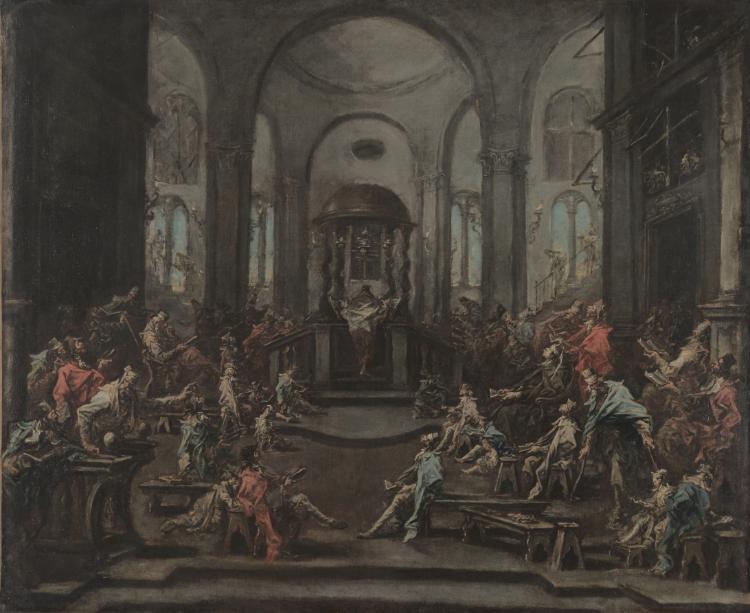
Alessandro Magnasco · The Cleveland Museum of Art · Purchase from the J. H. Wade Fund · CC0
- Name
- Alessandro Magnasco
- Born
- 4 February 1667
- Died
- 12 March 1749
- Field
- Painting
- Training
- Valerio Castello, Filippo Abbiati
- Movement
- Baroque
- Place of death
- Genoa, Republic of Genoa
- Nationality
- Republic of Genoa
- Occupation
- painter
- Known for
- Landscape with Figures
VALÉORINE Encyclopedia
VALÉORINE documentary reading
Documentary summary
Alessandro Magnasco (February 4, 1667 – March 12, 1749), also known as il Lissandrino, was an Italian late-Baroque painter active mostly in Milan and Genoa. He is best known for stylized, fantastic, often phantasmagoric genre or landscape scenes. Magnasco's distinctive style is characterized by fragmented forms rendered with swift brushstrokes and darting flashes of light.[1]
Admitted source layer · organised and presented by VALÉORINE
Note VALÉORINE
No house-authored Note is published until its assertions and sources pass the VALÉORINE evidence contract. The documentary article remains available in full while that enrichment is being consolidated.
Documentary enrichment in progress · no unsupported statement published
Reference Check
Propose documentary evidence for Alessandro Magnasco. A contribution is never written directly as fact: identity, source, rights and evidence gates still decide.
Sign in to contribute
World of VALÉORINE
Documentary connections
Only confirmed graph relationships appear here. Images are shown only when their identity and reuse rights both pass the documentary gate.

Documentary evidence
Evidence Panel
not yet certified
- Identity
- resolved
- Independent source families
- 0
- Admitted assertions
- 0
- Open conflicts
- 0
Authority files
gnd · 1091439583 · wikidata · Q516941 · wikipedia · Alessandro Magnasco
In this article
Biography
Biography
The field of work recorded is painting. Subjects and genres recorded for the work are landscape. Places of work recorded in the authority are Genoa, Milan and Florence. Works named in the authority record are Landscape with Figures. Work by Alessandro Magnasco is recorded in the collections of Museum Boijmans Van Beuningen, Städel Museum, Minneapolis Institute of Art, Museo del Prado and The Nelson-Atkins Museum of Art.
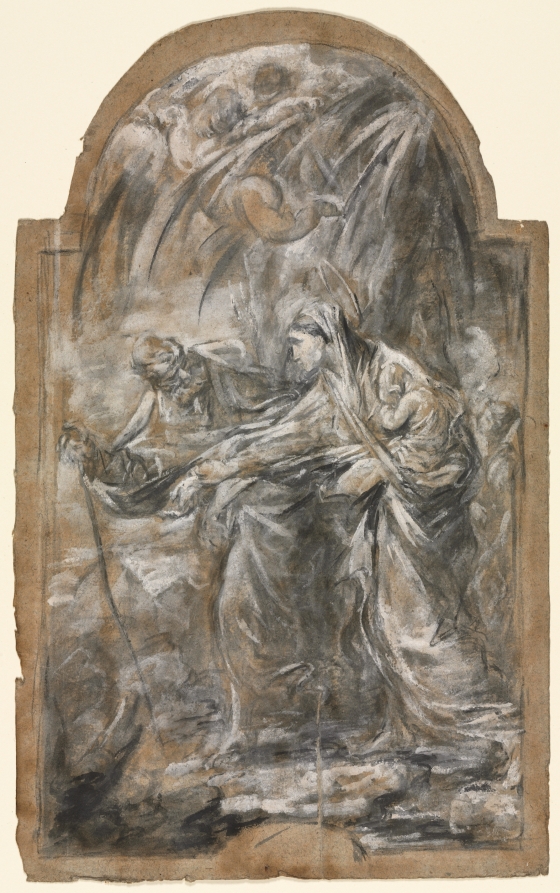
Flight into Egypt, 1740s?, by Alessandro Magnasco
Alessandro Magnasco · The Cleveland Museum of Art · John L. Severance Fund
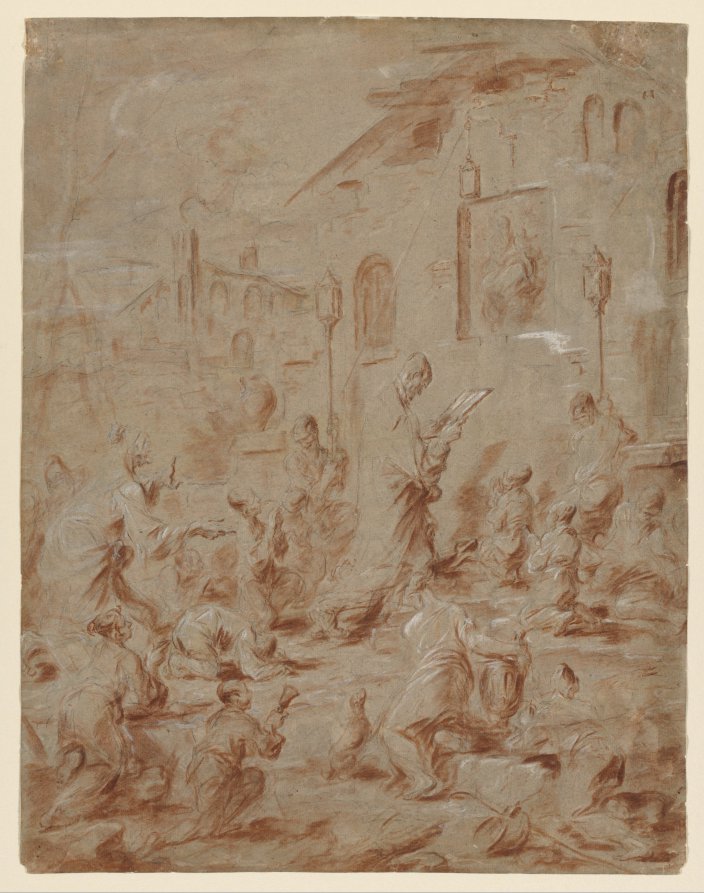
Worshippers at a Street Shrine, 1730/40, by Alessandro Magnasco
Alessandro Magnasco · The Cleveland Museum of Art · Dudley P. Allen Fund
Key facts
Key facts
• Name — Alessandro Magnasco • Born — 4 February 1667 • Died — 12 March 1749 • Field — Painting • Training — Valerio Castello, Filippo Abbiati • Movement — Baroque • Place of death — Genoa, Republic of Genoa • Birthplace — Genoa, Republic of Genoa
Life
Life
Born in Genoa to a minor artist, Stefano Magnasco, he apprenticed with Valerio Castello, and finally with Filippo Abbiati (1640–1715) in Milan. Except for 1703–09 (or 1709–11)[2] when working in Florence for the Grand Duke Cosimo III, Magnasco labored in Milan until 1735, when he returned to his native Genoa. Magnasco often collaborated with placing figures in the landscapes of Tavella and the ruins of Clemente Spera in Milan.
Mature style
Mature style
• Illustration — Joseph Interpreting Dreams After 1710, Magnasco excelled in producing small, hypochromatic canvases with eerie and gloomy landscapes and ruins, or crowded interiors peopled with small, often lambent and cartoonishly elongated characters. The people in his paintings were often nearly liquefacted beggars dressed in tatters, rendered in flickering, nervous brushstrokes. Often they deal with unusual subjects such as synagogue services, Quaker meetings, robbers' gatherings, catastrophes, and interrogations by the Inquisition. His sentiments regarding these subjects are generally unclear. A century later he would be described as a "romantic painter: who painted with candid touches, and ingenious expressiveness, little figures in Gothic churches; or in solitude, hermits and monks; or scoundrels assembled in town squares; soldiers in barracks".[3] The art historian and critic Luigi Lanzi described him as the Cerquozzi of his school; thereby signaling him into the circle of followers of the Bamboccianti. He indicates that Magnasco had "figures scarcely more than a span large... painted with humor and delight", but not as if this effect had been the intention of the painter. Lanzi says these eccentric pieces were favored by the Grand Duke Giovanni Gastone Medici of Florence.[4] Magnasco also found contemporary patronage for his work among prominent families and collectors of Milan, for example the Arese and Casnedi families.[5] This series of patrons underscores the fact that Magnasco was more esteemed by outsiders than by his fellow Genoese; as Lanzi noted, "his bold touch, though joined to a noble conception and to correct drawing, did not attract in Genoa, because it is far removed from the finish and union of tints which (Genoese) masters followed."[6] In the twentieth century, Rudolf Wittkower derided him as "solitary, tense, strange, mystic, ecstatic, grotesque, and out of touch with the triumphal course of the Venetian school" from 1710 onward.
Origins of his style
Origins of his style
• Illustration — Hermit in the Desert The influences on his work are obscure. Some suspect the influence of the loose painterly style of his Venetian contemporary Sebastiano Ricci (1659–1734), the Genoese Domenico Piola (1627–1703) and Gregorio de Ferrari, although the most prominent of the three, Ricci, painted in a more monumental and mythic style, and these artists may in fact have been influenced by Magnasco. Magnasco was likely influenced by Milanese il Morazzone (1573–1626) in the emotional quality of his work. Some of his canvases (see ill. (q.)) recall Salvator Rosa's romantic sea-lashed landscapes, and his affinity for paintings of brigands. The diminutive scale of Magnasco's figures relative to the landscape is comparable to Claude Lorrain's more airy depictions. While his use of figures of ragged beggars has been compared with Giuseppe Maria Crespi's genre style, Crespi's figures are larger, more distinct, and individual, and it is possible that Crespi himself may have influenced Magnasco. Others point to the influences of late Baroque Italian genre painters, the Roman Bamboccianti, and in his exotic scenography, the well-disseminated engravings of the Frenchman Callot.
Selected works
Selected works
• Illustration — The Tame Magpie (1707–08) Metropolitan Museum of Art • Illustration — Interrogations in Jail (c. 1710) Kunsthistorisches Museum • Illustration — Banditti at Rest (with Clemente Spera) (c. 1710) Hermitage Museum • Illustration — Garden Party in Albaro Strada Nuova Museums Genoa • Illustration — Gypsy Wedding Banquet (1730–35) Louvre • Illustration — Dissipation and Ignorance destroy the Arts and Sciences (1735–1740) private collection • Illustration — Nuns Musée des Beaux-Arts de Strasbourg • Illustration — Rest of the Comedians (1730s), Odesa Museum of Western and Eastern Art • Illustration — Jewish Funeral, oil on canvas, 87 x 117 cm, Musée d'Art et d'Histoire du Judaïsme • Illustration — Christ at the Sea of Galilee (c. 1740) National Gallery of Art Washington DC • Illustration — The Exorcism of the Waves (c. 1735), Memorial Art Gallery Rochester NY • Illustration — Christ attended by the Angels. C. 1705. Prado Museum. Madrid. Magnasco and Peruzzini. • Illustration — The painter's workshop. c. 1720. Real Academia de Bellas Artes de San Fernando. Madrid. • Painting — Dates — Site — Link • Gathering of Quakers — 1695 — Uffizi, Florence • Theodosius Repulsed from Church by St. Ambrose — 1700-10 — Art Institute of Chicago • Christ attended by angels — c. 1705 — Museo del Prado, Madrid — • Christ and Samaritan Woman — 1705-10 — Getty Museum, Los Angeles — • Noli Me Tangere — 1705-10 — ibid — • The Hunting Scene — 1710 — Wadsworth Atheneum • Muletrain and Castle — 1710 — Louvre — • Bacchanalian Scene — 1710s — Hermitage Museum — • Halt of the Brigands — 1710s — ibid — • Landscape with Washerwomen — 1710-20 — University of Michigan Museum of Art — • The Inquisition or Interrogations in a Jail — 1710-20 — Kunsthistorisches Museum — • The Temptation of Saint Anthony — 1710-20 — Louvre — • Landscape with Shepherds — c. 1710-30 — São Paulo Museum of Art, São Paulo — • Pulcinella singing with Family and Lute Player — 1710-35 — Columbia Museum of Art, South Carolina — • Three Camaldolite Monks at Prayer — 1713-14 — Rijksmuseum — • Three Capuchin Friars Meditating in their Hermitage — 1713-14 — ibid — • Christ Adored by Two Nuns — c. 1715 — Accademia — • The Sack of a City — 1719-25 — Brukenthal National Museum, Abbey of Seitenstetten, Sibiu • Satire of Nobleman in Misery — 1719-25 — Detroit Institute of Arts — • The painter's workshop — c. 1720 — Real Academia de Bellas Artes de San Fernando, Madrid — • Bacchanale — 1720-30 — The Getty Center in Los Angeles — • Triumph of Venus — 1720-30 — ibid — • Interior with Monks — 1725 — Norton Simon Museum — • Gamblers, Soldiers and Vagabonds — 1720-30 — Staatsgalerie Stuttgart — • Supper of Pulcinella & Colombina — 1725-30 — North Carolina Museum of Art, Raleigh — • The Synagogue — 1725-30 — Cleveland Museum of Art • Consecration of a Franciscan Friar — c. 1730 — El Paso Museum of Art, Texas — • Burial of a Franciscan Friar — c. 1730 — El Paso Museum of Art — • Monks chapter — 1730-1740 — Real Academia de Bellas Artes de San Fernando, Madrid — • Sacrilegious Robbery — 1731 — intended for church of Siziano, now in Quadreria Arcivescovile, Milan — • Exorcism of the Waves — after 1735 — Memorial Art Gallery, Rochester, New York — • Landscape with Travelers — 1735-1740 — New Orleans Museum of Art • The Observant Friars in the Refectory — 1736-37 — Museo Civico di Bassano del Grappa — • Figures Before a Stormy Sea — ca. 1740 — Honolulu Museum of Art • The Entrance to a Hospital — Muzeul des Arta, Bucharest • Landscape with Camaldolese friars — Museo Giannetino Luxora, Genoa — • The Marriage Banquet — Louvre • Praying Monks — Museum voor Schone Kunsten, Ghent — • Reception in a Garden — Palazzo Bianco, Genoa • Seashore — Hermitage Museum — • Supper at Emmaus — Convent S. Francesco in Albaro, Genoa • The Tame Magpie — Metropolitan Museum — • Two Hermits in Forest — Louvre — • A Hermit in the Desert — Lázaro Galdiano Museum, Madrid — • Untitled — • Rest of the Comedians — 1730s — Odesa Museum of Western and Eastern Art
Identity
Identity
The Temptation of St. Recognition and collections.
Life and career
Dated record
Life and career
The full dated record · 2 entries
1667
Alessandro Magnasco born at Genoa.
1749
Alessandro Magnasco died at Genoa.
Legacy
Magnasco's work may have influenced Marco Ricci, Giuseppe Bazzani, Francesco Maffei, and the famed painters de tocco (by touch) Gianantonio and Francesco Guardi in Venice. His depictions of torture in The Inquisition (or perhaps named Interrogations in a Jail) are an atypical subject for Italian baroque paintings, as were his depictions of the religious ceremonies of Jews and Quakers. Yet it remains unsolved, according to Wittkower, "how much quietism or criticism or farce went into the making of his pictures".[7]
Primary material
Documents and archives
reference work
- Wikidata, structured authority record Q516941: Alessandro Magnasco
Reputable secondary · Wikimedia Foundation
- “Alessandro Magnasco”, English Wikipedia, consulted as further reading
Reputable secondary · Wikipedia
authority file
- Gemeinsame Normdatei 1091439583, Alessandro Magnasco, 1667-1749 (1996 : Milano).
Unverified · Deutsche Nationalbibliothek
Notes from the source article
Cited by Wikipedia
Notes from the source article
These works are cited by the source article, in its own numbering. They are recorded as its citations, not as sources VALÉORINE has verified.
- 1.Alessandro Magnasco, called il Lissandrino (Genoa 1667-1749), Saint Joseph's dream at Christie's
- 2.Wittkower 1993, p. 478
- 3.Dizionario geografico-storico-statistico-commerciale degli stati del Re di Sardegna, Volume 7, by Goffredo Casalis, Turin (1840), page 726: "potrebbe chiamarsi pittore romantico: dipingeva a tocchi franchi, e con isprezzatura ingegnosa, figure piccole in chiese d'architettura gotica, o in solitudini, romiti, cappuccini; ovvero mariuoli sulle piazze, soldati ne’quartieri".
- 4.Lanzi, Luigi. History of Painting in Italy; From the Period of the Revival of the Fine Arts to the End of the Eighteenth Century. Henry G. Bohn. III. 287. 1847.
- 5.Spike 1986, p. 87.
- 6.Lanzi, p. 287.
- 7.Wittkower, 1993, p. 478
References
Citations
References
Each reference names the institution holding it, so a reader may go to the document itself.
authority file
Gemeinsame Normdatei 1091439583, Alessandro Magnasco, 1667-1749 (1996 : Milano).Deutsche Nationalbibliothek
Partially resolvedreference work
Wikidata, structured authority record Q516941: Alessandro MagnascoWikimedia Foundation
Partially resolvedreference work
Partially resolved
The Encyclopedia exists whether or not anything is for sale. Corrections are recorded rather than overwritten, and every version of this record is kept. Published 14 August 2026.
Elsewhere in Paintings
18,717 published records in this field, each with its sources named.
- Alessandro KokocinskiArtist
- Alessandro LanfrediniArtist
- Alessandro LupoArtist
- Alessandro MaganzaArtist
- Alessandro MantovaniArtist
- Alessandro MilesiArtist
- Alessandro PampurinoArtist
- Alessandro RosiArtist
Best supported in this field
For owners
Own a work by Alessandro Magnasco?
A specialist will read what you send and tell you what the house can establish, what it cannot, and whether the object is suited to sale. There is no charge and no obligation. The object stays with you throughout; nothing is shipped to us unless it is arranged in writing beforehand.