
Tommaso Sgricci
Tommaso Sgricci (31 October 1789 – 23 July 1836) was an Italian poet and actor, hugely admired in his time for his talent in improvisation.
Tommaso Sgricci

CC BY-SA 3.0
- Born
- 31 October 1789
- Birthplace
- Castiglion Fiorentino, Arezzo (Grand Duchy of Tuscany)
- Died
- 23 July 1836 (aged 46)
- Place of death
- Arezzo (Grand Duchy of Tuscany)
- Education
- University of Pisa
- Occupation
- actor, poet, improviser and writer.
VALÉORINE Encyclopedia
VALÉORINE documentary reading
Documentary summary
Tommaso Sgricci (31 October 1789 – 23 July 1836) was an Italian poet and actor, hugely admired in his time for his talent in improvisation.
Admitted source layer · organised and presented by VALÉORINE
Reference Check
Propose documentary evidence for Tommaso Sgricci. A contribution is never written directly as fact: identity, source, rights and evidence gates still decide.
Sign in to contribute
World of VALÉORINE
Documentary connections
Only confirmed graph relationships appear here. Images are shown only when their identity and reuse rights both pass the documentary gate.

Documentary evidence
Documentary basis
Authority files
wikidata · Q3531272 · wikipedia · Tommaso Sgricci
In this article
Key facts
Key facts
• Born — 31 October 1789 • Birthplace — Castiglion Fiorentino, Arezzo (Grand Duchy of Tuscany) • Died — 23 July 1836 (aged 46) • Place of death — Arezzo (Grand Duchy of Tuscany) • Notable Works — Idomeneo, La caduta di Missolungi, Crispo, Tieste, Sansone • Patrons — Leopold II, Grand Duke of Tuscany • Education — University of Pisa • Resting Place — Santa Croce, Florence
Biography
Biography
Tommaso Sgricci was born in Castiglion Fiorentino, Arezzo (Grand Duchy of Tuscany) into a modest family, from Jacopo, a physician, and the Florentine Assunta Lorenzi. On 6 June 1810, he graduated in law in Pisa. Tommaso Sgricci was one of the last heirs to the tradition of Italian improvvisatori. He practiced improvisation from an early age, and in 1813, he began a life of touring throughout Italy and even abroad. He knew how to create spontaneous poetry by using the Italian poetic language of prefabricated sentences, and to interpret it spectacularly on stage, declaiming so quickly that his audience can not evaluate the quality of the verse (thus receiving criticism from famous writers of the time, such as Pietro Giordani, a dear friend of Giacomo Leopardi). His good looks, despite a slight lameness, and innate stage presence favored his success as much as his celebrated memory and fantasy. • Illustration — Tommaso Sgricci, by François Gérard (1824). Museo Civico d'Arte, Modena. Successfully filling entire theaters, he received delirious welcomes. During these shows, he usually invited the audience to write topics on tickets: after having shot one, he composed an entire piece in verse (but not in rhymes) and recited all the roles. During a visit to Paris in 1824, he performed in front of a chosen society and successfully improvised tragedies in five acts on the themes of Bianca Cappello and the execution of Charles I of England. In 1825, in front of the Grand Duke of Tuscany, he improvised a tragedy on the death of Mary, Queen of Scots and succeeded so well that the enthusiastic Grand Duke assured him a pension of 2400 livres. In the same year, he was ascribed to the nobility of Arezzo. His success allowed him not to hide his homosexuality, and he created around him an atmosphere of accursed scandal that fascinated the public. Lord Byron, who met him in Ravenna, wrote on 3 March 1820: The greatest scandal happened in 1819 when, at the height of his glory, he came to Rome to be crowned poet on the Capitoline Hill, but he was expelled from the Papal States a few days before this great honor. The official explanation was that he would have criticized the Pope's government, but the rumour of a homosexual scandal spread, as the poet Count Giovanni Giraud wrote: Nevertheless, he continued to perform with great success in Paris, London and Naples. As his career declined, he returned to Florence in 1826 where the protection of the Grand Duke guaranteed him impunity despite police surveillance. He died on 23 July 1836 in Florence and was buried in the Basilica of Santa Croce.
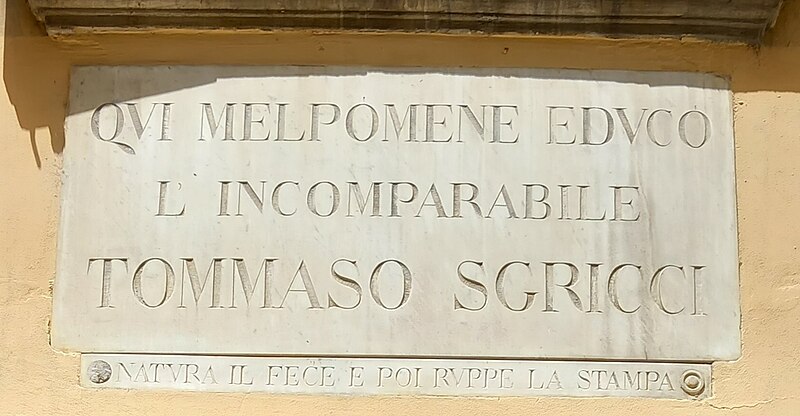
Targa che ricorda la formazione di Tommaso Sgricci ad Arezzo
Ricercastorica
Places
Named by the record
Places
Only places the record itself states, plotted where the house gazetteer settles their coordinates. Nothing is inferred from a name or a nationality.
Castiglion Fiorentino.
Birth place
Arezzo.
Death place
Primary material
Documents and archives
reference work
- “Tommaso Sgricci”, English Wikipedia, consulted as further reading
Reputable secondary · Wikipedia
authority record
- Wikidata, structured authority record Q3531272: Tommaso Sgricci
General reference · Wikidata
Notes from the source article
Cited by Wikipedia
Notes from the source article
These works are cited by the source article, in its own numbering. They are recorded as its citations, not as sources VALÉORINE has verified.
References
Citations
References
Each reference names the institution holding it, so a reader may go to the document itself.
reference work
Secondary witnessauthority record
General reference
People, houses and institutions
Knowledge graph
People, houses and institutions
Teachers, collaborators, publishers and institutions recorded against this person, each on a stated basis.
Studied at
1- University of PisaOrganisation
Established from a fact already recorded on a verified source.
The Encyclopedia exists whether or not anything is for sale. Corrections are recorded rather than overwritten, and every version of this record is kept. Published 18 August 2026.
Elsewhere in Books
39,015 published records in this field, each with its sources named.
- Tommaso CevaAuthor
- Tommaso GrossiAuthor
- Tommaso LandolfiAuthor
- Tommaso MarianiAuthor
- Tommaso StiglianiAuthor
- Tommaso TemanzaAuthor
- Tommy LapidAuthor
- Tommy LittleAuthor
Best supported in this field
For owners
Own a work by Tommaso Sgricci?
A specialist will read what you send and tell you what the house can establish, what it cannot, and whether the object is suited to sale. There is no charge and no obligation. The object stays with you throughout; nothing is shipped to us unless it is arranged in writing beforehand.