
Thomas Daniell
Thomas Daniell (174919 March 1840) was an English landscape painter who also painted Orientalist themes. He spent seven years in India, accompanied by his nephew William, also an artist, and published several series of aquatints of the country.
Also recorded as Thomas Daniel · Esq. R. A. Thomas Daniel · Thomas Daniels · Esq. R.A. T. Daniel
Thomas Daniell
Thomas Daniell · Wellcome Collection, London · Wellcome Collection · Public Domain Mark
- Name
- Thomas Daniell
- Born
- 1749
- Birthplace
- Kingston upon Thames, Surrey, England
- Died
- 19 March 1840
- Place of death
- Earls Terrace, Kensington, England
- Known for
- Painter, author, illustrator
- Training
- Queen Street, London; Royal Academy
- Movement
- Orientalist Thomas Daniel (disambiguation)
- Nationality
- United Kingdom of Great Britain and Ireland · United Kingdom
- Occupation
- painter · printmaker
- Movements
- Orientalism
- Languages
- English
VALÉORINE Encyclopedia
VALÉORINE documentary reading
Documentary summary
Thomas Daniell (174919 March 1840) was an English landscape painter who also painted Orientalist themes. He spent seven years in India, accompanied by his nephew William, also an artist, and published several series of aquatints of the country.
Admitted source layer · organised and presented by VALÉORINE
Reference Check
Propose documentary evidence for Thomas Daniell. A contribution is never written directly as fact: identity, source, rights and evidence gates still decide.
Sign in to contribute
World of VALÉORINE
Documentary connections
Only confirmed graph relationships appear here. Images are shown only when their identity and reuse rights both pass the documentary gate.

Documentary evidence
Documentary basis
Authority files
wikidata · Q708907 · wikipedia · Thomas Daniell
In this article
Key facts
Key facts
• Name — Thomas Daniell • Born — 1749 • Birthplace — Kingston upon Thames, Surrey, England • Died — 19 March 1840 • Place of death — Earls Terrace, Kensington, England • Known for — Painter, author, illustrator • Training — Queen Street, London; Royal Academy • Movement — Orientalist Thomas Daniel (disambiguation)
Early life
Early life
Thomas Daniell was born in 1749 in Kingston upon Thames, Surrey. His father was the landlord of the Swan Inn at Chertsey (where he was later succeeded by Thomas' elder brother William and his wife Sarah). Thomas began his career apprenticed to an heraldic painter and worked at Maxwell's the coach painter in Queen Street before attending the Royal Academy Schools. Although he exhibited 30 works – mainly landscapes and floral pieces – at the Academy between 1772 and 1784, Daniell found it difficult to establish himself as a landscape painter in Britain. Like many other Europeans at that time, Daniell was drawn to India by stories of the wealth and fame that awaited travellers to the newly accessible East, and in 1784 he obtained permission from the East India Company to travel to Calcutta to work as an engraver, accompanied by his nephew, William Daniell, as his assistant.
India
India
• Illustration — Sir Charles Warre Malet, Concluding a Treaty in 1790 in Durbar with the Peshwa of the Maratha Empire (1805) • Illustration — Thomas Daniell - Tiger Hunting in the East Indies, 1798 • Illustration — Thomas Daniell - Ruins of the Naurattan, Sasaram, Bihar, 1811 • Illustration — Thomas Daniell - Indian Temple, Said to Be the Mosque of Abo-ul-Nabi, Muttra, 1827 Thomas and William Daniell sailed from Gravesend on 7 April 1785, arriving in Calcutta via Whampoa in China early in 1786. In July of that year, Daniell announced, in an advertisement in the Calcutta Chronicle, his intention to publish a set of views of the city. Executed in etching and aquatint and hand-coloured by local painters, the twelve plates were completed in late 1788. In November of that year Daniell wrote to Ozias Humphrey "I was obliged to stand Painter Engraver Copper-smith Printer and Printers Devil myself. It was a devilish undertaking but I was determined to see it through at all events." On 3September 1788, the Daniells set out on a tour of north-west India leaving Calcutta by boat along the River Ganges, travelling as far as Srinagar (in the District of Garwhal, Uttrakhand), where they arrived in May 1789. Thomas and his nephew spent 1790 and 1791 in the town of Bhagalpur (now in the Indian state of Bihar) with the orientalist and amateur artist Samuel Davis, whom Thomas had first met during his apprenticeship in London. They made many stops on their return journey, not arriving back in Calcutta until February 1792. In April 1789, Daniell and his nephew travelled northward from Kanpur to Delhi, enchanted by Mughal architecture. They then explored the mountains of Garhwal, becoming among the first Europeans to visit and document the region through their artwork. On 10March 1792 the Daniells left Calcutta once more, this time for Madras (now Chennai), reaching it on the 29th of the same month. They left Madras after only 11 days, having hired the services of a considerable retinue, including two palanquins and their bearers, taking a route which more or less followed that of the British army which had defeated Tipu Sultan the previous year. They were back in Madras in January 1793. A briefer third tour took them through western India. They left Madras in the middle of February 1793 and reached Bombay the following month. In May 1793 the Daniells left India and returned to England, reaching home in September 1794.
Return to England
Return to England
On his return to England, Daniell set about publishing an extensive illustrated work under the general heading title of "Oriental Scenery". Six volumes, published between 1795 and 1808, were based on drawings made in India by the Daniells themselves; another consisted of plates of the caves at Ellora after drawings by James Wales. There were 144 plates in total including a set published as Twenty-four landscapes, views in Hindoostan drawn and engraved by Thomas and William Daniell, with permission respectfully dedicated to the Rt.Hon. George O'Brien, Earl of Egremont, first published on 1January 1804. The Daniells also published Views in Egypt (1808–9) and Picturesque Voyage to India, by Way of China (1810). They etched all the plates themselves, almost all in aquatint. Daniell continued to exhibit Eastern subjects until 1828. He also contributed drawings to Rees's Cyclopædia, but these have not been identified. • Illustration — Thomas Daniell - Temple, Fountain and Cave in Sezincote Park He contributed to some landscaping projects, designing an Indian temple for Sir John Osborne at Melchet Court, and various garden buildings for Sir Charles Cockerell's Sezincote. His paintings of Sezincote are rare exceptions to the Indian subjects which comprise almost his complete output after his return to England He was elected a Royal Academician in 1790, and a fellow of the Royal Society of Arts at around the same time. Daniell never married. He died at his home in Earls Terrace, Kensington, on 19March 1840, aged 91, having outlived both his nephews. He is buried at Kensal Green Cemetery.
Gallery
Gallery
• Illustration — Old Court House and Writers' Building, Calcutta (1786) • Illustration — Sambhal Jama Masjid, wash drawing by Thomas Daniell & William Daniell, 1789 • Illustration — Shivala Ghat, Benares, 1789 • Illustration — Hindu temples on the river at Jumna, India, 1795 • Illustration — Feroz Shah Kotla remains, Delhi, Aquatint, 1795, later reproduced on a Staffordshire earthenware dish c. 1810–20 • Illustration — The Rope Bridge at Serinagur, c. 1800 • Illustration — Taj Mahal, 1801 • Illustration — Mountain of Ellora, 1803 • Illustration — Dasavatara cave, Ellora, 1803 • Illustration — The Indian Rhinoceros • Illustration — Viswakarma, Ellora, a chaitya worship hall built around 650 CE, by Thomas Daniell and James Wales, 1803 • Illustration — The Observatory at Delhi, 1808 • Illustration — Jami Masjid, Delhi, 1811 • Illustration — A man overboard. Drawing by Thomas Daniell & William Daniell, 1810
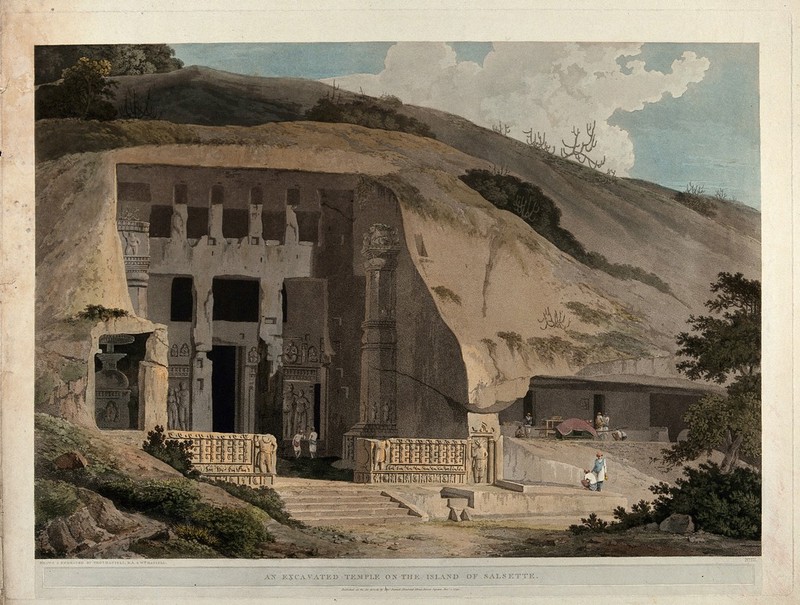
The Great Chaitya Temple on the island of Salsette, Maharashtra. Coloured aquatint by Thomas and William Daniell, 1799., 1 December 1799, by Thomas Daniell
Thomas Daniell · Wellcome Collection, London · Wellcome Collection
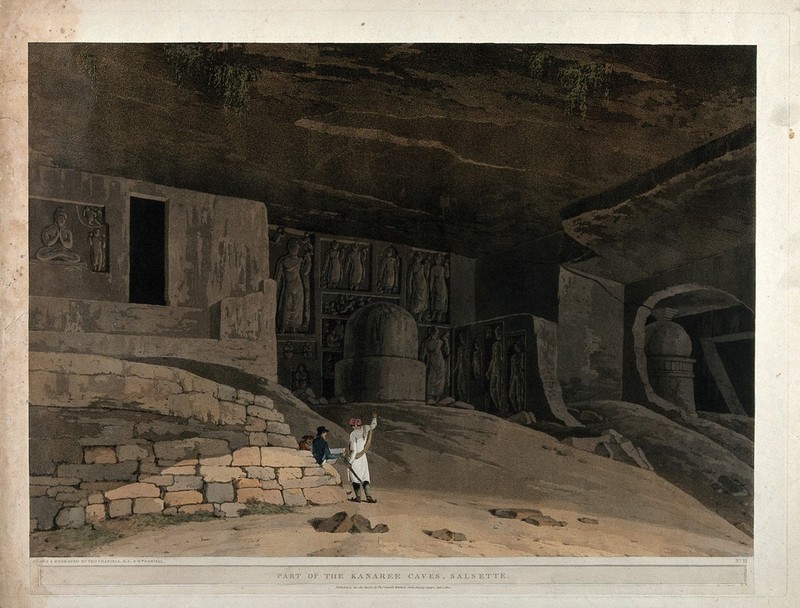
The Kanheri caves on the island of Salsette, near Bombay, Maharashtra. Coloured aquatint by Thomas and William Daniell, 1800., 1 June 1800, by Thomas Daniell
Thomas Daniell · Wellcome Collection, London · Wellcome Collection
Citations
References
Each reference names the institution holding it, so a reader may go to the document itself.
reference work
Secondary witnessreference work
Secondary witness
The Encyclopedia exists whether or not anything is for sale. Corrections are recorded rather than overwritten, and every version of this record is kept. Published 16 August 2026.
Elsewhere in Prints
4,138 published records in this field, each with its sources named.
- Thomas Charles WagemanEngraver
- Thomas CheesmanEngraver
- Thomas ChubbuckEngraver
- Thomas CookEngraver
- Thomas de LeuEngraver
- Thomas DeVany ForrestallEngraver
- Thomas DudleyEngraver
- Thomas EnderEngraver
Best supported in this field
For owners
Own a work by Thomas Daniell?
A specialist will read what you send and tell you what the house can establish, what it cannot, and whether the object is suited to sale. There is no charge and no obligation. The object stays with you throughout; nothing is shipped to us unless it is arranged in writing beforehand.