
Mary Ellen Edwards
Mary Ellen Edwards (9 November 1838 – 22 December 1934), also known as MEE, was a British artist and illustrator. She contributed to many newspapers, periodicals and children's books.
Also recorded as Mrs. Mary Ellen Staples · Mrs. Mary Ellen Freer · MEE · M. E. E.
Mary Ellen Edwards
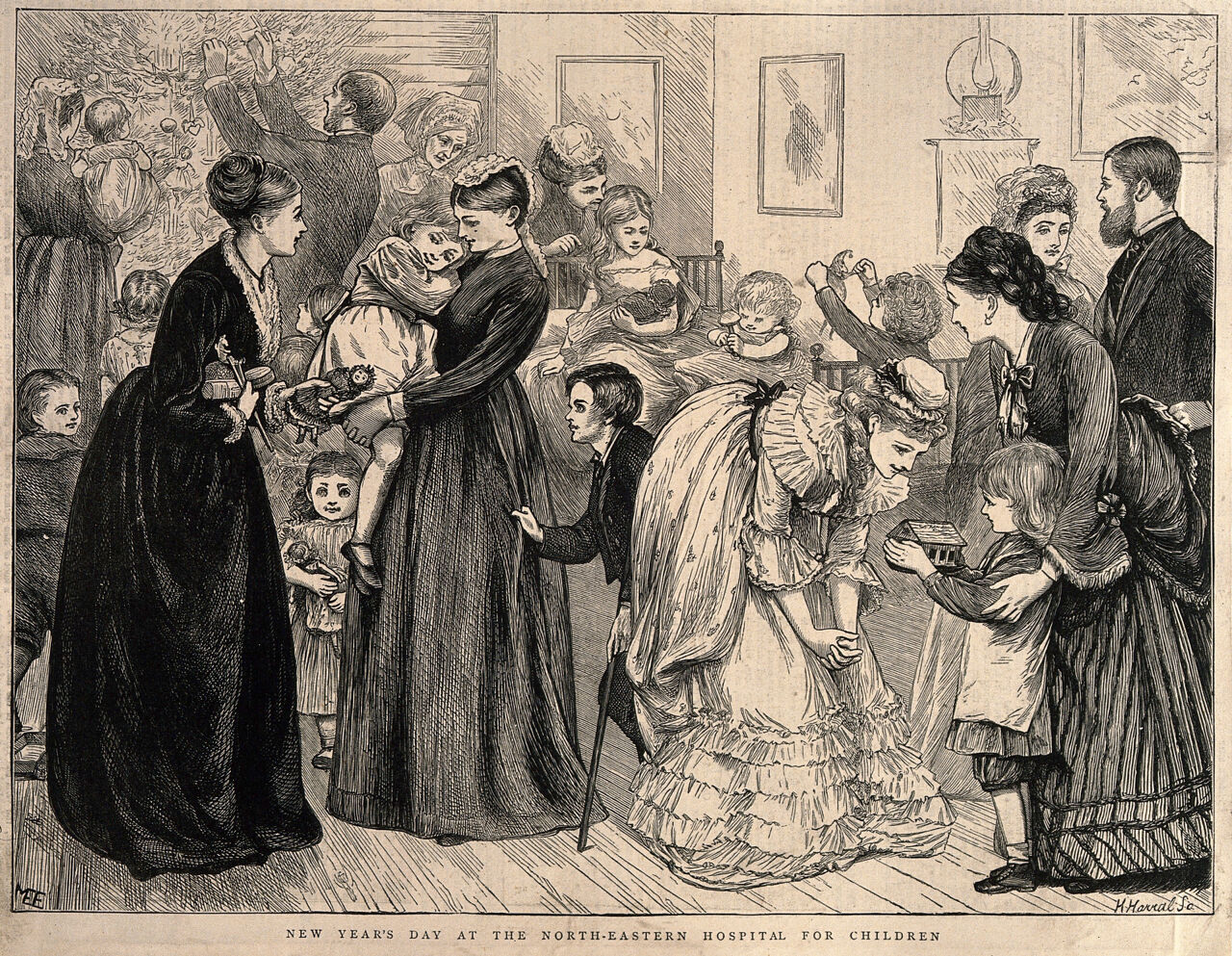
Mary Ellen Edwards · Wellcome Collection, London · Wellcome Collection · Public Domain Mark
- Born
- Mary Ellen Edwards was born on 9 November 1838. · Kingston upon Thames.
- Nationality
- United Kingdom · United Kingdom of Great Britain and Ireland
- Occupation
- illustrator
- Fields
- illustration
- Languages
- English
VALÉORINE Encyclopedia
VALÉORINE documentary reading
Documentary summary
Mary Ellen Edwards (9 November 1838 – 22 December 1934), also known as MEE, was a British artist and illustrator. She contributed to many newspapers, periodicals and children's books.
Admitted source layer · organised and presented by VALÉORINE
Reference Check
Propose documentary evidence for Mary Ellen Edwards. A contribution is never written directly as fact: identity, source, rights and evidence gates still decide.
Sign in to contribute
World of VALÉORINE
Documentary connections
Only confirmed graph relationships appear here. Images are shown only when their identity and reuse rights both pass the documentary gate.
Documentary evidence
Documentary basis
Authority files
wikidata · Q15616152 · wikipedia · Mary Ellen Edwards
In this article
Biography
Biography
• Illustration — Waifs from the Great City
Early life
Early life
Mary Ellen Edwards was born the daughter of farmer Mary Johnson and Downes Edwards, a farmer and engineer who had a number of successful inventions. She was born on her father's farm in Surbiton on 9 November 1838. She came from an artistic family. Her uncle was Edward Killingworth Johnson and her mother's uncle was James Wright, both Members of the Royal Watercolour Society. The family moved frequently. In 1848, her father built the Ravenscliffe Lodge in Douglas, Isle of Man for the family to reside in. They eventually returned to London, living in Pimlico, South Kensington and Chelsea. On 13 June 1866, Edwards married John Freer. Freer worked for the Peninsular and Oriental Company, a steam navigation service. Edwards and Freer had one son, John E. L. Freer, born in 1867. Edward's first husband (Freer) died in 1869. At this time and over the following decade Mary Ellen was submitting her work to the annual Royal Academy shows. In 1872 she married the artist John Charles Staples (1844–1897), with whom she worked on many projects until his death at the end of the century.
Education
Education
Due to her location early on in life, she was unable to receive much formal training in art. She did, however, attend South Kensington School of Art for one term. She moved frequently as a child and even as an adult, preventing extended periods of education at one place.
Career
Career
She started her artistic career at an early year in the medium of watercolor. At age 12, she switched from watercolor to oil. Outside of watercolor and engraving, Edwards was a successful illustrator, drawing her works on a wooden medium. In 1959, Checkmated, a self-made design was displayed on the cover of Illustrated Times, a weekly illustrated news magazine in Britain. In 1862, she sent her first two major works into the Royal Academy in London, England. Her works Idle Hours and I Wandered by the Brookside were accepted and displayed. From 1864 to 1908, she sent in work every year, missing only 1873 due to illness. By 1908, she had exhibited 38 art pieces at the Royal Academy. Her first piece that gained notoriety due to being purchased for publication, The Last Kiss, was displayed in 1865. Also purchased and subsequently engraved were her works In Memoriam and Good-bye. She established a substantial reputation for her illustrations of Trollope's The Claverings, which was serialized in the Cornhill Magazine from 1866 to 1867. She illustrated many children's books, including That Boy of Northcott's by Charles Lever, many of which were printed in Cornhill as well. From 1869 to 1880 she was on the staff of The Graphic. Throughout her lengthy career, she worked for the Cornhill Magazine, the Illustrated Times, the Graphic, Belgravia, Churchman, Argosy, and Good Works. Outside of her nearly-annual submissions to the Royal Academy, she exhibited four works at the Royal Society of British Artists, one work at the Royal Scottish Academy, eight works at the Royal Glasgow Institute, two works at the British Institution, and nine works at the Society of Women Artists. She contributed to exhibits at the Dudley Gallery in both watercolor and in black and white while her work was also exhibited in galleries in France. Her illustration Waifs from the Great City was included in the 1905 book Women Painters of the World.
Artistic works
Artistic works
• Idle Hours • I Wandered by the Brookside • The Last Kiss • In Memoriam • Good-bye • Checkmated • That Boy of Northcott's (illustrated) • Pleading for Peace • The Old Church Path • Rosalind and Celia • The Dance of Death • Illustration — Waifs from the Great City • Illustration — The Claverings
Identity
Identity
Mary Ellen Edwards is recorded as illustrator.
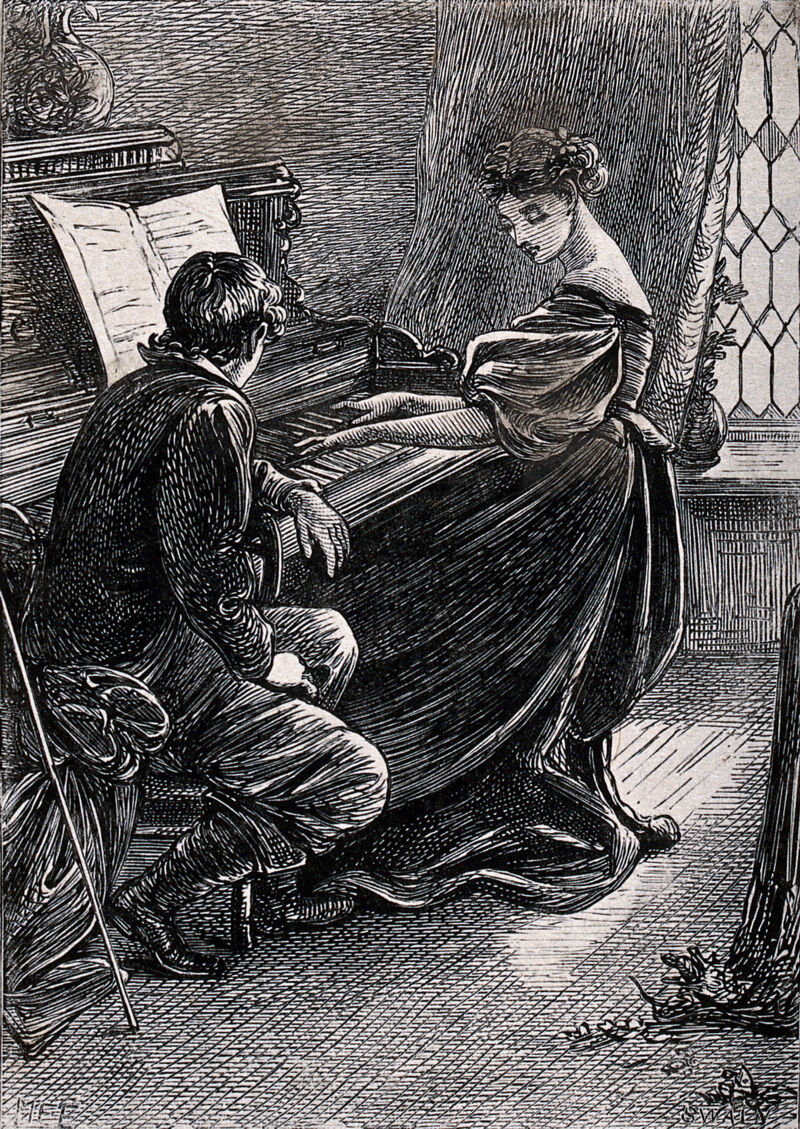
A young woman plays the piano while a young man leans and listens. Etching by Swain after M.E. Edwards., by Mary Ellen Edwards
Mary Ellen Edwards · Wellcome Collection, London · Wellcome Collection
Life and career
Dated record
Life and career
The full dated record · 2 entries
1838
Mary Ellen Edwards born at Kingston upon Thames.
1934
Mary Ellen Edwards died.
Places
Named by the record
Places
Only places the record itself states, plotted where the house gazetteer settles their coordinates. Nothing is inferred from a name or a nationality.
Mary Ellen Edwards was born in Kingston upon Thames.
Birthplace
Kingston upon Thames.
Birth place
Example of book illustration by Edwards
The following illustrations were painted by Edwards for Through the Meadows (1885) by Frederic Edward Weatherly (1848-1929). As well as the 24 colour illustrations by Edwards, there were as many silluoutes by John C. Staples. These images are by courtesy of the Osborne Collection of Early Children's Books at the Toronto Public Library. • Illustration — Page 6 • Illustration — Page 9 • Illustration — Page 11 • Illustration — Page 14 • Illustration — Page 16 • Illustration — Page 19 • Illustration — Page 22 • Illustration — Page 25 • Illustration — Page 27 • Illustration — Page 30 • Illustration — Page 32 • Illustration — Page 35 • Illustration — Page 38 • Illustration — Page 41 • Illustration — Page 43 • Illustration — Page 46 • Illustration — Page 48 • Illustration — Page 51 • Illustration — Page 54 • Illustration — Page 57 • Illustration — Page 59 • Illustration — Page 62 • Illustration — Page 64 • Illustration — Page 67
Style and influence
Mary Ellen Edwards worked and lived in both the 19th and early 20th centuries. Due to the prevailing social climate of the time, she was not very popular among a society that viewed her art through the traditional male lens. She focused more on illustrations that conveyed emotion in a social setting, and she was extremely successful at it. Furthermore, many of her works revolve around social settings with groups of people. She was exceptional at illustrating emotion in her work, and her pieces are very powerful and easy to understand. Unfortunately her style did not catch on among the broad population due to her status as a member of "feminine art"; her works were often viewed as "feminine", "sentimental", and "domestic": rarely equitably compared with her male counterparts.
Primary material
Documents and archives
scholarly publication
- Mary Ellen Edwards, Trollope and His Illustrators, 1980
Scholarly · Crossref registry · 1980
authority record
- Wikidata, structured authority record Q15616152: Mary Ellen Edwards
General reference · Wikidata
reference work
- “Mary Ellen Edwards”, English Wikipedia, consulted as further reading
Reputable secondary · Wikipedia
Literature
Scholarly footprint
A count of publications is evidence of attention, not of standing, and is given here only as a measure.
Notes from the source article
Cited by Wikipedia
Notes from the source article
These works are cited by the source article, in its own numbering. They are recorded as its citations, not as sources VALÉORINE has verified.
- 1.'Births, Marriages, Deaths', The Times, 24 December 1934, p. 1 [front-page].
- 2.Mary Ellen Edwards – A Victorian Woman Illustrator. Aberystwyth University School of Art Museum & Galleries. 10 January 2019.
- 3.Oxford University Press. Benezit Dictionary of British Graphic Artists and Illustrators, Volume 1. 364. 2012. 9780199923052.
- 4.Gray, Sara. The Dictionary of British Women Artists. Casemate Publishers. 2009-01-01. 9780718830847.
- 5.Women painters of the world, from the time of Caterina Vigri, 1413-1463, to Rosa Bonheur and the present day, by Walter Shaw Sparrow, The Art and Life Library, Hodder & Stoughton, 27 Paternoster Row, London, 1905
- 6.Mary Ellen Edwards and Illustration of the 1860s. www.victorianweb.org.
References
Citations
References
Each reference names the institution holding it, so a reader may go to the document itself.
scholarly publication
Mary Ellen Edwards, Trollope and His Illustrators, 1980Crossref registry
Institutional witnessauthority record
Secondary witnessreference work
Secondary witness
Further particulars
Held on the record
Further particulars
Open the remaining particulars
Mary Ellen Staples; MEE; Mrs. Mary Ellen Freer; Mrs.
The Encyclopedia exists whether or not anything is for sale. Corrections are recorded rather than overwritten, and every version of this record is kept. Published 16 August 2026.
Elsewhere in Illustration
5,224 published records in this field, each with its sources named.
- Mary Barbara BaileyIllustrator
- Mary BlairIllustrator
- Mary DobieIllustrator
- Mary Dora RogickIllustrator
- Mary Ellen Sigsbee FischerIllustrator
- Mary Emily EatonIllustrator
- Mary EngelbreitIllustrator
- Mary FabilliIllustrator
Best supported in this field
For owners
Own a work by Mary Ellen Edwards?
A specialist will read what you send and tell you what the house can establish, what it cannot, and whether the object is suited to sale. There is no charge and no obligation. The object stays with you throughout; nothing is shipped to us unless it is arranged in writing beforehand.