
Tenshō Shūbun
Illustration — Reading in a Bamboo Grove (1446) • Illustration — Landscape of the Four Seasons in the collection of Tokyo National Museum, attributed to Shūbun Tenshō Shūbun was a Japanese Zen Buddhist monk and painter of the Muromachi period.
Also recorded as Tensho Shubun · Tenshou Shuubun · Shūbun
Tenshō Shūbun
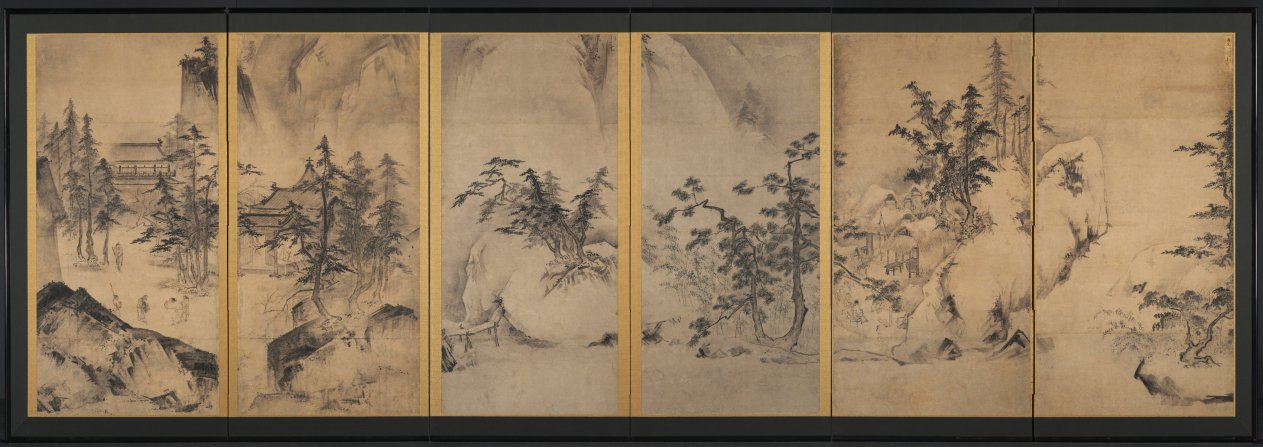
Tenshō Shūbun · The Cleveland Museum of Art · The Norweb Collection · CC0
- Born
- Tenshō Shūbun was born in 1414.
- Died
- Tenshō Shūbun died in 1463. · Kyoto.
- Nationality
- Japan
- Occupation
- painter · buddhist monk
- Teachers
- Josetsu
- Known for
- Hue of the Water and Light on the Peaks · Reading in a Bamboo Grove
VALÉORINE Encyclopedia
VALÉORINE documentary reading
Documentary summary
Illustration — Reading in a Bamboo Grove (1446) • Illustration — Landscape of the Four Seasons in the collection of Tokyo National Museum, attributed to Shūbun Tenshō Shūbun was a Japanese Zen Buddhist monk and painter of the Muromachi period.
Admitted source layer · organised and presented by VALÉORINE
Note VALÉORINE
No house-authored Note is published until its assertions and sources pass the VALÉORINE evidence contract. The documentary article remains available in full while that enrichment is being consolidated.
Documentary enrichment in progress · no unsupported statement published
Reference Check
Propose documentary evidence for Tenshō Shūbun. A contribution is never written directly as fact: identity, source, rights and evidence gates still decide.
Sign in to contribute
World of VALÉORINE
Documentary connections
Only confirmed graph relationships appear here. Images are shown only when their identity and reuse rights both pass the documentary gate.
Documentary evidence
Evidence Panel
not yet certified
- Identity
- unresolved
- Independent source families
- 0
- Admitted assertions
- 0
- Open conflicts
- 0
Authority files
wikidata · Q2706164 · wikipedia · Tenshō Shūbun
In this article
Biography
Biography
Training under Josetsu is recorded. Ten-Ō Sōtan is recorded as having studied under Tenshō Shūbun. Places of work recorded in the authority are Kyoto. Employment is recorded with Shōkoku-ji Temple. Works named in the authority record are Hue of the Water, Light on the Peaks and Reading in a Bamboo Grove. Work by Tenshō Shūbun is recorded in the collections of Cleveland Museum of Art, Seattle Art Museum, Metropolitan Museum of Art, Nara National Museum and Tokyo National Museum.
Shūbun was born in the late 14th century in Ōmi Province and became a professional painter around 1403. He settled in Kyoto, then the capital city. He became director of the court painting bureau, established by Ashikaga shōguns, which consisted of influential art patrons. He was chosen by the members of the diplomatic mission to Joseon in 1423. Shūbun is considered to be the founder of the Chinese style of suiboku ink painting in Japan. He was influenced by Chinese landscape painters Xia Gui and Ma Yuan. Throughout his life, Shūbun was associated with the Zen Buddhist temple, Shōkoku-ji. Early in his career, he studied painting there under Josetsu, a Chinese immigrant who became the father of the new Japanese ink painting tradition. Under Josetsu's influence, Shūbun started studying Chinese Song dynasty painting by masters such as Xia Gui and Ma Yuan; consequently, Shūbun's style was an intermediate step between early Japanese artists who imitated Chinese models very closely, and later artists, who developed a national style. Later in life, Shūbun became overseer of buildings and grounds at Shōkoku-ji. In the 1440s he taught the young Sesshū Tōyō, who became his best pupil and the most highly regarded Japanese artist of his time. Another important pupil may have been Kanō Masanobu, who succeeded Shūbun as the chief painter of the Ashikaga shogunate, and also founded the Kanō school of painting. Shūbun's most well-known painting, designated as a National Treasure in Japan, is Reading in a Bamboo Grove, now kept in the Tokyo National Museum. The same museum houses a few other works attributed to Shūbun, among them a pair of folding screens titled Landscape of Four Seasons. Two more pairs of folding screens depicting landscapes of the four seasons are held by the Seikadō Bunko Art Museum. As with many Japanese and Chinese artists of this and earlier periods, many works survive that are attributed to Shūbun, but only for a few is this attribution secure. Contemporary accounts describe Shūbun as a very versatile artist, yet the only extant works with the authorship issue resolved are landscapes.
Life and career
Dated record
Life and career
The full dated record · 2 entries
1414
Tenshō Shūbun was born on 1 January 1414.
1463
Tenshō Shūbun died on 1 January 1463.
Places
Named by the record
Places
Only places the record itself states, plotted where the house gazetteer settles their coordinates. Nothing is inferred from a name or a nationality.
Tenshō Shūbun died in Kyoto.
Deathplace
Kyoto.
Death place
Primary material
Documents and archives
authority record
- Wikidata, structured authority record Q2706164: Tenshō Shūbun
Unverified · Wikidata
reference work
- “Tenshō Shūbun”, English Wikipedia, consulted as further reading
Reputable secondary · Wikipedia
Citations
References
Each reference names the institution holding it, so a reader may go to the document itself.
authority record
Partially resolvedreference work
Partially resolved
The Encyclopedia exists whether or not anything is for sale. Corrections are recorded rather than overwritten, and every version of this record is kept. Published 18 August 2026.
Elsewhere in Paintings
18,452 published records in this field, each with its sources named.
- Temo SvirelyArtist
- Tenga RinpocheArtist
- Tengiz KitovaniArtist
- Tennyson ColeArtist
- Teo OttoArtist
- Teodor AxentowiczArtist
- Teodor BuchholzArtist
- Teodor Ilić ČešljarArtist
Best supported in this field
For owners
Own a work by Tenshō Shūbun?
A specialist will read what you send and tell you what the house can establish, what it cannot, and whether the object is suited to sale. There is no charge and no obligation. The object stays with you throughout; nothing is shipped to us unless it is arranged in writing beforehand.