
Robert Gibb
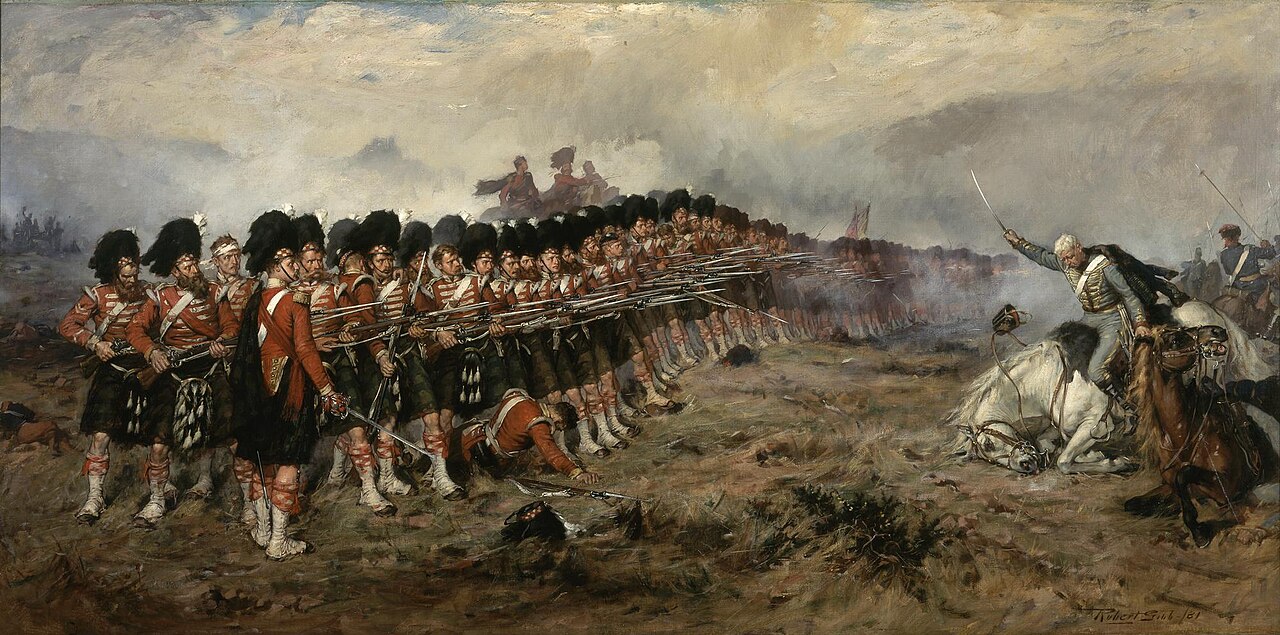
Illustration — The Thin Red Line, 1881 • Illustration — Gibb's home at 2 Bruntsfield Crescent, Edinburgh Robert Gibb RSA (28 October 1845 – 11 February 1932) was a Scottish painter. He was Keeper of the National Gallery of Scotland from 1895 to 1907 and was Painter and Limner to the King from 1908 until his death. He built his reputation on romantic, historical and particularly military paintings but was also a significant portrait artist.
Also recorded as Robert II Gibb · Robert, le jeune Gibb
Robert Gibb
Robert Gibb · Public domain
- Born
- 1845 · Edinburgh.
- Died
- 1932 · Edinburgh.
- Nationality
- United Kingdom · United Kingdom of Great Britain and Ireland
- Occupation
- painter
- Education
- Royal Scottish Academy
- Languages
- English
VALÉORINE Encyclopedia
VALÉORINE documentary reading
Documentary summary
Illustration — The Thin Red Line, 1881 • Illustration — Gibb's home at 2 Bruntsfield Crescent, Edinburgh Robert Gibb RSA (28 October 1845 – 11 February 1932) was a Scottish painter. He was Keeper of the National Gallery of Scotland from 1895 to 1907 and was Painter and Limner to the King from 1908 until his death. He built his reputation on romantic, historical and particularly military paintings but was also a significant portrait artist.
Admitted source layer · organised and presented by VALÉORINE
Reference Check
Propose documentary evidence for Robert Gibb. A contribution is never written directly as fact: identity, source, rights and evidence gates still decide.
Sign in to contribute
World of VALÉORINE
Documentary connections
Only confirmed graph relationships appear here. Images are shown only when their identity and reuse rights both pass the documentary gate.
Documentary evidence
Documentary basis
Authority files
wikidata · Q3286980
In this article
Life
Life
Robert Gibb studied at Royal Scottish Academy. The recorded working language is English. Work by Robert Gibb is recorded in the collections of Scottish National Gallery, National Galleries Scotland, Kelvingrove Art Gallery and Museum, Perth Art Gallery and Royal Cambrian Academy of Art.
• Illustration — The Gibb grave, Warriston Cemetery Gibb was born at 28 Greenside Street in Edinburgh, the son of Alexander Gibb, a builder. His older brother was the artist William Gibb. The family moved to 5 Regent Terrace on Calton Hill in 1855. The family moved again to Mayfield Terrace in the south of the city when Robert was a teenager. Gibb studied art at evening classes at the Board of Manufacturers in Edinburgh and at the life school of the Royal Scottish Academy (RSA). He began exhibiting at the RSA in 1867 showing an Arran landscape; this would be the first of no fewer than 143 paintings exhibited at the academy. By the end of the next decade, he had begun to establish his reputation as a painter of battles. Following Comrades, his first foray into the military genre, he was elected an Associate of the Royal Scottish Academy. The theme of this painting, a group of three soldiers, one of whom has fallen in the snow, was taken from his painting showing the retreat from Moscow which was shown the following year. He was made a full member following the enormous success of his 1881 painting The Thin Red Line which was inspired by his reading of Alexander William Kinglake's book The Invasion of Crimea. Three years later came Schoolmates, depicting two highland officers in the heat of battle, one falling wounded into the arms of the other. In 1895, he was appointed Principal Curator of the National Gallery of Scotland, following the death of Gourlay Steell, and served in this role until 1907. He continued painting military scenes throughout the Great War, and his last military painting Backs to the Wall appeared in 1929. Gibb was also sought after as a portrait painter. Among his subjects were Henry Morton Stanley, Rev. Joseph Parker, D.D., and Sir Arthur Halkett, Bart. He also painted his wife, the former Margaret Shennan, second daughter of the Lord Dean of the Guild, whom he married in 1885. The artist died at his residence at 2 Bruntsfield Crescent, Edinburgh in 1932. He was given a full military funeral with honour guard in Warriston Cemetery on 15 February. Although some claim his grave lies on a path edge south of the vaults (with no gravestone), this does not make complete sense as the family already had a burial plot in a south-west section (around 30m south of the alleged site). This was the burial place of his brother William in 1929. The lack of inscription to Robert is explained by his lack of family at the time of death.
Works about
Works about
• Gilbert, W. Matthews, "Robert Gibb, R.S.A.", Art Journal 1897, pp. 25–28. • Harrington, Peter. (1993). - British Artists and War: The Face of Battle in Paintings and Prints, 1700-1914. - London: Greenhill. - • Harrington, Peter, "The Man who Painted the Thin Red Line", Scots Magazine, Volume 130, No, 6, March 1989, pp. 587–595. • Obituary, Times, 13 February 1932, p. 12.

Backs to the Wall, 1918
Robert Gibb · [1]

Painting entitled The Thin Red Line, oil on canvas, by Robert Gibb, 1881
Robert Gibb · This file was derived from: Robert Gibb - The Thin Red Line.jpg
Life and career
Dated record
Life and career
The full dated record · 2 entries
1845
Robert Gibb born at Edinburgh.
1932
Robert Gibb died at Edinburgh.
Paintings
• Head of Glen-Lester, Arran (1867) • Visit of William, Lord Russell's Family before his Execution (1872) • Death of Marmion (1873) • Columbia in sight of Iona (1874) • Elaine (1875) • Margaret of Anjou and the Outlaw (1875) • Death of St Columba (1876) • Bridge of Sighs (1877) • Comrades (1878 - Private Collection) • Retreat from Moscow (1879 - Private Collection) • The Thin Red Line, (1881 - National War Museum, Edinburgh) • Last Voyage of the Viking, 1883) • The Sea King (1883) • Schoolmates (1884 - Private Collection) • Letters from Home (1885 - destroyed) • Alma: Advance of the 42nd Highlanders (1889 - Kelvingrove Art Gallery and Museum, Glasgow) • Saving the Colours; the Guards at Inkerman (1895 - Naval and Military Club, London) • Comrades (1878 - Private Collection) • Comrades (1896 - Black Watch) • Hougomont-1815 (1903 - National War Museum, Edinburgh) • Dargai, October 20, 1897 (1909 - Private Collection) • The Red Cross (1913) • Communion at the Front (1917) • Backs to the Wall, 1918 (1929 - Arbroath Museum)
Notes from the source article
Cited by Wikipedia
Notes from the source article
These works are cited by the source article, in its own numbering. They are recorded as its citations, not as sources VALÉORINE has verified.
- 1.Edinburgh and Leith Post Office Directory 1845-46
- 2.William Gibb Artist. 16 August 2014.
- 3.Edinburgh and Leith Post Office Directory 1859-60
- 4.Wordsworth, Dot. What, exactly, is a 'red line'?. The Spectator magazine. 8 June 2013.
- 5.The Concept of the Master in Art Education: by Matthew Potter
- 6.Edinburgh and Leith Post Office Directory 1911-12
References
Citations
References
Each reference names the institution holding it, so a reader may go to the document itself.
reference work
Secondary witness
Further particulars
Held on the record
Further particulars
Open the remaining particulars
Recognition and collections
Work by Robert Gibb is
Scottish National Gallery, National Galleries Scotland, Kelvingrove Art Gallery and Museum and Perth Art Gallery
The Encyclopedia exists whether or not anything is for sale. Corrections are recorded rather than overwritten, and every version of this record is kept. Published 18 August 2026.
Elsewhere in Paintings
18,623 published records in this field, each with its sources named.
- Robert FuestArtist
- Robert FultonArtist
- Robert G. L. LeonoriArtist
- Robert GeninArtist
- Robert GreenleesArtist
- Robert GriffierArtist
- Robert GuttmannArtist
- Robert HammerstielArtist
Best supported in this field
For owners
Own a work by Robert Gibb?
A specialist will read what you send and tell you what the house can establish, what it cannot, and whether the object is suited to sale. There is no charge and no obligation. The object stays with you throughout; nothing is shipped to us unless it is arranged in writing beforehand.