
QF 6 inch/40 gun
The QF 6-inch 40 calibre naval gun (Quick-Firing) was used by many United Kingdom-built warships around the end of the 19th century and the start of the 20th century. In British service it was known as the QF 6-inch Mk I, II, III guns. It was also the heaviest gun ever carried by a pre-Cold War destroyer.
QF 6 inch/40 gun

Imperial Japanese Navy General Staff · Records of Naval Battles in Meiji 37th, 38th vol. 2 · Public domain
- Name
- QF 6-inch 40 calibre naval gun 15 cm/40 (6") 41st Year Type
- Field
- rifled breech loader · naval artillery
- Region
- United Kingdom of Great Britain and Ireland
VALÉORINE Encyclopedia
VALÉORINE documentary reading
Documentary summary
The QF 6-inch 40 calibre naval gun (Quick-Firing) was used by many United Kingdom-built warships around the end of the 19th century and the start of the 20th century. In British service it was known as the QF 6-inch Mk I, II, III guns. It was also the heaviest gun ever carried by a pre-Cold War destroyer.
Admitted source layer · organised and presented by VALÉORINE
Note VALÉORINE
No house-authored Note is published until its assertions and sources pass the VALÉORINE evidence contract. The documentary article remains available in full while that enrichment is being consolidated.
Documentary enrichment in progress · no unsupported statement published
Reference Check
Propose documentary evidence for QF 6 inch/40 gun. A contribution is never written directly as fact: identity, source, rights and evidence gates still decide.
Sign in to contribute
Documentary evidence
Evidence Panel
not yet certified
- Identity
- resolved
- Independent source families
- 0
- Admitted assertions
- 0
- Open conflicts
- 0
Authority files
wikidata · Q1642887
In this article
Key facts
Key facts
• Name — QF 6-inch 40 calibre naval gun 15 cm/40 (6") 41st Year Type • Origin — United Kingdom License-produced in Japan • Type — Naval gun Coast defence gun • Is Ranged — YES • Is Artillery — YES • Is Uk — YES • Service — 1892–1945 • Used By — Royal Navy Imperial Japanese Navy Chilean Navy Italian Navy Argentine Navy United States Romanian Navy Royal Canadian Navy • Wars — Russo-Japanese War World War I World War II • Manufacturer — Elswick Ordnance Company Royal Arsenal, Woolwich • Weight — 6.6 tons • Part Length — 240 in bore • Cartridge — QF, separate cartridge and shell • Cartridge Weight — 100 lb • Caliber — 6-inch (152mm) • Rate — 5–7 rounds per minute • Velocity — 2154 ft/s 820 ft/s for anti-submarine shells • Range — 10000 yd at 20°elevation; 15000 yd at 28°elevation • Elevation — -5 / +20 degrees • Traverse — +150 / -150 degrees
QF technology
QF technology
• Illustration — Loading a MK I or II deck gun on Ariadne. The man at left holds a shell, the men at right hold brass powder cartridges. Note the coned breech screw and lugs on the underside of the breech ring to which recoil cylinders are attached These guns were developed to exploit the new "QF" technology, which involved loading the propellant charge in a brass case with integrated primer in its base. This allowed a faster rate of fire than the older "Breech Loading" system, where the propellant was loaded in cloth bags and then a separate friction or percussion tube fitted into the breech for firing. The brass case sealed the breech, allowing a lighter mechanism, and at the same time disposed with the necessity of washing or sponging any smouldering fragments left from the previous shot, which could ignite the charge (then of black powder) prematurely. The QF principle had proved successful with the much smaller QF 3 pounder Hotchkiss and Nordenfelt QF 3- and 6-pounders from 1885 onwards, and with QF 4.7-inch Mk I – IV naval gun from 1886. The Mk I was an Elswick gun of built up construction, which passed its trials on Elswick range near Silloth in the presence of Lord George Hamilton in October 1890. Mk II was built by Woolwich Arsenal and in 1891 became the first Royal Navy gun using the Armstrong wire-wound construction. The breech mechanisms were developed from the existing 6 in BL mechanisms, but as it no longer had to provide obturation (sealing of the breech), the front was made coned rather than straight which allowed it to be swung round to the side before it was fully withdrawn, rather than having to be fully withdrawn before swinging to the side as with the BL gun.
Recoil system
Recoil system
• Illustration — MK III gun at Fort Nelson. This shows the left trunnion (detailed in black) by which it is mounted on a Vavasseur recoil slide, and there are no lugs on the underside of the breech ring The preceding generation of British 6-inch guns (BL Mks III, IV and VI) had old-style trunnions by which they were mounted on Vavasseur inclined slides to absorb recoil. QF Mk I and II dispensed with trunnions and instead on the lower side of the breech ring were lugs to which were attached modern recoil buffer and hydrospring recuperator (runout) cylinders to absorb recoil and return the barrel to loading position after firing. This allowed the gun to recoil directly backwards rather than backwards and upwards as previously and is the recoil system which in essence is still in use. Mk III was built by Elswick and was similar to Mk I except that it had trunnions which allowed it to be deployed on the remaining obsolescent but still in service Vavasseur recoil mountings. All 3 Marks had the same dimensions and performance.
Royal Navy service
Second Boer War land service
Second Boer War land service
During the Second Boer War one gun was brought ashore from Terrible in Natal in February 1900 at the request of General Redvers Buller, presumably in response to the failure at Colenso. It was mounted on an improvised field carriage by Captain Percy Scott and transported by rail to Chieveley, just south of Colenso. There it was manned by Royal Navy gunners to provide useful fire support for the British Army during the relief of Ladysmith. It is reported on 17 February to have fired from "Gun Hill" (a small kopje two miles (3 km) north of Chieveley) and knocked out a Boer gun at, followed by a Boer searchlight, as Buller approached Ladysmith from the South East and pushed the Boers back towards the Tugela river. On 26 February Lieutenant Burne reports firing from the same position on a Boer gun at at 28° elevation and falling short. The 7-ton weight (compared to the 2½ tons of the Boer 155 mm "Long Tom") meant that it was effectively immobile on the battlefield and could not be moved forward to shorten the range. Two guns were also mounted on armoured trains, crewed by the Royal Garrison Artillery.
Coast defence gun
Coast defence gun
From 1894 a number of guns were adapted for coast defence use, with the original 3-motion breeches replaced by modern single-motion breeches to increase the rate of fire, which designated them as "B" guns. Nineteen guns were still active in the defence of the UK as at April 1918: Jersey (2), Guernsey (2), Alderney (2), Shoeburyness (2), Blyth (2), Clyde Garrison (1), Mersey (2), Berehaven Garrison (Bantry Bay, Ireland) (6).
World War I anti-aircraft gun
World War I anti-aircraft gun
• Illustration — Anti-aircraft mounting on Prince of Wales Pier, Dover At least one gun is known to have been mounted by the Royal Navy on an improvised anti-aircraft mounting on a railway truck, defending docks during the First World War.
Conversion to 8 inch (203 mm) howitzer
Conversion to 8 inch (203 mm) howitzer
In World War I Britain urgently needed heavy artillery on the Western Front, and various obsolete 6-inch naval guns were converted to 8-inch howitzers. Sixty-three QF 6-inch Mk II guns were shortened, bored out to and converted to BL type to produce the BL 8-inch howitzer Mk V. Four entered service in December 1915 and 59 followed in 1916.
Italian naval service
Japanese naval service
Romanian naval service
US service
US service
• Illustration — Gun relocated from Fort Dade to Fort DeSoto, Florida These guns were adopted in very limited quantity by the United States Army Coast Artillery Corps as part of the Endicott period fortifications, and were initially mounted 1898–1907. They were acquired in 1898 due to the outbreak of the Spanish–American War. It was feared that the Spanish fleet would bombard US ports, and most of the Endicott forts were still years from completion. So the 6-inch guns, along with 34 4.7-inch Armstrong guns and 21 8-inch M1888 guns on 1870s carriages, were acquired to quickly arm some forts with modern quick-firing guns. They were designated as "6-inch Armstrong guns" and mounted on pedestals in US service, and appear to have been withdrawn from service by 1925. A total of nine guns were mounted in one-, two-, or three-gun batteries, with four of the nine transferred to Hawaii 1913–1917. Eight guns were initially at Fort Williams (Maine) (1), Fort Greble, Rhode Island (1), Fort Wadsworth, Staten Island, NY (2), Fort Moultrie, Charleston, South Carolina (1), Fort Screven, Tybee Island, Georgia (1), and Fort Dade, Tampa Bay, FL (2). The guns at Fort Greble and Fort Moultrie were dismounted in 1903-04. In 1907 three guns were mounted at Fort Adams, Rhode Island, probably the two dismounted guns plus one either newly acquired or from spares. The four guns from Fort Williams and Fort Adams were transferred to Ford Island, Pearl Harbor, Hawaii as Batteries Adair and Boyd beginning in 1913. The two from Fort Dade survive at Fort DeSoto near St. Petersburg, Florida. Their battery at Fort Dade has succumbed to tide action over the years.
Canadian service
Canadian service
These guns were aboard Niobe when the ship was transferred to Canada as HMCS Niobe in 1910.
Surviving examples
Surviving examples
• On board Japanese battleship Mikasa, Yokosuka, Japan • Two coast defence guns at Fort DeSoto, Florida, USA. • A Mk III gun and shield from HMS Calypso at Fort Nelson, Portsmouth, UK • Two guns are on display at Howe Military Academy in Howe Indiana • Two guns, originally from HMS Gibraltar, set up on the island of Vementry, Shetland during WW1 to defend the approach to Swarbacks Minn naval anchorage.
Weapons of comparable role, performance and era
Weapons of comparable role, performance and era
• 15 cm SK L/40 naval gun German equivalent • 6"/40 caliber gun US equivalent
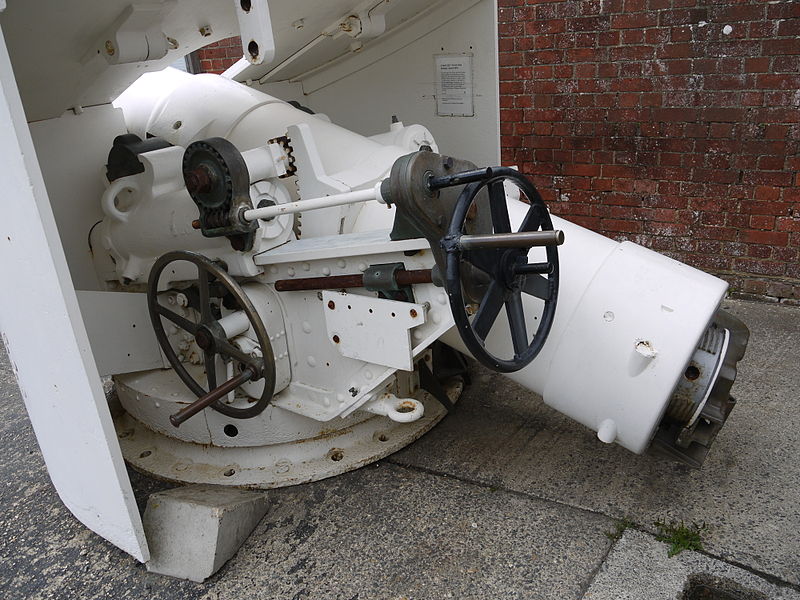
Photo of the rear of a QF 6 inch Mk III naval gun on Vavasseur recoil mounting, at Royal Armouries, Fort Nelson. For front left view see File:6 inch gun from HMS Calypso.jpg
Geni · Photo by user:geni

Diagram depicting 6-inch common pointed shell for BL or QF gun. Weight filled and fuzed 100 pounds.
British government · Plate XXV in "Handbook of the B.L. 6-inch 26-cwt. Mark I howitzer on Mark I travelling carriage, (land service)", 1919.
Citations
References
Each reference names the institution holding it, so a reader may go to the document itself.
reference work
Partially resolved
The Encyclopedia exists whether or not anything is for sale. Corrections are recorded rather than overwritten, and every version of this record is kept. Published 14 August 2026.
Elsewhere in Militaria
6,095 published records in this field, each with its sources named.
- QF 4.7 inch Mk I–IV gunTerminology
- QF 4.7 inch Mk XI gunTerminology
- QF 5.25 inch gunTerminology
- QF 6 inch Mark N5 gunTerminology
- QF 6 pounder 10 cwt gunTerminology
- QF 6 pounder 6 cwt HotchkissTerminology
- QF 6 pounder Nordenfelt gunTerminology
- QF 6-pounder 7-cwt gun Mark 2Terminology
Best supported in this field
For owners
Own an object connected with QF 6 inch/40 gun?
A specialist will read what you send and tell you what the house can establish, what it cannot, and whether the object is suited to sale. There is no charge and no obligation. The object stays with you throughout; nothing is shipped to us unless it is arranged in writing beforehand.