
QF 12 pounder 12 cwt gun
The QF 12-pounder 12-cwt gun (Quick-Firing) (abbreviated as Q.F. 12-pdr. [12-cwt.]) was a common, versatile 3 in calibre naval gun introduced in 1894 and used until the middle of the 20th century. It was produced by Armstrong Whitworth, Elswick and used on Royal Navy warships, exported to allied countries, and used for land service. In British service "12-pounder" was the rounded value of the projectile weight, and "12 cwt (hundredweight)" was the weight of the barrel and breech, to differentiate it from other "12-pounder" guns.
Also recorded as 76L40 naval gun 12-pdr 12-cwt · 12 pounder 12 cwt naval gun · 3"/40 naval gun 12-pdr 12-cwt · 12-pdr QF gun
QF 12 pounder 12 cwt gun
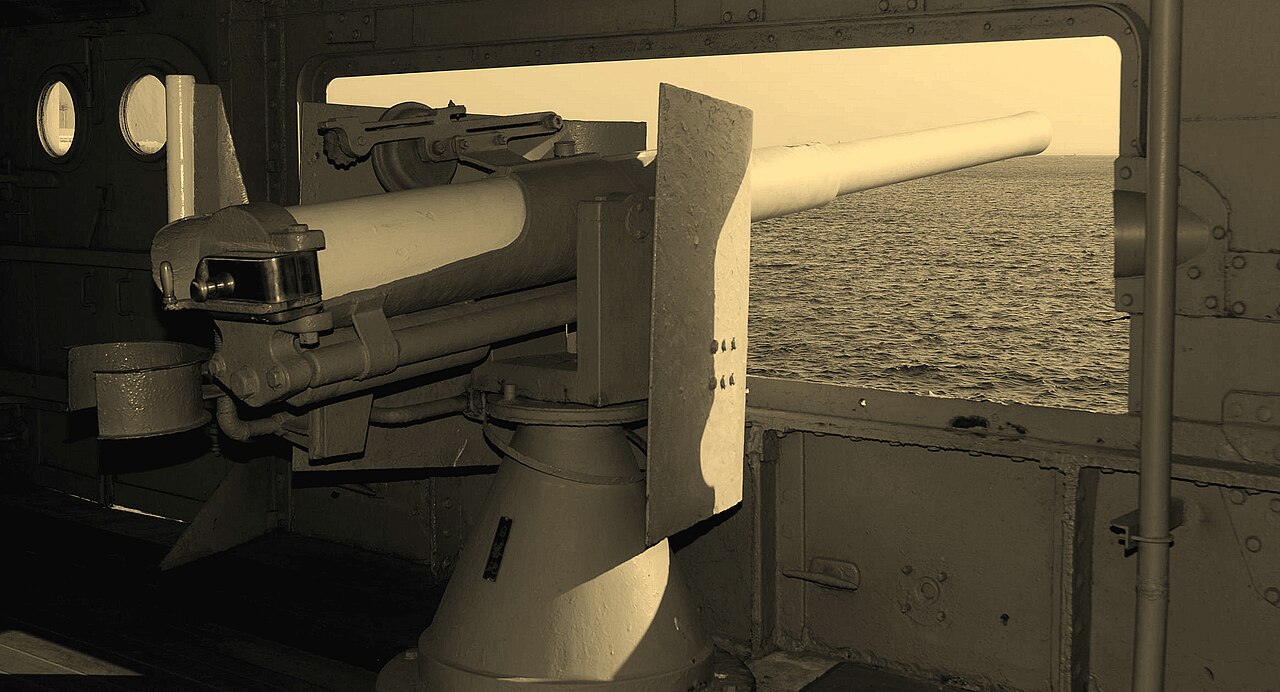
MChew · Public domain
- Name
- QF 12-pounder 12 cwt naval gun Type 41 3-inch (7.62 cm) 40 calibre gun
- Field
- rifled breech loader · quick-firing gun · naval artillery
- Region
- United Kingdom of Great Britain and Ireland
VALÉORINE Encyclopedia
VALÉORINE documentary reading
Documentary summary
The QF 12-pounder 12-cwt gun (Quick-Firing) (abbreviated as Q.F. 12-pdr. [12-cwt.]) was a common, versatile 3 in calibre naval gun introduced in 1894 and used until the middle of the 20th century. It was produced by Armstrong Whitworth, Elswick and used on Royal Navy warships, exported to allied countries, and used for land service. In British service "12-pounder" was the rounded value of the projectile weight, and "12 cwt (hundredweight)" was the weight of the barrel and breech, to differentiate it from other "12-pounder" guns.
Admitted source layer · organised and presented by VALÉORINE
Note VALÉORINE
No house-authored Note is published until its assertions and sources pass the VALÉORINE evidence contract. The documentary article remains available in full while that enrichment is being consolidated.
Documentary enrichment in progress · no unsupported statement published
Reference Check
Propose documentary evidence for QF 12 pounder 12 cwt gun. A contribution is never written directly as fact: identity, source, rights and evidence gates still decide.
Sign in to contribute
World of VALÉORINE
Documentary connections
Only confirmed graph relationships appear here. Images are shown only when their identity and reuse rights both pass the documentary gate.

Documentary evidence
Evidence Panel
not yet certified
- Identity
- resolved
- Independent source families
- 0
- Admitted assertions
- 0
- Open conflicts
- 0
Authority files
wikidata · Q1360084
In this article
Overview
Overview
Italy built guns under licence as the 76.2 mm/40 (3") by Ansaldo.
Key facts
Key facts
• Name — QF 12-pounder 12 cwt naval gun Type 41 3-inch (7.62 cm) 40 calibre gun • Origin — United Kingdom • Type — Naval gun Coastal artillery • Is Ranged — yes • Is Artillery — yes • Is Uk — yes • Service — 1894–1945 • Used By — United Kingdom Kingdom of Italy Empire of Japan • Design Date — 1893 • Manufacturer — Elswick Ordnance Company, Vickers, Japan Steel Works Canadian Pacific Railway Gio. Ansaldo & C. • Number — Mk I, Mk II 4,737 Mk V 3,494 • Variants — Mk I, Mk II, Mk V • Weight — 12 cwt (0.6 tons, 510 kg) • Length — 10 ft • Part Length — 10 ft • Cartridge — UK & Japan: Separate-loading QF Italy: Fixed QF • Caliber — 3 in • Rate — 15 rounds per minute • Velocity — 2210 ft/s • Range — 11750 yd at 40° elevation • Feed — Breech-loaded • Breech — single-motion screw • Elevation — mounting dependent • Traverse — mounting dependent
United Kingdom naval service
Gun mounting data
Gun mounting data
• Mounting — Elevation — Weight including gun • PI* — | -10° to +30° — 1.23 tons / 1,253 kg • HA VIII — | -10° to +90° — 2.10 tons / 2,134 kg • HA/LA IX — | -10° to +70° — 2.45 tons / 2,489 kg
South African War (1899–1902) land service
South African War (1899–1902) land service
• Illustration — Naval brigade with a "long twelve" in Natal The gun was primarily a high-velocity naval gun, with its heavy recoil suiting it to static mountings, hence it was generally considered unsuitable for use as a mobile field gun. An exception was made when the British army were outgunned by the Boer artillery in South Africa and the Royal Navy was called on for help. Among other guns, 16 QF 12-pounder 12 cwt were landed from warships and were mounted on improvised field carriages designed by Captain Percy Scott RN, with solid wooden trails and utilizing small-diameter Cape wagon wheels. Their 10000 yd range provided valuable long-range fire support for the army throughout the war. They were known as "long twelves" to distinguish them from the BL 12-pounder 6 cwt and QF 12-pounder 8 cwt which had much shorter barrels and ranges. Lieutenant Burne reported that the original electric firing system, while working well under ideal conditions, required support of an armourer and the maintenance and transport of charged batteries in the field, which was generally not possible. He reported switching to percussion tubes for firing and recommended percussion for future field operations. Another six guns were diverted from a Japanese battleship being built at Newcastle in January 1900, bought by Lady Meux, and were equipped with proper field carriages by the Elswick Ordnance Company in Newcastle and sent to South Africa. Perhaps uniquely, the guns were refused by the War Office and donated directly to Lord Roberts, the British commander in South Africa and became his personal property. They were known as the "Elswick Battery" and were manned by men from Elswick, recruited by 1st Northumberland Royal Garrison Artillery (Volunteers). The Elswick guns served throughout the war.
Coast defense gun
Coast defense gun
• Illustration — Typical coast defense mounting, at Newhaven Fort, UK Many guns were mounted on "pedestals" secured to the ground to defend harbours around the UK, and at many ports around the Empire, against possible attack by small fast vessels such as torpedo boats, until the 1950s. There were 103 of these guns (of a total 383 of all types) employed in coast defense around the UK as at April 1918. Many of these were still in service in World War II although they had by then been superseded by more modern types such as twin QF 6-pounder 10 cwt mounts. Guns were traversed (moved from side to side) manually by the gunlayer as he stood on the left side with his arm hooked over a shoulder piece as he aimed, while he operated the elevating handwheel with his left hand and grasped the pistol grip with trigger in his right hand.
Army anti-aircraft gun
Army anti-aircraft gun
In World War I a number of coast defense guns were modified and mounted on special wheeled traveling carriages to create a marginally effective mobile anti-aircraft gun.
United Kingdom ammunition
United Kingdom ammunition
UK shells weighed 12.5 lb (5.67 kg) filled and fuzed. The cordite propellant charge was normally ignited by an electrically activated primer (in the base of the cartridge case), with power provided by a battery. The electric primer in the cartridge could be replaced by an adaptor which allowed the use of electric or percussion tube to be inserted to provide ignition. • — — — — • 2 lb Cordite cartridges Mk II & Mk III, 1914 — Mk II common pointed shell — Mk III & Mk II common Lyddite shell — Mk IV common Lyddite shell with internal night tracer, 1914 — Mk IX shrapnel shell, 1914
Italian service
Italian service
The Italian Cannon 76/40 Model 1916 was a licensed derivative of the QF 12-pounder used in a number of roles during World War I and World War II.
Japanese service
Japanese service
• Illustration — A captured Type 41 8 cm naval gun. The Japanese Type 41 3 in naval gun was a direct copy of the QF 12-pounder. The first guns were bought from the English firms as "Elswick Pattern N" and "Vickers Mark Z" guns. The gun was officially designated as the Type 41 3 in naval gun from the 41st year of the reign of Emperor Meiji on 25 December 1908. Thereafter production was in Japan under license. On 5 October 1917 during the third year of the Taishō period, the gun was redesignated as the 8 cm/40 3rd Year Type naval gun as part of the Imperial Japanese Navy's conversion to the metric system. Although classified as an 8 cm gun the bore was unchanged. The gun fired a 12.5 lb high-explosive shell. It was the standard secondary or tertiary armament on most Japanese warships built between 1890 and 1920, and was still in service as late as the Pacific War. The 8 cm/40 3rd Year Type was also widely used as a coastal defense gun and anti-aircraft gun to defend Japanese island bases during World War II. Guns with both English and Japanese markings were found on Kiska, Kolombangara, Saipan, Tarawa, and Tinian. Japanese Artillery Weapons CINPAC-CINPOA Bulletin 152-45 calls the guns "8 cm Coast Defense Gun 13th Year Type (1924)".
Surviving guns
Surviving guns
• Illustration — Gun at Explosion Museum of Naval Firepower • A gun of the Elswick Battery that served in the Second Boer War is displayed in the Royal Artillery Museum, London but the museum has closed and re-located to Larkhill, Wiltshire. • Another Elswick gun is with 203 (Elswick) Battery RA (V) • Mk V naval gun was at Royal Artillery Museum, London but the museum has closed and re-located to Larkhill, Wiltshire. • Early coast defence gun at Newhaven Fort, UK • Coast defence gun at Army Memorial Museum, Waiouru, New Zealand • On the battleship Mikasa, Yokosuka, Japan • The gun of Campbeltown, recovered around 1972, on display in Saint-Nazaire, France • 12-pdr on coastal defence pedestal at Pendennis Castle, Falmouth, Cornwall • The gun of HMS Overdale Wyke of the Ceylon Naval Volunteer Force, now kept in SLNS Ranagalle • A good example can be seen mounted at Tilbury Fort in Essex. This is an ex-naval type of WW2 vintage. • A 12-pdr of First World War vintage is mounted on a skeletal high-angle mount at Predannack Anti-Aircraft battery and museum in Cornwall • At Explosion Museum of Naval Firepower, Gosport, UK
Books
* * * • Lieutenant C. R. N. Burne R.N., With the Naval Brigade in Natal (1899–1900). London: Edward Arnold, 1902 * * * * * • Admiral Percy Scott, "Fifty Years in the Royal Navy" published 1919 *
Primary material
Context
The circumstances in which QF 12 pounder 12 cwt gun stands. Recorded as a kind of rifled breech loader. Manufactured by Elswick Ordnance Company.
References
Citations
References
Each reference names the institution holding it, so a reader may go to the document itself.
authority record
Unverified
Further particulars
Held on the record
Further particulars
Open the remaining particulars
QF 12 pounder 12 cwt gun is classified as a rifled breech loader, quick-firing gun or naval artillery. Associated with United Kingdom of Great Britain and Ireland. Connected to 3 other published records in the VALÉORINE Encyclopedia.
Within the Encyclopedia
The Encyclopedia exists whether or not anything is for sale. Corrections are recorded rather than overwritten, and every version of this record is kept. Published 14 August 2026.
Elsewhere in Militaria
6,095 published records in this field, each with its sources named.
- QBZ-95Terminology
- QCW-05Terminology
- QF 1 pounder pom-pomTerminology
- QF 12 pounder 12 cwt AA gunTerminology
- QF 12 pounder 18 cwt gunTerminology
- QF 12 pounder 8 cwt Mk I gunTerminology
- QF 13 pounder 6 cwt AA gunTerminology
- QF 13 pounder Mk IV AA gunTerminology
Best supported in this field
For owners
Own an object connected with QF 12 pounder 12 cwt gun?
A specialist will read what you send and tell you what the house can establish, what it cannot, and whether the object is suited to sale. There is no charge and no obligation. The object stays with you throughout; nothing is shipped to us unless it is arranged in writing beforehand.