
Pinturicchio
Pinturicchio, or Pintoricchio (Italian: [pintuˈrikkjo]; born Bernardino di Betto; 1454–1513), also known as Benetto di Biagio or Sordicchio, was an Italian Renaissance painter. He acquired his nickname (meaning "little painter") because of his small stature and he used it to sign some of his artworks that he produced during the fifteenth and sixteenth centuries.
Also recorded as Bernardino di Betto · Bernardino Pintoricchio · Bernardino Di Betto-Benedetto di Biagio · Bernardino di Betto Pintoricchio
Pinturicchio
![Saint Mary (the Blessed Virgin) with the Christ Child. Engraving by J.M. Leroux, 1840, after B. Betti, il Pintoricchio., [1840], by Pinturicchio](https://iiif.wellcomecollection.org/image/V0033747/full/1280,/0/default.jpg)
Pinturicchio · Wellcome Collection, London · Wellcome Collection · Public Domain Mark
- Born
- 1454.
- Died
- 1513.
- Occupation
- painter, illuminator and draftsperson.
- Movements
- Renaissance.
- Known for
- Chapel of the Bishop Eroli, Crucifixion Between Saints Jerome and Christopher, Piccolomini Library, Madonna del davanzale and Madonna with child.
VALÉORINE Encyclopedia
VALÉORINE documentary reading
Documentary summary
Pinturicchio, or Pintoricchio (Italian: [pintuˈrikkjo]; born Bernardino di Betto; 1454–1513), also known as Benetto di Biagio or Sordicchio, was an Italian Renaissance painter. He acquired his nickname (meaning "little painter") because of his small stature and he used it to sign some of his artworks that he produced during the fifteenth and sixteenth centuries.
Admitted source layer · organised and presented by VALÉORINE
Note VALÉORINE
No house-authored Note is published until its assertions and sources pass the VALÉORINE evidence contract. The documentary article remains available in full while that enrichment is being consolidated.
Documentary enrichment in progress · no unsupported statement published
Reference Check
Propose documentary evidence for Pinturicchio. A contribution is never written directly as fact: identity, source, rights and evidence gates still decide.
Sign in to contribute
Documentary evidence
Evidence Panel
not yet certified
- Identity
- resolved
- Independent source families
- 0
- Admitted assertions
- 0
- Open conflicts
- 0
Authority files
getty · 500023716 · gnd · 16048905-2 · wikidata · Q5591 · wikipedia · Pinturicchio
In this article
Early years
Early years
Pinturicchio was born the son of Benedetto or Betto di Biagio, in Perugia. In his career, he may have trained under lesser-known Perugian painters such as Bonfigli and Fiorenzo di Lorenzo. According to Vasari, Pinturicchio was a paid assistant of Perugino. The works of the Perugian Renaissance school are very similar and often paintings by Perugino, Pinturicchio, Lo Spagna, and a young Raphael may be mistaken, one for the other. In the execution of large frescoes, pupils and assistants had a large share in the work, either in enlarging the master's sketch to the full-sized cartoon, in transferring the cartoon to the wall, or in painting backgrounds or accessories. His assignment in Rome, to decorate the Sistine Chapel, was an experience fraught with learning from prominent artists of the time, including: Sandro Botticelli, Domenico Ghirlandaio, Pietro Vanucci, and Luca Signorelli. The Sistine Chapel was where it is believed that Pinturicchio was collaborating with Perugino to some extent. Pinturicchio's fresco, Assumption of Mary, executed in 1481 on the altar wall of the Sistine Chapel, was destroyed in 1535 to make way for Michelangelo's Last Judgement.
Work in Santa Maria del Popolo in Rome
Work in Santa Maria del Popolo in Rome
After assisting Perugino in his frescoes in the Sistine Chapel, Pinturicchio was employed by various members of the Della Rovere family to decorate the Semi-Gods Ceiling of Palazzo dei Penitenzieri as well as a series of chapels in the church of Santa Maria del Popolo, where he appears to have worked from 1484, or earlier, until 1492. Critic Evelyn March Phillipps sums up his work by saying that the basilica "[w]ould be if it had been left with all its original decorations, one of the finest monuments to Pintoricchio’s art in Italy. A great deal remains, but much has been swept away". The earliest known of his works is an altarpiece of the Adoration of the Shepherds, in the Della Rovere Chapel, the first chapel (from the west) on the south, built by Cardinal Domenico della Rovere. In the lunettes under the vault, Pinturicchio painted small scenes from the life of St. Jerome. The polychrome grotesque wall decoration on a yellow-gold background probably was inspired by the paintings of the Domus Aurea, and belongs the earliest and highest quality of their kind in Rome. The frescos he painted in the Cybo Chapel, built by Cardinal Lorenzo Cybo de Mari in the beginning of the sixteenth century, were destroyed in 1682, when the chapel was rebuilt by Cardinal Alderano Cybo. The old fresco of the Virgin and the Child by Pinturicchio was detached from the wall and sent by the cardinal to Massa in 1687. The fragment was re-used as the altarpiece of the Ducal Chapel of the Cathedral of Massa. The third chapel on the south is that of Girolamo Basso della Rovere, nephew of Pope Sixtus IV, and bishop of Recanati. The Basso Della Rovere Chapel contains an altarpiece, Madonna enthroned between Four Saints, and on the eastern side a fresco of the Assumption of the Virgin. The vault and its lunettes are richly decorated with small paintings of the Life of the Virgin, surrounded by graceful arabesques; and the dado is covered with monochrome paintings of scenes from the lives of saints, illusionistic benches, and gracefully and powerfully drawn figures of women in full length, in which the influence of Luca Signorelli may be traced. In the Costa Chapel, Pinturicchio or one of his helpers painted the Four Latin Doctors in the lunettes of the vault. Most of these frescoes are considerably injured by moisture and have suffered little from restoration. The last paintings completed by Pinturicchio in this church are found on the vault behind the choir, where he painted decorative frescoes, with main lines arranged to suit their surroundings in a skilful way. In the centre is an octagonal panel, Coronation of the Virgin, and surrounding it, are medallions of the Four Evangelists. The spaces between them are filled by reclining figures of the Four Sibyls. On each pendentive is a figure of one of the Four Doctors enthroned under a niched canopy. The bands that separate these paintings have elaborate arabesques on a gold ground, and the whole is painted with broad and effective touches, very telling when seen (as is necessarily the case) from a considerable distance below.
Works in the Vatican Library
Works in the Vatican Library
In 1492, Pinturicchio was summoned to Orvieto Cathedral. However, he was also commissioned by Pope Alexander VI (Borgia) to decorate a recently completed suite of six rooms, the Borgia Apartments in the Apostolic Palace of the Vatican. These rooms now form part of the Vatican Library, and five still retain a series of Pinturicchio frescoes. He worked in these rooms until around 1494, assisted by his pupils, and not without interruption. It was not until Pope Alexander VI died that Pinturicchio left Rome for Umbria, leaving much of the work in Rome to be completed by Michelangelo, Raphael, and others. Among other important frescoes by Pinturicchio that still exist in Rome and are in good condition, are in the Bufalini Chapel in the southwest sector of Santa Maria in Ara Coeli, probably executed around 1484–1486. On the altar wall is a grand painting of St. Bernardino of Siena between two other saints, crowned by angels; in the upper part is a figure of Christ in a mandorla, surrounded by angel musicians; on the left wall is a large fresco of the miracles performed by the corpse of St. Bernardino, which includes portraits of members of the sponsoring Bufalini family. One group of three women, the central figure with a child at her breast, recalls the grace of Raphael's second manner. The composition of the main group around the saint's corpse appears to have been suggested by Giotto's painting of St. Francis on his bier that is found in Santa Croce at Florence. On the vault are four noble figures of the Evangelists, usually attributed to Luca Signorelli, but as with the rest of the frescoes in this chapel, they are more probably by Pinturicchio. On the vault of the sacristy of Santa Cecilia in Trastevere, Pinturicchio painted the Almighty surrounded by the Evangelists. During a visit to Orvieto in 1496, Pinturicchio painted in the choir of the Duomo two more figures of the Latin Doctors. For these he received fifty gold ducats. Now, like the rest of his work at Orvieto, these figures are almost destroyed. In Umbria, his masterpiece is the Baglioni Chapel in the church of S. Maria Maggiore in Spello. Among his panel paintings the following are the most important: an altarpiece for S. Maria de' Fossi at Perugia, painted in 1496–1498, now moved to the city gallery, depicts a Madonna enthroned among Saints, very minutely painted; the wings of the retable have standing figures of St. Augustine and St. Jerome; and the predella has paintings in miniature of the Annunciation and the Evangelists. Another fine altarpiece, similar in delicacy of detail, and probably painted about the same time, is that in the cathedral of San Severino — the Madonna enthroned looks down toward the kneeling donor. In beauty of face and expression, the angels at the sides recall the manner of Lorenzo di Credi or Leonardo da Vinci. The Vatican galleries have the largest of Pinturicchio's panels — the Coronation of the Virgin, with the apostles and other saints below. Several well-executed portraits occur among the kneeling saints. The Virgin, who kneels at Christ's feet to receive her crown, is a figure of great tenderness and beauty, and the lower group is composed with great skill and grace in arrangement. In 1504, Pinturicchio designed a mosaic floor panel for the Cathedral of Siena: the Story of Fortuna, or the Hill of Virtue. This was executed by Paolo Mannucci in 1506. On top of the panel, a symbolic representation of Knowledge hands the palm of victory to Socrates. Among the public collections holding works by Pinturicchio are, the Ashmolean Museum (University of Oxford), Biblioteca Ambrosiana (Milan), the Cleveland Museum of Art, the Courtauld Institute of Art (London), the Denver Art Museum, the Fitzwilliam Museum (University of Cambridge), the Honolulu Museum of Art, the Louvre, the Museum of Fine Arts, Boston, the National Gallery, London, Palazzo Ruspoli (Rome), the Philadelphia Museum of Art, the Pinacoteca Ambrosiana (Milan), Princeton University Art Museum, Walters Art Museum in Baltimore, the Vatican Museums, and the Museum of Fine Arts (Budapest).
Works
Works
Miracles of St Bernardino (1473), Galleria Nazionale dell'Umbria, Perugia Saint Jerome in the Desert (1475–1480), Walters Art Museum, Baltimore, Maryland The Crucifixion with Sts. Jerome and Christopher, c. 1475, oil on wood, 59 × 40 cm, Galleria Borghese, Rome Della Rovere Chapel (late 1470s to 1482), Santa Maria del Popolo, Rome; including The Adoration of the Child with St. Jerome Madonna with Writing Child and St. Jerome (c. 1481), 49.5 × 38 cm, Gemäldegalerie, Berlin Assumption of Mary, fresco, Sistine Chapel (1481), later destroyed Madonna with Blessing Child (c. 1480), National Gallery, London Bufalini Chapel (c. 1484–1486), frescoes, Santa Maria in Ara Coeli, Rome Basso Della Rovere Chapel (c. 1484–1492), frescoes, Santa Maria del Popolo, Rome Cybo Chapel (c. 1489–1503) in Santa Maria del Popolo, Rome, Italy (destroyed); including The Virgin and the Child now in the Cathedral of Massa, Massa, Tuscany Costa Chapel (c. 1488–90), frescos, Santa Maria del Popolo, Rome: The Four Doctors of the Church Madonna of Peace (c. 1490), oil on panel, 143 × 70 cm, Pinacoteca civica Tacchi-Venturi, San Severino Marche, Marche Semi-Gods Ceiling (c. 1490), oil on paper on wood, Palazzo dei Penitenzieri, Rome Nursing Madonna (1492), 29.2 × 21.6 cm, Sarah Campbell Blaffer Foundation, Houston, Texas Borgia Apartments (c. 1492–1494), frescoes. Vatican City, Rome Madonna col Bambino e paesaggio 59 x 44 cm, Palazzo Baldeschi, Perugia Madonna with Reading Child (c. 1494–1498), 33.7 × 25.4 cm, North Carolina Museum of Art, Raleigh, North Carolina Madonna with Writing Child (c. 1494–1498), 61 × 41.6 cm, Philadelphia Museum of Art, Philadelphia Madonna with Writing Child and Bishop (c. 1495), 158 × 77.3 cm, Museu de Belles Arts, Valencia Madonna with Child and St. John the Baptist (c. 1495), 45.5 x 37 cm, National Museum, Warsaw Eroli Chapel (1497), frescoes, Cathedral of Spoleto, Spoleto Santa Maria dei Fossi Altarpiece, oil on panel and canvas, 513 × 314 cm, Galleria Nazionale dell'Umbria, Perugia Portrait of a Boy (c. 1500), Gemäldegalerie Alte Meister, Dresden Baglioni Chapel (c. 1500–1501). Santa Maria Maggiore, Spello Piccolomini Library (1502–1507), frescoes, Cathedral of Siena, Siena Coronation of Pius II (c. 1503–1508), fresco, Cathedral of Siena, Siena St. John the Baptist Chapel (1504), Cathedral of Siena, Siena Madonna Enthroned with Saints (1506–1508), 318 × 257 cm, church of Sant'Andrea, Spello Virgin and Child (51,4 × 40,6) tempera and gold on wood panel, Alicem institute, Luxembourg
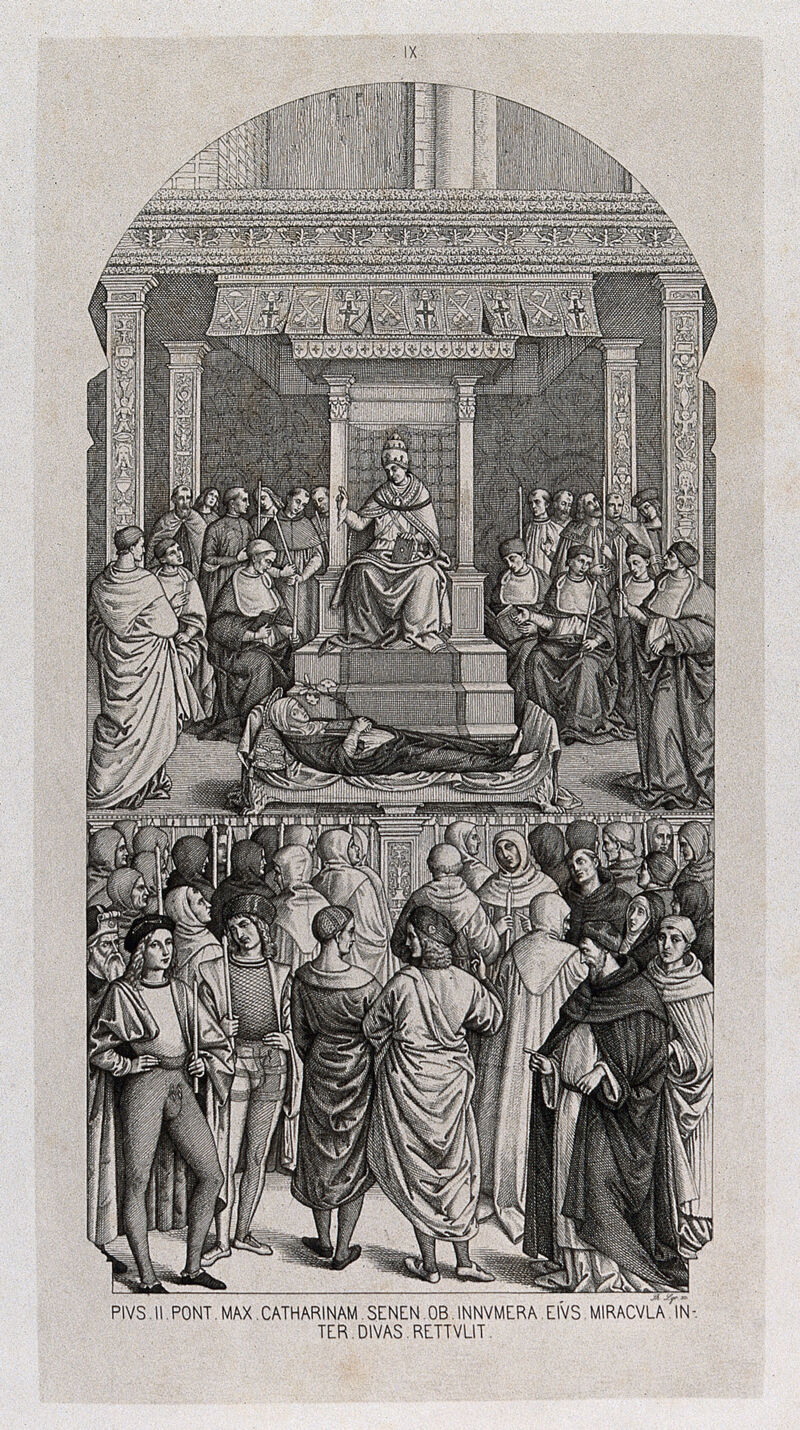
Saint Catherine of
Pinturicchio · Wellcome Collection, London · Wellcome Collection
Life and career
Dated record
Life and career
The full dated record · 2 entries
1454
Pinturicchio was born in 1454.
1513
Pinturicchio died at Siena.
Primary material
Documents and archives
reference work
- “Pinturicchio”, English Wikipedia, consulted as further reading
Reputable secondary · Wikipedia
- Wikidata, structured authority record Q5591: Pinturicchio
Reputable secondary · Wikimedia Foundation
scholarly publication
- Pinturicchio (Bernardino Di Betto; C. 1454–1513), Historical Dictionary of Renaissance Art, 2016
Scholarly · Crossref registry · 2016
authority file
- Getty Union List of Artist Names 500023716, Pinturicchio, Bernardino.
Unverified · The Getty Research Institute
Notes from the source article
Cited by Wikipedia
Notes from the source article
These works are cited by the source article, in its own numbering. They are recorded as its citations, not as sources VALÉORINE has verified.
- 1.Cite Merriam-Webster Pinturicchio access-date=21 June 2019
- 2."PINTURICCHIO." Benezit Dictionary of Artists. Oxford Art Online. Oxford University Press. Web. 14 February 2017. http://www.oxfordartonline.com/subscriber/article/benezit/B00142364 .
- 3.Phillipps, cit., pag. 59.
- 4.Federici (2003), cit., pp. 344-45, 350.
- 5.Madonna col Bambino e paesaggio Pintoricchio.
Bibliography printed in the source article · 3
- Scarpellini, Pietro. Pintoricchio. Federico Motta Editore. 2004.
- Fabrizio Federici, La diffusione della “prattica romana”: il cardinale Alderano Cybo e le chiese di Massa (1640-1700), in: Atti e Memorie della Deputazione di Storia Patria per le antiche Provincie Modenesi, s. XI - v. XXV, 2003, pp. 315–389.
- Evelyn March Phillips, Pintoricchio, George Bell & Sons, London, 1901.
References
Citations
References
Each reference names the institution holding it, so a reader may go to the document itself.
scholarly publication
Pinturicchio (Bernardino Di Betto; C. 1454–1513), Historical Dictionary of Renaissance Art, 2016Crossref registry
Verifiedreference work
Partially resolvedauthority file
Getty Union List of Artist Names 500023716, Pinturicchio, Bernardino.The Getty Research Institute
Partially resolvedreference work
Wikidata, structured authority record Q5591: PinturicchioWikimedia Foundation
Partially resolved
The Encyclopedia exists whether or not anything is for sale. Corrections are recorded rather than overwritten, and every version of this record is kept. Published 14 August 2026.
Elsewhere in Paintings
18,792 published records in this field, each with its sources named.
- Pilipili MulongoyArtist
- Pimen OrlovArtist
- Pinchas BursteinArtist
- Pinchus KrémègneArtist
- Pio SanquiricoArtist
- Piotr AbraszewskiArtist
- Piotr AlbertiArtist
- Piotr BelousovArtist
Best supported in this field
For owners
Own a work by Pinturicchio?
A specialist will read what you send and tell you what the house can establish, what it cannot, and whether the object is suited to sale. There is no charge and no obligation. The object stays with you throughout; nothing is shipped to us unless it is arranged in writing beforehand.