
Pinchas Burstein
He was born in Nowy Sącz, Poland, into an Orthodox Jewish family and was only 12 when the Nazis invaded Poland in 1939. Burstein was subsequently captured by the Nazis and imprisoned at Auschwitz concentration camp. After Poland was liberated by the Soviet army in 1945, Burstein was the sole survivor of his family and required a leg amputation due the injuries sustained while at the concentration camp.
Also recorded as Maryan S. Maryan · Maryan Pinchas Burstein · Maryan · P. B. Maryan
Pinchas Burstein
Artem.G · CC BY-SA 4.0
- Name
- Maryan
- Birth Name
- Pinchas Burstein
- Born
- 1927
- Birthplace
- Nowy Sącz, Poland
- Died
- 15 June 1977
- Place of death
- New York City, United States
- Field
- painting
- Movement
- post-expressionism
- Nationality
- United States and Poland.
- Fields
- painting.
- Movements
- Expressionism.
- Education
- Beaux-Arts de Paris and Bezalel Academy of Art and Design.
VALÉORINE Encyclopedia
VALÉORINE documentary reading
Documentary summary
He was born in Nowy Sącz, Poland, into an Orthodox Jewish family and was only 12 when the Nazis invaded Poland in 1939. Burstein was subsequently captured by the Nazis and imprisoned at Auschwitz concentration camp. After Poland was liberated by the Soviet army in 1945, Burstein was the sole survivor of his family and required a leg amputation due the injuries sustained while at the concentration camp.
Admitted source layer · organised and presented by VALÉORINE
Reference Check
Propose documentary evidence for Pinchas Burstein. A contribution is never written directly as fact: identity, source, rights and evidence gates still decide.
Sign in to contribute
World of VALÉORINE
Documentary connections
Only confirmed graph relationships appear here. Images are shown only when their identity and reuse rights both pass the documentary gate.
Documentary evidence
Documentary basis
Authority files
wikidata · Q935676 · wikipedia · Pinchas Burstein
In this article
Biography
Biography
In the aftermath of the war, he spent two years in displaced persons camps in Germany. In 1947, Burstein moved to Mandatory Palestine, where he faced challenges due to his disability and briefly lived in a kibbutz. He later attended the Bezalel Academy of Art and Design in Jerusalem and witnessed the 1948 Arab–Israeli War. In 1950, Burstein relocated to Paris, adopting the name Maryan Bergman, and enrolled at the École nationale supérieure des Beaux-Arts where he studied with the French avant-garde artist Fernand Léger. His artistic career flourished in Paris, where he received a commission to design the Monument to the Unknown Jewish Martyr and was awarded the Prix des Critiques d’Art in 1959. In 1962, after being denied French citizenship, he moved to New York City, where he continued to paint, creating an extensive body of work that included his best-known Personnage paintings series. His figurative style, often violent and exaggerated, reflected the influence of Pablo Picasso, Jean Dubuffet, and the CoBrA group. In 1971, following a mental breakdown, he produced a series of drawings depicting his life story, which have since been interpreted as the artist's response to the traumatic experiences of living through the Holocaust. In 1975, he co-created a film titled Ecce Homo, a blend of performance art and historical imagery. Maryan died of a heart attack in 1977 at the Hotel Chelsea in New York, which is where he was living at the time, and was buried at Montparnasse Cemetery Paris.
Pinchas Burstein studied at Beaux-Arts de Paris and Bezalel Academy of Art and Design. The recorded working language is Polish. The field of work recorded is painting. Work by Pinchas Burstein is recorded in the collections of Museum of Modern Art, Artotheque Mons, Art Institute of Chicago, Carnegie Museum of Art and Yale University Art Gallery. Distinctions recorded are Chevalier des Arts et des Lettres.

Exhibition room designed after Maryan's room in New York hotel
Artem.G

Exhibition room designed after Maryan's room in New York hotel
Artem.G
Key facts
Key facts
• Name — Maryan • Birth Name — Pinchas Burstein • Born — 1927 • Birthplace — Nowy Sącz, Poland • Died — 15 June 1977 • Place of death — New York City, United States • Field — painting • Movement — post-expressionism
Early life
Early life
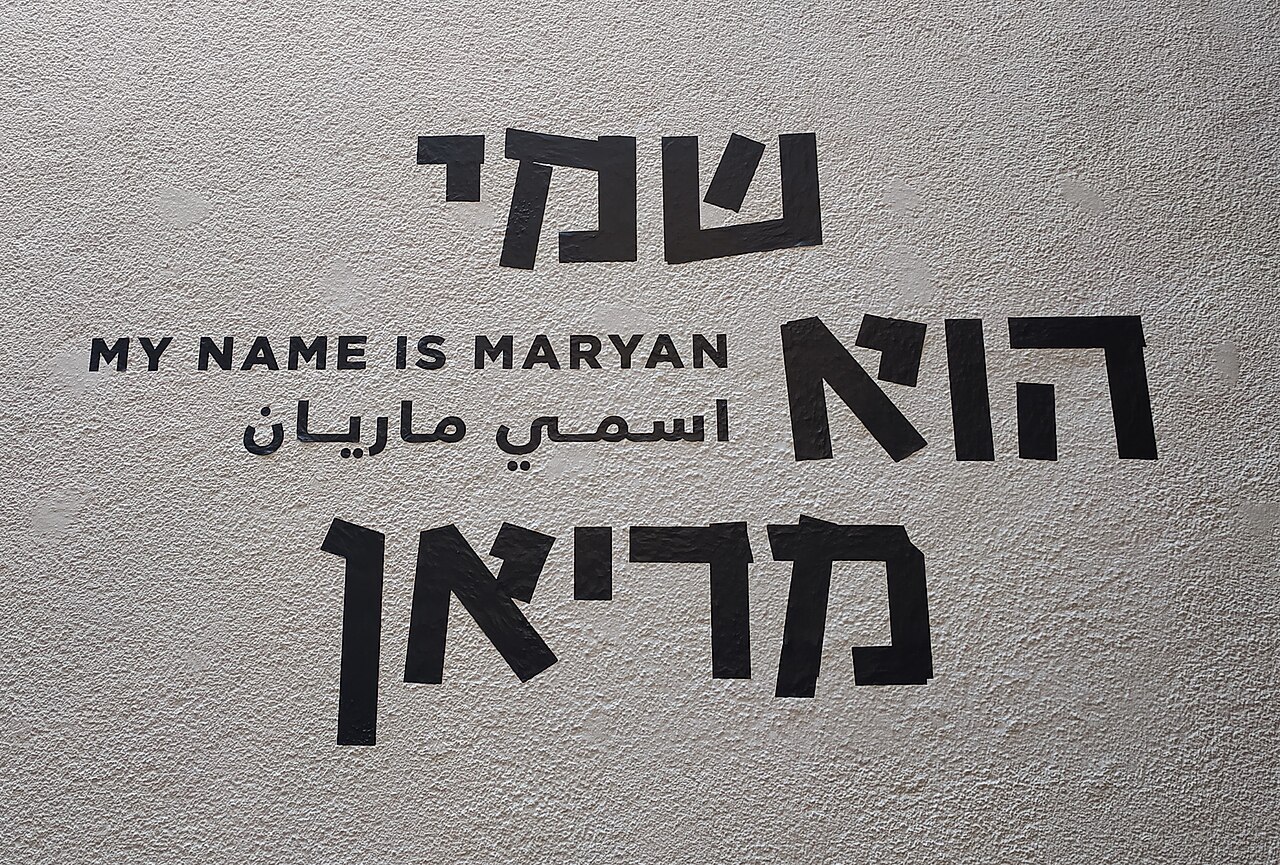
• Illustration — "My Name Is Maryan", 2022-2023 exhibition at the Tel Aviv Museum of Art Pinchas Burstein (Pinkas Bursztyn) was born in Nowy Sącz, Poland, on January 1, 1927, the second son of an Orthodox Jewish family. His mother was Gitel Burstein; his father, Avraham Schindel, was a baker. Burstein was 12 when the Nazis invaded Poland in 1939. He lived in the Rzeszów Ghetto in 1942–1943, in which period he was shot in the neck while delivering food to Jews in hiding. In 1943 or 1944 he was sent to the Auschwitz concentration camp and worked in Gleiwitz. Burstein was given the inmate number A17986. On the night of his arrival he was chosen as one of 22 Jews who were to be shot, but survived. In 1945, when the Soviet army liberated prisoners of the Auschwitz death camp, Burstein was found "wounded among bodies in a lime pit", and had his leg amputated. After the war, in 1946, he left Poland and spent two years in Germany in camps for displaced persons. Burstein was the only member of his family to survive the Holocaust.
Palestine, Israel and France
Palestine, Israel and France
In 1947 Burstein moved to Palestine. In a later interview he said that he had been persuaded to move there while in a displaced persons camp, but once he arrived, found himself labeled "handicapped" and sent to a kibbutz that had "a residence for elderly and disabled immigrants". After I received the certificate, they left me alone on the platform. No one came to me. I found a pile of oranges and sat on it. I waited. Yes, I waited for someone to come and take me to the kibbutz, as that official had promised me. I waited for several hours and suddenly I was horrified. I began to see the truth. No one was waiting for me. This clerk, his name will be omitted, lied to me. They left me on the platform. After a while I realized that it was worse than a concentration camp, because I was not alone there, we went to die together, whereas on the platform at the port of Haifa I went to die alone. He left that kibbutz after five months, when he was admitted in the Bezalel Academy of Art and Design in Jerusalem. He saw the 1948 Palestine war and creation of the state of Israel, and witnessed Battle for Jerusalem. His first solo exhibition was at the YMCA in Jerusalem. In 1950 Burstein arrived in Paris, where he studied at the École nationale supérieure des Beaux-Arts for three years, including two in the lithography workshop. While at the academy, Burstein studied with the French avant-garde artist Fernand Léger. In Paris Pinchas Burstein took a new name, Maryan Bergman, "which he "borrowed" from his schoolmate in Bezalel, the painter Marian (Meir Marinel), who committed suicide a few years later." There, he had works included in several major exhibitions and was commissioned to design a tapestry for the Monument to the Unknown Jewish Martyr in Paris, and was awarded the Prix des Critiques d’Art at the Paris Biennale. His first solo exhibition in the United States was held at the famed André Emmerich Gallery in 1960.
USA
USA
• Illustration — Exhibition room designed after Maryan's room in New York hotel. 2022-2023 exhibition at the Tel Aviv Museum of Art • Illustration — Maryan's Personnages, Tel Aviv Museum of Art Maryan moved to New York in 1962, after being denied French citizenship. Together with his wife, Annette, a Holocaust survivor he met in France, he arrived in the USA aboard the Leonardo da Vinci. In 1969 he received American citizenship and officially changed his name to Maryan S. Maryan. His best-known works, the movie Ecce Homo, the painting After Goia, and a series of paintings called Personnage, were done in New York. The Personnage paintings were described by Grace Glueck as brutal, exaggerated Piccasoid forms in which could be seen the influence also of Dubuffet and the CoBrA group of young European painters that included Karel Appel and Asger Jorn. They were mocking, clownish zombies with mask-like faces and lolling tongues, suggesting visual realizations of characters from Gunter Grass's Tin Drum. Later, they got wider and more gestural, with maybe a touch of de Kooning, winding up as slobbering, almost illegible bundles of mouths, flailing limbs, and flying organs. In 1971 Maryan had a mental breakdown, and temporarily lost his ability to speak. To overcome this state, his psychiatrist told him to draw depictions of his life story. In a year he created a series of drawings, later titled Ecce homo, and completed 9 notebooks with 478 drawings, each 20x30 cm. Daniel Kupermann examined these drawings as a psychoanalyst, and found them to be a "blend of infantile and monstrous, with their incontinent bodies and with the omnipresence of death in the form of grotesque terror-filled faces, seem to reveal an attempt to find a language in images that is able to transmit the experience of the obscene tragedy lived by the inmates of concentration camps". In 1975 Maryan and Kenny Schneider created a 90-minute film, also titled Ecce homo, in his hotel. Katarzyna Bojarska describes the film as a series of staged recollections where photographic images and reproductions of Maryan’s paintings, drawings, and lithographs alternate with a disturbing performance. Maryan reenacts Holocaust memories with the use of numerous accessories such as an M16 gun, dummies of SS officers, a straitjacket, ropes, and paint. The film opens with the following sequences of images appearing one after another: the Virgin Mary, women in robes during a Ku-Klux-Klan ceremony, Maryan himself in a black dress resembling a cassock with his arms stretched wide (as if crucified), Yasser Arafat, the Pope on a stool, images of crucifixion, a black cloth with a white swastika on it, black crosses on the white robes of Ku-Klux-Klan members, the shooting of Maryan as a Nazi, black tape covers his eyes and mouth, then pictures of Pinochet, Napoleon, Maximilian Kolbe (with the camp number 214510672 on his chest), piles of corpses from the Mỹ Lai massacre, Christ in a crown of thorns covered in paint. Religious motifs, iconic images of historical events and people, press clips and holy images are all montaged in a sequence that stimulates imagination and affect, driving both to the very limits of alarm. Maryan lived in the Chelsea Hotel in New York. He died of a heart attack in his hotel room in 1977, and was buried in the Montparnasse cemetery in Paris.
Life and career
Dated record
Life and career
The full dated record · 2 entries
1927
Pinchas Burstein born at Nowy Sącz.
1977
Pinchas Burstein died at New York City.
Places
Named by the record
Places
Only places the record itself states, plotted where the house gazetteer settles their coordinates. Nothing is inferred from a name or a nationality.
Nowy Sącz.
Birth place
New York City.
Death place
Primary material
Documents and archives
reference work
- “Pinchas Burstein”, English Wikipedia, consulted as further reading
Reputable secondary · Wikipedia
authority record
- Wikidata, structured authority record Q935676: Pinchas Burstein
General reference · Wikidata
References
Citations
References
Each reference names the institution holding it, so a reader may go to the document itself.
reference work
Secondary witnessauthority record
General reference
Further particulars
Held on the record
Further particulars
Open the remaining particulars
Pinchas Burstein received Chevalier des Arts et des Lettres. Recorded with the occupation painter. Recorded as painter, draftsperson, graphic artist and lithographer.
Recognition and collections
Work by Pinchas Burstein is
Museum of Modern Art, Artotheque Mons, Art Institute of Chicago and Carnegie Museum of Art
The Encyclopedia exists whether or not anything is for sale. Corrections are recorded rather than overwritten, and every version of this record is kept. Published 17 August 2026.
Elsewhere in Paintings
18,717 published records in this field, each with its sources named.
- PigcassoArtist
- Pilar NouvilasArtist
- Pilipili MulongoyArtist
- Pimen OrlovArtist
- Pinchus KrémègneArtist
- PinturicchioArtist
- Pio SanquiricoArtist
- Piotr AbraszewskiArtist
Best supported in this field
For owners
Own a work by Pinchas Burstein?
A specialist will read what you send and tell you what the house can establish, what it cannot, and whether the object is suited to sale. There is no charge and no obligation. The object stays with you throughout; nothing is shipped to us unless it is arranged in writing beforehand.