
Petrus Camper
Petrus Camper FRS (11 May 1722 – 7 April 1789), was a Dutch physician, anatomist, physiologist, midwife, zoologist, anthropologist, palaeontologist and a naturalist in the Age of Enlightenment. He was one of the first to take an interest in comparative anatomy, palaeontology, and the facial angle. He was among the first to mark out an "anthropology," which he distinguished from natural history.
Also recorded as Peter Camper · Camper · P. Camper · n
Petrus Camper
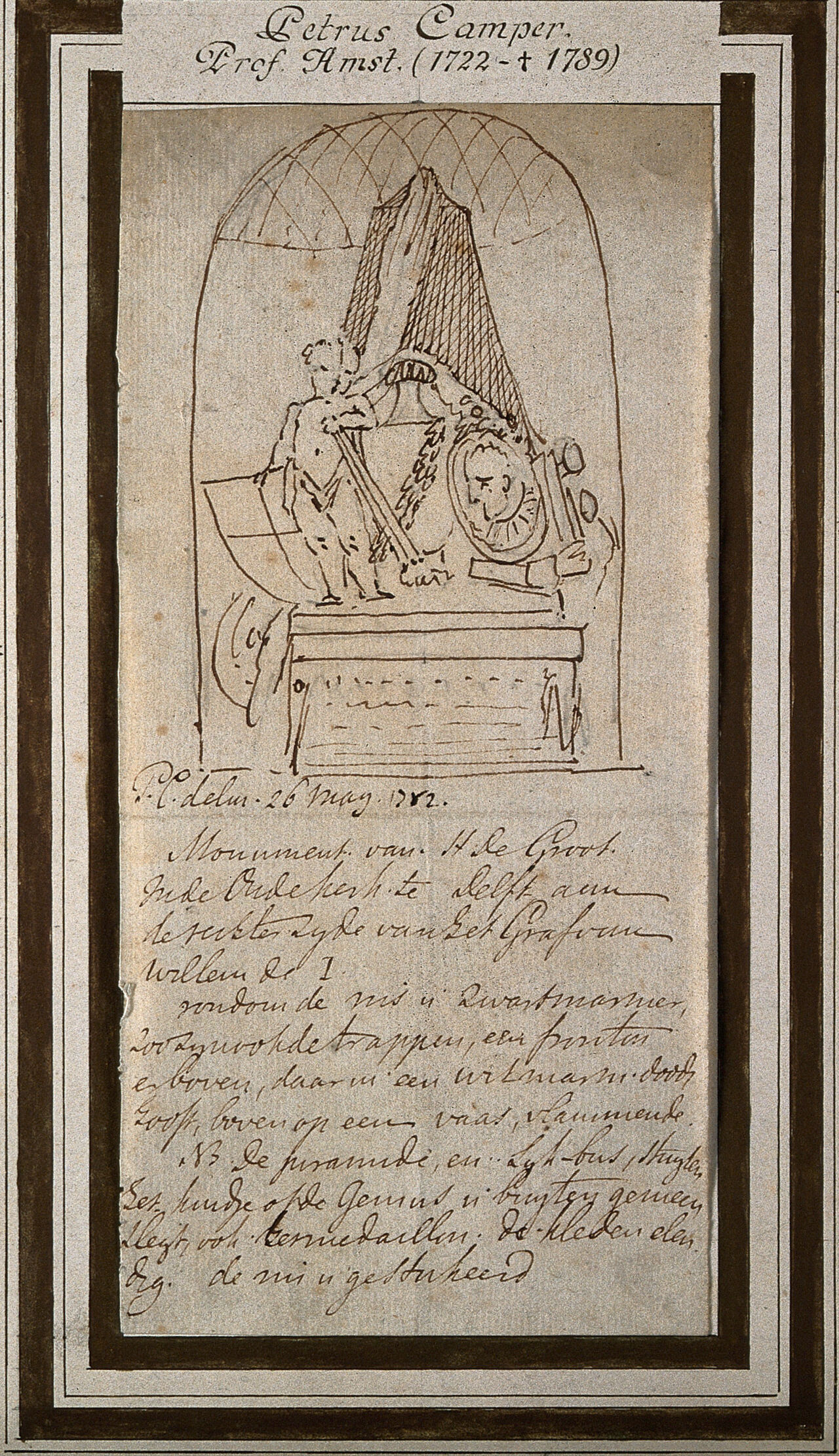
Petrus Camper · Wellcome Collection, London · Wellcome Collection · Public Domain Mark
- Name
- Petrus Camper
- Birthplace
- Leiden
- Died
- 7 April 1789
- Place of death
- The Hague
- Field
- anatomist physiologist philosopher surgeon (dissection) Draughtsman
- Education
- University of Leiden, Oxford College
- Known for
- inventing the term "extinct" along with Georges Cuvier to describe the mammoth
- Born
- 1722 · Leiden.
- Nationality
- Dutch Republic
- Occupation
- zoologist · physician · anatomist · surgeon · university teacher · paleontologist · physiologist · botanist
- Fields
- anatomy · physiology
- Honours
- Fellow of the Royal Society
VALÉORINE Encyclopedia
VALÉORINE documentary reading
Documentary summary
Petrus Camper FRS (11 May 1722 – 7 April 1789), was a Dutch physician, anatomist, physiologist, midwife, zoologist, anthropologist, palaeontologist and a naturalist in the Age of Enlightenment. He was one of the first to take an interest in comparative anatomy, palaeontology, and the facial angle. He was among the first to mark out an "anthropology," which he distinguished from natural history.
Admitted source layer · organised and presented by VALÉORINE
Note VALÉORINE
No house-authored Note is published until its assertions and sources pass the VALÉORINE evidence contract. The documentary article remains available in full while that enrichment is being consolidated.
Documentary enrichment in progress · no unsupported statement published
Reference Check
Propose documentary evidence for Petrus Camper. A contribution is never written directly as fact: identity, source, rights and evidence gates still decide.
Sign in to contribute
World of VALÉORINE
Documentary connections
Only confirmed graph relationships appear here. Images are shown only when their identity and reuse rights both pass the documentary gate.
Documentary evidence
Evidence Panel
not yet certified
- Identity
- resolved
- Independent source families
- 0
- Admitted assertions
- 0
- Open conflicts
- 0
Authority files
gnd · 1052619673 · wikidata · Q382682 · wikipedia · Petrus Camper
In this article
Biography
Biography
He studied the orangutan, the Javan rhinoceros, and the skull of a mosasaur, which he believed was a whale. Camper was a celebrity in Europe and became a member of the Royal Society (1750), the Göttingen (1779), and Russian Academy of Sciences (1778), the Royal Society of Edinburgh (1783), the French (1786) and the Prussian Academy of Sciences (1788). He designed and constructed tools for his patients, and for surgeries. He was an amateur drawer, a sculptor, a patron of art and a conservative, royalist politician. Camper published some lectures containing an account of his craniometrical methods. These laid the foundation of all subsequent work.
Petrus Camper studied at Leiden University. Meinard Simon du Pui is recorded as having studied under Petrus Camper. The recorded working language is Dutch and Latin. The field of work recorded is anatomy and physiology. Places of work recorded in the authority are Leiden. Residence is recorded at Netherlands. Employment is recorded with University of Franeker, Athenaeum Illustre of Amsterdam and University of Groningen. Work by Petrus Camper is recorded in the collections of Museum De Lakenhal. Distinctions recorded are Fellow of the Royal Society.
Key facts
Key facts
• Name — Petrus Camper • Birthplace — Leiden • Died — 7 April 1789 • Place of death — The Hague • Field — anatomist physiologist philosopher surgeon (dissection) Draughtsman • Workplaces — University of Franeker, Amsterdamse Atheneum, University of Groningen • Education — University of Leiden, Oxford College • Doctoral Students — Martin van Marum • Known for — inventing the term "extinct" along with Georges Cuvier to describe the mammoth
Surgeon's Guild
Surgeon's Guild
• Illustration — Camper's Anatomy lesson painted in 1758 commemorating his installment as "praelector" of the Surgeon's guild in 1755 in Amsterdam. This painting hung in the Waag and later in the Athenaeum Illustre of Amsterdam • Illustration — The Indian Elephants Hans and Parki Belonging to the menagerie of Stadholder Willem V In 1755 he had moved to Amsterdam, where he occupied a chair of anatomy and surgery at the Athenaeum Illustre, later completed by a medicine chair. He investigated inguinal hernia, patella and the best form of shoe. He withdrew five years later to dedicate himself to scientific research, living on his wife's estate "Klein Lankum" just outside Franeker. In his farewell speech, he mentioned that he had dissected more than 50 bodies in public, including a twelve-year-old Angolese African boy. His experience led to the publication of Demonstrationum anatomico-pathologicarum (1760–1762). In 1762 he became politically active and promoted public health issues such as vaccination against smallpox. In 1763 he accepted the chair of anatomy, surgery and botany at the University of Groningen. He made drawings to illustrate his eloquent lectures and the number of students grew. His main focus of attention was anatomy, zoology and his collection of minerals and fossils. Among his many works, he studied osteology of birds and discovered the presence of air in the inner cavities of birds' skeletons. He investigated the anatomy of eight young orangutans, establishing it as a different species to humans, as quadrupeds, against the theories of contemporary scientists. "Camper cleared up a lot of confusion when he distinguished the orangutan from the chimpanzee." Petrus Camper published treatises on the hearing of fishes and the sound of frogs. He studied the diseases of rinderpest and rabies (1768–1770). Camper kept a surgical clinic. Before retiring in 1773, he introduced several new instruments and procedures for surgery and obstetrics. Back in Franeker, he dissected an elephant and a Javan rhinoceros, after they died in the menagerie of the stadtholder. In 1782 he published his latest research, a treatise in which he disagreed with Carl Linnaeus and De Buffon on the taxonomy of apes. • In 1778 he was visited by Samuel Thomas von Sömmering, who later became a professor in Göttingen. Camper was in contact with Johann Friedrich Blumenbach and Johann Heinrich Merck. • In 1780 he travelled in the company of his son to Wolfenbüttel and met with Gotthold Ephraim Lessing. In Potsdam, he was received by Frederick the Great, introduced by Henri de Catt. In Berlin he met with Moses Mendelsohn and Samuel Formey. • In 1781 he traveled to Hamburg and met with Prince Henry and Charlotte Sophie of Aldenburg; in 1782 Camper visited the Duke Louis Ernest of Brunswick-Lüneburg. • In November 1783 he was a Foreign Founding Member of the Royal Society of Edinburgh. • In 1783 he was appointed by the stadtholder as one of the burgomasters of Workum and in 1784 became one of the directors of the Admiralty of Friesland. Camper was an Orangist, opposing the patriots. • In 1785 he visited Edmund Burke. • In September 1787 he became the president of the state council of the Dutch Republic and warmly welcomed the return of the stadtholder William V of Orange and his wife Wilhelmine of Prussia in the Hague. • At the end of life he suffered from pleuritis; Camper had a Burgundian lifestyle, drank a good glass of champagne and died.
Comparative anatomy
Comparative anatomy
• Illustration — Camper was interested in the classification of all sorts of fossil discoveries, such as the Mosasaurus in Maastricht, which he inspected and drew in the 1770s. His drawings were later published by Barthélemy Faujas de Saint-Fond One of the first to study comparative anatomy, Petrus Camper demonstrated the principle of correlation in all organisms by "metamorphosis". In his 1778 lecture, "On the Points of Similarity between the Human Species, Quadrupeds, Birds, and Fish; with Rules for Drawing, founded on this Similarity," he metamorphosed a horse into a human being, thus showing the similarity between all vertebrates. Étienne Geoffroy Saint-Hilaire theorised this in 1795 as the "unity of organic composition," the influence of which is perceptible in all his subsequent writings; nature, he observed, presents us with only one plan of construction, the same in principle, but varied in its accessory parts. Camper's metamorphoses which demonstrated this "unity of Plan" greatly impressed Diderot and Goethe. In 1923 and 1939 some Dutch authors suggested that Camper foreshadowed Goethe's famous idea of "type" – a common structural pattern in some manner
"Facial angle"
"Facial angle"
• Illustration — Picture of a human male based on Petrus Camper measurements Petrus Camper is renowned for his theory of facial angle (prognathism). He determined that humans had facial angles between 70° and 80°, with African and Asian angles closer to 70°, and European angles closer to 80. According to his new portraiture technique, an angle is formed by drawing two lines: one horizontally from the nostril to the ear, and the other perpendicularly from the advancing part of the upper jawbone to the most prominent part of the forehead. He claimed that antique Greco-Roman statues presented an angle of 100°-95°, Europeans of 80°, 'Orientals' of 70°, Black people of 70° and the orangutan of 42–58°. He stated that, out of all races, Africans were most removed from the classical sense of ideal beauty. These results were later used as scientific racism, with research continued by Étienne Geoffroy Saint-Hilaire and Paul Broca. Camper, however, agreed with Buffon in drawing a sharp line between human and animals (although he was misinterpreted by Diderot, who claimed that he was a supporter of the Great Chain of Being theory). Camper confirmed the categorizing species by Linné.
Camper and the arts
Camper and the arts
He was interested in architecture, mathematics, furniture making, drawing and illustrated his own lectures. Four times he gave lectures in Amsterdam to art students, e.g. on beauty and portraiture. He disagreed that artists painted the black Magus (in the nativity) with a Caucasian face. In 1780 he took lessons from Étienne Maurice Falconet. In his ideas about art, Camper was influenced by Johann Joachim Winckelmann. He made drawings of the Dolmen near Noordlaren. He was in the selection committee for the prize contest for the design of the new townhall in Groningen that was awarded to his friend Jacob Otten Husly.
Works
Works
• Dissertation from Leiden University. • Demonstrationes anatomico- pathologicae [1760–1762] • Dissertation sur les différences des traits du visage and Discours sur l'art de juger les passions de l'homme par les traits de son visage • On the Best Form of Shoe • Two lectures to the Amsterdam Drawing society on the facial angle (1770) • On the Points of Similarity between the Human Species, Quadrupeds, Birds, and Fish; with Rules for Drawing, founded on this Similarity (1778) • Historiae literariae cultoribus S.P.D. Petrus Camper. A list of his work, published by himself. • Works by Petrus Camper, the French compilation of Camper's work, based on Camper's French lecture notes and the posthumous publications by his son A.G. Camper, published and partially translated by Hendrik Jansen in 1803 in three octavo volumes. Camper
Career and activity
Career and activity
Petrus Camper worked in anatomy and physiology. He was employed by University of Franeker, Athenaeum Illustre of Amsterdam and University of Groningen. He belonged to Royal Society, French Academy of Sciences, Russian Academy of Sciences, Royal Prussian Academy of Sciences and Accademia Nazionale delle Scienze detta dei XL. He worked at Leiden and Netherlands.
Life and career
Dated record
Life and career
Explore 1722–1789
The full dated record · 3 entries
1722
Petrus Camper was born on 11 May 1722.
1786
De Hominis Varietate is dated 1786.
1789
Petrus Camper died on 8 April 1789.
Places
Named by the record
Places
Only places the record itself states, plotted where the house gazetteer settles their coordinates. Nothing is inferred from a name or a nationality.
- Netherlands
Named but not plotted · 2
Leiden.
Birth place
The Hague.
Death place
Studies and teaching
• Illustration — The Academia van Vrieslant in Franeker Petrus Camper was the son of a well-to-do minister, who made his fortune in Batavia, Dutch East Indies and returned with a (young?) pickled Bornean orangutan in a jar. A brilliant alumnus, he studied medicine and philosophy at the University of Leiden and obtained a degree in both sciences on the same day at the age of 24. After both his parents died Camper travelled to England (where he met with William Smellie), to France (where he met with Georges de Buffon) and Geneva. In the meantime he was appointed professor of philosophy, anatomy and surgery at the University of Franeker, and Camper traveled to Friesland. In 1756, Camper married the widow Johanna Boerboom, daughter of the burgomaster of Leeuwarden, whom he met while treating her husband, the burgomaster of Harlingen.
Legacy
• Illustration — Abbildung der Camperschen Ebene basierend auf einem Kupferstich aus Peter Campers Werk Über den natürlichen Unterschied der Gesichtszüge in Menschen verschiedener Gegenden und verschiedenen Alters von 1792. Die Campersche Ebene ist orange hervorgehoben. Georges Cuvier praised his "genius eye" but criticised him for keeping himself to simple sketches. He had a eulogy in his honour composed by Nicolas de Condorcet and Félix Vicq-d'Azyr. Camper influenced Louis-Jean-Marie Daubenton. His son Adriaan Gilles Camper published much of his father's unpublished research in addition to a biography of him. The Dutch author Thomas Rosenboom used Petrus Camper as a character in his novel, Gewassen vlees (1994). Camper was elected to the American Philosophical Society in 1789.
Primary material
Documents and archives
scholarly publication
- Petrus Camper, Amsterdam Anatomy Lessons Dissected, 2025
Scholarly · Crossref registry · 2025
- Twee brieven aan den hooggeleerden heer Petrus Camper, Dutch Pamphlets Online
Scholarly · Crossref registry
authority file
- Gemeinsame Normdatei 1052619673, Petrus Camper Stichting.
Unverified · Deutsche Nationalbibliothek
reference work
- “Petrus Camper”, English Wikipedia, consulted as further reading
Reputable secondary · Wikipedia
References
Citations
References
Each reference names the institution holding it, so a reader may go to the document itself.
scholarly publication
Petrus Camper, Amsterdam Anatomy Lessons Dissected, 2025Crossref registry
Verifiedscholarly publication
Verifiedauthority file
Gemeinsame Normdatei 1052619673, Petrus Camper Stichting.Deutsche Nationalbibliothek
Partially resolvedreference work
Partially resolvedauthority record
Unverified
Further particulars
Held on the record
Further particulars
Open the remaining particulars
The authorities additionally record the headings Peter Camper, Camper, P. Camper and n. His recorded languages were Dutch and Latin. 2 children are recorded: Adriaan Gilles Camper and Jacob Camper. Formation and teaching. Camper studied at Leiden University. Each of those relationships is stated by the authority record rather than inferred from style. Recorded as zoologist, physician, anatomist, surgeon and university teacher.
Identity and origins
The Encyclopedia exists whether or not anything is for sale. Corrections are recorded rather than overwritten, and every version of this record is kept. Published 14 August 2026.
Elsewhere in Paintings
18,717 published records in this field, each with its sources named.
- Petronėlė GerlikienėArtist
- Petronella van WoenselArtist
- Petronilo MonroyArtist
- Petros PetrosyanArtist
- Petrus ChristusArtist
- Petrus Johannes SchotelArtist
- Petrus Johannes van RegemorterArtist
- Petrus Norbertus van ReysschootArtist
Best supported in this field
For owners
Own a work by Petrus Camper?
A specialist will read what you send and tell you what the house can establish, what it cannot, and whether the object is suited to sale. There is no charge and no obligation. The object stays with you throughout; nothing is shipped to us unless it is arranged in writing beforehand.