
Gabriel Metsu
Gabriël Metsu (lang; 1629–1667) was a Dutch painter of history paintings, still lifes, portraits, and genre works. He was "a highly eclectic artist, who did not adhere to a consistent style, technique, or one type of subject for long periods". Only 14 of his 133 works are dated.
Also recorded as Gabriel Metza · Gabriel Metezu · Gabriel Metzee · Gabriel Metzur
Gabriel Metsu
![A moneylender visited by a woman customer who is weeping. Etching by Léopold Flameng after Gabriel Metsu., [1873?], by Gabriel Metsu](https://iiif.wellcomecollection.org/image/V0039472/full/1280,/0/default.jpg)
Gabriel Metsu · Wellcome Collection, London · Wellcome Collection · Public Domain Mark
- Name
- Gabriël Metsu
- Born
- 1629
- Birthplace
- Leiden, Dutch Republic
- Died
- Buried 24 October 1667 1629
- Place of death
- Amsterdam, Dutch Republic
- Known for
- Painting
- Nationality
- Dutch Republic
- Occupation
- painter · artist
- Fields
- history · genre · religious art · portrait
- Movements
- Baroque
- Teachers
- Gerrit Dou
- Languages
- Dutch
VALÉORINE Encyclopedia
VALÉORINE documentary reading
Documentary summary
Gabriël Metsu (lang; 1629–1667) was a Dutch painter of history paintings, still lifes, portraits, and genre works. He was "a highly eclectic artist, who did not adhere to a consistent style, technique, or one type of subject for long periods". Only 14 of his 133 works are dated.
Admitted source layer · organised and presented by VALÉORINE
Note VALÉORINE
Gabriel Metsu (1629–1667) was an artist and painter, of Dutch nationality. The artist was born in Leiden and died in Amsterdam.
Gabriel Metsu worked in Amsterdam and Leiden. The artist was associated with Baroque.
Among the works are Man Writing a Letter, The Huntsman, The Vegetable Market in Amsterdam and Woman Reading a Letter. The work spans genre, history and portrait, among others. Languages used include Dutch. Works are held at Minneapolis Institute of Art, Museo del Prado and Museum Boijmans Van Beuningen, among others.
Composed from admitted, traceable facts · 26 September 2026
VALÉORINE
Reference Check
Propose documentary evidence for Gabriel Metsu. A contribution is never written directly as fact: identity, source, rights and evidence gates still decide.
Sign in to contribute
World of VALÉORINE
Documentary connections
Only confirmed graph relationships appear here. Images are shown only when their identity and reuse rights both pass the documentary gate.
Documentary evidence
Documentary basis
Authority files
wikidata · Q355213
In this article
Biography
Biography
Training under Gerrit Dou is recorded. The recorded working language is Dutch. Subjects and genres recorded for the work are history, genre, religious art and portrait. Places of work recorded in the authority are Leiden and Amsterdam. Works named in the authority record are The Huntsman, Woman Reading a Letter, Man Writing a Letter and The Vegetable Market in Amsterdam. Work by Gabriel Metsu is recorded in the collections of Museum Boijmans Van Beuningen, Städel Museum, Minneapolis Institute of Art, Museo del Prado and The Nelson-Atkins Museum of Art.
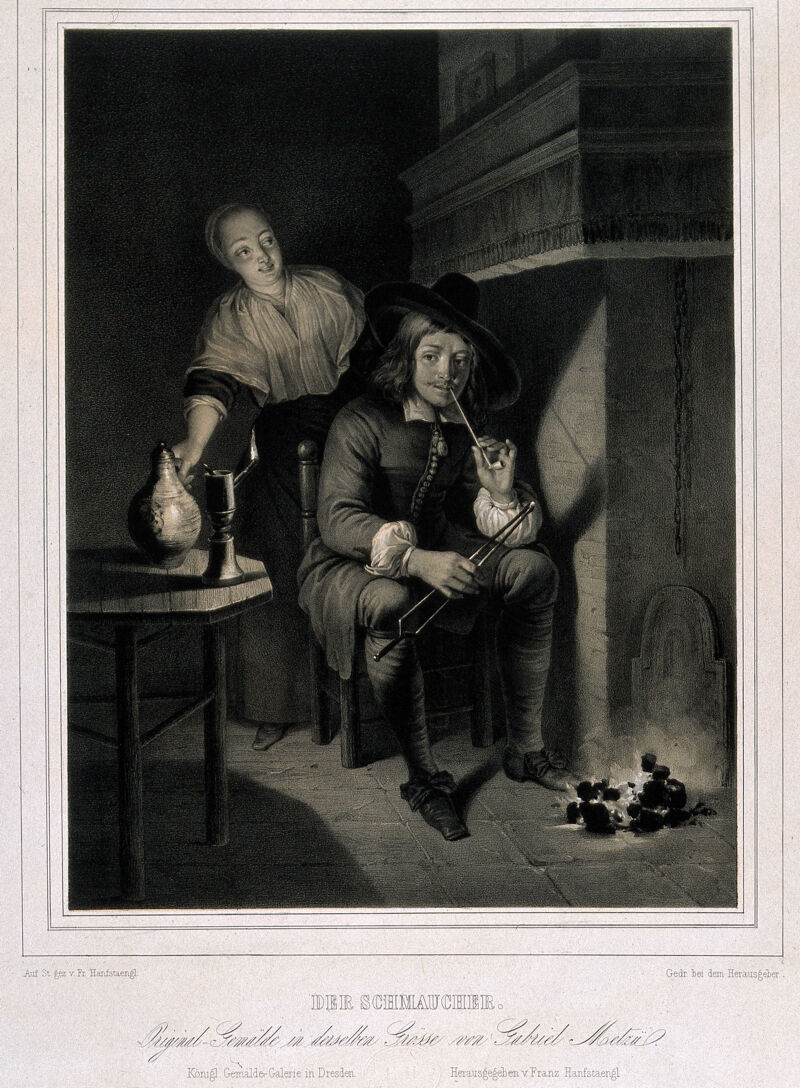
A man sits by a fireplace lighting his pipe with an ember while a servant girl brings his drink. Lithograph by F. Hanfstaengl after G. Metsu., 1800-1899, by Gabriel Metsu
Gabriel Metsu · Wellcome Collection, London · Wellcome Collection
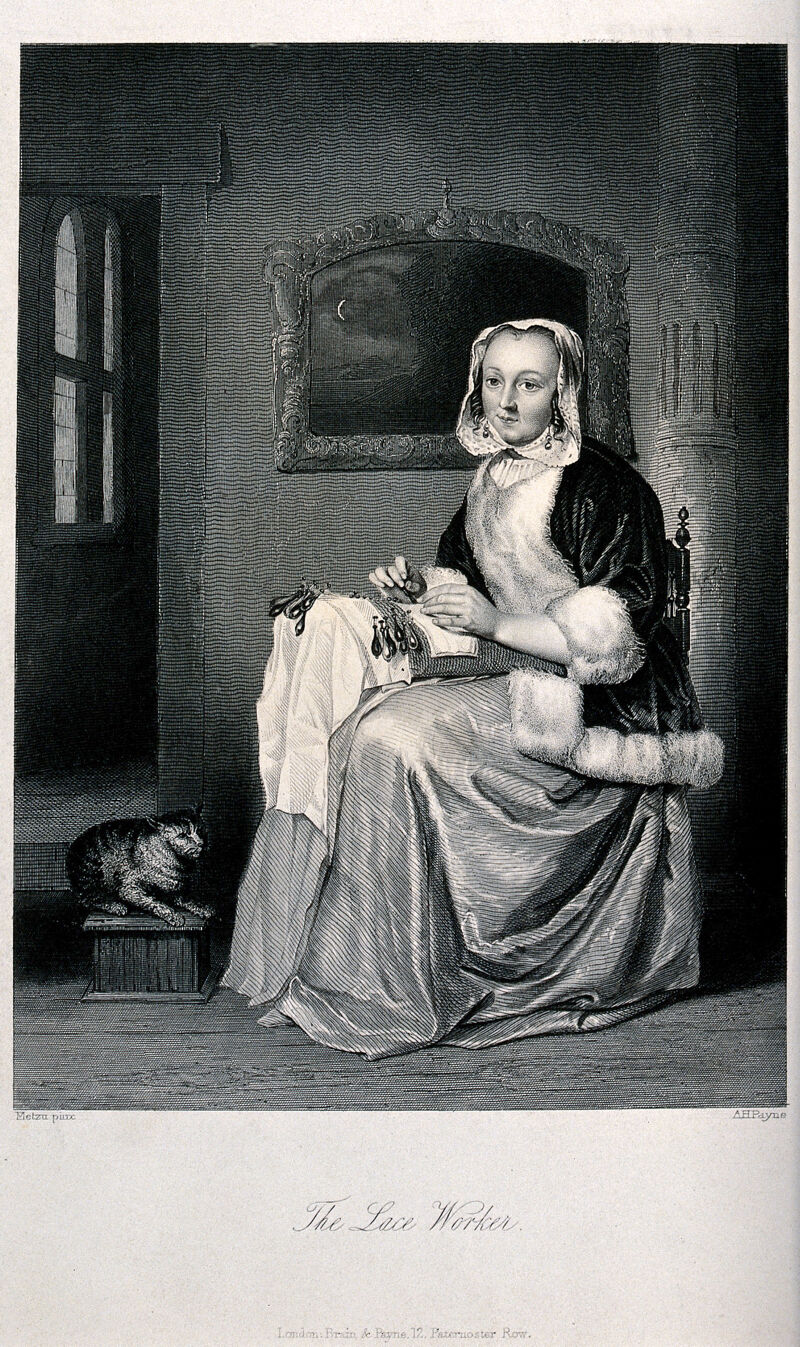
A woman is sitting on a chair making bobbin lace on a lace pillow. Engraving by A. H. Payne after G. Metsu., by Gabriel Metsu
Gabriel Metsu · Wellcome Collection, London · Wellcome Collection
Key facts
Key facts
• Name — Gabriël Metsu • Born — 1629 • Birthplace — Leiden, Dutch Republic • Died — Buried 24 October 1667 1629 • Place of death — Amsterdam, Dutch Republic • Known for — Painting
Life
Life
• Illustration — Man Writing a Letter (1662–1665) (National Gallery of Ireland, Dublin) Gabriël Metsu was the son of Jacques Metsu (c. 1588 – March 1629), a tapestry worker and painter originally from Hainault, who lived most of his days in Leiden, and Jacquemijntje Garniers (c. 1590 – 8 September 1651), the widow of a painter with three children of her own. It is not known when and where Gabriel was baptized; most likely in a Catholic hidden church but the baptismal records did not survive. Gabriel grew up on Lange Mare and his stepfather, a skipper, must have supported his education, because his mother was a poor midwife. In 1648 Metsu was registered among the first members of the painters' guild at Leiden, but in 1650 he ceased to be subscribed. Metsu was possibly trained in Utrecht by the Catholic painters Nicolaus Knüpfer and Jan Weenix. • Illustration — The pendant Woman Reading a Letter, (1665) (National Gallery of Ireland, Dublin) Around 1655 Metsu moved to Amsterdam; he lived in an alley on Prinsengracht, next to a brewery and near his relatives, the children of the sugar refiner Philips Metsu. In 1657 he got into an argument with a neighbor. (It was alleged that Metsu left a brothel at six in the morning.) Gabriel moved to a house on the canal side, where a daily vegetable market was held. In 1658 he married Isabella de Wolff, whose father was a potter and mother the painter Maria de Grebber. At the onset of the 1660s Metsu turned for inspiration to the art of the "fijnschilders" from his native Leiden. Metsu was responding to the market of Dou's paintings, who sold his paintings all over for exorbitant prices. Metsu may have also influenced Pieter de Hooch. For a while Metsu trained Michiel van Musscher and Joost van Geel. Metsu died at the age of 38 and was buried in the Nieuwe Kerk. Three bells were tolled; a habit in use with Dutch Catholics at that time. His widow left for Enkhuizen, to live with her mother. Isabella was buried in the Zuiderkerk in 1718.
Style and works
Style and works
• Illustration — An alley on Prinsengracht 369 close to where Metsu lived between number 351 and 353 • Illustration — The Sick Child According to Arnold Houbraken, Metsu was taught by Gerard Dou, though prior to about 1653 his influence is not apparent. One of his earliest pictures is The Rich Man and Lazarus at the Strasbourg Museum, painted under the influence of Jan Steen. Under the influence of Rembrandt he produced the Woman taken in Adultery, (1653) a large picture in the Louvre. To the same period belong the Dismissal of Hagar, in the Museum De Lakenhal, Leiden, and the Widow's Mite at the Schwerin Gallery. Around 1653–1654, Metsu began placing his figures in domestic interiors and specialized in genre scenes on small panels. Old people were among Metsu's favorite thematic borrowings from Dou during his first years in Amsterdam. Metsu often painted young (single) women who either fed pets, sold goods at market (fruit, vegetables, fish, poultry, or meat), or were grocery-shopping themselves for these provisions. Another significant painting from this period was The Vegetable Market in Amsterdam, in the Louvre, for which the Encyclopædia Britannica Eleventh Edition praised ", the characteristic movement and action of the dramatis personae, the selection of faces, the expression and the gesture, and the texture of the things depicted". Houbraken ends his biography with the comment that he was "of impeccable reputation", but he may have meant this ironically. Often, the subject of a Metsu painting was based on a popular emblem from an emblem book. This can give the painting a double meaning, such as in The Poultry seller, 1662, showing an old man offering a rooster to a young girl in a symbolic pose that is based on a lewd engraving by Gillis van Breen (1595–1622), with the same scene. The accompanying verse is: The Sick Child in Rijksmuseum from c. 1664 "prompts the thought that Metsu strongly admired Vermeer's work. [The latter's Woman with a Water Jug was sold as a Metsu in 1877.] It also provides us with a hint about what he thought was lacking in Vermeer's paintings: emotional involvement of the viewer". This is in compliance with other painting, The Doctor's Visit, where there is emotional involvement in the painting of a tragic event involving the ill woman. One of the finest collection of Metsu paintings was owned by Gerrit Braamcamp in the 18th century; he owned eight of them, including "man writing" and "woman reading a letter".
Carpets
Carpets
At least thirteen of his paintings show carpets and he probably used the same model. He included several fine examples of minutely depicted floral and cloud band carpets in his works and even a silk oriental rug, as well as so-called "lotto" rugs which he for some reason, in contrast to his meticulous rendering of the floral carpets, depicted only in a very sketchy fashion.
Two paintings of the Hinlopen family
Two paintings of the Hinlopen family
Around the year 1661, Metsu won the patronage of the Amsterdam cloth merchant Jan J. Hinlopen and painted his family more than once in a fashionable surrounding. There is still some confusion about two paintings by Metsu — the Portrait of the family Hinlopen, now in the Gemäldegalerie, which for a few decades was referred to as The Family of burgomaster Gillis Valckenier, and Visit to the Nursery — in the Metropolitan Museum. There is some general resemblance. The latter belonged to Jan J. Hinlopen.
Visit to the Nursery
Visit to the Nursery
In 1662 Jan Vos published a poem about this painting. It might depict the Hinlopen family, but as the sitters have not been identified this painting it is more a genre work than a portrait. In 1721 Arnold Houbraken recalled the latter painting as the largest and finest work by Metsu he had ever seen. Franits calls it one of his most intriguing images. What makes this painting especially interesting is its provenance. The provenance is well-known, except for between the years 1666 and 1706. In 1680, after the burial of his brother and guardian Jacob J. Hinlopen the paintings were divided in lots and given to his daughters but none of the paintings or painters is mentioned. The scene is set in an imaginary room of unrealistically large proportions. The father gestures deferentially while a maid dutifully fetches a chair for this esteemed visitor. The chimney resembles the one in the "schepenzaal" of former Amsterdam townhall, also painted by Pieter de Hooch. There is a seascape on the wall and Persian carpets on the table and the floor. The carpet on the table is divided into compartments, which are partly vermilion red and partly purple red, and shield-shaped. The dark blue color of the borders on the carpet are relatively unusual. The dog in the painting could be a Bolognese dog. Hung in the reception room of Hinlopen's home, the Visit to the Nursery thus alluded to his powerful role in local politics.
Works
Works
• Illustration — A Hunter Getting Dressed after Bathing, c. 1654-1656 • Illustration — The Cook, 1657 • Illustration — A Girl Receiving a Letter, 1658 • Illustration — The Vegetable Market in Amsterdam, c. 1660–1 • Illustration — A Baker Blowing his Horn, c. 1660-3 • Illustration — Portrait of a Lady in Red, 1667 • Illustration — The Intruder c. 1661 • Illustration — The Hinlopen family c. 1662 • Illustration — Woman Playing a Viola de gamba, 1663 • Illustration — A Young Woman Composing Music and a Curious Man 1662-1663 • Illustration — The Lacemaker, 1663 • Illustration — Young Couple at Breakfast by Gabriël Metsu • Illustration — The Visit to the Nursery (1661) • Illustration — The Poultry-Seller, 1662 • Illustration — Crucifixion • Illustration — Lady at a Virginal, 1660-1667 • Illustration — The Old Drinker circa 1650-1667
Identity and origins
Identity and origins
The authorities additionally record the headings Gabriel Metza, Gabriel Metezu, Gabriel Metzee, Gabriel Metzur and Gabriel Metsue. His recorded language was Dutch. He was the child of Jacques Metsu and Jacquemijntje Garniers. He married Isabella de Wolff.
Identity
Identity
Gabriel Metsu is recorded with the occupation visual artist. Recorded as a citizen of Dutch Republic. Classed in the genre history painting. Classed in the genre religious art. Classed in the genre portrait. Associated with Baroque.
Life and career
Dated record
Life and career
The full dated record · 2 entries
1629
Gabriel Metsu was born on 1 January 1629.
1667
Gabriel Metsu died on 24 October 1667.
Places
Named by the record
Places
Only places the record itself states, plotted where the house gazetteer settles their coordinates. Nothing is inferred from a name or a nationality.
Leiden.
Birth place
Amsterdam.
Death place
Notes from the source article
Cited by Wikipedia
Notes from the source article
These works are cited by the source article, in its own numbering. They are recorded as its citations, not as sources VALÉORINE has verified.
- 1.A. Waiboer, "Gabriel Metsu. Life and Work. A Catalogue Raisonné", New Haven 2012, p. 1.
- 2.Gabriel Metsu 1629—1667. National Gallery of Art.
- 3.Van der Hut, Margreet. Garniers, Jacquemijntje (ca. 1590-1651). Resources Huygens ING.
- 4.Waiboer, A. (2005) The early years of Gabriël Metsu. In: The Burlington Magazine, No. 1223, Vol. CXLVII, p.80-90.
- 5.[ANONYMOUS] - Art Records. frick.org.
- 6.massu/metsu stamboom. bloggen.be.
- 7.The Speed Art Museum has a portrait of Metsu and his wife.
- 8.Franits, W. (2008) Dutch seventeenth-century Genre Painting. Its stylistic and thematic evolution, p. 182.
- 9.According to Stone-Ferrier, L. (1989), p. 448-452 it is where Metsu lived.
- 10.Waiboer 2012, p. 11
- 11.Waiboer 2012, p. 25, 33.
- 12.Waiboer 2012, p. 110.
- 13.Gabriel Metzu biography in De groote schouburgh der Nederlantsche konstschilders en schilderessen (1718) by Arnold Houbraken, courtesy of the Digital library for Dutch literature
- 14.E. de Jongh, 'Erotica in vogelperspectief. De dubbelzinnigheid van een reeks zeventiende-eeuwse genrevoorstellingen' · dbnl. dbnl.org.
- 15.Young Woman with a Water Pitcher. www.metmuseum.org.
- 16.Waiboer 2012, p. 130.
- 17.Dutch and Flemish paintings from the Hermitage. 1988. 0-87099-510-3.
- 18.Le Temple des Arts ou Le Cabinet de M. Braamcamp By Jean François de Bastide (1766), p. 56-57
- 19.Onno Ydema (1991) Carpets and their Datings in Netherlandish Paintings, 1540 - 1700, p. 31, 32. .
- 20.Onno Ydema (1991) Carpets and their Datings in Netherlandish Paintings, 1540 - 1700, p. 123.
- 21.Metropolitan Museum of Art. The Visit to the Nursery by Gabriël Metsu.
- 22.Vos, J. (1662) p. 654.
- 23.Houbraken 1718-1721, vol. 3, p. 41.
- 24.Judith van Gent, p. 134-135, notes 20, 22. See also note 4 and check provenance. The "extraordinary pretty" painting was sold as no. 2 on 18 May 1706 bringing up 435 guilders; for most people in those days more than a year salary.
- 25.RAU 67-59. Familiearchief Huydecoper, on 11/7/1679, 12/8/1679 and 2/22/1680.
- 26.Franits, W. (2008) Dutch seventeenth-century Genre Painting. Its stylistic and thematic evolution, p. 183.
- 27.Os, H. van (2002) Beeldenstorm in het Paleis op de Dam, p. 28-33.
- 28.Liedtke, W. (2007) Dutch Paintings in The Metropolitan Museum of Art, p. 463.
- 29.Onno Ydema (1991) Carpets and their Datings in Netherlandish Paintings, 1540 - 1700, p. 74.
Bibliography printed in the source article · 4
- Metsu, Gabriel. 18. 301.
- Robinson, F.W. (1974) Gabriel Metsu (1629–1667) a Study of His Place in Dutch Genre Painting of the Golden Age.
- Stone-Ferrier, L. (1989) Gabriel Metsu's Vegetable Market at Amsterdam: seventeenth century Dutch market paintings and horticulture. In: Art Bulletin Jrg. 71 (1989), nr. 3 (September)
- Waiboer, Adriaan, editor (2010) Gabriel Metsu. Yale University Press Exhibition catalog to 2010 exhibit at the National Gallery of Ireland and National Gallery of Art
References
Citations
References
Each reference names the institution holding it, so a reader may go to the document itself.
authority record
General reference
Further particulars
Held on the record
Further particulars
Open the remaining particulars
Work and production. Works recorded as notable number 4: The Huntsman, Woman Reading a Letter, Man Writing a Letter and The Vegetable Market in Amsterdam. His recorded genres are history, genre, religious art and portrait.
Recognition and collections
Work by Gabriel Metsu is
Museum Boijmans Van Beuningen, Städel Museum, Minneapolis Institute of Art and Museo del Prado
The Encyclopedia exists whether or not anything is for sale. Corrections are recorded rather than overwritten, and every version of this record is kept. Published 17 August 2026.
Elsewhere in Paintings
18,717 published records in this field, each with its sources named.
- Gabriel KargArtist
- Gabriel LettuArtist
- Gabriel LoryArtist
- Gabriel MälesskircherArtist
- Gabriel RevelArtist
- Gabriel RobinArtist
- Gabriel RobyArtist
- Gabriel SweidelArtist
Best supported in this field
For owners
Own a work by Gabriel Metsu?
A specialist will read what you send and tell you what the house can establish, what it cannot, and whether the object is suited to sale. There is no charge and no obligation. The object stays with you throughout; nothing is shipped to us unless it is arranged in writing beforehand.