
Palma il Giovane
Iacopo Negretti (1548/50 – 14 October 1628), best known as Jacopo or Giacomo Palma il Giovane or simply Palma Giovane ('Young Palma'), was an Italian painter from Venice and a notable exponent of the Venetian school. After Tintoretto's death (1594), Palma became Venice's dominant artist, perpetuating his style. Outside Venice, he received numerous commissions in the area of Bergamo, then part of the Venetian Domini di Terraferma, and in Central Europe, most prominently from the connoisseur emperor Rudolph II in Prague.
Also recorded as Jacopo Negreti · II Jacopo Palma · Jacopo Palma the Younger · Jacopo Negreti Palma Il Giovane
Palma il Giovane
![Saint Francis of Assisi receiving the stigmata of Christ. Etching by A. Viviani after F. Bosa after J. Palma il Giovane., [between 1800 and 1899], by Palma il Giovane](https://iiif.wellcomecollection.org/image/V0032078/full/1280,/0/default.jpg)
Palma il Giovane · Wellcome Collection, London · Wellcome Collection · Public Domain Mark
- Birth Name
- Iacopo Negretti
- Born
- 1548/50
- Birthplace
- Venice, Republic of Venice
- Died
- 14 October 1628 (aged 77–80)
- Known for
- Painting
- Movement
- High Renaissance
- Nationality
- Republic of Venice
- Occupation
- painter · etcher · graphic artist · engraver · draftsperson · visual artist
- Fields
- portrait
VALÉORINE Encyclopedia
VALÉORINE documentary reading
Documentary summary
Iacopo Negretti (1548/50 – 14 October 1628), best known as Jacopo or Giacomo Palma il Giovane or simply Palma Giovane ('Young Palma'), was an Italian painter from Venice and a notable exponent of the Venetian school. After Tintoretto's death (1594), Palma became Venice's dominant artist, perpetuating his style. Outside Venice, he received numerous commissions in the area of Bergamo, then part of the Venetian Domini di Terraferma, and in Central Europe, most prominently from the connoisseur emperor Rudolph II in Prague.
Admitted source layer · organised and presented by VALÉORINE
Note VALÉORINE
Palma il Giovane was a draftsperson, engraver and etcher, among other activities, a national of the Republic of Venice.
The draftsperson worked in Venice. Palma il Giovane was associated with High Renaissance.
Among the works are Adoration of the Crucifix by the Dominican saints, Conquest of Padua, Lot and his Daughters and Portrait of Vincenzo Cappello, among others. The work spans portrait.
Composed from admitted, traceable facts · 27 September 2026
VALÉORINE
Reference Check
Propose documentary evidence for Palma il Giovane. A contribution is never written directly as fact: identity, source, rights and evidence gates still decide.
Sign in to contribute
World of VALÉORINE
Documentary connections
Only confirmed graph relationships appear here. Images are shown only when their identity and reuse rights both pass the documentary gate.
Documentary evidence
Evidence Panel
not yet certified
- Identity
- resolved
- Independent source families
- 0
- Admitted assertions
- 0
- Open conflicts
- 0
Authority files
gnd · 5505674-X · wikidata · Q651795 · wikipedia · Palma il Giovane
In this article
Key facts
Key facts
• Birth Name — Iacopo Negretti • Born — 1548/50 • Birthplace — Venice, Republic of Venice • Died — 14 October 1628 (aged 77–80) • Place of death — Venice, Republic of Venice • Known for — Painting • Movement — High Renaissance
Biography
Biography
Palma was born in Venice. Born into a family of painters, he was the great-nephew of the painter Palma Vecchio ("Old Palma") and the son of Antonio Nigreti (1510/15–1575/85), a minor painter who was himself the pupil of the elder Palma's workshop foreman Bonifacio de' Pitati and who after Bonifazio's death (1553) inherited Bonifacio's shop and clientele; the younger Palma seems to have polished his style making copies after Titian. In 1567, Guidobaldo II della Rovere, duke of Urbino, recognised Palma's talents, supporting him for four years and sending him to Rome, where he remained until about 1572. Shedding most remnants of Roman manner after his return to Venice, Palma adopted the inescapable models and mannerisms of Tintoretto. His early biographers assert that he found a place in the ageing Titian's workshop; when the master died, Palma stepped in to finish his last work, the Pietà in the Accademia, Venice. Palma's first major public commission arrived after a 1577 fire in the Doge's Palace: three scenes in its grand council hall. By the mid-1580s, he had digested Tintoretto's versatile figure postures and Titian's thick surfaces, emphasis on light, and loose brushstroke. In Palma Giovane's output, Freedberg also detects "an occasional discursive opulence à la Veronese; and inclinations towards descriptive naturalism à la Bassano." Rejecting Mannerism in the 1580s, he embraced a reformist naturalism. He varied the ingeniously synthesised amalgam according to subject matter and patrons' own eclectic and conservative tastes, with "virtuoso skill and a facile intelligence". • Illustration — Monument to Palma il Giovane, Basilica di San Giovanni e Paolo He worked alongside Veronese and Tintoretto on the decorations in the Doge's Palace, where he came to know fully the Venetian tradition. From 1580–90, he painted cycles of large canvases either for Venetian Schools or sacred buildings (the sacristies of San Giacomo dell'Orio and of the Jesuit church (I Gesuiti, Venice, the Scuola di San Giovanni Evangelista, and the Oratorio dei Crociferi). Thanks to the intelligent way they quoted from Tintoretto and their own narrative drive, these are Palma the Younger's best works. After this, he went back to official commissions at the Doge's Palace. Among these, there is the portrait of Pope Pius V, commissioned by the Bellanti Counts, an influential family who gave four "Capitani del popolo" to the city of Siena in the Middle Ages. After three centuries in Tuscany, it was bought by Sir Robert Dick in 1842. After almost two hundred years, the portrait was bought from Bonham's in London by Roberto Gagliardi, and returned to Tuscany where it is now held at the Chianciano Museum of Art, a few kilometres from Siena. Palma il Giovane went on to organise his own large studio, which he used to produce a repetitive series of religious and allegorical pictures that can be found throughout the territory of the Venetian Republic. One of these works is Venus with a Mirror (after Titian). After 1600, he painted mythologies for a small circle of intellectuals. After the death of Tintoretto in 1594, he remained one of the leading painters in the City of Venice. He was commissioned to complete Titian’s unfinished Pietà. He was interred in the Basilica di San Giovanni e Paolo, a traditional burial place of the doges. Among his followers was the Brescian painter, Camillo Rama.
Gallery
Gallery
• Illustration — Crucifixion, Madonna dell'Orto • Illustration — Venus and Mars, c. 1590, The National Gallery, London • Illustration — Yael Killing Sisera • Illustration — Madonna and Child, Saint Benedict and other saints, 1605, San Zaccaria, Venice • Illustration — Davide vincitore...San Zaccaria, Venice • Illustration — Pope Saint Pius V • Illustration — Venus with a Mirror • Illustration — Saint Jerome in the Wilderness, c. 1590–1595 • Illustration — Paolo Veronese, c. 1600–1610
Identity and origins
Identity and origins
His recorded language was Italian. He was the child of Antonio Palma.
Work and production
Work and production
Works recorded as notable number 8: St Jerome Reading in the Desert, Portrait of Vincenzo Cappello, Lot and his Daughters, Victory of Francesco Bembo over Filippo Maria Visconti, Adoration of the Crucifix by the Dominican saints, Conquest of Padua, Doge Francesco Venier presents the cities subjected to Venice and Doge Pasquale Cicogna begging the Christ. His recorded genre is portrait.
Identity
Identity
Palma il Giovane is recorded with the occupation graphic artist. Classed in the genre portrait. Recorded as painter, etcher, graphic artist and engraver. Associated with High Renaissance. Recognition and collections.
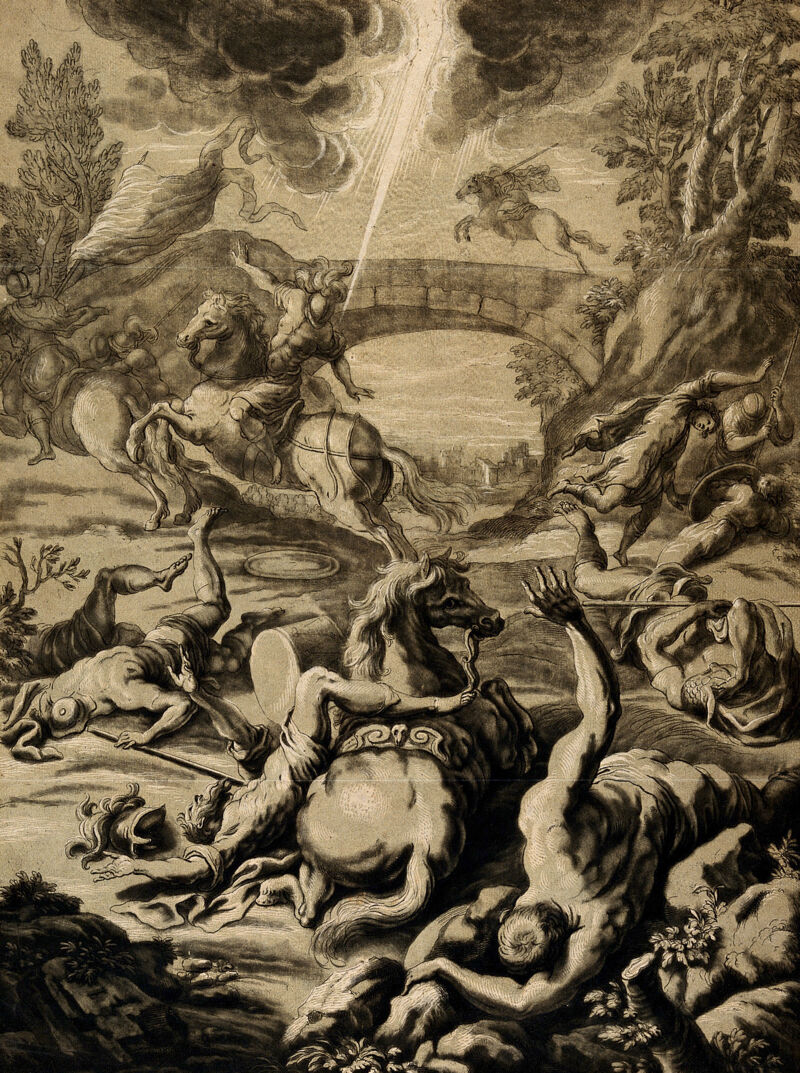
Paul undergoes a mystical experience on the way to Damascus; he falls from his horse. Mixed media colour print by E. Kirkall, 1723, after J. da Palma, il Giovane., 1723, by Palma il Giovane
Palma il Giovane · Wellcome Collection, London · Wellcome Collection
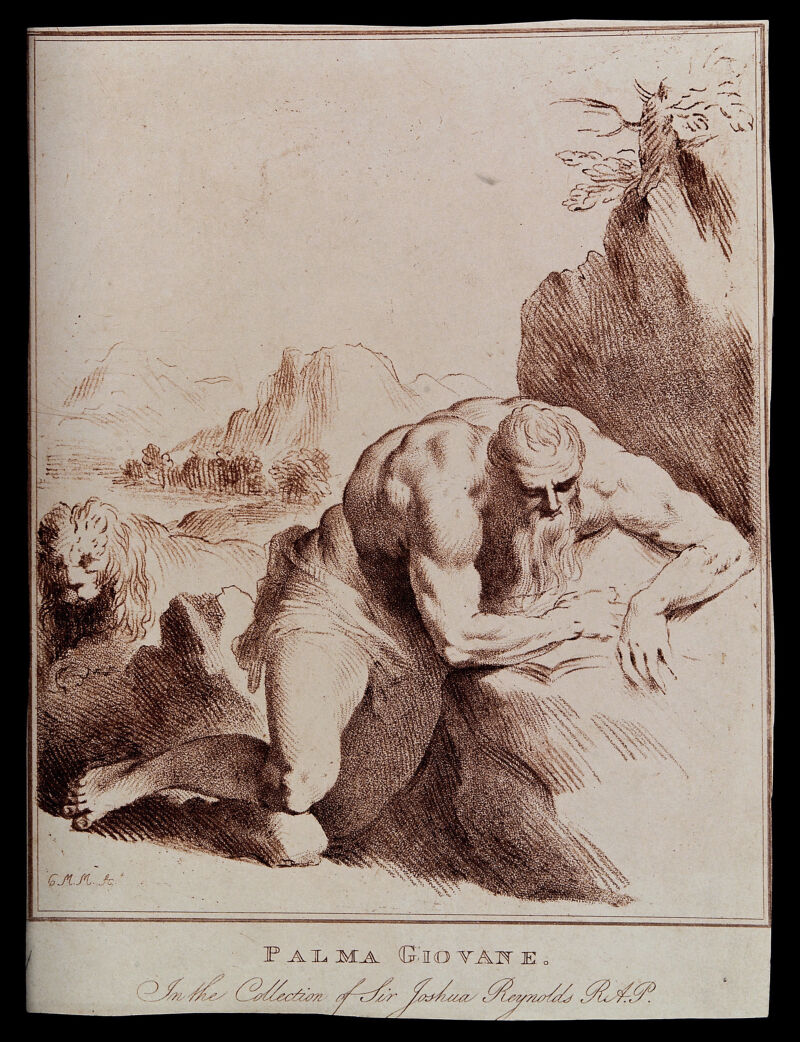
Saint Jerome. Crayon manner print by C.M. Metz after J. Palma., 1798, by Palma il Giovane
Palma il Giovane · Wellcome Collection, London · Wellcome Collection
Life and career
Dated record
Life and career
The full dated record · 2 entries
1544
Palma il Giovane was born on 1 January 1544.
1628
Palma il Giovane died on 17 October 1628.
Places
Named by the record
Places
Only places the record itself states, plotted where the house gazetteer settles their coordinates. Nothing is inferred from a name or a nationality.
Palma il Giovane was born at Venice.
Birthplace
Palma il Giovane died at Venice.
Deathplace
Primary material
Documents and archives
Institutional database
- Wikidata, structured authority record Q651795: Palma il Giovane
Scholarly · Wikimedia Foundation
authority file
- Gemeinsame Normdatei 5505674-X, Mostra di Disegni di Jacopo Palma il Giovane (1958 : Florenz).
Unverified · Deutsche Nationalbibliothek
reference work
- “Palma il Giovane”, English Wikipedia, consulted as further reading
Reputable secondary · Wikipedia
Notes from the source article
Cited by Wikipedia
Notes from the source article
These works are cited by the source article, in its own numbering. They are recorded as its citations, not as sources VALÉORINE has verified.
- 1.Spelling and dates as in Sydney J. Freedberg, Painting in Italy 1500–1600, 3rd ed. (Yale University Press) 1993:560-62.
- 2."Jacopo Palma called Palma Giovane, in Federico Zeri, Italian Paintings (Metropolitan Museum of Art), 1973:45.
- 3.S. J. Freedberg characterises him among Venetian painters as "the only painter of this generation to exhibit a semblance of vitality, even within formulae based mostly upon Tintorettesque style." (Freedberg 1993:560).
- 4.Bonifacio inherited the elder Palma's workshop in 1528; see Philip Cottrell, "The Artistic Parentage of Palma Giovane" The Burlington Magazine 144 No. 1190 (May 2002), pp. 289–291.
- 5.Freedberg 1993:561.
- 6.Freedberg notes in this context the Martyrdom of Saint Lawrence, San Giacomo dell'Orio, Venice, before 1584, then more conspicuously in the histories of the Doge Pasquale Cicogna in the Oratorio dei Crociferi, Venice 1586–87.
- 7.Freedberg 1993:561.
- 8.Roberto Gagliardi – Biography. 23 March 2014.
- 9.Jacopo Negretti, called Palma il Giovane – Old Master Paintings 2020/06/09 – Realized price: EUR 19,050 – Dorotheum. www.dorotheum.com.
References
Citations
References
Each reference names the institution holding it, so a reader may go to the document itself.
Institutional database
Wikidata, structured authority record Q651795: Palma il GiovaneWikimedia Foundation
Verifiedauthority file
Gemeinsame Normdatei 5505674-X, Mostra di Disegni di Jacopo Palma il Giovane (1958 : Florenz).Deutsche Nationalbibliothek
Partially resolvedreference work
Partially resolved
The Encyclopedia exists whether or not anything is for sale. Corrections are recorded rather than overwritten, and every version of this record is kept. Published 14 August 2026.
Elsewhere in Prints
4,138 published records in this field, each with its sources named.
- P.A. SparreEngraver
- Pablo O'HigginsEngraver
- Pablo ReyEngraver
- Pae WhiteEngraver
- Pamvo BeryndaEngraver
- Panagiotis TetsisEngraver
- Pancrace BessaEngraver
- Paolo CaronniEngraver
Best supported in this field
For owners
Own a work by Palma il Giovane?
A specialist will read what you send and tell you what the house can establish, what it cannot, and whether the object is suited to sale. There is no charge and no obligation. The object stays with you throughout; nothing is shipped to us unless it is arranged in writing beforehand.