
Ohara Koson
Ohara • Illustration — Ohara Koson, around the age of 53 Ohara Koson (also Ohara Hōson, Ohara Shōson) (Kanazawa 1877 – Tokyo 1945) was a Japanese painter and woodblock print designer of the late 19th and early 20th centuries, at the forefront of shinsaku-hanga and shin-hanga art movements. Famous as a master of kachō-e (bird-and-flower) designs. Throughout a prolific career, in which he created around 500 prints, he went by three different titles: Ohara Hōson (小原豊邨), Ohara Shōson (小原祥邨) and Ohara Koson.
Also recorded as Koson Ohara · Ohara Hōson · Ohara Shoson · Ohara Shōson
Ohara Koson
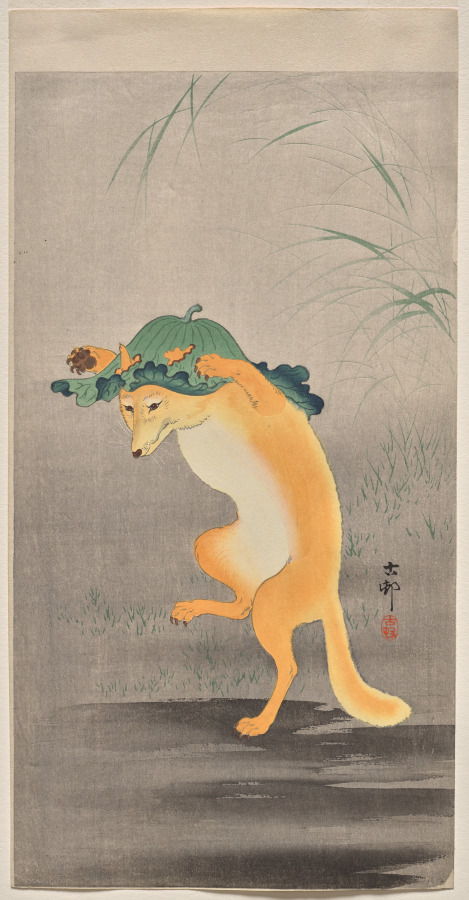
Ohara Koson · The Cleveland Museum of Art · Gift in honor of Delbert Gutridge, CMA Registrar 1968-1996 · CC0
- Full name
- 小原又雄.
- Born
- 1877. · Kanazawa.
- Died
- 1945. · Tokyo.
- Nationality
- Japan.
- Occupation
- printmaker and painter.
- Movements
- Nihonga.
- Teachers
- Suzuki Kason.
VALÉORINE Encyclopedia
VALÉORINE documentary reading
Documentary summary
Ohara • Illustration — Ohara Koson, around the age of 53 Ohara Koson (also Ohara Hōson, Ohara Shōson) (Kanazawa 1877 – Tokyo 1945) was a Japanese painter and woodblock print designer of the late 19th and early 20th centuries, at the forefront of shinsaku-hanga and shin-hanga art movements. Famous as a master of kachō-e (bird-and-flower) designs. Throughout a prolific career, in which he created around 500 prints, he went by three different titles: Ohara Hōson (小原豊邨), Ohara Shōson (小原祥邨) and Ohara Koson.
Admitted source layer · organised and presented by VALÉORINE
Reference Check
Propose documentary evidence for Ohara Koson. A contribution is never written directly as fact: identity, source, rights and evidence gates still decide.
Sign in to contribute
World of VALÉORINE
Documentary connections
Only confirmed graph relationships appear here. Images are shown only when their identity and reuse rights both pass the documentary gate.
Documentary evidence
Documentary basis
Authority files
wikidata · Q2585236 · wikipedia · Ohara Koson
In this article
Biography
Biography
• Illustration — Blue irises, 1900–1930, Rijksmuseum. He was born Ohara Matao; it is thought that he started training in painting and design at the Ishikawa Prefecture Technical School in 1889–1893. He also studied painting with Suzuki Kason (1860–1919), although accounts differ on whether this happened during his school years or after he moved to Tokyo in the middle to late 1890s. In keeping with Japanese custom, on completing his training he changed his name from Matao to Koson, meaning "son of Kason", in recognition of his debt to his teacher. Around 1900 he taught at the Tokyo School of Fine Arts (Tokyo Bijutsu Gakkō), where he met Ernest Fenollosa, then a professor at Tokyo Imperial University, who would later, as curator of the Japanese art department at the Museum of Fine Arts, Boston, ask him to send numerous kachō-e prints to the United States. In Tokyo, he produced some ukiyo-e triptychs illustrating episodes of the Russo-Japanese War, but most of his production was prints of birds-and-flowers (kachō-e), typically flat in colour and produced in the borderless naga-ōban format. He worked at first with publishers Akiyama Buemon (Kokkeidō) and Matsuki Heikichi (Daikokuya), signing his work Koson. Starting around 1926, he became associated with the publisher Watanabe Shōzaburō, and signed his work Shōson. He also worked with the publisher Kawaguchi, signing his works Hōson. Through his association with Watanabe, for whom he produced ōban-format prints in unusually vivid colours, and with the support and promotion of Ernest Fenollosa, Ohara's work was exhibited abroad, and his prints sold well, particularly in the United States. He was appointed professor at the newly founded Tokyo University of the Arts (Tokyo Geijutsu Daigaku) and served as a consultant to the Tokyo National Museum. Largely unknown in Japan during most of his career, his prints had to be reimported once they became popular there from 1970 onward. He was active designing prints until at least 1935, and died at his home in Tokyo in 1945. His work is held in several museums worldwide, including the Toledo Museum of Art, the Brooklyn Museum, the British Museum, the University of Michigan Museum of Art, the Chazen Museum of Art, the Museum of Fine Arts, Boston, the Harvard Art Museums, the Rijksmuseum, the Carnegie Museum of Art, the Saint Louis Art Museum, the Indianapolis Museum of Art, the Museum of New Zealand, the Museum of Anthropology at the University of British Columbia, the Birmingham Museum of Art, the John and Mable Ringling Museum of Art, and the Clark Art Institute. The Manggha museum in Krakow, Poland held a large retrospective in 2021 from the collection of Romanian musical artist Adrian Ciceu, brother of Eugen Cicero.
Gallery
Gallery
• Illustration — Wagtail and Lotus, between 1912 and 1918, woodblock print, 37.7 × 16.4 cm. Brooklyn Museum • Illustration — Cawing crow, c. 1900s • Illustration — Cat and Bowl of Goldfish, 1933 • Illustration — Crow and Blossom, c. 1910 • Illustration — Five Egrets Descending in Snow, c. 1920s • Illustration — Blue Irises, date unknown • Illustration — Siberian Blue Nightingale near a peony under a snowy sheaf, c.1925-c.1936 • Illustration — Sumō-wrestling toads, c. 1930 • Illustration — Scops Owl, Cherry Blossoms, and Moon, 1926 • Illustration — Heron at full moon
Places
Named by the record
Places
Only places the record itself states, plotted where the house gazetteer settles their coordinates. Nothing is inferred from a name or a nationality.
Kanazawa.
Birth place
Tokyo.
Death place
Notes from the source article
Cited by Wikipedia
Notes from the source article
These works are cited by the source article, in its own numbering. They are recorded as its citations, not as sources VALÉORINE has verified.
- 1.Shimizu, Hisao The Publisher Watanabe Shozaburo and the Birth of Shin-Hanga p24
- 2.Ohara Koson (Shōson) (1877-1945) The Lavenberg Collection of Japanese Prints
- 3.Milone, Marco. La xilografia giapponese moderno-contemporanea. Edizioni Clandestine. 86. 2023. 9788865967461.
- 4.Herons in Reeds. emuseum.toledomuseum.org.
- 5.Pheasant. Indianapolis Museum of Art Online Collection.
- 6.Milone, Marco. La xilografia giapponese moderno-contemporanea. Edizioni Clandestine. 86–87. 2023. 9788865967461.
- 7.Milone, Marco. La xilografia giapponese moderno-contemporanea. Edizioni Clandestine. 87. 2023. 9788865967461.
- 8.Brooklyn Museum. www.brooklynmuseum.org.
- 9.print British Museum. The British Museum.
- 10.Exchange: Two white cranes in a stream. exchange.umma.umich.edu.
- 11.The Permanent Collection. Chazen Museum of Art.
- 12.Water Lilies. collections.mfa.org.
- 13.Harvard. From the Harvard Art Museums' collections Kingfisher with Lotus Flower. harvardartmuseums.org.
- 14.Mandarijneenden, Ohara Koson, 1925 - 1936. Rijksmuseum.
- 15.CMOA Collection. collection.cmoa.org.
- 16.Swallows and Wisteria. Saint Louis Art Museum.
- 17.Eagle in flight against a snowy sky. collections.tepapa.govt.nz.
- 18.Collection Online Museum of Anthropology at UBC. collection-online.moa.ubc.ca.
- 19.Rooster and Weasel. www.artsbma.org.
- 20.Crow on Snowy Branch. emuseum.ringling.org. December 2025.
- 21.Nuthatcher atop Persimmons. www.clarkart.edu.
- 22.Eveniment marca Artmark: Made in Japan.
- 23.Muzeum Sztuki i Techniki Japońskiej Manggha - Ohara Koson. Japanese Woodblock Prints from the Collection of Adrian Ciceu.
References
Citations
References
Each reference names the institution holding it, so a reader may go to the document itself.
reference work
Secondary witnessreference work
Secondary witness
The Encyclopedia exists whether or not anything is for sale. Corrections are recorded rather than overwritten, and every version of this record is kept. Published 16 August 2026.
Elsewhere in Prints
4,138 published records in this field, each with its sources named.
- Octave de RochebruneEngraver
- Odilon RedonEngraver
- Ofelia Gelvezon-TequiEngraver
- Ofer LelloucheEngraver
- Olaf NicolaiEngraver
- Oldřich HameraEngraver
- Olga BlinderEngraver
- Olga ČechováEngraver
Best supported in this field
For owners
Own a work by Ohara Koson?
A specialist will read what you send and tell you what the house can establish, what it cannot, and whether the object is suited to sale. There is no charge and no obligation. The object stays with you throughout; nothing is shipped to us unless it is arranged in writing beforehand.