
Odilon Redon
Odilon Redon (born Bertrand Redon; French: [ɔdilɔ̃ ʁədɔ̃]; 20 April 1840 – 6 July 1916) was a French Symbolist draftsman, printmaker, and painter. Early in his career, both before and after fighting in the Franco-Prussian War, Redon worked almost exclusively in charcoal and lithography, works known as his noirs. He gained recognition after his drawings were mentioned in the 1884 novel À rebours (Against Nature) by Joris-Karl Huysmans.
Also recorded as Bertrand-Jean Redon · Bertrand Redon · Odilon Bertrand-Jean Redon · Odilon-Bertrand Redon
Odilon Redon
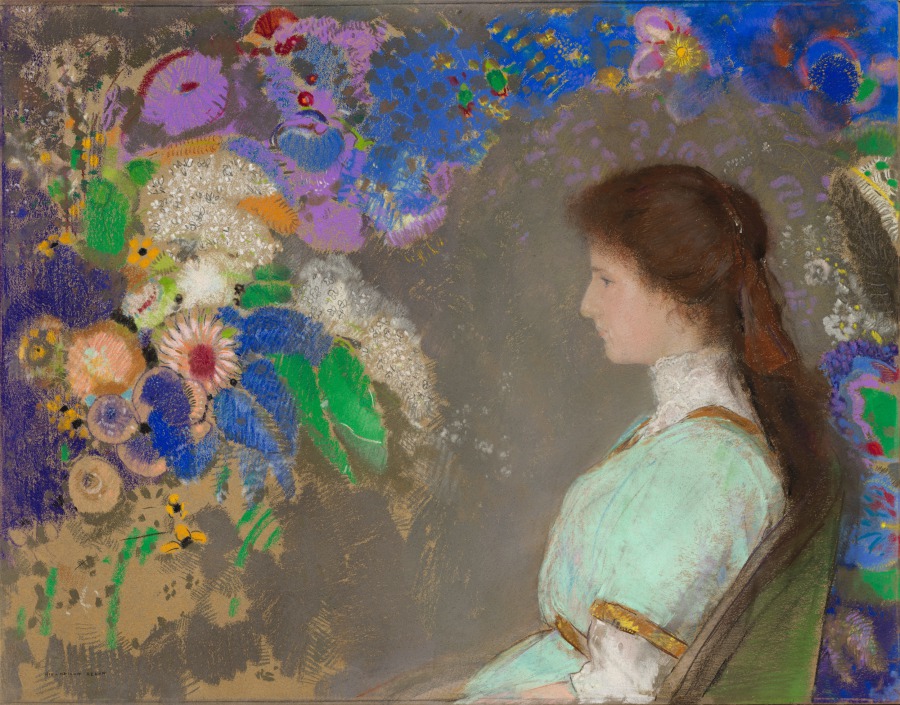
Odilon Redon · The Cleveland Museum of Art · Hinman B. Hurlbut Collection · CC0
- Born
- Odilon Redon was born on 20 April 1840.
- Died
- Odilon Redon died on 6 July 1916.
- Nationality
- France.
- Occupation
- Odilon Redon is recorded with the occupation painter.
- Fields
- genre art, allegory, history painting, landscape painting, portrait and still life.
- Movements
- Symbolism.
- Known for
- The Birth of Venus, Les Yeux clos and The Cyclops.
VALÉORINE Encyclopedia
VALÉORINE documentary reading
Documentary summary
Odilon Redon (born Bertrand Redon; French: [ɔdilɔ̃ ʁədɔ̃]; 20 April 1840 – 6 July 1916) was a French Symbolist draftsman, printmaker, and painter. Early in his career, both before and after fighting in the Franco-Prussian War, Redon worked almost exclusively in charcoal and lithography, works known as his noirs. He gained recognition after his drawings were mentioned in the 1884 novel À rebours (Against Nature) by Joris-Karl Huysmans.
Admitted source layer · organised and presented by VALÉORINE
Note VALÉORINE
Odilon Redon (1840–1916) was a French draftsperson, graphic artist and lithographer, among other activities. Born Bertrand Redom in Bordeaux, the draftsperson died in Paris.
Odilon Redon worked in Amsterdam, Haarlem and Netherlands, among others. The draftsperson was active in graphics, painting and printmaking. Odilon Redon was associated with Symbolism.
Works include Les Yeux clos, The Birth of Venus and The Cyclops. Genres include allegory, genre art and history painting, among others. Languages used include French. The draftsperson received Knight of the Legion of Honour.
Composed from admitted, traceable facts · 26 September 2026
VALÉORINE
Reference Check
Propose documentary evidence for Odilon Redon. A contribution is never written directly as fact: identity, source, rights and evidence gates still decide.
Sign in to contribute
World of VALÉORINE
Documentary connections
Only confirmed graph relationships appear here. Images are shown only when their identity and reuse rights both pass the documentary gate.


Documentary evidence
Evidence Panel
technical hold · checked 25 September 2026
- Identity
- resolved
- Independent source families
- 0
- Admitted assertions
- 0
- Open conflicts
- 0
Authority files
gnd · 3013470-5 · wikidata · Q154349 · wikipedia · Odilon Redon
In this article
Early life
Early life
During the 1890s, Redon began working in pastel and oil, which quickly became his favorite medium, abandoning his previous style of noirs completely after 1900. He developed a keen interest in Hindu and Buddhist religion and culture, which increasingly showed in his work. Redon is perhaps best known today for the dreamlike paintings created in the first decade of the 20th century, which were inspired by Japanese art and leaned toward abstraction. His work is considered a precursor to Surrealism.
Odilon Redon was born, on 20 April 1840, in Bordeaux, Aquitaine, to a prosperous family. Redon's father made his fortune in the slave trade in Louisiana in the 1830s. Redon was conceived in New Orleans and his parents made the transatlantic journey back to France while his French Creole mother, Marie Guérin, was pregnant with him. The young Bertrand Redon acquired the nickname "Odilon" from his mother's first name, Odile. Redon started drawing as a child; at the age of ten, he was awarded a drawing prize at school. He began the formal study of drawing at fifteen but, at his father's insistence, he changed to architecture. Failure to pass the entrance exams at Paris' École des Beaux-Arts ended any plans for a career as an architect, although he briefly studied painting there under Jean-Léon Gérôme in 1864. (His younger brother Gaston Redon would become a noted architect.) Back in his native Bordeaux, he took up sculpting, and Rodolphe Bresdin instructed him in etching and lithography. His artistic career was interrupted in 1870 when he was drafted to serve in the army in the Franco-Prussian War until its end in 1871.
Career
Career
At the end of the war, Redon moved to Paris and resumed working almost exclusively in charcoal and lithography. He called his visionary works, conceived in shades of black, his noirs. It was not until 1878 that his work gained any recognition with Guardian Spirit of the Waters; he published his first album of lithographs, titled Dans le Rêve, in 1879. Still, Redon remained relatively unknown until the appearance in 1884 of a cult novel by Joris-Karl Huysmans titled À rebours (Against Nature). The story featured a decadent aristocrat who collected Redon's drawings. In 1886, Redon exhibited his work with the Impressionists in their last exhibition. The same year, he also began participating in the exhibitions of Les XX in Brussels. In the 1890s, Redon worked in pastel and oil; he did not make noirs after 1900. In 1899, he exhibited with the Nabis at Durand-Ruel's. Redon had a keen interest in Hindu and Buddhist religion and culture. The figure of the Buddha increasingly showed in his work. Influences of Japonisme blended into his art, such as the painting The Death of the Buddha around 1899, The Buddha in 1906, Jacob and the Angel in 1905, and Vase with Japanese Warrior in 1905, among others. Baron Robert de Domecy (1867–1946) commissioned Redon in 1899 to create 17 decorative panels for the dining room of the Château de Domecy-sur-le-Vault near Sermizelles in Burgundy. Redon had created large decorative works for private residences in the past, but his compositions for the château de Domecy in 1900–1901 were his most radical compositions to that point and mark the transition from ornamental to abstract painting. The landscape details do not show a specific place or space. Only details of trees, twigs with leaves, and budding flowers in an endless horizon can be seen. The colors used are mostly yellow, grey, brown and light blue. The influence of the Japanese painting style found on folding screens, byōbu, is discernible in his choice of colors and the rectangular proportions of most of the up to 2.5 metres high panels. Fifteen of them are located today in the Musée d'Orsay, acquired in 1988. Domecy also commissioned Redon to paint portraits of his wife and their daughter Jeanne, two of which are in the collections of the Musée d'Orsay and the Getty Museum in California. Most of the paintings remained in the Domecy family collection until the 1960s.
Personal life
Personal life
At the age of 40, Redon married Camille Falte, a young Creole from Île Bourbon. They had a son, Arï Redon (30 April 1889 – 13 May 1972 in Paris). A visual artist himself and subject of his father's portraiture as a child, Arï's partner was Suzanne Redon. Redon died on 6 July 1916 in Paris.
Modern exhibitions
Modern exhibitions
In 2005, the Museum of Modern Art launched an exhibition entitled "Beyond The Visible", a comprehensive overview of Redon's work showcasing more than 100 paintings, drawings, prints and books from The Ian Woodner Family Collection. The exhibition ran from 30 October 2005 to 23 January 2006. In 2007, the Schirn Kunsthalle Frankfurt presented the exhibition "As in a Dream" with a survey of Redon's work with more than 200 drawings, lithographs, pastels, and paintings. The Grand Palais in Paris, France featured a vast exhibition of Redon's art from March to June 2011 The Fondation Beyeler in Basel, Switzerland showed a retrospective from February to May 2014. The Kröller-Müller Museum in Otterlo, The Netherlands, had an exhibition with an emphasis on the role that literature and music played in Redon's life and work, under the title La littérature et la musique. The exhibition ran from 2 June to 9 September 2018. The Getty Center is hosting "Odilon Redon: Otherworldly Visions" from July 14 through October 18, 2026, featuring the French Symbolist's transition from dark charcoal drawings to vibrant pastels. The exhibition includes major works like "The Battle of the Bones" and "Baronne de Domecy," with free, timed-entry tickets required for entry.
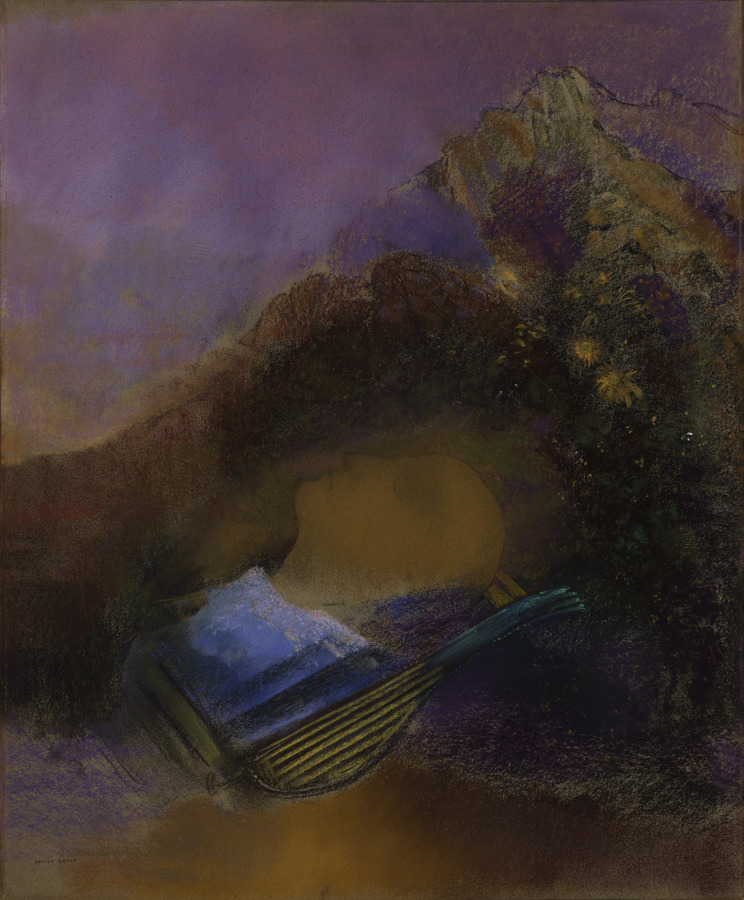
Orpheus, c. 1903–10, by Odilon Redon
Odilon Redon · The Cleveland Museum of Art · Gift from J. H. Wade
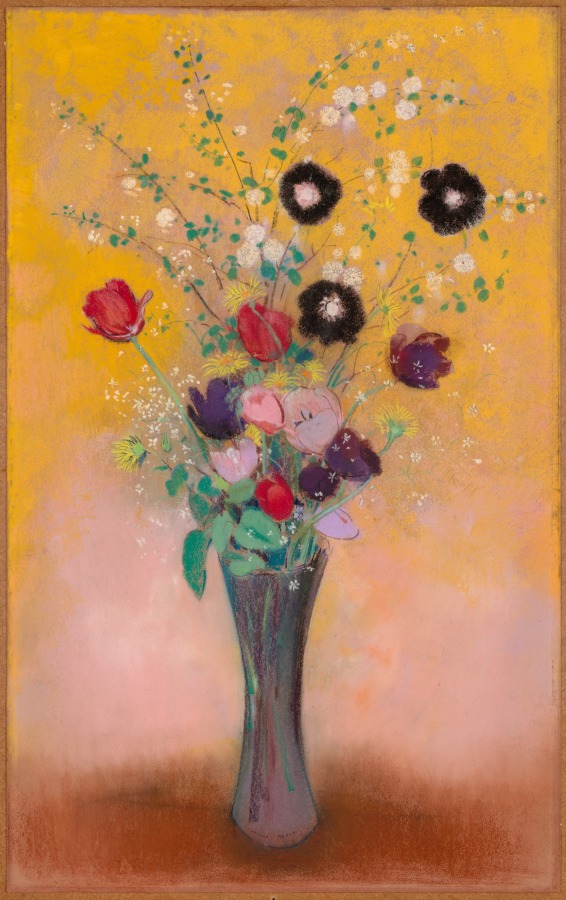
Vase of Flowers, 1916, by Odilon Redon
Odilon Redon · The Cleveland Museum of Art · Bequest of Leonard C. Hanna Jr.
Life and career
Dated record
Life and career
Explore 1840–1916
The full dated record · 4 entries
1840
Odilon Redon born at Bordeaux.
1903
Receives Knight of the Legion of Honour.
1916
Dies at Paris.
1916
Odilon Redon died at Paris.
Places
Named by the record
Places
Only places the record itself states, plotted where the house gazetteer settles their coordinates. Nothing is inferred from a name or a nationality.
Odilon Redon was born at Bordeaux.
Birthplace
Odilon Redon died at Paris.
Deathplace
Reception and interpretations of his work
Reception and interpretations of his work
During his early years as an artist, Redon's works were described as "a synthesis of nightmares and dreams", as they contained dark, fantastical figures from the artist's own imagination. His work represents an exploration of his internal feelings and psyche. Redon wanted to place "the logic of the visible at the service of the invisible". A telling source of Redon's inspiration and the forces behind his works can be found in his journal A Soi-même (To Myself). Of his process he wrote: I have often, as an exercise and as a sustenance, painted before an object down to the smallest accidents of its visual appearance; but the day left me sad and with an unsatiated thirst. The next day I let the other source run, that of imagination, through the recollection of the forms and I was then reassured and appeased. Redon's drawings are characterized as mysterious and evocative by Joris-Karl Huysmans in the following passage from the novel À rebours (1884): Those were the pictures bearing the signature: Odilon Redon. They held, between their gold-edged frames of unpolished pearwood, undreamed-of images: a Merovingian-type head, resting upon a cup; a bearded man, reminiscent both of a Buddhist priest and a public orator, touching an enormous cannon-ball with his finger; a spider with a human face lodged in the centre of its body. Then there were charcoal sketches which delved even deeper into the terrors of fever-ridden dreams. Here, on an enormous die, a melancholy eyelid winked; over there stretched dry and arid landscapes, calcinated plains, heaving and quaking ground, where volcanos erupted into rebellious clouds, under foul and murky skies; sometimes the subjects seemed to have been taken from the nightmarish dreams of science, and hark back to prehistoric times; monstrous flora bloomed on the rocks; everywhere, in among the erratic blocks and glacial mud, were figures whose simian appearance—heavy jawbone, protruding brows, receding forehead, and flattened skull top—recalled the ancestral head, the head of the first Quaternary Period, the head of man when he was still fructivorous and without speech, the contemporary of the mammoth, of the rhinoceros with septate nostrils, and of the giant bear. These drawings defied classification; unheeding, for the most part, of the limitations of painting, they ushered in a very special type of the fantastic, one born of sickness and delirium. The art historian Michael Gibson says that Redon began to want his works, even the ones darker in colour and subject matter, to portray "the triumph of light over darkness." Redon described his work as ambiguous and undefinable: My drawings inspire, and are not to be defined. They place us, as does music, in the ambiguous realm of the undetermined.
Legacy
Legacy
In 1903, Redon was awarded the Legion of Honour. His popularity increased when a catalogue of etchings and lithographs was published by André Mellerio in 1913; that same year, he was given the largest single representation at the groundbreaking US International Exhibition of Modern Art (aka Armory Show), in New York City, Chicago and Boston. His choice of color and subject matter in the second part of his career led to Redon being considered a precursor to Dadaism and Surrealism. According to Surrealist André Masson, Redon's use of bright colors in his flower pastels, as well as his choice of depicting uncommon or imaginary species renders his works "released from stylized naturalism", thus demonstrating the "endless possibilities of lyrical chromatics". In 1923, Mellerio published Odilon Redon: Peintre Dessinateur et Graveur. An archive of Mellerio's papers is held by the Ryerson & Burnham Libraries at the Art Institute of Chicago. Redon was the inspiration for Guy Maddin's 1995 short film Odilon Redon, or The Eye Like a Strange Balloon Mounts Toward Infinity.
Primary material
Documents and archives
institutional register
- Wikidata, structured authority record Q154349: Odilon Redon
Unverified · Wikimedia Foundation
reference work
- “Odilon Redon”, English Wikipedia, consulted as further reading
Reputable secondary · Wikipedia
Notes from the source article
Cited by Wikipedia
Notes from the source article
These works are cited by the source article, in its own numbering. They are recorded as its citations, not as sources VALÉORINE has verified.
- 1.Odilon Redon 1840–1916. Tate.
- 2.Pfohl, Katie. Odilon Redon: How Louisiana ancestry influenced his Symbolist art. New Orleans Museum of Art. 28 October 2016.
- 3.Base Léonore. Ministère de la culture.
- 4.Seiferle, Rebecca. Odilon Redon's Life and Legacy. The Art Story Contributors.
- 5.The Fitzwilliam Museum – Home Online Resources Online Exhibitions Redon About Odilon Redon Childhood and Early Career. www.fitzmuseum.cam.ac.uk. 5 November 2009.
- 6.Sharyk, Hailee. Chapter 10 – Odilon Redon. Library Publishing for Open Textbooks. 1 January 2022.
- 7.Odilon Redon: Schwarze Phantasien zu Farbe und Mystik. Kunst, Künstler, Ausstellungen, Kunstgeschichte. 8 February 2014.
- 8.Redon, Odilon. Des Esseintes, Frontispiece for A Rebours by J.K. Huysmans. The Art Institute of Chicago. 21 January 2018.
- 9.Huysmans, Joris-Karl. Gegen den Strich. 2012. 978-3-8496-1684-7.
- 10.Odilon Redon (The J. Paul Getty Museum Collection). The J. Paul Getty Museum Collection.
- 11.Samu, Margaret. Impressionism: Art and Modernity. www.metmuseum.org. October 2004.
- 12.Anonymous. Melancholy. Cleveland Museum of Art. 31 October 2018.
- 13.Odilon Redon – Tiermalerei – Tiere in der Kunst. Catplus.de. 6 November 2015.
- 14.ODILON REDON (1840–1916). Christie's. 19 November 2022.
- 15.Christies.com. Odilon Redon (1840–1916) | Vase au guerrier japonais | IMPRESSIONIST & MODERN ART Auction | 20th Century, Drawings & Watercolors | Christie's. 2 February 2010.
- 16.Pressimages.fondationbeyeler.ch. Odilon Redon | Press Images – Fondation Beyeler.
- 17.Musee-orsay.fr. Musée d'Orsay: non_traduit. 14 October 1987.
- 18.Musee-orsay.fr. Musee d'Orsay : Homepage.
- 19.Musée d'Orsay: Odilon Redon Baroness Robert de Domecy. 4 February 2009.
- 20.Getty.edu. Baronne de Domecy (Getty Museum).
- 21.Sothebys.com. Sotheby's Impressionist & Modern Art Evening Sale.
- 22.Geipel, Gary (25 January 2013). "A Late Blooming". The Wall Street Journal
- 23.L'abbaye de Fontfroide accueille une exposition du peintre Odilon Redon – Fédération Patrimoine-Environnement.
- 24.Portrait d'Arï Redon au col marin – Odilon Redon. Musée d'Orsay. 9 January 2023.
- 25.Die Pinakotheken. Die Kathedrale (M+).
- 26.Redon, Odilon, and Raphaël Bouvier (2014). Odilon Redon. p. 2.
- 27.Redon, Odilon (1988). Odilon Redon: the Woodner Collection. Washington, D.C.: Phillips Collection. unpaginated. .
- 28.Redon, Odilon. A soi-même journal, 1867–1915 : notes sur la vie, l'art et les artistes. J. Corti. 1989. 2-7143-0357-9.
- 29.Joris-Karl Huysmans. Against Nature. Oxford University Press. 52–53. 1998. 0-14-044086-0.
- 30.Gibson, Michael, and Odilon Redon (2011). Odilon Redon, 1840–1916: The Prince of Dreams. Los Angeles, Calif: Taschen America. p. 97. .
- 31.Goldwater, Robert. Artists on Art. Pantheon. 1945. 0-394-70900-4.
- 32.Redon and Werner (1969), p. ix.
- 33.Scott, Chadd. Strange—And Wonderful—Odilon Redon At Cleveland Museum Of Art. Forbes. 20 October 2021.
- 34.Hopkins, David. Dada and Surrealism: A Very Short Introduction. Oxford University Press. 78. 2004. 978-0-19-157769-7.
- 35.Odilon Redon - French painter. Encyclopedia Britannica. 27 May 1999.
- 36.Hauptman, Jodi. Beyond the Visible: The Art of Odilon Redon. The Museum of Modern Art. 43. 2005. 978-0-87070-601-1.
- 37.Odilon Redon, peintre, dessinateur et graveur : Mellerio, André, b. 1862 : Free Download, Borrow, and Streaming : Internet Archive. Internet Archive. 14 January 2022.
- 38.Mellerio, André. André Mellerio Papers. The Art Institute of Chicago. 21 January 2018.
- 39.William Beard, Into the Past: The Cinema of Guy Maddin. University of Toronto Press, 2010. . pp. 363–365.
- 40.Danielle O'Steen. Dark Dreamer. Art + Auction. November 2005.
- 41.Odilon Redon. Schirn Kunsthalle Frankfurt. 27 January 2007.
- 42.Odilon Redon. www.grandpalais.fr.
- 43.Fondationbeyeler.ch. Introduction | Fondation Beyeler.
- 44.Odilon Redon: La littérature et la musique;.
- 45.Henderson, Taylor. Getty Center is debuting its new Odilon Redon collection on July 14 with free Sunday printmaking sessions and a kickoff concert. Secret Los Angeles. 2026-07-04.
- 46.Folven, Edwin. Getty explores Redon’s dream worlds. Beverly Press & Park Labrea News. 2026-07-02.
Bibliography printed in the source article · 6
- Russell T. Clement, Four French Symbolists: A Sourcebook on Pierre Puvis de Chavannes, Gustave Moreau, Odilon Redon, and Maurice Denis, Greenwood Press, 1996, &
- Jodi Hauptman and Marina Van Zuylen, Beyond the Visible: The Art of Odilon Redon, 2005, &
- Andre Mellerio, Odilon Redon, 1968, ASIN B0007DNIKO
- Odilon Redon and Alfred Werner, The Graphic Works of Odilon Redon, Dover, 1969,
- Odilon Redon and Alfred Werner, The Graphic Works of Odilon Redon, (Dover Pictorial Archive), 2005, &
- Margret Stuffmann, Odilon Redon: As in a Dream, 2007, &
References
Citations
References
Each reference names the institution holding it, so a reader may go to the document itself.
institutional register
Wikidata, structured authority record Q154349: Odilon RedonWikimedia Foundation
Partially resolvedreference work
Partially resolved
A further 2 witnesses are held back from this article because the person or object named in them is not yet resolved to this record. They are kept, not discarded, and return once the identity is established.
People, houses and institutions
Knowledge graph
People, houses and institutions
Teachers, collaborators, publishers and institutions recorded against this person, each on a stated basis.
Died at
1- ParisPlace
Established from a fact already recorded on a verified source.
The Encyclopedia exists whether or not anything is for sale. Corrections are recorded rather than overwritten, and every version of this record is kept. Published 14 August 2026.
Elsewhere in Prints
4,138 published records in this field, each with its sources named.
- Norman IvesEngraver
- NosadellaEngraver
- Obed MokhuhlaniEngraver
- Octave de RochebruneEngraver
- Ofelia Gelvezon-TequiEngraver
- Ofer LelloucheEngraver
- Ohara KosonEngraver
- Olaf NicolaiEngraver
Best supported in this field
For owners
Own a work by Odilon Redon?
A specialist will read what you send and tell you what the house can establish, what it cannot, and whether the object is suited to sale. There is no charge and no obligation. The object stays with you throughout; nothing is shipped to us unless it is arranged in writing beforehand.