
Marie Laurencin
Marie Laurencin (31 October 1883 – 8 June 1956) was a French painter and printmaker. She became an important figure in the Parisian avant-garde as a member of the Cubists associated with the Section d'Or.
Also recorded as Marie-Mélanie Laurencin · Marie-Melanie Laurencin
Marie Laurencin
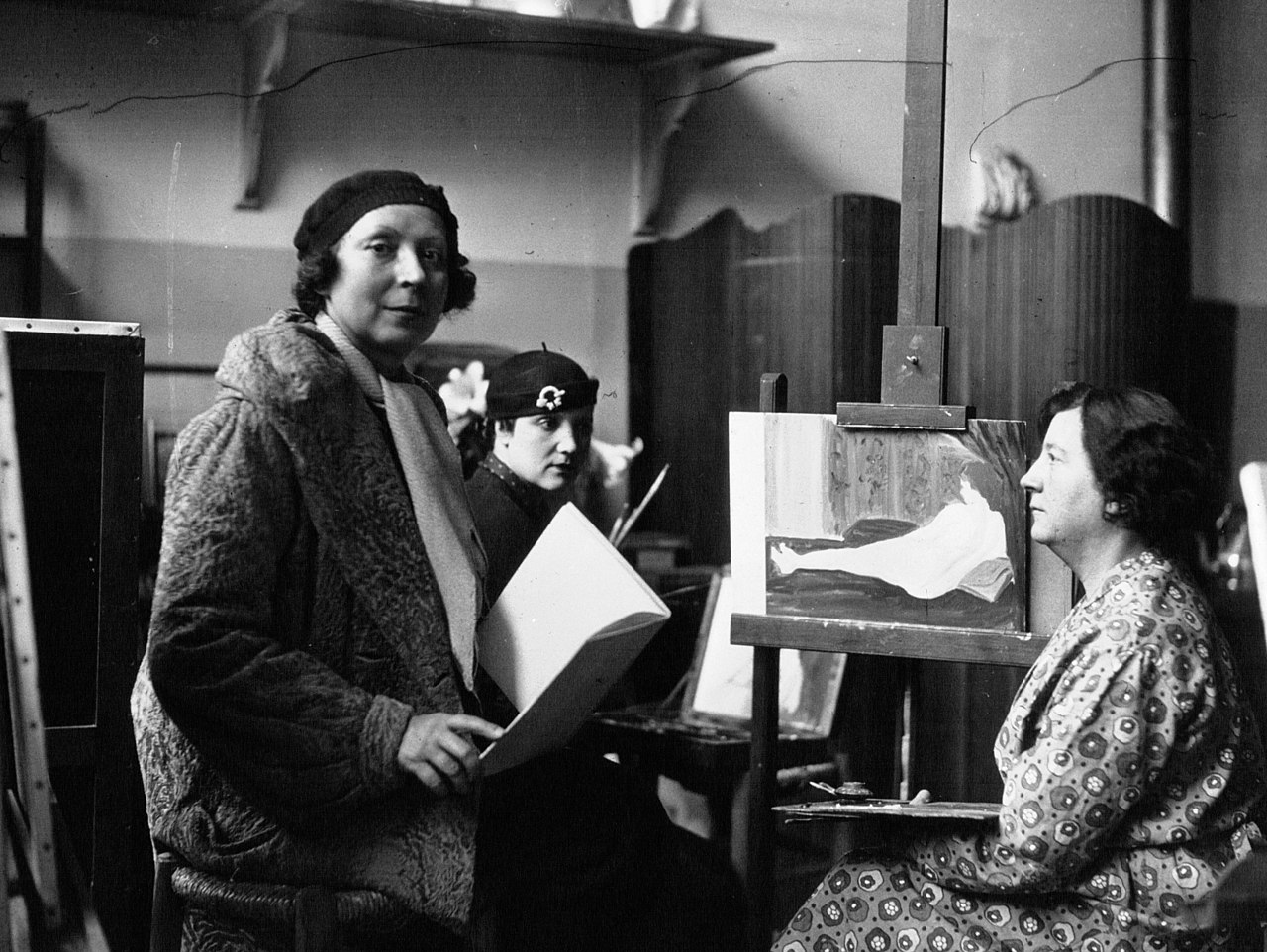
Agence de presse Mondial Photo-Presse · Bibliothèque nationale de France · Public domain
- Born
- 1883.
- Died
- 1956.
- Nationality
- France.
- Fields
- portrait and floral painting.
- Movements
- Fauvism and cubism.
VALÉORINE Encyclopedia
VALÉORINE documentary reading
Documentary summary
Marie Laurencin (31 October 1883 – 8 June 1956) was a French painter and printmaker. She became an important figure in the Parisian avant-garde as a member of the Cubists associated with the Section d'Or.
Admitted source layer · organised and presented by VALÉORINE
Note VALÉORINE
Marie Laurencin (1883–1956) was an artist, designer and etcher, among other activities, of French nationality. The artist was born in 10ᵗʰ arrondissement of Paris and died in 7th arrondissement of Paris.
Marie Laurencin worked in Habas. Activity centred on engraving process and painting. Marie Laurencin was associated with cubism and Fauvism.
The work spans floral painting and portrait. Languages used include French.
Composed from admitted, traceable facts · 30 September 2026
VALÉORINE
Reference Check
Propose documentary evidence for Marie Laurencin. A contribution is never written directly as fact: identity, source, rights and evidence gates still decide.
Sign in to contribute
Documentary evidence
Documentary basis
Authority files
wikidata · Q233088 · wikipedia · Marie Laurencin
In this article
Biography
Biography
Laurencin was born in Paris, where she would live for most of her life. She was raised there by her mother, Pauline-Mélanie Laurencin (1861–1913), an unmarried domestic servant. Although never confirmed, Marie Laurencin believed that she had Creole heritage through her maternal grandmother, something she saw as part of her identity her whole life. Her father, fiscal administrator Alfred-Stanislas Toulet (1839–1905), visited her during her childhood and paid for her education. At 18, she studied porcelain painting in Sèvres. She then returned to Paris and continued her art education at the Académie Humbert, where she changed her focus to oil painting. During the early years of the 20th century, Laurencin was an important figure in the Parisian avant-garde. A member of both the circle of Pablo Picasso, and Cubists associated with the Section d'Or, such as Jean Metzinger, Albert Gleizes, Robert Delaunay, Henri le Fauconnier, and Francis Picabia, exhibiting with them at the Salon des Indépendants (1910–1911) and the Salon d'Automne (1911–1912), and Galeries Dalmau (1912) at the first Cubist exhibition in Spain. She became romantically involved with the poet Guillaume Apollinaire, and has often been identified as his muse. In addition, Laurencin had important connections to the salon of the American expatriate and lesbian writer Natalie Clifford Barney. She had relationships with men and women, and her art reflected her life, her "balletic wraiths" and "sidesaddle Amazons" providing the art world with her brand of "queer femme with a Gallic twist." She had a forty years long love relationship with fashion designer Nicole Groult. During the First World War, Laurencin left France for exile in Spain with her German-born husband, the artist, Baron Otto von Waëtjen, since through her marriage she had automatically lost her French citizenship. The couple subsequently lived together briefly in Düsseldorf. She was greatly affected by her separation from the French capital, the unrivaled center of artistic creativity. After they divorced in 1920, she returned to Paris, where she achieved financial success as an artist until the economic depression of the 1930s. During the 1930s she worked as an art instructor at a private school. She lived in Paris until her death.
Work
Work
Laurencin's works include paintings, watercolors, drawings, and prints. She is known as one of the few female Cubist painters, with Sonia Delaunay, Marie Vorobieff, and Franciska Clausen, although she later distanced herself from it, stating in an interview in 1923: "Cubism has poisoned three years of my life, preventing me from doing any work. [...] As long as I was influenced by the great men surrounding me, I could do nothing." While her work shows the influence of Cubist painters Pablo Picasso and Georges Braque, who was her close friend, she developed a unique approach to abstraction which often centered on the representation of groups of women and animals. Her work lies outside the bounds of Cubist norms in her pursuit of a specifically feminine aesthetic by her use of pastel colors and curvilinear forms. Originally influenced by Fauvism, she simplified her forms through the influence of the Cubist painters. From 1910, her palette consisted mainly of grey, pink, and pastel tones. Her distinctive style developed upon her return to Paris in the 1920s post exile. The muted colours and the geometric patterns inherited from Cubism were replaced by light tones and undulating compositions. Her signature motif is marked by willowy, ethereal female figures, and a palette of soft pastel colours, evoking an enchanted world. Art history professor Libby Otto said, "Marie Laurencin is of the 'lipstick lesbian' variety: She constructs this very soft, feminine world that really spoke to viewers at the time. And if you realize that, in her soft way, she's constructing a world without men, of female harmony, there's something pretty revolutionary in there as well." Laurencin continued to explore themes of femininity and what she considered to be feminine modes of representation until her death. Her works include paintings, watercolors, drawings, and prints.
Life and career
Dated record
Life and career
The full dated record · 2 entries
1883
Marie Laurencin born at 10ᵗʰ arrondissement of Paris.
1956
Marie Laurencin died at 7th arrondissement of Paris.
Collections
Collections
Laurencin's artistic accomplishments are seen in collections around the world. On the 100th anniversary of her birth in 1983, the Musée Marie Laurencin opened in Nagano, Japan. To date, the Musée Marie Laurencin is the only museum in the world that solely contains the art of a female painter. Founder Masahiro Takano was enamored with Laurencin's sensual and lyrical worldview, and the museum holds over 600 art pieces by her. Laurencin's work is also found in The Museum of Modern Art in New York, the Barnes Foundation in Philadelphia, the Hermitage Museum in St. Petersburg, and the Tate Gallery in London. Her work is also shown in the permanent collection of the Musée de l'Orangerie gallery in Paris, France, housing some of her most famous pieces. In 2023, the Barnes Foundation opened a retrospective of Laurencin's work, titled Marie Laurencin: Sapphic Paris.
Documents and archives
Primary material
Documents and archives
scholarly publication
- Laurencin, Marie (1883–1956), Routledge Encyclopedia of Modernism, 2018
Scholarly · Crossref registry · 2018
Institutional database
- Wikidata, structured authority record Q233088: Marie Laurencin
Scholarly · Wikimedia Foundation
reference work
- “Marie Laurencin”, English Wikipedia, consulted as further reading
Reputable secondary · Wikipedia
Notes from the source article
Cited by Wikipedia
Notes from the source article
These works are cited by the source article, in its own numbering. They are recorded as its citations, not as sources VALÉORINE has verified.
- 1.Maurice Raynal: Modern French Painters, Ayer Publishing, 1928, p. 108. .
- 2.Phaidon Editors, Great Women Artists. Phaidon Press, 2019, p. 233.
- 3.The Barnes Foundation. Marie Laurencin. Sapphic Paris. 165. 2023. 978-0-300-27363-2.
- 4.Fraquelli, Simonetta. Marie Laurencin: Sapphic Paris. the Barnes Foundation. 6. 2023. 978-0-300-27363-2.
- 5.Laurençin, Marie. glbtq.com.
- 6.Pilcher, Alex. A Queer Little History of Art. Tate Publishing. 37. 2017. 978-1-84976-503-9.
- 7.Musée d'Orsay.
- 8.Fraquelli, Simonetta. Marie Laurencin: sapphic Paris [exhibition, Philadelphia, Barnes Foundation, October 22, 2023-January 21, 2024]. the Barnes Foundation. 3-4. 2023. 978-0-300-27363-2.
- 9.Marie Laurencin Musée de l'Orangerie. www.musee-orangerie.fr.
- 10.Musée d'Orsay.
- 11.Marie Laurencin Musée de l'Orangerie. www.musee-orangerie.fr.
- 12.Lange, Maggie, "The Exhibition Making the Case for Art Without Men" The New York Times, 25 October 2023.
- 13.Sotheby's - Marie Laurencin.
- 14.Chernick, Karen. A Marie Laurencin Exhibition Offers a View into the Lesbian Circles of 1920s Paris. ARTnews.com. 16 January 2024.
References
Citations
References
Each reference names the institution holding it, so a reader may go to the document itself.
scholarly publication
Institutional witnessInstitutional database
Wikidata, structured authority record Q233088: Marie LaurencinWikimedia Foundation
Institutional witnessreference work
Secondary witness
The Encyclopedia exists whether or not anything is for sale. Corrections are recorded rather than overwritten, and every version of this record is kept. Published 14 August 2026.
Elsewhere in Prints
4,138 published records in this field, each with its sources named.
- Marie DanseEngraver
- Marie Élisabeth Delatour-SimonsEngraver
- Marie EllenriederEngraver
- Marie Elyse St. GeorgeEngraver
- Marie-Anne TardieuEngraver
- Marie-Antoine CarêmeEngraver
- Marie-Jeanne Renard du BosEngraver
- Marie-Josée CoulombeEngraver
Best supported in this field
For owners
Own a work by Marie Laurencin?
A specialist will read what you send and tell you what the house can establish, what it cannot, and whether the object is suited to sale. There is no charge and no obligation. The object stays with you throughout; nothing is shipped to us unless it is arranged in writing beforehand.