
Kōshirō Onchi
Kōshirō Onchi (恩地 孝四郎, 2 July 1891 – 3 June 1955), who is also known as Onchi Kōshirō was Tokyo-born Japanese artist who is best known for his prints. He was the father of the sōsaku-hanga movement in twentieth-century Japan, and a photographer. His work was part of the painting event in the art competition at the 1932 Summer Olympics.
Also recorded as Koshiro Onchi · Koushirou Onchi · Onzi Koshiro
Kōshirō Onchi
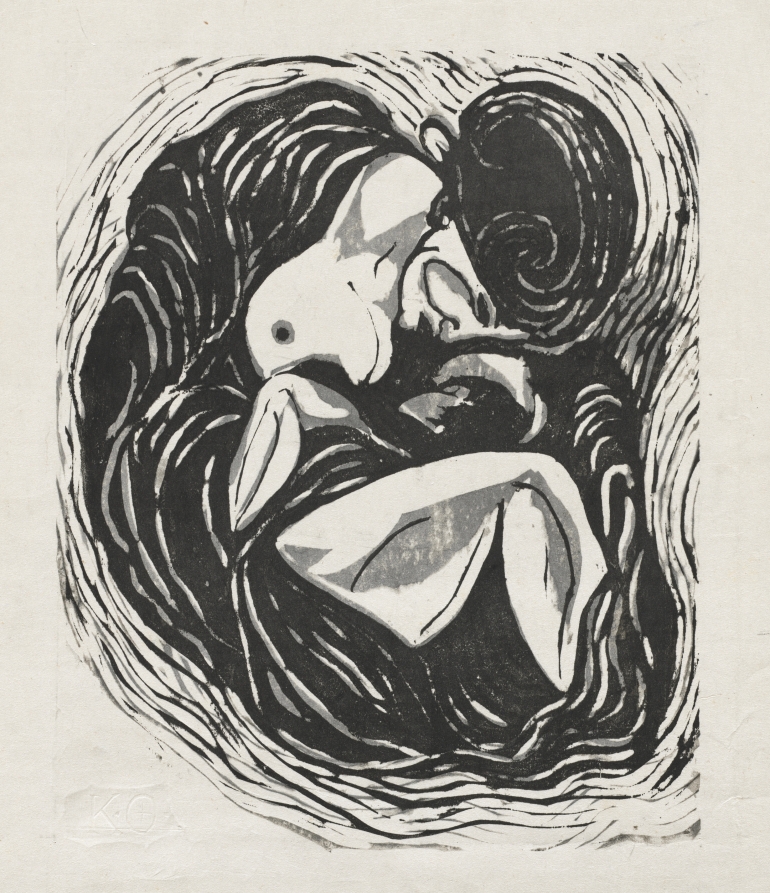
Koshiro Onchi · The Cleveland Museum of Art · Norman O. Stone and Ella A. Stone Memorial Fund · CC0
- Born
- 1891. · Tokyo.
- Died
- 1955. · Tokyo.
- Nationality
- Japan and Empire of Japan.
- Occupation
- painter, poet, printmaker, photographer, artist and book designer.
- Languages
- Japanese.
VALÉORINE Encyclopedia
VALÉORINE documentary reading
Documentary summary
Kōshirō Onchi (恩地 孝四郎, 2 July 1891 – 3 June 1955), who is also known as Onchi Kōshirō was Tokyo-born Japanese artist who is best known for his prints. He was the father of the sōsaku-hanga movement in twentieth-century Japan, and a photographer. His work was part of the painting event in the art competition at the 1932 Summer Olympics.
Admitted source layer · organised and presented by VALÉORINE
Reference Check
Propose documentary evidence for Kōshirō Onchi. A contribution is never written directly as fact: identity, source, rights and evidence gates still decide.
Sign in to contribute
World of VALÉORINE
Documentary connections
Only confirmed graph relationships appear here. Images are shown only when their identity and reuse rights both pass the documentary gate.
Documentary evidence
Documentary basis
Authority files
wikidata · Q2038322 · wikipedia · Kōshirō Onchi
In this article
Biography
Biography
The recorded working language is Japanese. Places of work recorded in the authority are Tokyo. Work by Kōshirō Onchi is recorded in the collections of Minneapolis Institute of Art, Art Institute of Chicago, Museum of Modern Art, National Museum of World Cultures and Print Collection.
Onchi came from an aristocratic family that had close connections with the imperial family. As a child, he received the same kind of education that a prince received. Onchi was trained in both traditional calligraphy and modern western art. Onchi's father, Tetsuo Onchi, was himself a calligrapher, painter and scholar of Chinese studies, and served as tutor to three young princes who were to marry daughters of the Emperor Meiji. Onchi completed elementary school at Bancho in 1904, then attended a school for German studies in Tokyo in 1909; after failing the entrance examination for the Daiichi Kōtōgakkō, he studied oil painting at the Aoibashi branch of the Hakubakai Yōga Kenkyūsho. In December 1909 he sent the painter Takehisa Yumeji his impressions of Takehisa's recently published book Yumeji Gashū - Haru no Maki, the beginning of the contact that, between 1910 and 1915, encouraged him to study oil painting and sculpture at the Tokyo School of Fine Arts. After contacts with Takehisa Yumeji in 1909, between 1910 and 1915, he studied oil painting and sculpture at the Tokyo School of Fine Arts (東京美術学校, Tōkyō Bijutsu Gakkō). In 1912, he founded the print and poetry magazine called "Tsukubae". Onchi was also a book designer in the early days when it was impossible for sōsaku-hanga artists to survive by just doing creative prints. He designed over 1000 books in his career. In 1928 he joined with seven other sōsaku hanga artists to work on the 100 Views of New Tokyo series, to which he contributed thirteen prints. He was described as having the most "forceful personality" of the group, with the "widest intellectual interests and the deepest intellectual convictions." In 1939, he founded the First Thursday Society (一木会, Ichimokukai), which was crucial to the postwar revival of the sōsaku-hanga movement. The society held artist gatherings once a month in Onchi’s house. Members such as Gen Yamaguchi (1896–1976) and Sekino Jun'ichirō (1914–1988) discussed subjects of prints. The American connoisseurs Ernst Hacker, William Hartnett and Oliver Statler also attended. The First Thursday Collection (一木集, Ichimoku-shū), a collection of prints by members to circulate to each other, was produced in 1944. Through the First Thursday Society, Onchi provided aspiring young artists with resources and comradeship during the war years when resources were scarce and censorship severe. Like many artists, Onchi was conscripted into national service during the Second World War; from 1942 he served as president of the Nihon Hanga Hōkokai and took part in the collaborative print series Tokyo Kaiko Zue in an attempt to revitalize woodblock printing in the immediate postwar period. After the war, he emerged as the leader of the sōsaku-hanga movement that flourished in the international art scene. The 1951 São Paulo Biennial marked a decisive step in gaining recognition for the movement within Japan itself."
Life and career
Dated record
Life and career
The full dated record · 2 entries
1891
Kōshirō Onchi born at Tokyo.
1955
Kōshirō Onchi died at Tokyo.
Style and technique
Onchi's prints range from early representational to postwar abstract prints. As an early advocate of the sōsaku-hanga movement, Onchi believed that artistic creation originates from the self. He was more interested in expressing subjective emotions through abstract prints than in replicating images and forms in the objective world. His prints evoke lyrical and poetic mood. He said: Art is not to be understood by the mind but by the heart. If we go back to its origin, painting is expressed in color and form by the heart, and it should never be limited to a world of reflected forms captured by visual sense. Therefore, expression of the heart through color and forms separated from color and form in the real world is that true realm of painting. I will for the time call this type of work the 'lyrique'. Onchi innovated by incorporating fabrics, string, paper blocks, fish fins, and leaves in his prints. In the print Nijūbashi, Onchi placed a willow in the foreground, obscuring the view of the bridge, while the palace's stone walls fill the left third of the composition; uninterested in literal representation, the artist used the walls almost as sculpture, building texture to capture an impression of the famous landmark rather than a topographical record. In Ueno Dōbutsuen he captured the relaxed mood of a typical Sunday, with city-dwelling parents and children enjoying the park-like grounds of Ueno Zoo and its many native and foreign species. In December 1953 Onchi made a self-portrait by coating an ordinary wooden board with a heavy layer of glue, around which he wound thick butcher's cord to form the rough outline of a human face before printing from the resulting relief.
Photography
From around 1932, Onchi worked on the design of a number of books about photography published by Genkōsha (玄光社) and Ars. He also became interested in photography. Through the 1930s and 1940s, Onchi worked in the spirit of shinkō shashin. He worked on plants, animals and objets, and also created photograms. Later museum accounts, including the Tokyo section of the Tokyo Photographic Art Museum exhibition Avant-Garde Rising: The Photographic Vanguard in Modern Japan, situated such work within the wider milieu of avant-garde photography in Tokyo. Onchi was sent to China in 1939 and later the same year returned to Tokyo and had an exhibition of his Chinese works. Onchi exhibited his photograms in 1951 but otherwise dropped out of photography. He died in Tokyo on 3 June 1955.
Collections
Collections
Onchi's works are held in several museums worldwide, including the National Museum of Modern Art, Tokyo, the Tokyo Photographic Art Museum, the National Museum of Modern Art, Kyoto, the University of Michigan Museum of Art, the Museum of Fine Arts, Boston, the Smart Museum of Art, the British Museum, the Museum of Modern Art, the Portland Art Museum, the Saint Louis Art Museum, the Brooklyn Museum, the Worcester Art Museum, the Harvard Art Museums, and the Art Gallery of New South Wales.
Documents and archives
Primary material
Documents and archives
scholarly publication
- Onchi, Kōshirō (1890–1955), Routledge Encyclopedia of Modernism, 2018
Scholarly · Crossref registry · 2018
- Onchi, Koshiro, Benezit Dictionary of Artists, 2011
Scholarly · Crossref registry · 2011
reference work
- “Kōshirō Onchi”, English Wikipedia, consulted as further reading
Reputable secondary · Wikipedia
authority record
- Wikidata, structured authority record Q2038322: Kōshirō Onchi
General reference · Wikidata
Notes from the source article
Cited by Wikipedia
Notes from the source article
These works are cited by the source article, in its own numbering. They are recorded as its citations, not as sources VALÉORINE has verified.
- 1.Kōshirō Onchi. Olympedia.
- 2.Milone, Marco. La xilografia giapponese moderno-contemporanea. Edizioni Clandestine. 229. 2023. 9788865967461.
- 3.Milone, Marco. La xilografia giapponese moderno-contemporanea. Edizioni Clandestine. 229–230. 2023. 9788865967461.
- 4.Jinbo, "Onchi Kōshirō".
- 5.Austin, James B. Shin Tokyo Hyakkei: The Eastern Capital Revisited by the Modern Print Artists. Ukiyo-e Art a Journal of the Japan Ukiyo-e Society. 14. 1966.
- 6.Milone, Marco. La xilografia giapponese moderno-contemporanea. Edizioni Clandestine. 235. 2023. 9788865967461.
- 7.Milone, Marco. La xilografia giapponese moderno-contemporanea. Edizioni Clandestine. 236. 2023. 9788865967461.
- 8.Milone, Marco. La xilografia giapponese moderno-contemporanea. Edizioni Clandestine. 235–236. 2023. 9788865967461.
- 9.Milone, Marco. La xilografia giapponese moderno-contemporanea. Edizioni Clandestine. 236. 2023. 9788865967461.
- 10.Avant-Garde Rising: The Photographic Vanguard in Modern Japan. Tokyo Photographic Art Museum.
- 11.The Independent Administrative Institution National Museum of Art - Collections. search.artmuseums.go.jp.
- 12.Collection search results for Onchi Koshiro. Tokyo Photographic Art Museum Collection Search.
- 13.Exchange: Family of the Mountain. exchange.umma.umich.edu.
- 14.Diving. collections.mfa.org.
- 15.Onchi Koshiro. smartcollection.uchicago.edu.
- 16.illustrated book; print British Museum. The British Museum.
- 17.Koshiro Onchi. Plate (folio 7, recto) from Umi no dowa. 1934 MoMA. The Museum of Modern Art.
- 18.Onchi Kōshirō. portlandartmuseum.us.
- 19.Impression of a Violinist (Portrait of Suwa Nejiko). Saint Louis Art Museum.
- 20.Brooklyn Museum. www.brooklynmuseum.org.
- 21.Fable of the Sea (Umi no dowa). worcester.emuseum.com.
- 22.Harvard. From the Harvard Art Museums' collections Portrait of the Artist Onchi Kōshirō. harvardartmuseums.org.
- 23.A face, 1914 by Onchi Kōshirō. www.artgallery.nsw.gov.au.
References
Citations
References
Each reference names the institution holding it, so a reader may go to the document itself.
scholarly publication
Institutional witnessscholarly publication
Onchi, Koshiro, Benezit Dictionary of Artists, 2011Crossref registry
Institutional witnessreference work
Secondary witnessauthority record
General reference
The Encyclopedia exists whether or not anything is for sale. Corrections are recorded rather than overwritten, and every version of this record is kept. Published 14 August 2026.
Elsewhere in Paintings
19,261 published records in this field, each with its sources named.
- Kora of SicyonArtist
- Kōriki EnkōanArtist
- Kornylo UstyianovychArtist
- Koryun NahapetyanArtist
- Kossa BokchanArtist
- Kosta KulundzicArtist
- Kosta MiličevićArtist
- Kostandin ShpatarakuArtist
Best supported in this field
For owners
Own a work by Kōshirō Onchi?
A specialist will read what you send and tell you what the house can establish, what it cannot, and whether the object is suited to sale. There is no charge and no obligation. The object stays with you throughout; nothing is shipped to us unless it is arranged in writing beforehand.