
Konstantinos Kontarinis
Konstantinos Kontarinis (1679–1738), also known as Konstantino Kontarini, was a Greek Baroque painter of the Heptanese school. He was heavily influenced by the works of Theodore Poulakis. His contemporaries at the time were Stephano Tzangarola and Panagiotis Doxaras.
Also recorded as Konstantino Kontarini
Konstantinos Kontarinis

shakko · CC BY-SA 3.0
- Name
- Konstantinos Kontarinis
- Born
- 1679
- Birthplace
- Corfu, Greece
- Died
- 1738
- Place of death
- Lefkada, Greece
- Known for
- Iconography and hagiography
- Movement
- Heptanese school Greek Baroque
- Occupation
- painter · iconographer
- Movements
- Heptanese school
- Languages
- Greek
Enciclopedia VALÉORINE
Il dossier documentario
Ogni enunciato è letto negli archivi di autorità delle istituzioni nominate. Scegliete «Prova» accanto a un enunciato per vedere la scheda da cui è tratto, il punto esatto e la data di lettura.
Konstantinos Kontarinis fu “Ikonenmaler”; la nascita è registrata nel 1669 a Rethimnon e la morte nel 1738.
Vita
Entrambi gli eventi sono registrati dalla Deutsche Nationalbibliothek.
Istituzioni citate
Deutsche Nationalbibliothek
Non indicato dalle fonti citate: nazionalità
Catena di lettura completa (JSON)Reference Check
Propose documentary evidence for Konstantinos Kontarinis. A contribution is never written directly as fact: identity, source, rights and evidence gates still decide.
Sign in to contribute
World of VALÉORINE
Documentary connections
Only confirmed graph relationships appear here. Images are shown only when their identity and reuse rights both pass the documentary gate.
Documentary evidence
Documentary basis
Authority files
wikidata · Q108861918 · wikipedia · Konstantinos Kontarinis
In this article
Biography
Biography
His work signals a transition for the Cretan school to the more refined Heptanese school. Kontarinis clearly follows the traditional maniera greca. The art was heavily influenced by the Venetian style. He influenced the works of countless Greek and Italian painters namely Spyridon Sperantzas and Nikolaos Kallergis. According to the Institute of Neohellenic Research, eighty-five of his works survived. His most notable work is the portable icon consisting of Scenes from Genesis. It is featured at the Byzantine Museum Athens, Greece.

Circle of Konstantinos Kontarinis. The Descent from the cross. Middle of 18 c. A.S. Onassis collection
shakko
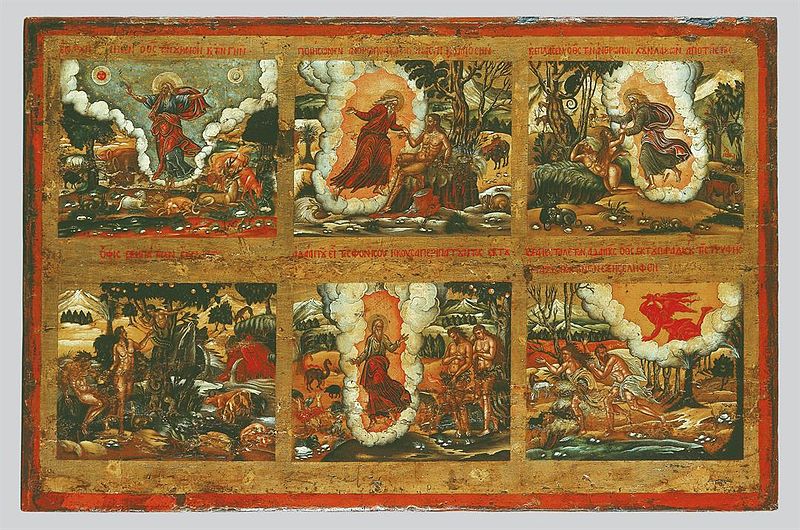
Scenes from Genesis Portable icon with scenes from Genesis. It is attributed to the Painter Konstantinos Kontarinis. In the lower part, Adam and Eve are being chased out of Eden.
Konstantinos Kontarinis (att) · http: id=69
Key facts
Key facts
• Name — Konstantinos Kontarinis • Born — 1679 • Birthplace — Corfu, Greece • Died — 1738 • Place of death — Lefkada, Greece • Known for — Iconography and hagiography • Movement — Heptanese school Greek Baroque
History
History
Kontarinis was born on the island of Corfu. His family migrated from Rethymno, Crete. The family was featured in the works of Marinos Tzanes. Not much is known about his life. He was married. He had a son named Nicholas. He is mentioned in the archives of Corfu around 1715. He traveled around the Ionian Islands. By the 1730s he was in Lefkada. He was recorded on October 14, 1731. He was a witness. His work was heavily influenced by Theodore Poulakis, he was another Greek painter associated with the island of Corfu. Both of the artists are representatives of the Heptanese school Kontarinis is among a unique class of Greek painters. He allowed patrons to be featured in his works. One such instance was Saint Lucian's Miracle, the Saving of Spyridon Voulgaris. Clearly, Voulgaris is the feature of the work. Stephanos Tzangarolas also employs a similar technique. He featured Bernardo (Vernardo) Aninou in his Virgin Glykofilousa. Franghias Kavertzas featured a nun named Evgenia Trapezontiopoulla at the bottom of his Last Judgment. She was also the patron of the masterpiece. Another impressive painting by Kontarinis Saint Alexander and Scenes of Martyrdom features a Camel. Greek painter Konstantinos Kontaris is often confused with Kontarinis due to the similarity of their names. Some theories evolved that Kontaris is Kontarinis. There is considerable debate regarding Kontarinis masterpiece Descent from the Cross.
Gallery
Gallery
• Illustration — The Allegory of the Holy Communion • Illustration — Adam and Eve • Illustration — Circle of Kontarinis Descent from the Cross • Illustration — Scenes from Genesis • Illustration — Saint Alexander and Scenes of Martyrdom
Notable works
Notable works
• Alypius Private Collection Kölliken Switzerland • Entrance of the Virgin (ΘΚ), Noether Collection Mannheim, Germany
Life and career
Dated record
Life and career
The full dated record · 2 entries
1679
Konstantinos Kontarinis born at Corfu.
1738
Konstantinos Kontarinis died at Lefkada.
Places
Named by the record
Places
Only places the record itself states, plotted where the house gazetteer settles their coordinates. Nothing is inferred from a name or a nationality.
Corfu.
Birth place
Lefkada.
Death place
Text attribution
Licensing
Text attribution
Part of the biographical narrative on this page reuses licensed material. Its origin, revision and licence are recorded here.
The biographical narrative on this page is based on the Wikipedia article Konstantinos Kontarinis, revision 1343236243 (EN edition), by its contributors. VALÉORINE has edited that text and built its own documentary record around it. The reused material is available under CC BY-SA 4.0, and this page's reuse of it is offered under the same licence. Everything else on this page — the chronology, the holdings, the evidence, the plates and the connections — is VALÉORINE's own record. Sources and licences.
Notes from the source article
Cited by Wikipedia
Notes from the source article
These works are cited by the source article, in its own numbering. They are recorded as its citations, not as sources VALÉORINE has verified.
- 1.Eugenia Drakopoulou. Kontarinis Konstantinos. Institute for Neohellenic Research. October 10, 2021.
- 2.Hatzidakis, Manolis. Greek painters after the fall (1450-1830) Volume B. Center for Modern Greek Studies E.I.E. 104–106. 1997.
- 3.Hatzidakis, Nano M. Icons, the Velimezis Collection: Catalogue Raisonné. Museum Benaki. 336. 1998.
- 4.Georgopoulou Verra, Myrto. Holy Passion, Sacred Images, The Interaction of Byzantine and Western Art in Icon Painting. S.U.N.Y. The University of Binghamton. 33. 1999. 9789602142578.
- 5.Hatzidakis, 1997, pp 104-106
- 6.Hatzidakis, 1997, pp 104-106
- 7.Eugenia Drakopoulou. Kontaris Konstantinos. Institute for Neohellenic Research. June 6, 2022.
Bibliography printed in the source article · 3
- Drakopoulou, Eugenia. Greek painters after the fall (1450-1830) Volume C. Center for Modern Greek Studies E.I.E. 2010.
- Hatzidakis, Manolis. Greek painters after the fall (1450-1830) Volume A. Center for Modern Greek Studies E.I.E. 1987.
- Hatzidakis, Manolis. Greek painters after the fall (1450-1830) Volume B. Center for Modern Greek Studies E.I.E. 1997.
References
Citations
References
Each reference names the institution holding it, so a reader may go to the document itself.
reference work
Secondary witnessreference work
Secondary witness
The Encyclopedia exists whether or not anything is for sale. Corrections are recorded rather than overwritten, and every version of this record is kept. Published 25 August 2026.
Elsewhere in Paintings
19,456 published records in this field, each with its sources named.
- Konstantin TrutovskyArtist
- Konstantin VasilyevArtist
- Konstantin von KügelgenArtist
- Konstantin YuonArtist
- Konstantinos MaleasArtist
- Konstantinos PaleokapasArtist
- Konstantinos ParthenisArtist
- Konstantinos TzanesArtist
Best supported in this field
For owners
Own a work by Konstantinos Kontarinis?
A specialist will read what you send and tell you what the house can establish, what it cannot, and whether the object is suited to sale. There is no charge and no obligation. The object stays with you throughout; nothing is shipped to us unless it is arranged in writing beforehand.