
John Perceval
John de Burgh Perceval AO (1 February 1923 – 15 October 2000) was a well-known Australian artist. Perceval was the last surviving member of a group known as the Angry Penguins who redefined Australian art in the 1940s. Other members included John Reed, Joy Hester, Sidney Nolan, Arthur Boyd and Albert Tucker.
Also recorded as John de Burgh Perceval · Linwood Robert Stevens South
John Perceval
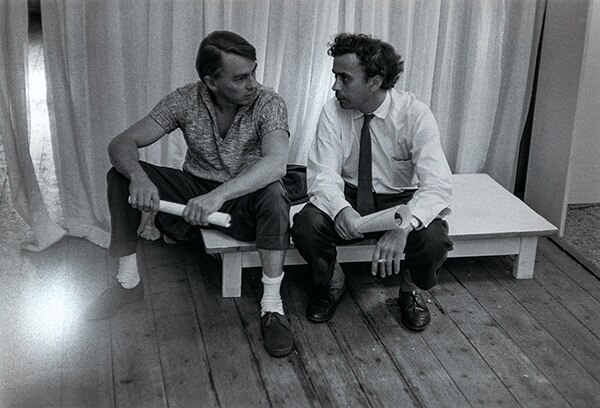
Jamesmcardle · CC BY-SA 4.0
- Name
- John Perceval
- Birth Name
- Linwood Robert Steven South
- Born
- 1 February 1923
- Birthplace
- Bruce Rock, Western Australia, Australia
- Died
- 15 October 2000
- Place of death
- Melbourne, Victoria, Australia
- Field
- Painter, ceramicist
- Awards
- McCaughey Prize (1958) Wynne Prize (1960) Officer of the Order of Australia (1991)
- Nationality
- Australia
- Occupation
- painter · musician · artist
- Fields
- painting
- Education
- Trinity Grammar School Kew
VALÉORINE Encyclopedia
VALÉORINE documentary reading
Documentary summary
John de Burgh Perceval AO (1 February 1923 – 15 October 2000) was a well-known Australian artist. Perceval was the last surviving member of a group known as the Angry Penguins who redefined Australian art in the 1940s. Other members included John Reed, Joy Hester, Sidney Nolan, Arthur Boyd and Albert Tucker.
Admitted source layer · organised and presented by VALÉORINE
Note VALÉORINE
John Perceval (1923–2000) was an Australian artist, musician and painter. Born in Bruce Rock, the artist died in Melbourne.
John Perceval studied at Trinity Grammar School Kew. The artist was active in painting.
Works by John Perceval are held at Art Gallery of New South Wales, Art Gallery of South Australia and National Gallery of Australia, among others. The artist received Officer of the Order of Australia and Wynne Prize.
Composed from admitted, traceable facts · 27 September 2026
VALÉORINE
Reference Check
Propose documentary evidence for John Perceval. A contribution is never written directly as fact: identity, source, rights and evidence gates still decide.
Sign in to contribute
World of VALÉORINE
Documentary connections
Only confirmed graph relationships appear here. Images are shown only when their identity and reuse rights both pass the documentary gate.
Documentary evidence
Documentary basis
Authority files
wikidata · Q6252532 · wikipedia · John Perceval
In this article
Biography
Biography
He was also an Antipodean and contributed to the Antipodeans exhibition of 1959.
John Perceval studied at Trinity Grammar School Kew. The field of work recorded is painting. Work by John Perceval is recorded in the collections of National Gallery of Victoria, Art Gallery of South Australia, Art Gallery of New South Wales and National Gallery of Australia. Distinctions recorded are Wynne Prize and Officer of the Order of Australia.

Castlemaine Art Museum's Higgins Gallery south wall, 2023, with works by Roger Kemp, John Perceval
Jamesmcardle
Key facts
Key facts
• Name — John Perceval • Birth Name — Linwood Robert Steven South • Born — 1 February 1923 • Birthplace — Bruce Rock, Western Australia, Australia • Died — 15 October 2000 • Place of death — Melbourne, Victoria, Australia • Field — Painter, ceramicist • Awards — McCaughey Prize (1958) Wynne Prize (1960) Officer of the Order of Australia (1991)
Biography
Biography
Perceval was born Linwood Robert Steven South on 1 February 1923 at Bruce Rock, Western Australia, the second child of Robert South (a wheat farmer) and Dorothy (née Dolton). His parents separated in 1925 and he remained at his father's farm until reunited with his mother and travelling to Melbourne in 1935. Following the marriage of his mother to William de Burgh Perceval, he changed his name to John and adopted the surname de Burgh Perceval. In 1938 Perceval contracted polio and was hospitalised, giving him the opportunity to further his skills at drawing and painting. Enlisting in the army in 1941 Perceval first met and befriended Arthur Boyd. After leaving the army and moving into the Boyd family home, "Open Country", Murrumbeena, he married Boyd's younger sister Mary Boyd in 1944. Together he and Mary Boyd produced four children. Perceval held his first solo exhibition at the Melbourne Book Club in 1948 and showed regularly with the Contemporary Art Society. Between 1949 and 1955 he concentrated on producing earthenware ceramics and helped to establish the Arthur Merric Boyd Pottery in Murrumbeena. Returning to painting in 1956 Perceval produced a series of images of Williamstown and Gaffney's Creek. Moving to England in 1963 Perceval held solo exhibitions in London, and travelled to Europe, before returning to Australia in 1965 to take up the first Australian National University Creative Fellowship. John Perceval, a major retrospective exhibition, was held at Albert Hall, Canberra in 1966. Author Margaret Plant's monograph John Perceval, was published in 1971. Suffering from alcoholism, and later in life from schizophrenia, in 1974 Perceval was committed to the psychiatric hospital Larundel, Melbourne, where he remained until 1981. John Perceval: A Retrospective Exhibition of Paintings was held at Heide Park and Art Gallery in 1984. He was awarded Officer of the Order of Australia (AO) in 1991, the year before the National Gallery of Victoria held John Perceval: A Retrospective, where writer and art historian, Traudi Allen's John Perceval was launched. A second, entirely revised and updated edition of this publication was released in 2015. • Illustration — Perceval's grave (front) at Brighton General Cemetery In 2000 from 19 August to 19 October John Perceval Retrospective Exhibition was held in Galeria Aniela Fine Art Gallery and Sculpture Park. It was officially opened by the Chairman of Sotheby’s (it included 80 oil paintings and works on paper from 1946 to 1999). It was Perceval's last retrospective and was mentioned on ABC TV's National News. Prior to his death Scudding Swans (1959) sold for $552,500, a record for a living Australian painter. In March 2010, it was sold for $690,000. Perceval died on 15 October 2000, and was buried at Brighton General Cemetery. He was survived by his four children; Matthew, Tessa, Celia and Alice, all of whom are practising artists today.
Places
Named by the record
Places
Only places the record itself states, plotted where the house gazetteer settles their coordinates. Nothing is inferred from a name or a nationality.
Bruce Rock.
Birth place
Melbourne.
Death place
Honours and awards
• 1958: McCaughey Prize • 1959: Maude Vizard-Wholohan Prize, Art Gallery of South Australia • 1960: Wynne Prize for Dairy Farm, Victoria • 1991: Officer of the Order of Australia for service to the visual arts
Notes from the source article
Cited by Wikipedia
Notes from the source article
These works are cited by the source article, in its own numbering. They are recorded as its citations, not as sources VALÉORINE has verified.
- 1.Allen, Traudi. John de Burgh Perceval (1923–2000). Australian Dictionary of Biography. 2026.
- 2.Entrance to open country, the Boyd family home, Murrumbeena [picture].
- 3.John Perceval Biography. Eva Breuer, art dealer.
Bibliography printed in the source article · 3
- Allen, Traudi. John Perceval; Art and Life. Melbourne University Press. 2015. 9780522868609.
- Allen, Traudi. John Perceval. Melbourne University Press. 1992. 0-522-84489-8.
- Plant, Margaret. John Perceval. Lansdowne Australian art library. 1971. 0-7018-0350-9.
References
Citations
References
Each reference names the institution holding it, so a reader may go to the document itself.
reference work
Secondary witnessreference work
Secondary witness
The Encyclopedia exists whether or not anything is for sale. Corrections are recorded rather than overwritten, and every version of this record is kept. Published 18 August 2026.
Elsewhere in Paintings
19,261 published records in this field, each with its sources named.
- John OpieArtist
- John Paddy CarstairsArtist
- John PairmanArtist
- John PartridgeArtist
- John PerreaultArtist
- John Peter RussellArtist
- John PettieArtist
- John PhillipArtist
Best supported in this field
For owners
Own a work by John Perceval?
A specialist will read what you send and tell you what the house can establish, what it cannot, and whether the object is suited to sale. There is no charge and no obligation. The object stays with you throughout; nothing is shipped to us unless it is arranged in writing beforehand.