
Johannes Lingelbach
Johannes (or Johann) Lingelbach (1622 – 3 November 1674) was a Dutch Golden Age painter, associated with the second generation of Bambocciate, a group of genre painters working in Rome from 1625–1700. • Illustration — Mezzotint of Johannes Lingelbach by Bernard Vaillant
Also recorded as Johannes Lingerbagh · Johannes Lingebagh · I. Lingelbach · Johannes Singleback
Johannes Lingelbach
Johannes Lingelbach · L'Histoire April-June 2009, p.74 · Public domain
- Born
- 1622 · Frankfurt.
- Died
- 1674 · Amsterdam.
- Nationality
- Dutch Republic
- Occupation
- painter · artist
- Fields
- history
- Known for
- Harbour on the Mediterranean · Charles II (1630-1685) stopping at the Estate of Wema on the Rotte on his Journey from Rotterdam to The Hague, 25 May 1660 · The Departure of Charles II (1630-1685) from Scheveningen and 2 June 1660
- Languages
- Dutch
Reference Check
Propose documentary evidence for Johannes Lingelbach. A contribution is never written directly as fact: identity, source, rights and evidence gates still decide.
Sign in to contribute
World of VALÉORINE
Documentary connections
Only confirmed graph relationships appear here. Images are shown only when their identity and reuse rights both pass the documentary gate.
Documentary evidence
Documentary basis
Authority files
wikidata · Q629856 · wikipedia · Johannes Lingelbach
VALÉORINE Encyclopedia
The documentary record
Statements marked “Documentary record” are set in the article beside the passage they confirm. Each is read from the authority records of the institutions named here; select “Prove” to see the record it was read from, where in that record, and when.
Institutions cited
Bibliothèque nationale de France · Deutsche Nationalbibliothek
Complete reading chain (JSON)In this article
Biography
Biography
The recorded working language is Dutch. Subjects and genres recorded for the work are history. Works named in the authority record are Harbour on the Mediterranean, Charles II (1630-1685) stopping at the Estate of Wema on the Rotte on his Journey from Rotterdam to The Hague, 25 May 1660 and The Departure of Charles II (1630-1685) from Scheveningen, 2 June 1660. Work by Johannes Lingelbach is recorded in the collections of Museum Boijmans Van Beuningen, Städel Museum, Minneapolis Institute of Art, Finnish National Gallery and J. Paul Getty Museum.
Lingelbach was born in Frankfurt as the son of David Lingelbach, a German innkeeper, who settled in Amsterdam with his wife and children in 1636 but remarried twice. In 1638 the father hired a labyrinth at Prinsengracht and started a new one at Rozengracht in 1646. Together with his son Philip he furnished the garden with an astronomical clock and machines, that could move or play music and depicting biblical or mythological scenes. Johannes lived in Paris between 1642 and 1644, and moved to Lyon, Genoa and Rome where he collaborated with several Bentvueghels located near Piazza di Spagna before returning to Amsterdam in June 1650. In 1653 he married and his children were baptized in the Lutheran church. Initially he lived in or next to the labyrinth (and opposite of Rembrandt and Jan Abrahamsz. van Beerstraten) but in 1662 Lingelbach bought a house at Reestraat, now part of Hotel Pulitzer. He was friendly with Karel Dujardin, Jurriaen Ovens and Joan Huydecoper II living at Lauriergracht. • Illustration — Reestraat 4
Style
Style
Who instructed him is not known, but he may have been a pupil of Philips Wouwerman as his works show an influence from Wouwerman's landscapes. Lingelbach's skill in painting genre figures is no less accomplished in his depictions of architectural and natural objects. He was often invited to paint the figures and animals within other artists landscape pieces, such as the Dutch master landscape painter, Beerstraten, Meindert Hobbema and Jan van der Heyden. His study of architectural forms came from observing the paintings of another Bamboccianti, Viviano Codazzi, an architectural Vedutisti, or view painter. Lingelbach’s forms were accomplished in there effects of light and spatial accuracy, but much freer than that of Codazzi. • Illustration — Dam Square (1656) with town hall under construction and Wisselbank to the left Lingelbach followed the style of the original Bamboccianti, called Il Bamboccio, bringing his own Italianate style into influence of Northern European painters. He is one of the few Dutch painters of the Bamboccianti, whose works are documented in depth, making his influence greater in the progression of the style. Some of his works in Rome were once attributed to Pieter van Laer, but are now rightfully claimed to be Lingelbach’s, such as his, Roman Street Scene with Card Players, (National Gallery). These works show the Italian influence of Caravaggio in their realism and refined chiaroscuro effect, also seen in works such as Lingelbach's, Figures before a Locanda, with a View of the Piazza del Popolo, Rome, (Royal Collection). Lingelbach was buried in the Lutheran Church at Singel.
Selected works
Selected works
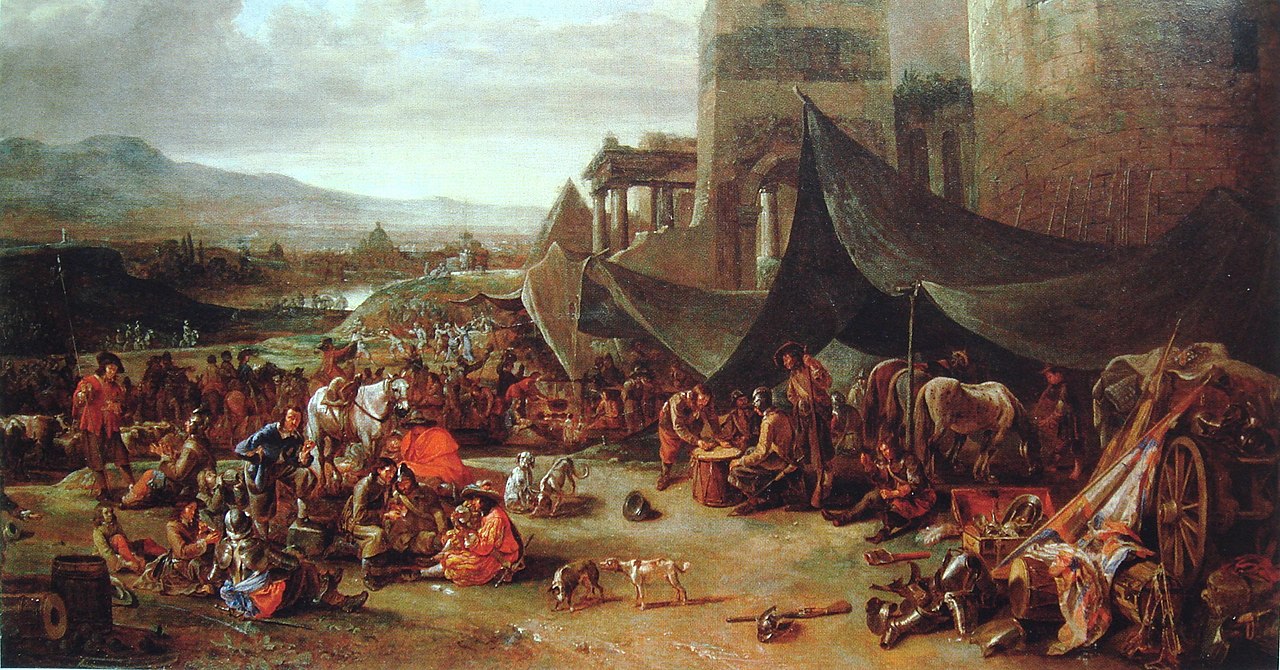
• Illustration — Battle of Milvian Bridge, c. 1650. • Illustration — Flemish Town Sieged by the Spanish Soldiers, c. 1674. • 17th century - Bathing Gypsies, Oil on canvas, (Öffentliche Kunstsammlung, Basel) • 17th century - A Sea Battle, Oil on canvas, (Private Collection) • 1640s - Roman Street Scene with Card Players, Oil on canvas, (National Gallery, London) • 1640s - Figures before a Locanda, with a View of the Piazza del Popolo, Rome, Oil on canvas, (Royal Collection, London) • c. 1650 - Battle of Milvian Bridge • 1650 - The Blacksmith, (Private Collection) • 1650 - Self-portrait with Violin, (Zurich) • 1651 - Dentist on Horseback, (Rijksmuseum, Amsterdam) • 1651 - Peasants Dancing, Oil on canvas, (Metropolitan Museum of Art, New York City) • 1652 - Battle Scene, Oil on panel, (Getty Museum, Los Angeles) • 1653 - Roman Market Scene, Oil on canvas, (Royal Museums of Fine Arts, Belgium) • 1660s - Deer Hunt, Oil on canvas, (Hermitage Museum, Saint Petersburg) • 1660 - The Piazza del Popolo, Rome, Oil on canvas, (Minneapolis Institute of Arts, Minneapolis) • 1664 - Peasants loading a Hay Cart, Oil on canvas, (National Gallery, London) • 1671 - Battle Scene, Oil on canvas, (Metropolitan Museum of Art, New York City) • 1674 - Flemish Town Sieged by the Spanish Soldiers, Oil on canvas, (Hermitage Museum, Saint Petersburg) • Imaginary Harbor, oil on canvas, John and Mable Ringling Museum of Art, Sarasota, Florida • 17th Century Mediterranean Harbor Scene, Städel Art Museum Frankfurt, Germany
Documentary record
Johannes Lingelbach (1622 – 1674) was an artist and painter. The birth of Johannes Lingelbach is recorded in 1622 in Francfort sur Main, and the death in 1674 in Amsterdam.

Identificatie Titel(s): Portret van de schilder Johannes Lingelbach
Rijksmuseum
Life and career
Dated record
Life and career
The full dated record · 2 entries
1622
Johannes Lingelbach born at Frankfurt.
1674
Johannes Lingelbach died at Amsterdam.
Places
Named by the record
Places
Only places the record itself states, plotted where the house gazetteer settles their coordinates. Nothing is inferred from a name or a nationality.
Frankfurt.
Birth place
Amsterdam.
Death place
Primary material
Documents and archives
reference work
- Wikidata, structured authority record Q629856: Johannes Lingelbach
Reputable secondary · Wikimedia Foundation
- “Johannes Lingelbach”, English Wikipedia, consulted as further reading
Reputable secondary · Wikipedia
scholarly publication
- Lingelbach, Johannes or Jan, Benezit Dictionary of Artists, 2011
Scholarly · Crossref registry · 2011
Text attribution
Licensing
Text attribution
Part of the biographical narrative on this page reuses licensed material. Its origin, revision and licence are recorded here.
The biographical narrative on this page is based on the Wikipedia article Johannes Lingelbach, revision 1366097968 (EN edition), by its contributors. VALÉORINE has edited that text and built its own documentary record around it. The reused material is available under CC BY-SA 4.0, and this page's reuse of it is offered under the same licence. Everything else on this page — the chronology, the holdings, the evidence, the plates and the connections — is VALÉORINE's own record. Sources and licences.
Notes from the source article
Cited by Wikipedia
Notes from the source article
These works are cited by the source article, in its own numbering. They are recorded as its citations, not as sources VALÉORINE has verified.
- 1.Archibald, E.H.H. Dictionary of Sea Painters. Antique Collectors' Club. 148. 1989. 978-1-85149-047-9.
- 2."Johannes Lingelbach", The J. Paul Getty Trust.
- 3."LINGELBACH, Johannes", Kren and Marx, Web Gallery of Art
- 4."Lingelbach, Johannes", The Grove Dictionary of Art, 2000
- 5."Johannes Lingelbach", The Royal Collection, 2004
- 6.Web Gallery of Art, searchable fine arts image database.
- 7.Possibly by Jan Lingelbach - Roman Street Scene with Card Players - NG6640 - National Gallery, London.
- 8.royalcollection.org.uk
- 9.metmuseum.org
- 10.Battle Scene (Getty Museum).
- 11.hermitagemuseum.org
- 12.artsmia.org
- 13.Jan Lingelbach - Peasants loading a Hay Cart - NG837 - National Gallery, London.
- 14.metmuseum.org
- 15.hermitagemuseum.org
References
Citations
References
Each reference names the institution holding it, so a reader may go to the document itself.
scholarly publication
Lingelbach, Johannes or Jan, Benezit Dictionary of Artists, 2011Crossref registry
Institutional witnessreference work
Wikidata, structured authority record Q629856: Johannes LingelbachWikimedia Foundation
Secondary witnessreference work
Secondary witness
The Encyclopedia exists whether or not anything is for sale. Corrections are recorded rather than overwritten, and every version of this record is kept. Published 14 August 2026.
Elsewhere in Paintings
19,456 published records in this field, each with its sources named.
- Johannes Joseph DestréeArtist
- Johannes KühnArtist
- Johannes KuveenisArtist
- Johannes le Francq van BerkheyArtist
- Johannes MeintjesArtist
- Johannes MytensArtist
- Johannes NevalaArtist
- Johannes of LjubljanaArtist
Best supported in this field
For owners
Own a work by Johannes Lingelbach?
A specialist will read what you send and tell you what the house can establish, what it cannot, and whether the object is suited to sale. There is no charge and no obligation. The object stays with you throughout; nothing is shipped to us unless it is arranged in writing beforehand.