
Jean-Baptiste-Claude Odiot
Illustration — Odiot by Robert Lefèvre, 1822. • Illustration — Soup tureen made in silver gilt from 1819, Indianapolis Museum of Art, Indianapolis, Indiana, USA. • Illustration — Cradle of the King of Rome, Secular and Ecclesiastical Treasury, Vienna, Austria. Jean-Baptiste-Claude Odiot (1763–1850) was a French silversmith working in the neoclassical style.
Also recorded as Jean Baptiste Claude Odiot
Jean-Baptiste-Claude Odiot
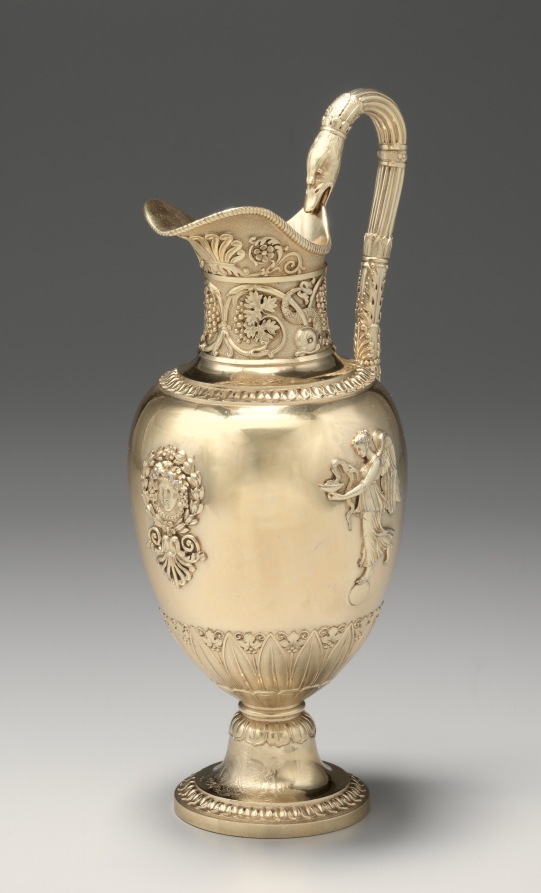
Jean Baptiste Claude Odiot · The Cleveland Museum of Art · Purchase from the J. H. Wade Fund · CC0
- Born
- 1763 · Paris.
- Died
- 1850 · Paris.
- Nationality
- France
- Occupation
- goldsmith · silversmith
- Known for
- Return from Egypt bracelet
- Honours
- Legion of Honour
- Languages
- French
VALÉORINE Encyclopedia
VALÉORINE documentary reading
Documentary summary
Illustration — Odiot by Robert Lefèvre, 1822. • Illustration — Soup tureen made in silver gilt from 1819, Indianapolis Museum of Art, Indianapolis, Indiana, USA. • Illustration — Cradle of the King of Rome, Secular and Ecclesiastical Treasury, Vienna, Austria. Jean-Baptiste-Claude Odiot (1763–1850) was a French silversmith working in the neoclassical style.
Admitted source layer · organised and presented by VALÉORINE
Reference Check
Propose documentary evidence for Jean-Baptiste-Claude Odiot. A contribution is never written directly as fact: identity, source, rights and evidence gates still decide.
Sign in to contribute
World of VALÉORINE
Documentary connections
Only confirmed graph relationships appear here. Images are shown only when their identity and reuse rights both pass the documentary gate.
Documentary evidence
Documentary basis
Authority files
wikidata · Q3176320 · wikipedia · Jean-Baptiste-Claude Odiot
In this article
Business
Business
The recorded working language is French. Places of work recorded in the authority are Paris. Works named in the authority record are Return from Egypt bracelet. Work by Jean-Baptiste-Claude Odiot is recorded in the collections of Nationalmuseum, Art Institute of Chicago, Victoria and Albert Museum, Kunsthistorisches Museum and Cleveland Museum of Art. Distinctions recorded are Legion of Honour.
Maison Odiot, in English "House of Odiot", was established in 1690, during the reign of Louis XIV by Jean-Baptiste Gaspard Odiot, considered a fine silversmith. Emperor Napoleon Bonaparte gave Jean-Baptiste Claude, grandson of Jean-Baptiste Gaspard, many prestigious commissions for himself and his family, such as the sacred scepter and sword and the King of Rome's cradle. Immense dinner services were ordered by Pauline Borghèse, by her mother and by the Emperor himself. Jean-Baptiste Claude was influenced by the return of the classical Greek and Egyptian motifs as expressed in the Directoire and Empire styles. Court commissions help further the reputation of Maison Odiot, and the firm provided vermeil services to courts across European. Charles Nicolas Odiot, who excelled in the rocaille style, succeeded his father and became the purveyor by appointment to His Majesty the King Louis-Philippe and to the Royal Family of Orleans. He was later succeeded by his son Gustave who received the House of Odiot's most important commission ever, id est, 3,000 pieces of solid gold flatware for Saïd Pacha, the Viceroy of Egypt. He later became the purveyor by appointment to the court of His Imperial Majesty the Tsar. Gustave was also the last member of the Odiot family to preside over the company.
Works
Works
The only surviving work by him dating from before the French Revolution (1789–95) is a coffee urn (Monticello, Virginia, Jefferson Foundation) designed and commissioned by Thomas Jefferson. In 1802 he was awarded a gold medal in the third Exposition de l’Industrie in Paris. He executed a travelling service (c. 1795–1809) for Napoleon and a large table service (1798–1809; Munich, Residenz) for Maximilian I Joseph of Bavaria (1756–1825). Odiot’s most complex work was a set of dressing-table furniture made for Empress Marie Louise in 1810 (destr. 1832).
Cradle of the King of Rome
Cradle of the King of Rome
Among the most prominent commissions received by Odiot, was the Cradle of the King of Rome, a wood, bronze and silver gilt cradle given as a gift by the city of Paris to Napoleon and his wife Empress Marie-Louise, on the birth of their son Napoleon II. Jean-Baptiste-Claude Odiot (1763–1850) contributed to its making along with silversmith Pierre-Philippe Thomire (1751–1843) and is signed on two of the feet: Odiot et Thomire and Thomire et Odiot. It is in the Secular and Ecclesiastical Treasury in Vienna today.
Notes from the source article
Cited by Wikipedia
Notes from the source article
These works are cited by the source article, in its own numbering. They are recorded as its citations, not as sources VALÉORINE has verified.
- 1.La maison Odiot a été fondée en 1690. Elle est renommée depuis Jean-Baptiste Gaspard Odiot (1692-1767), fils de Gaspard Odiot (1665-1709) et de Charlotte Lefébvre, maître en 1720, père de Jean-Claude Odiot (1722-1788), marié en secondes noces avec Marie Catherine Vavasseur. Leur fils, Jean-Baptiste Claude Odiot (1763-1850), marié en 1787 avec Joséphine Denève (1769-1849), a obtenu sa maîtrise en 1785. Il est l'orfèvre de après la faillite de l'orfèvre Henri Auguste en 1809. Sa société est reprise en 1826 (voir : Anne Dion-Tenenbaum, op. cité, ). par son fils, Charles Nicolas Odiot (1789-1868), marié en 1822 avec Correntine Levasseur, qui devient le fournisseur de et de la famille d'Orléans. La société est reprise par son fils Jean-Baptiste Gustave Odiot (1823-1912) le 16 août 1856 qui a été le fournisseur de la Cour de Sa Majesté impériale le Tsar. N'ayant pas d'enfant, il forme une nouvelle société en s'associant en 1894 avec Émile Prévost et Paul Edouard Récipon, père de Georges Récipon, pour fonder la société Odiot Prévost Récipon et Cie jusqu'en 1906.
- 2.La Barrière de Clichy - Défense de Paris, le 30 mars 1814 Musée du Louvre Département des Peintures : Peinture française
- 3.Grimod de la Reynière, Almanach des Gourmands ou calendrier nutritif], Paris, Maradan, an X-1803, p. 170-171. Consulter sur Gallica.
- 4.Entre les Petites Écuries et la rue de l'Échelle (De la Tynna, Almanach du Commerce pour l'an ).
- 5.Allard, P.-J.-H., Almanach de Paris, capitale de l'Empire, et Annuaire administratif et statistique du département de la Seine pour 1808, Paris, Imprimerie de la Compagnie des Notaires, 1808, p. 316. Consulter sur Gallica.
- 6.appl. ODIOT Jean-Baptiste Claude (1763-1850). Cimetière du Père Lachaise - APPL. 03/01/2023.
- 7.Voir cet objet.
- 8.Le MET conserve plusieurs œuvres de J.-B. Odiot Voir les œuvres conservées à New-York.
- 9.Voir les dessins et objets conservés au Musée des Arts Décoratifs.
- 10.Deux siècles d'histoire au Père-Lachaise. Mémoire et Documents. 2006. 978-2-914611-48-0.
Bibliography printed in the source article · 5
- Eugène-Oscar Lami, « Odiot », dans Dictionnaire encyclopédique et biographique de l'industrie et des arts industriels, Librairie des dictionnaires, Paris, 1886, tome 6, L-O, (lire en ligne)
- Audrey Gay-Mazuel dir., Odiot, un atelier d’orfèvrerie sous le premier Empire et la Restauration, Paris, musée des Arts décoratifs, 2017
- Anne Dion-Tenenbaum, « Les trésors de l'orfèvrerie française du », dans Grande Galerie – le Journal du Louvre, sept./oct./ , , , .
- Anne Dion-Tenenbaum, LOrfèvrerie française du - La collection du musée du Louvre, Paris, coéd. Somogy et musée du Louvre, 2011, .
- Jean-Marie Pincon, Olivier GAUBE DU GERS, Odiot l’orfèvre, Paris, Sous le vent, 1990.
References
Citations
References
Each reference names the institution holding it, so a reader may go to the document itself.
reference work
Secondary witnessreference work
Secondary witness
The Encyclopedia exists whether or not anything is for sale. Corrections are recorded rather than overwritten, and every version of this record is kept. Published 16 August 2026.
Elsewhere in Silver
384 published records in this field, each with its sources named.
- Jean DunandArtist
- Jean PuiforcatArtist
- Jean ToutinArtist
- Jean-Baptiste FossinArtist
- Jean-Claude Chambellan DuplessisArtist
- Jean-Jacques KellerArtist
- Jean-Valentin MorelArtist
- Jérémie PauziéArtist
Best supported in this field
For owners
Own a work by Jean-Baptiste-Claude Odiot?
A specialist will read what you send and tell you what the house can establish, what it cannot, and whether the object is suited to sale. There is no charge and no obligation. The object stays with you throughout; nothing is shipped to us unless it is arranged in writing beforehand.