
René Lalique
René Jules Lalique (ʁəne ʒyl lalik; 6 April 1860 – 1 May 1945)[1] was a French jeweller, medallist,[2][3] and glass designer known for his creations of glass art, perfume bottles, vases, jewellery, chandeliers, clocks, and automobile hood ornaments.[4][5][6]
Also recorded as Rene Lalique · René-Jules Lalique · Rene J. Lalique · René-Jean Lalique
René Lalique
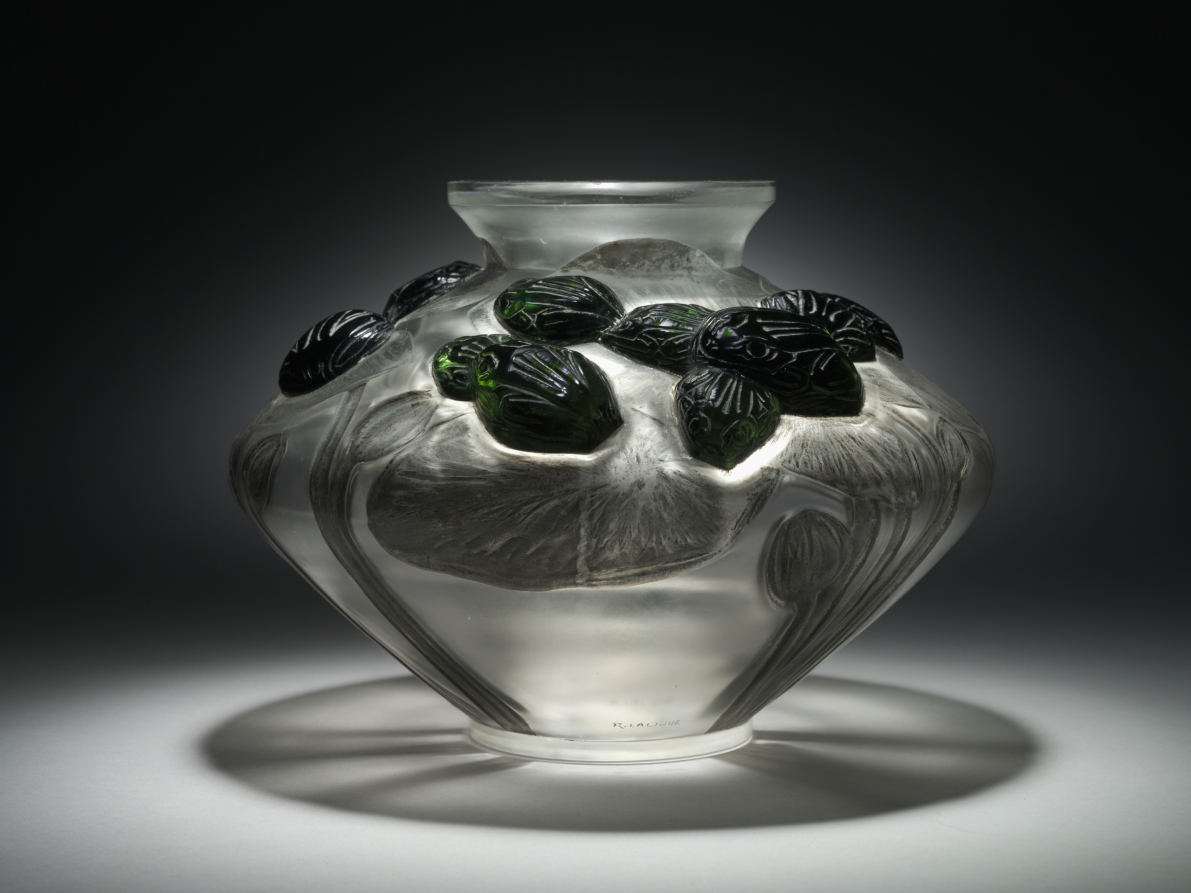
René Lalique · The Cleveland Museum of Art · John L. Severance Fund · CC0
- Name
- René Lalique
- Born
- 6 April 1860
- Birthplace
- Aÿ, Marne, France
- Died
- 1 May 1945 (aged 85)
- Place of death
- Paris, France
- Known for
- Glass art
- Education
- Collège Turgot, Ecole des arts décoratifs, Crystal Palace School of Art
- Spouse
- * Marie-Louise Lambert
- Occupation
- Glass designer
- Birth Name
- René Jules Lalique
- Nationality
- France
- Movements
- Art Nouveau · Art Deco
VALÉORINE Encyclopedia
VALÉORINE documentary reading
Documentary summary
René Jules Lalique (ʁəne ʒyl lalik; 6 April 1860 – 1 May 1945)[1] was a French jeweller, medallist,[2][3] and glass designer known for his creations of glass art, perfume bottles, vases, jewellery, chandeliers, clocks, and automobile hood ornaments.[4][5][6]
Admitted source layer · organised and presented by VALÉORINE
Note VALÉORINE
René Lalique (1860–1945) was a French artist, draftsperson and glassblower, among other activities.
The artist worked in Paris. René Lalique was associated with Art Deco and Art Nouveau.
Composed from admitted, traceable facts · 27 September 2026
VALÉORINE
Reference Check
Propose documentary evidence for René Lalique. A contribution is never written directly as fact: identity, source, rights and evidence gates still decide.
Sign in to contribute
World of VALÉORINE
Documentary connections
Only confirmed graph relationships appear here. Images are shown only when their identity and reuse rights both pass the documentary gate.

Documentary evidence
Evidence Panel
not yet certified
- Identity
- resolved
- Independent source families
- 0
- Admitted assertions
- 0
- Open conflicts
- 0
Authority files
gnd · 5101674-6 · wikidata · Q451400 · wikipedia · René Lalique
In this article
Key facts
Key facts
• Name — René Lalique • Born — 6 April 1860 • Birthplace — Aÿ, Marne, France • Died — 1 May 1945 (aged 85) • Place of death — Paris, France • Known for — Glass art • Education — Collège Turgot, Ecole des arts décoratifs, Crystal Palace School of Art • Spouse — * Marie-Louise Lambert • Alice Ledru • Children — 6 • Occupation — Glass designer • Birth Name — René Jules Lalique
Early life and education
Early life and education
Lalique was born 6 April 1860 in Aÿ, Marne, France, one of two children, to Auguste Jules Lalique (1831–1875), a traveling peddler, and Olympe Lalique (née Berthellemy; 1835–1906). The family relocated to Paris in 1862. His early life was spent learning the methods of design and art he would use in his later life. At the age of two, his family moved to the suburbs of Paris, but traveled to Aÿ for summer holidays. These trips influenced Lalique later on in his naturalistic glasswork. • Illustration — Tomb of Lalique (and of his wife Alice and son Marc) in the Père Lachaise Cemetery, Paris In 1872, when he was twelve, René entered the Collège Turgot, where he started drawing and sketching. He attended evening classes at the Ecole des arts décoratifs. He worked there from 1874 to 1876 and subsequently spent two years at the Crystal Palace School of Art Sydenham, London. During that time, he also practised as an apprentice goldsmith to leading Parisian Art Nouveau jeweller and goldsmith Louis Aucoc. At the Sydenham Art College, his skills for graphic design were improved, and his naturalistic approach to art was further developed. In 1876, at 16, René Lalique was apprenticed to the jeweler Louis Aucoc.[8] Aucoc was among the leading jewelers working in Paris at the time, and this provided the young René Lalique with an excellent opportunity to learn jewelry production and design. During this time, Lalique also studied at the Ecole des Arts Decoratifs in Paris.
Professional career
Professional career
By 1881, Lalique worked as a freelance designer for several French jewelry firms, including Cartier and Boucheron. In 1886, he started working in his workshop in Paris, in the former workshop of Jules Destape. In 1890, René Lalique opened a jewelry store in the Opéra district of Paris. While working in this new shop, some of René Lalique's most famous jewelry designs were created, as well as his experimentation and use of glass. The main motif of Lalique's jewelry design was the natural world. His designs often featured motifs such as dragonflies, orchids, and peacocks, crafted using a combination of enamel, gemstones, and semi-precious materials.[9] Lalique surrounded himself at work with flowers to serve as subtle inspiration for his art.[10] These motifs symbolized the organic flow of life, metamorphosis, and beauty in motion. He also incorporated Japanese nature motifs into his art, and used materials that were uncommon in jewelry at the time, including glass, horn, and enamel.[11]
Art Nouveau jewellery designer
Art Nouveau jewellery designer
When he returned from England, he worked as a freelance artist, designing pieces of jewellery for French jewelers Cartier, Boucheron, and others. In 1885, he opened his own business, designed and made his own jewellery and other glass pieces. After 1895, Lalique also created pieces for Samuel Bing's Paris shop, the Maison de l'Art Nouveau, which gave Art Nouveau its name. One of Lalique's major patrons was Calouste Sarkis Gulbenkian, who commissioned more than 140 of his works over nearly 30 years.[12] Many of these works can be seen on permanent display at the Calouste Gulbenkian Museum in Lisbon, Portugal.
Glass maker
Glass maker
Lalique was best known for his creations in glass art. In the 1920s, he became noted for his work in the Art Deco style. He was responsible for the walls of lighted glass and elegant coloured glass columns which filled the dining room and "grand salon" of the Normandie and the interior fittings, cross, screens, reredos and font of St. Matthew's Church at Millbrook in Jersey (Lalique's "Glass Church").[13] As part of the Art Nouveau style, many of his jewellery pieces and vases showcase plants, flowers and flowing lines.[14] In 1907, Lalique began collaborating with François Coty to design luxury perfume bottles.[15] Lalique was also a pioneer in the use of 'pâte-de-verre,' an ancient glassworking technique, which he used to mold ground glass into intricate, lifelike forms in both jewelry and decorative objects.[16] Both unique and commercial works of René Lalique are in the collections of a large number of public museums around the world including the Museu Calouste Gulbenkian in Lisbon, the Lalique Museum of Hakone in Japan, the Musée Lalique and the Musée des Arts Décoratifs in France, the Schmuckmuseum Pforzheim in Germany, the Victoria and Albert Museum in London, the Metropolitan Museum and the Corning Museum in New York State, and the Rijksmuseum in Amsterdam.
Personal life
Personal life
Lalique died on 1 May or 5 May 1945, in Paris. René Lalique was buried in Père Lachaise Cemetery in Paris, France. His daughter Suzanne Lalique was the painter and set designer for the Comédie-Française. His son Marc Lalique continued the family business as a glass artist himself. It was under his impetus that the Maison Lalique began its transition from glass to crystal in the early 1950s.[17] Marc's daughter, Marie Claude-Lalique (b. 1936), was also a glass maker who died on 14 April 2003 in Fort Myers, Florida.
Works
Works
• Illustration — Citroën Company Spirit of the Wind, Blackhawk Museum • Illustration — Toyota: Horse • Illustration — Cicadas, Museu Calouste Gulbenkian • Illustration — 1956 Rolls-Royce Silver Wraith, glass model • Illustration — Tiara, Museu Calouste Gulbenkian • Illustration — Lalique Hood ornament • Illustration — Glass vase • Illustration — Fern Leaves Brooch, Walters Art Museum, Baltimore • Illustration — Medusa • Illustration — Lalique glass altarpiece in St. Matthew's Church (the Glass Church), Millbrook, Jersey • Illustration — Dragonfly lady brooch, Museu Calouste Gulbenkian, acquired from the artist in 1903[18] • Illustration — Glass vase, Museu Calouste Gulbenkian • Illustration — Pendant, Museu Calouste Gulbenkian • Illustration — Necklace designed for Lalique's second wife, Alice Ledru, ca 1897–99, Metropolitan Museum of Art, New York • Illustration — A lighting fixture in the great dining room in the Tokyo Metropolitan Teien Art Museum. • Illustration — Corsage ornament, Khalili Collection of Enamels of the World • Illustration — Nude Venus of René Lalique in the Mougins Museum of Classical Art • Illustration — Mistletoe Bowl, Aberdeen Archives, Gallery and Museums • Illustration — Finger ring with bean pod motif in the Museum of Applied Arts, Vienna
Identity and origins
Identity and origins
René Lalique was recorded at birth as René Jules Lalique. The authorities additionally record the headings Rene Lalique, René-Jules Lalique, Rene J. Lalique, René-Jean Lalique and René J. His recorded language was French. He was the child of Olympe Lalique. He married Alice Ledru and Marie-Louise Lambert. 4 children are recorded: Marc Lalique, Suzanne Lalique-Haviland, Georgette-Renée Lalique and René-Claude Le Mesnil.
Identity
Identity
René Lalique is recorded with the occupation stained-glass artist. Recorded with the occupation jewelry designer. Recorded as goldsmith, stained-glass artist, jeweler and artist.
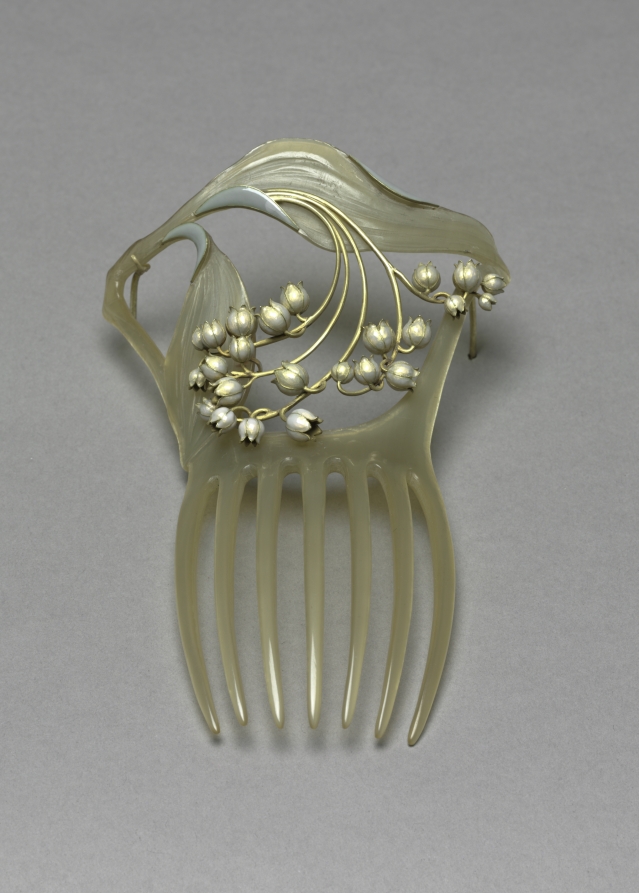
Lily of the Valley Comb, c. 1900, by René Lalique
René Lalique · The Cleveland Museum of Art · Gift of Mrs. A. Dean Perry
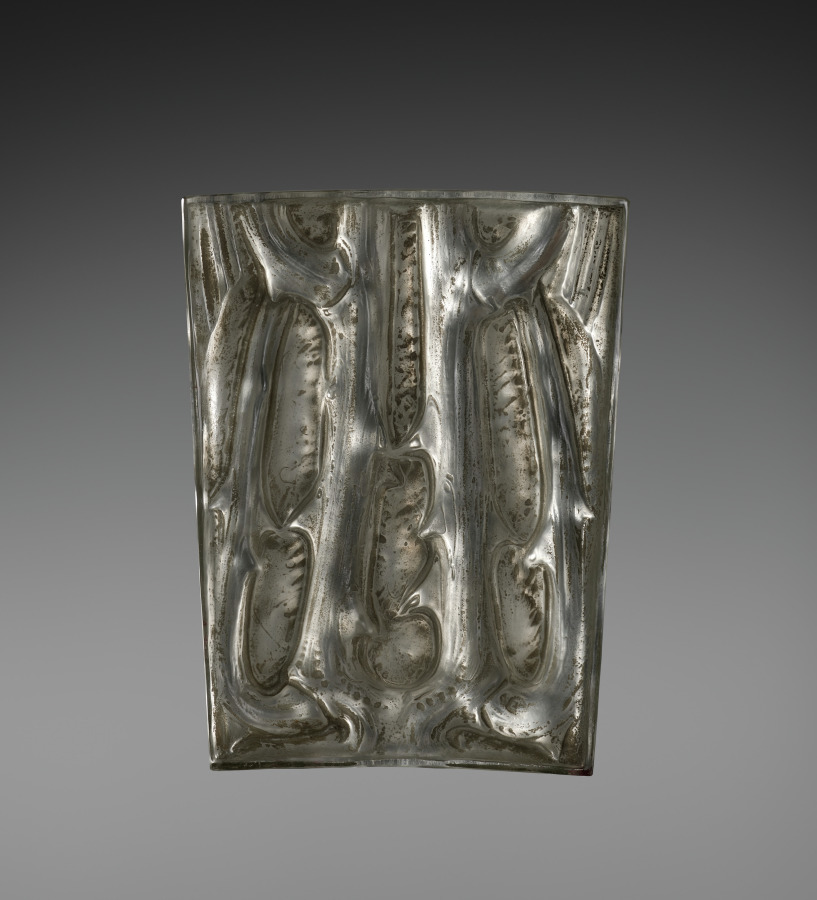
Section of the Two Pigeons Panel (Panneau deux pigeons), 1914, by René Lalique
René Lalique · The Cleveland Museum of Art · Museum purchase from various donors by exchange
Life and career
Dated record
Life and career
Explore 1860–1945
The full dated record · 4 entries
1860
René Lalique was born on 6 April 1860.
1878
Hôtel Frugès is dated 1878.
1912
"Capricornes" (Capricorn Beetles) is dated 1912.
1945
René Lalique died at Paris.
Recognition and collections
Where the work is held
Recognition and collections
René Lalique received Knight of the Legion of Honour, Officer of the Legion of Honour and Commander of the Legion of Honour.
Context
Primary material
Context
The circumstances in which René Lalique stands. Associated with Art Nouveau. Associated with Art Deco.
Documents and archives
Primary material
Documents and archives
scholarly publication
- Lalique, René J, Benezit Dictionary of Artists, 2011
Scholarly · Crossref registry · 2011
authority file
- Gemeinsame Normdatei 5101674-6, René Lalique et Cie. (Paris).
Unverified · Deutsche Nationalbibliothek
authority record
- Wikidata, structured authority record Q451400: René Lalique
Unverified · Wikidata
Notes from the source article
Cited by Wikipedia
Notes from the source article
These works are cited by the source article, in its own numbering. They are recorded as its citations, not as sources VALÉORINE has verified.
- 1.BNF 12101962w
- 2.Forrer, L. Biographical Dictionary of Medallists. Spink & Son Ltd. III. 275–278. 1907.
- 3.Forrer, L. Biographical Dictionary of Medallists. Spink & Son Ltd. VII. 528. 1923.
- 4.Warmus, William. The essential René Lalique. Wonderland Press: Harry N. Abrams. 2003. 9780810958364.
- 5.Rene Lalique - A Giant Among Giants. rlalique.com.
- 6.René Lalique: Enchanted by Glass. Corning Museum of Glass.
- 7.Lalique, more than a name. Musée Lalique.
- 8.Fiell, Charlotte. Design of the 20th Century. Taschen. 402. 2005. 9783822840788.
- 9.Misiorowski, Elise B. Art Nouveau: Jewels and Jewelers. Gems & Gemology. 22. 4. 209–228. 1986-01-01. 0016-626X.
- 10.Vivienne Becker. Art Nouveau Jewelry. Penguin Publishing Group. 1985. 978-0-525-24345-8.
- 11.René Lalique Biography. RLalique.com. 16 August 2012.
- 12.Yager, Jan. Patrons who make history. Art Jewelry Forum. 4. 1998.
- 13.Jane Ashelford, 1980, "Lalique's Glass Church," The Journal of the Decorative Arts Society, Vol. 4, pp. 28–33.
- 14.American Bar Association. It's All in the Details. ABA Journal. 86. 88. June 2000. 0747-0088.
- 15.René Lalique. museelalique.
- 16.Misiorowski, Elise B. Art Nouveau: Jewels and Jewelers. Gems & Gemology. 22. 4. 209–228. 1986-01-01. 0016-626X.
- 17.Marc Lalique. museelalique.
- 18.'Dragonfly' Broach. Museu Calouste Gulbenkian.
Bibliography printed in the source article · 7
- Bayer, Patricia & Waller, Mark: The Art of René Lalique, Bloomsbury Publishing Ltd, London 1988
- Dawes, Nicholas M.: Lalique Glass, Crown Publishers, London 1986
- Elliott, Kelley J. René Lalique: Enchanted by Glass, The Corning Museum of Glass, Corning, New York 2014.
- Weiner, Geoffrey George Unique Lalique Mascots, The Book Guild Ltd., Brighton 2014
- Weiner, Geoffrey George Unique Lalique Mascots, Grosvenor House Publishing Co.2020
- Weiner, Geoffrey George Catalogue Raisonne, The Definitive Collector's Guide to Lalique Automobile Mascots (Decorative Hood Ornaments) published in January 2025 (ISBN / 978-1-80381-886-3)
- "Lalique Mascots - Catalogue Raisonné (or critical catalogue) The Automotive Radiator Hood, Desk Ornaments, Trophies and Bookends of master glass artisan R. Lalique (including auction realisation prices with market values guide" by G.G. Weiner., i.a.m, o.t.r, c.s.m.a. Bi-lingual with both English and French captions. ISBN 978-1-80381-886-3 (in oversize A3 format).
References
Citations
References
Each reference names the institution holding it, so a reader may go to the document itself.
scholarly publication
Lalique, René J, Benezit Dictionary of Artists, 2011Crossref registry
Verifiedauthority file
Gemeinsame Normdatei 5101674-6, René Lalique et Cie. (Paris).Deutsche Nationalbibliothek
Partially resolvedauthority record
Partially resolvedreference work
Partially resolved
People, houses and institutions
Knowledge graph
People, houses and institutions
Teachers, collaborators, publishers and institutions recorded against this person, each on a stated basis.
Died at
1- ParisPlace
Established from a fact already recorded on a verified source.
Further particulars
Held on the record
Further particulars
Open the remaining particulars
Career and activity. Lalique worked in jewelry and jewelry design. His work is associated with Art Nouveau and Art Deco. He was employed by François Coty, Cartier, Boucheron, La Maison Aucoc and Lalique. He worked at Paris.
The Encyclopedia exists whether or not anything is for sale. Corrections are recorded rather than overwritten, and every version of this record is kept. Published 14 August 2026.
Elsewhere in Silver
384 published records in this field, each with its sources named.
- Pietro BernardinoArtist
- Pompeia HelenaArtist
- Procopius WaldvogelArtist
- Reinhold VastersArtist
- René WellerArtist
- Renee NeleArtist
- Renier de HuyArtist
- Richard JoyceArtist
Best supported in this field
For owners
Own a work by René Lalique?
A specialist will read what you send and tell you what the house can establish, what it cannot, and whether the object is suited to sale. There is no charge and no obligation. The object stays with you throughout; nothing is shipped to us unless it is arranged in writing beforehand.