
Jean-Valentin Morel
Jean-Valentin Morel (1794–1860) was a French gold and silversmith noted for the quality of his work. • Illustration — Bronze medallion representing Morel by the French sculptor Pierre-Adolphe Dammouse, 1858 • Illustration — Covered Jug, c. Cleveland Museum of Art • Illustration — Jewelry Box, c.
Jean-Valentin Morel
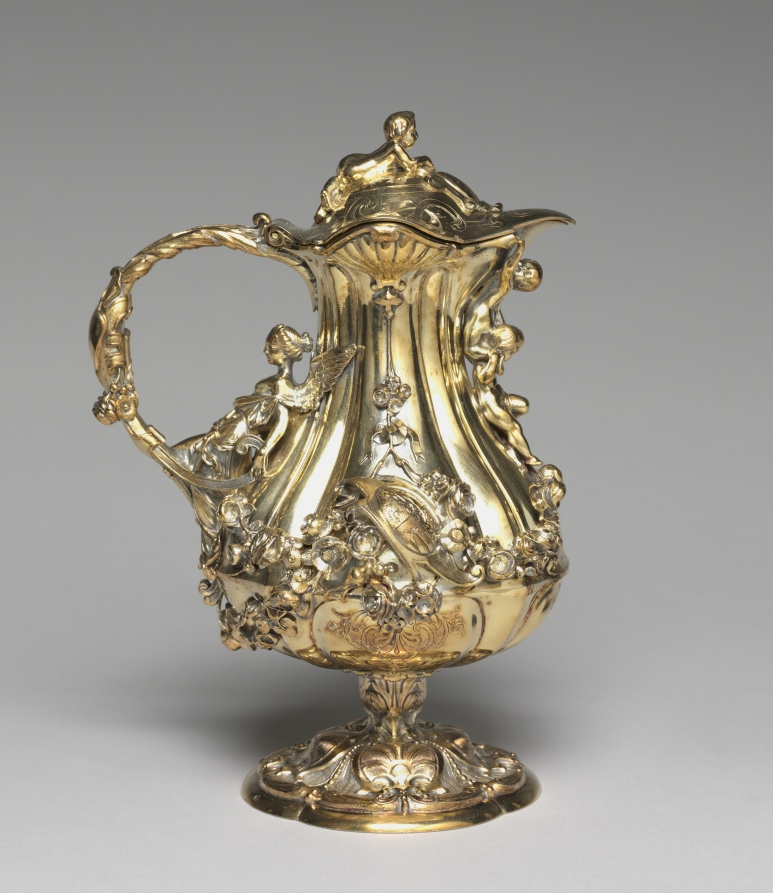
Jean-Valentin Morel · The Cleveland Museum of Art · Bequest of John L. Severance (by exchange) · CC0
- Born
- 1794 · île de la Cité.
- Died
- 1860 · Paris.
- Nationality
- France
- Occupation
- goldsmith · jeweler · silversmith · lapidary · jewelry · wholesaler
- Languages
- French
VALÉORINE Encyclopedia
VALÉORINE documentary reading
Documentary summary
Jean-Valentin Morel (1794–1860) was a French gold and silversmith noted for the quality of his work. • Illustration — Bronze medallion representing Morel by the French sculptor Pierre-Adolphe Dammouse, 1858 • Illustration — Covered Jug, c. Cleveland Museum of Art • Illustration — Jewelry Box, c.
Admitted source layer · organised and presented by VALÉORINE
Reference Check
Propose documentary evidence for Jean-Valentin Morel. A contribution is never written directly as fact: identity, source, rights and evidence gates still decide.
Sign in to contribute
World of VALÉORINE
Documentary connections
Only confirmed graph relationships appear here. Images are shown only when their identity and reuse rights both pass the documentary gate.
Documentary evidence
Documentary basis
Authority files
wikidata · Q16066120 · wikipedia · Jean-Valentin Morel
In this article
Life and career
Life and career
The recorded working language is French. Work by Jean-Valentin Morel is recorded in the collections of The Nelson-Atkins Museum of Art, Victoria and Albert Museum, Cleveland Museum of Art, The Keir Collection of Islamic Art and Dallas Museum of Art.
Morel was born in Paris. He was the son of lapidary Valentin Morel, and his mother's family were silversmiths. He learned the lapidary craft from his father and apprenticed with goldsmith Adrien Vachette who worked in the production of gold boxes. Morel opened his own business in 1818 and registered his first mark on August 2, 1827. After opening his own shop, Morel specialized in high-quality inlay and in the production of hard stone cups in a revival of 16th-century style. At one time, Morel was forced to close his shop because of health problems and lost a year of work, but in 1834 he found a position as head of the workshop of Jean-Baptiste Fossin, where he worked in embossing on gold and hard stone. In 1842 he signed a contract with silver and goldsmith Henri Duponchel, establishing a craft shop called Morel & Cie which was highly successful and quickly gained an international reputation. The business produced such items as ornamental vases, jewelry sets, table silverware, a missal binding for Pope Gregory XVI, a table service for the King of Sardinia and works for the future William III of the Netherlands, the future Alexander II of Russia and the French patron of the arts Duc de Luynes. In 1844, Morel & Cie won a gold medal at the Exposition Nationale des Produits de l'Industrie in Paris. The economic climate declined and the partnership was dissolved after disagreements. Duponchel filed a lawsuit in 1848 which prevented Morel from working in Paris, and Morel established a partnership with Jules Fossin and moved his business to London between 1848 and 1852. In London, Morel located his business in New Burlington Street near the Piccadilly firms of Garrard and Storr & Mortimer, but he found it difficult to establish an English clientele. He gained the support of French exiles from the 1848 Revolution, and was granted a permit as an official supplier by Queen Victoria. At the Great Exhibition of 1851 in London, Morel was awarded a Council Medal. He made a bloodstone jasper cup for English collector Henry Thomas Hope, with which he won the gold medal the Exposition Universelle (1855). The Hope Cup, considered a masterpiece of 19th century lapidary art, was purchased by the Musée d'Orsay at Sotheby's in February 2024. Despite this, he received only modest commissions and by the end of 1852, he was in difficult financial straits. He left London and opened a new workshop in Sèvres, France. Also in 1855, Morel was awarded the title of Chevalier of the Legion of Honour by Napoleon III. Morel had a son Prosper whose daughter married Joseph Chaumet, who inherited the family jewelry business in 1885. It now bears his name. In 1860 Morel died in financial difficulties, after which Duponchel took over exhibition of his work.
Places
Named by the record
Places
Only places the record itself states, plotted where the house gazetteer settles their coordinates. Nothing is inferred from a name or a nationality.
île de la Cité.
Birth place
Paris.
Death place
Citations
References
Each reference names the institution holding it, so a reader may go to the document itself.
reference work
Secondary witnessreference work
Secondary witness
The Encyclopedia exists whether or not anything is for sale. Corrections are recorded rather than overwritten, and every version of this record is kept. Published 16 August 2026.
Elsewhere in Silver
384 published records in this field, each with its sources named.
- Jean-Baptiste FossinArtist
- Jean-Baptiste-Claude OdiotArtist
- Jean-Claude Chambellan DuplessisArtist
- Jean-Jacques KellerArtist
- Jérémie PauziéArtist
- Jerónimo CosidaArtist
- Joanna HardyArtist
- João Frederico LudoviceArtist
Best supported in this field
For owners
Own a work by Jean-Valentin Morel?
A specialist will read what you send and tell you what the house can establish, what it cannot, and whether the object is suited to sale. There is no charge and no obligation. The object stays with you throughout; nothing is shipped to us unless it is arranged in writing beforehand.