
Ivan Kramskoi
Ivan Nikolayevich Kramskoi (8 June 1837 – 5 April 1887) was a Russian Realist painter and art critic. One of the most prominent artisans during Tsar Alexander II's reign, he is remembered as co-founding member and public frontman of the Peredvizhniki movement.
Also recorded as Ivan Nikolayevich Kramskoy · Ivan Nikolaevič Kramskoj · Ivan Kramskoy · Ivan Nikolaevich Kramskoy
Ivan Kramskoi
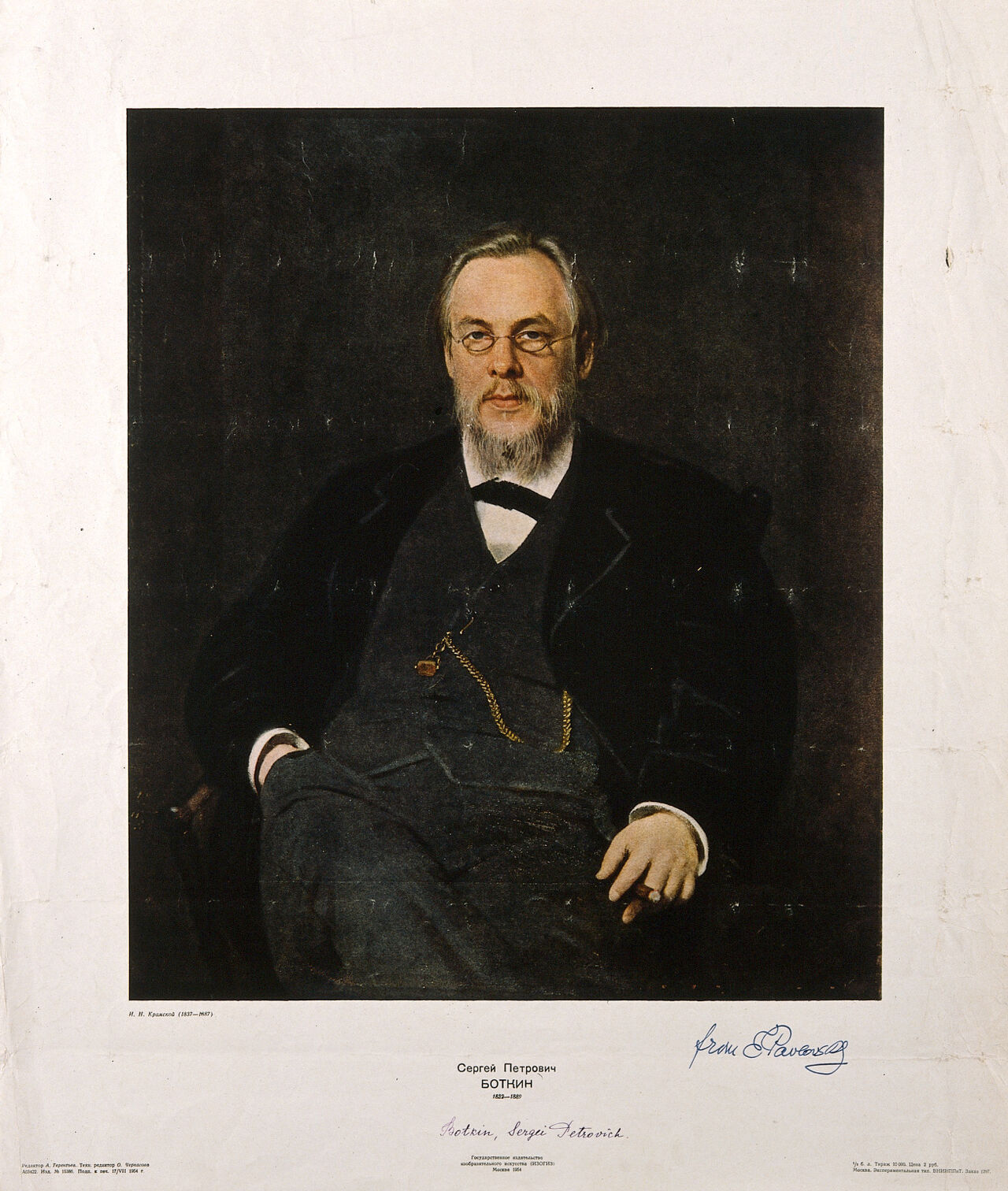
Ivan Kramskoi · Wellcome Collection, London · Wellcome Collection · Public Domain Mark
- Name
- Ivan Kramskoi
- Birthplace
- Ostrogozhsk, Voronezh Governorate, Russia
- Died
- 5 April 1887
- Place of death
- St.
- Training
- * Mikhail Tulinov
- Education
- alumni
- Elected
- Member
- Movement
- Realism, Peredvizhniki
- Born
- 1837 · Ostrogozhsk.
- Nationality
- Russian Empire
- Occupation
- painter · art critic · draftsperson
- Fields
- painting · visual arts
Reference Check
Propose documentary evidence for Ivan Kramskoi. A contribution is never written directly as fact: identity, source, rights and evidence gates still decide.
Sign in to contribute
World of VALÉORINE
Documentary connections
Only confirmed graph relationships appear here. Images are shown only when their identity and reuse rights both pass the documentary gate.
Documentary evidence
Documentary basis
Authority files
wikidata · Q207758 · wikipedia · Ivan Kramskoi
VALÉORINE Encyclopedia
The documentary record
Statements marked “Documentary record” are set in the article beside the passage they confirm. Each is read from the authority records of the institutions named here; select “Prove” to see the record it was read from, where in that record, and when.
Institutions cited
Deutsche Nationalbibliothek
Not stated by the sources cited: nationality
Complete reading chain (JSON)In this article
Biography
Biography
Ivan Kramskoi studied at Imperial Academy of Arts. Training under Alexey Tarasovich Markov and Mikhail Borisovich Tulinov is recorded. The recorded working language is Russian. The field of work recorded is painting and visual arts. Subjects and genres recorded for the work are portrait and genre. Karl Bryullov is recorded as an influence. Places of work recorded in the authority are Saint Petersburg. Works named in the authority record are Portrait of an Unknown Woman and Self-portrait. Work by Ivan Kramskoi is recorded in the collections of Finnish National Gallery, Tretyakov Gallery, Kiev National Picture Gallery, Russian Museum and Hermitage Museum.
Key facts
Key facts
• Name — Ivan Kramskoi • Birthplace — Ostrogozhsk, Voronezh Governorate, Russia • Died — 5 April 1887 • Place of death — St. Petersburg, Russia • Resting Place — Tikhvin Cemetery, St. Petersburg • Children — seven, including Nikolai Kramskoi and Sophia • Training — * Mikhail Tulinov • Alexey Markov • Education — alumni • Elected — Member • Movement — Realism, Peredvizhniki • Notable Works — The Mermaids (1871) Christ in the Desert (1872) Portrait of an Unknown Woman (1883) • Patrons — Pavel Tretyakov
Documentary record
Ivan Kramskoi lived from 1837 to 1887 and was a painter. The birth of Ivan Kramskoi is recorded in 1837, and the death in 1887.
Life
Life
• Illustration — Self-Portrait, 1867 Kramskoi came from an impoverished petit-bourgeois family. From 1857 to 1863 he studied at the St. Petersburg Academy of Arts; he reacted against academic art and was an initiator of the "Revolt of the Fourteen" which ended with the expulsion from the Academy of a group of its graduates, who organized the Artel of Artists ("Артель художников"). Influenced by the ideas of the Russian revolutionary democrats, Kramskoi asserted the high public duty of the artist, principles of realism, and the moral substance and nationality of art. He became one of the main founders and ideologists of the Company of Itinerant Art Exhibitions (or Peredvizhniki). In 1863–1868, he taught at the drawing school of a society for the promotion of applied arts. In 1871, ten years after Taras Shevchenko's death, Kramskoi created a portrait of the poet that became widely popular. He created a gallery of portraits of important Russian writers, scientists, artists and public figures (Lev Nikolaevich Tolstoy, 1873, Ivan Shishkin, 1873, Pavel Mikhailovich Tretyakov, 1876, Mikhail Saltykov-Shchedrin, 1879, Sergei Botkin, 1880) in which expressive simplicity of composition and clarity of depiction emphasize profound psychological elements of character. Kramskoi's democratic ideals found their brightest expression in his portraits of peasants, which portrayed a wealth of character-details in representatives of the common people. In one of Kramskoi's most well known paintings, Christ in the Desert (1872, Tretyakov gallery), he continued Alexander Ivanov's humanistic tradition by treating a religious subject in moral–philosophical terms. He imbued his image of Christ with dramatic experiences in a deeply psychological and vital interpretation, evoking the idea of his heroic self-sacrifice. Aspiring to expand the ideological expressiveness of his images, Kramskoi created art that existed on the cusp of portraiture and genre-painting ("Nekrasov during the period of 'Last songs,'" 1877–78; "Unknown Woman," 1883; "Inconsolable grief," 1884; all in Tretyakov gallery). These paintings disclose their subjects' complex and sincere emotions, their personalities and fates. The orientation of Kramskoi's art, his acute critical judgments about it, and his persistent quest for objective public criteria for the evaluation of art exerted an essential influence on the development of realist art and aesthetics in Russia in the last third of the nineteenth century. Kramskoi was considered an eccentric for giving his works to customers in expensive frames and not charging money for it. He died from an aortic aneurysm while working at his easel, aged only forty-nine.
Gallery
Gallery
• Illustration — The Mermaids, 1871 • Illustration — Christ in the Desert, 1872 • Illustration — Inconsolable Grief, 1884 • Illustration — Taras Shevchenko, 1871, after the 1859 photograph by Andrey Denyer • Illustration — Old Man with a Crutch, 1872 • Illustration — Leo Tolstoy, 1873 • Illustration — Pavel Tretyakov, 1876 • Illustration — Ivan Shishkin, 1880 • Illustration — Empress Maria Feodorovna, 1880s • Illustration — The Reading, 1881 • Illustration — Mina Moiseyev, 1882 • Illustration — Portrait of an Unknown Woman, 1883 • Illustration — Vladimir Solovyov, 1885 • Illustration — Tsar Alexander III, 1886
Identity and origins
Identity and origins
The authorities additionally record the headings Ivan Nikolayevich Kramskoy, Ivan Nikolaevič Kramskoj, Ivan Kramskoy, Ivan Nikolaevich Kramskoy and Iwan Nikolajewitsch Kramskoj. His recorded language was Russian. One child is recorded: Sofya Junker-Kramskaya.
Identity
Identity
Portrait of E.A. Portrait of V. Bouquet of Flowers.
Life and career
Dated record
Life and career
The full dated record · 2 entries
1837
Ivan Kramskoi born at Ostrogozhsk.
1887
Ivan Kramskoi died at Saint Petersburg.
Places
Named by the record
Places
Only places the record itself states, plotted where the house gazetteer settles their coordinates. Nothing is inferred from a name or a nationality.
Ostrogozhsk.
Birth place
Saint Petersburg.
Death place
Publications
* *
Primary material
Documents and archives
reference work
- Wikidata, structured authority record Q207758: Ivan Kramskoi
Reputable secondary · Wikimedia Foundation
- “Ivan Kramskoi”, English Wikipedia, consulted as further reading
Reputable secondary · Wikipedia
scholarly publication
- Ivan Kramskoi: Painting Women—Known and Unknown, Picturing Russia’s Men, 2020
Scholarly · Crossref registry · 2020
Text attribution
Licensing
Text attribution
Part of the biographical narrative on this page reuses licensed material. Its origin, revision and licence are recorded here.
The biographical narrative on this page is based on the Wikipedia article Ivan Kramskoi, revision 1375164216 (EN edition), by its contributors. VALÉORINE has edited that text and built its own documentary record around it. The reused material is available under CC BY-SA 4.0, and this page's reuse of it is offered under the same licence. Everything else on this page — the chronology, the holdings, the evidence, the plates and the connections — is VALÉORINE's own record. Sources and licences.
References
Citations
References
Each reference names the institution holding it, so a reader may go to the document itself.
scholarly publication
Institutional witnessreference work
Wikidata, structured authority record Q207758: Ivan KramskoiWikimedia Foundation
Secondary witnessreference work
Secondary witness
People, houses and institutions
Knowledge graph
People, houses and institutions
Teachers, collaborators, publishers and institutions recorded against this person, each on a stated basis.
Studied at
1- Imperial Academy of ArtsOrganisation
Established from a fact already recorded on a verified source.
Died at
1- Saint PetersburgPlace
Established from a fact already recorded on a verified source.
Further particulars
Held on the record
Further particulars
Open the remaining particulars
Formation and teaching. Kramskoi studied at Imperial Academy of Arts. He trained under Alexey Tarasovich Markov and Mikhail Borisovich Tulinov. His recorded influences include Karl Bryullov. Kramskoi worked in painting and visual arts. His work is associated with realism. He worked at Saint Petersburg.
Career and activity
Recognition and collections
Work by Ivan Kramskoi is
Finnish National Gallery, Tretyakov Gallery, Kiev National Picture Gallery and Russian Museum
The Encyclopedia exists whether or not anything is for sale. Corrections are recorded rather than overwritten, and every version of this record is kept. Published 14 August 2026.
Elsewhere in Paintings
19,456 published records in this field, each with its sources named.
- Ivan KhvorostetskyiArtist
- Ivan KirkovArtist
- Ivan KliunArtist
- Ivan Kovalčik MileševacArtist
- Ivan KulakovArtist
- Ivan KulikovArtist
- Ivan Lacković CroataArtist
- Ivan LeonidovArtist
Best supported in this field
For owners
Own a work by Ivan Kramskoi?
A specialist will read what you send and tell you what the house can establish, what it cannot, and whether the object is suited to sale. There is no charge and no obligation. The object stays with you throughout; nothing is shipped to us unless it is arranged in writing beforehand.