
Konstantin Makovsky
Konstantin Yegorovich Makovsky ((20 June o.c.) 2 July n.c. 1839 – 17 o.c. (30 n.c.) September 1915) was a Russian painter during the Belle Époque, affiliated with the "Peredvizhniki (Wanderers)".
Also recorded as Konstantin Yegorovich Makovsky · Konstantin Egorovič Makovskij · Konstantin Egorovic Makovskij · Constantin Igorovich Makowsky
Konstantin Makovsky
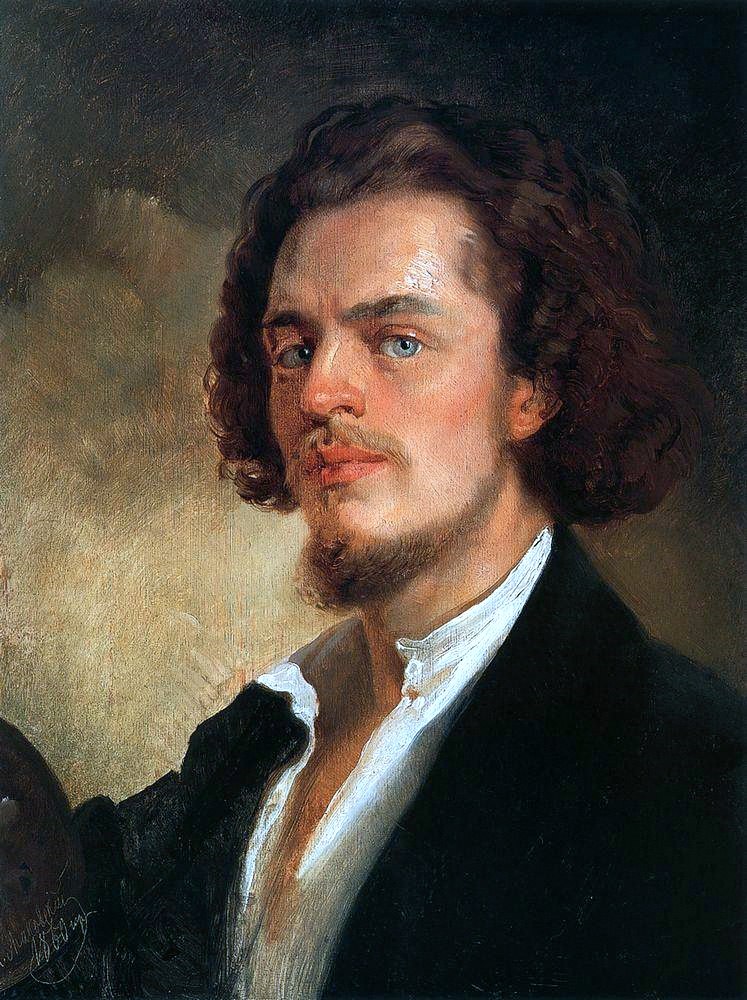
Konstantin Makovsky · Государственная Третьяковская галерея. [1] · Public domain
- Name
- Konstantin Makovsky
- Birth Name
- Konstantin Yegorovich Makovsky
- Born
- 20 June 1839
- Birthplace
- Moscow, Moskovsky Uyezd, Moscow Governorate, Russian Empire
- Died
- 17 September 1915
- Place of death
- Petrograd, Russian Empire
- Known for
- Painting
- Movement
- Peredvizhniki, Academism
- Education
- Moscow School of Painting, Sculpture and Architecture Imperial Academy of Arts
- Awards
- Member Full
- Nationality
- Russian Empire
- Occupation
- painter
VALÉORINE Encyclopedia
VALÉORINE documentary reading
Documentary summary
Konstantin Yegorovich Makovsky ((20 June o.c.) 2 July n.c. 1839 – 17 o.c. (30 n.c.) September 1915) was a Russian painter during the Belle Époque, affiliated with the "Peredvizhniki (Wanderers)".
Admitted source layer · organised and presented by VALÉORINE
Note VALÉORINE
Konstantin Makovsky (1839–1915) was a painter, of Russian nationality. The painter was born in Moscow and died in Saint Petersburg.
Konstantin Makovsky was educated at Imperial Academy of Arts and Moscow School of Painting, Sculpture and Architecture. The painter was a member of Peredvizhniki and worked in Cairo, Moscow and Paris, among others. Activity centred on genre painting, painting and portrait painting. The painter was associated with academic art and realism.
Among the works is Grand Duke Alexis of Russia. The work spans portrait. Languages used include Russian. Works are held at Fine Arts Museums of San Francisco, Grodno State Museum of the History of Religion and Hermitage Museum, among others. Honours include Order of Saint Anna, 2nd class.
Composed from admitted, traceable facts · 27 September 2026
VALÉORINE
Reference Check
Propose documentary evidence for Konstantin Makovsky. A contribution is never written directly as fact: identity, source, rights and evidence gates still decide.
Sign in to contribute
World of VALÉORINE
Documentary connections
Only confirmed graph relationships appear here. Images are shown only when their identity and reuse rights both pass the documentary gate.
Documentary evidence
Evidence Panel
not yet certified
- Identity
- resolved
- Independent source families
- 0
- Admitted assertions
- 0
- Open conflicts
- 0
Authority files
wikidata · Q460337 · wikipedia · Konstantin Makovsky
In this article
Biography
Biography
Many of his historical paintings, such as Beneath the Crown (1889) also known as The Russian Bride's Attire and Before the Wedding, showed an idealized view of Russian life of prior centuries. He is often considered a representative of Academic art.
Konstantin Makovsky studied at Imperial Academy of Arts and Moscow School of Painting, Sculpture and Architecture. The recorded working language is Russian. The field of work recorded is painting, portrait painting and genre painting. Subjects and genres recorded for the work are portrait. Karl Bryullov is recorded as an influence. Places of work recorded in the authority are Cairo, Paris and Moscow. Works named in the authority record are Grand Duke Alexis of Russia. Work by Konstantin Makovsky is recorded in the collections of Metropolitan Museum of Art, Hillwood Estate, Museum & Gardens, Grodno State Museum of the History of Religion, Tyumen Regional Museum of Fine Arts and Fine Arts Museums of San Francisco. Distinctions recorded are Order of Saint Anna, 2nd class.

Konstantin Makovsky – Street Scene in Cairo (1872-1875) 2
Konstantin Makovsky · Wikimedia Commons

Konstantin Makovsky – Flowers (1884)
Konstantin Makovsky
Key facts
Key facts
• Name — Konstantin Makovsky • Birth Name — Konstantin Yegorovich Makovsky • Born — 20 June 1839 • Birthplace — Moscow, Moskovsky Uyezd, Moscow Governorate, Russian Empire • Died — 17 September 1915 • Place of death — Petrograd, Russian Empire • Known for — Painting • Movement — Peredvizhniki, Academism • Patrons — Alexander II of Russia • Education — Moscow School of Painting, Sculpture and Architecture Imperial Academy of Arts • Awards — Member Full • Resting Place — Nikolskoe Cemetery, St. Petersburg (lost)
Biography
Biography
Konstantin Makovsky (1839–1915) was a famous Russian realist painter who opposed academic restrictions that existed in the art world at the time. His father was the Russian art figure and amateur painter, Egor Makovsky and his mother was a composer. Because of his parents' professions, Makovsky showed an early interest in painting and music. He entered the Moscow School of Painting, Sculpture and Architecture at the age of 12, where he was influenced by teachers such as Vasily Tropinin and Karl Bryullov. After graduating, Makovsky went to France in hopes of becoming a composer, but after touring Europe in order to get acquainted with traditional folk and classical music, he ultimately chose painting. In 1858 Makovsky entered the Imperial Academy of Arts in Saint Petersburg, where he created artworks such as Curing of the Blind (1860) and Agents of the False Dmitry kill the son of Boris Godunov (1862). In 1863, Makovsky and thirteen other students protested against the Academy's decision to only allow artwork of Scandinavian mythology in the competition for the Large Gold Medal of Academia. Thus, all of them left the academy without a diploma. This incident later came to be known as the "Revolt of the Fourteen". Later, Makovsky joined the Artel of Artists, a cooperative association founded by Ivan Kramskoi, whose members were realist artists that advocated for more realistic depictions of the everyday life of old Russia. Notable works by Makovsky of this period are "The Widow" (1865) and "The Herringwoman" (1867). In 1870 he became a founding member of the Society for Travelling Art Exhibitions and continued to work on paintings in the realism genre. He went on to travel North Africa and Serbia in the mid-1870s., which resulted in a significant stylistic change as he started putting greater emphasis on colours and shapes. At the World's Fair of 1889 in Paris, he received the Large Gold Medal for his paintings Death of Ivan the Terrible, The Judgement of Paris, and Demon and Tamara. By the end of the century, Makovsky was one of the most respected and highly-paid Russian artists, regarded by some critics as the forerunner of Russian impressionism. He died in 1915 when his crew crashed into a tram on the streets of St. Petersburg.
Artist's style
Artist's style
The artist's painterly style has the features of several styles. Having left school and being a representative of academism, he demonstrated some of the qualities which would be most clearly shown in the work of the Russian Impressionists. In addition, some of his historical paintings, such as Bride-show (1889), show an idealised view of life in Russia in previous eras.
Artworks
Artworks
• Illustration — A Boyar Wedding Feast • Illustration — The Bulgarian martyresses • Illustration — Kissing Ceremony • Illustration — Beneath the Crown/The Russian Bride's Attire/Before the Wedding • Illustration — Bride-show • Illustration — The Murder of False Dmitry • Illustration — The Toilet of Venus • Illustration — Happy Arcadia • Illustration — The Judgement of Paris • Illustration — Self-Portrait, c. 1856 • Illustration — Portrait of S. L. Stroganova • Illustration — Portrait of Sergei Stroganov • Illustration — Portrait of Muraviev-Amursky • Illustration — Tsar Alexander II • Illustration — Christmastide Divination. Historic paintings of Russian peasant life made Konstantin Makovsky popular in Russia • Illustration — Children of the Artist, 1882 • Illustration — Ophelia
Identity and origins
Identity and origins
The authorities additionally record the headings Konstantin Yegorovich Makovsky, Konstantin Egorovič Makovskij, Konstantin Egorovic Makovskij, Constantin Igorovich Makowsky and Konstantin Egorovich Makovsky. His recorded language was Russian. He was the child of Egor Makovsky. 3 children are recorded: Elena Luksch-Makowsky, Sergey Makovsky and Wladimir Makovsky.
Identity
Identity
Konstantin Makovsky is recorded as having studied at Imperial Academy of Arts and Moscow School of Painting, Sculpture and Architecture.
Life and career
Dated record
Life and career
Explore 1839–1915
The full dated record · 6 entries
1839
Konstantin Makovsky born at Moscow.
1850
Portrait of Alexandrer II of Russia, Konstantin Egorovich Makovsky is dated 1850.
1864
S. L. Stroganova is dated 1864.
1877
Porträt der Vera Zubov is dated 1877.
1915
Konstantin Makovsky died at Saint Petersburg.
1915
Boyaryshnya-u-okna is dated 1915.
Places
Named by the record
Places
Only places the record itself states, plotted where the house gazetteer settles their coordinates. Nothing is inferred from a name or a nationality.
Moscow.
Birth place
Saint Petersburg.
Death place
Primary material
Documents and archives
reference work
- Wikidata, structured authority record Q460337: Konstantin Makovsky
Reputable secondary · Wikimedia Foundation
- “Konstantin Makovsky”, English Wikipedia, consulted as further reading
Reputable secondary · Wikipedia
scholarly publication
- Konstantin Makovsky: the tsar's painter in America and Paris, Choice Reviews Online, 2016
Scholarly · Crossref registry · 2016
authority file
Notes from the source article
Cited by Wikipedia
Notes from the source article
These works are cited by the source article, in its own numbering. They are recorded as its citations, not as sources VALÉORINE has verified.
- 1.ВТ-ЭСБЕ Маковский Andrey Somov
- 2.Blouin Media. Biography of Konstantin Makovsky. blouinartinfo.com.
- 3.Faculty of Philology, Moscow State University. Особенности реализма в России. philol.msu.ru.
- 4.Krasnoselsky district of Moscow. Makovsky Konstantin Egorovich, artist.
Bibliography printed in the source article · 1
- Makovsky, Sergey K. Портреты современников. Agraf. 9–70. 2000. 5-7784-0099-3.
References
Citations
References
Each reference names the institution holding it, so a reader may go to the document itself.
scholarly publication
Konstantin Makovsky: the tsar's painter in America and Paris, Choice Reviews Online, 2016Crossref registry
Verifiedauthority file
Partially resolvedreference work
Wikidata, structured authority record Q460337: Konstantin MakovskyWikimedia Foundation
Partially resolvedreference work
Partially resolved
Further particulars
Held on the record
Further particulars
Open the remaining particulars
Formation and teaching. Makovsky studied at Imperial Academy of Arts and Moscow School of Painting, Sculpture and Architecture. His recorded influences include Karl Bryullov. Makovsky worked in painting, portrait painting and genre painting. His work is associated with realism and academic art. He belonged to Peredvizhniki. He worked at Cairo, Paris, Moscow and Saint Petersburg.
Career and activity
The Encyclopedia exists whether or not anything is for sale. Corrections are recorded rather than overwritten, and every version of this record is kept. Published 14 August 2026.
Elsewhere in Paintings
18,717 published records in this field, each with its sources named.
- Konstantin FlavitskyArtist
- Konstantin GorbatovArtist
- Konstantin KapıdağlıArtist
- Konstantin KorovinArtist
- Konstantin MelnikovArtist
- Konstantin PantelićArtist
- Konstantin ShtarkelovArtist
- Konstantin TrutovskyArtist
Best supported in this field
For owners
Own a work by Konstantin Makovsky?
A specialist will read what you send and tell you what the house can establish, what it cannot, and whether the object is suited to sale. There is no charge and no obligation. The object stays with you throughout; nothing is shipped to us unless it is arranged in writing beforehand.