
Gutzon Borglum
John Gutzon de la Mothe Borglum (March 25, 1867 – March 6, 1941) was an American sculptor best known for his work on Mount Rushmore. He is also associated with various other public works of art across the U.S, including Stone Mountain in Georgia, statues of Union General Philip Sheridan in Washington, D.C, and in Chicago, as well as a bust of Abraham Lincoln exhibited in the White House by Theodore Roosevelt and now held in the United States Capitol crypt in Washington, D.C.
Also recorded as John Gutzon de la Mothe Borglum · John Gutzon Mothe Borglum · John Gutzon Borglum · John Gutzon de la Borglum
Gutzon Borglum

Unidentified photographer · Flickr · Public domain
- Name
- Gutzon Borglum
- Birth Name
- John Gutzon de la Mothe Borglum
- Born
- 25 March 1867
- Birthplace
- St.
- Died
- 6 March 1941
- Place of death
- Chicago, Illinois, U.S.
- Field
- Sculpture, painting
- Training
- Mark Hopkins Institute of Art Académie Julian École des Beaux-Arts California School of Design
- Movement
- Bull Moose Party
- Nationality
- United States.
- Occupation
- sculptor and painter.
- Fields
- art of sculpture.
VALÉORINE Encyclopedia
VALÉORINE documentary reading
Documentary summary
John Gutzon de la Mothe Borglum (March 25, 1867 – March 6, 1941) was an American sculptor best known for his work on Mount Rushmore. He is also associated with various other public works of art across the U.S, including Stone Mountain in Georgia, statues of Union General Philip Sheridan in Washington, D.C, and in Chicago, as well as a bust of Abraham Lincoln exhibited in the White House by Theodore Roosevelt and now held in the United States Capitol crypt in Washington, D.C.
Admitted source layer · organised and presented by VALÉORINE
Note VALÉORINE
Gutzon Borglum (1867–1941) was a painter and sculptor, of American nationality. The painter died in Chicago. Gutzon Borglum was also known as John Gutzon de la Mothe Borglum.
Gutzon Borglum was educated at Académie Julian, Creighton Preparatory School and San Francisco Art Institute. The painter was a member of Ku Klux Klan, Royal Society and Royal Society of London and worked in New York City, Paris and San Francisco. Activity centred on art of sculpture.
Among the works are General Philip Sheridan, Mount Rushmore, Rabboni and Stone Mountain Confederate Memorial, among others. The work spans animal, animal painting and portrait, among others. Works are held at Ackland Art Museum, National Gallery of Canada and New Mexico Museum of Art, among others. Honours include Logan Medal of the Arts.
Composed from admitted, traceable facts · 28 September 2026
VALÉORINE
Reference Check
Propose documentary evidence for Gutzon Borglum. A contribution is never written directly as fact: identity, source, rights and evidence gates still decide.
Sign in to contribute
World of VALÉORINE
Documentary connections
Only confirmed graph relationships appear here. Images are shown only when their identity and reuse rights both pass the documentary gate.
Documentary evidence
Documentary basis
Authority files
museum · 10169574 · wikidata · Q336432 · wikipedia · Gutzon Borglum
In this article
Biography
Biography
Gutzon Borglum studied at Académie Julian, San Francisco Art Institute and Creighton Preparatory School. Malvina Hoffman is recorded as having studied under Gutzon Borglum. The field of work recorded is art of sculpture. Subjects and genres recorded for the work are portrait, religious and animal. Places of work recorded in the authority are San Francisco, Paris and New York City. Works named in the authority record are General Philip Sheridan, Rabboni, Wars of America, Mount Rushmore and Stone Mountain Confederate Memorial. Work by Gutzon Borglum is recorded in the collections of The Nelson-Atkins Museum of Art, National Gallery of Canada, New Mexico Museum of Art, Smithsonian American Art Museum and Ackland Art Museum. Distinctions recorded are Logan Medal of the Arts.
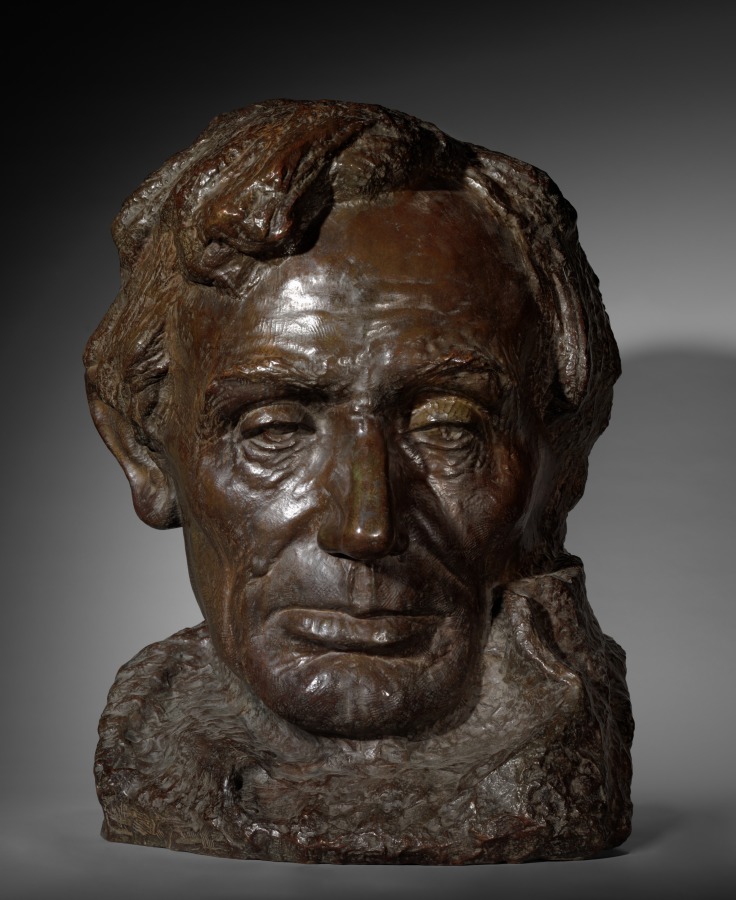
Head of Lincoln, 1908, by Gutzon Borglum
Gutzon Borglum · The Cleveland Museum of Art · Gift of Mrs. Salmon P. Halle
Key facts
Key facts
• Name — Gutzon Borglum • Birth Name — John Gutzon de la Mothe Borglum • Born — 25 March 1867 • Birthplace — St. Charles, Idaho Territory, U.S. • Died — 6 March 1941 • Place of death — Chicago, Illinois, U.S. • Resting Place — Forest Lawn Memorial Park • Notable Works — Mount Rushmore Stone Mountain • Field — Sculpture, painting • Training — Mark Hopkins Institute of Art Académie Julian École des Beaux-Arts California School of Design • Movement — Bull Moose Party • Children — 3, including Lincoln
Early life
Early life
The son of Danish immigrants, John Gutzon de la Mothe Borglum was born in 1867 in St. Charles, in what was then thought to be in Utah but was later determined to be in Idaho Territory. Borglum was a child of Mormon polygamy. His father, Jens Møller Haugaard Børglum (1839–1909), came from the village of Børglum in northwestern Denmark. He had two wives when he lived in Idaho: Gutzon's mother, Christina Mikkelsen Børglum (1847–1871), and her sister Ida, who was Jens's first wife. Jens Borglum decided to leave the LDS Church and moved to Omaha, Nebraska, where polygamy was both illegal and taboo. Jens Borglum had worked mainly as a woodcarver before his decision to attend the Saint Louis Homeopathic Medical College in St. Louis, Missouri. At this point "Jens and Christina divorced, the family left the LDS church, and Jens, Ida, their children, and Christina's two sons, Gutzon and Solon, moved to St. Louis, where Jens earned a medical degree." Upon his graduation from the Missouri Medical College in 1874, Dr. Borglum moved the family to Fremont, Nebraska, where he established a medical practice. Gutzon Borglum remained in Fremont until 1882, when his father enrolled him in St. Mary's College, Kansas. After a brief stint at Saint Mary's College, Gutzon Borglum moved to Omaha, Nebraska, where he apprenticed in a machine shop and graduated from Creighton Preparatory School.
New York City
New York City
In New York City, he sculpted saints and apostles for the new Cathedral of St. John the Divine in 1901; in 1906 he had a group sculpture accepted by the Metropolitan Museum of Art —the first sculpture by a living American the museum had ever purchased—and made his presence further felt with some portraits. He also won the Logan Medal of the Arts. His reputation soon surpassed that of his younger brother Solon Borglum, already an established sculptor.
Family
Family
In 1889, Borglum married his painting instructor, Elizabeth Putnam Janes, who was 18 years his senior. After divorcing his first wife, Borglum married Mary Montgomery Williams, on May 20, 1909, with whom he had three children, including a son, Lincoln, and a daughter, Mary Ellis (Mel) Borglum Vhay.
Public life
Public life
Borglum was active in the committee that organized the New York Armory Show of 1913, the birthplace of modernism in American art. By the time the show was ready to open, however, Borglum had resigned from the committee, feeling that the emphasis on avant-garde works had co-opted the original premise of the show and made traditional artists like himself look provincial. He moved into an estate in Stamford, Connecticut, in 1914 and lived there for 10 years. He sheltered Czechoslovak Legion members on his land at Stamford in 1917. Borglum was an active member of the Ancient Free and Accepted Masons (the Freemasons), raised in Howard Lodge #35, New York City, on June 10, 1904, and serving as its Worshipful Master 1910–11. In 1915, he was appointed Grand Representative of the Grand Lodge of Denmark near the Grand Lodge of New York. He received his Scottish Rite Degrees in the New York City Consistory on October 25, 1907. He was friends with Theodore Roosevelt for many years and during the 1912 United States presidential election Borglum was a very active campaign organizer and member of the Bull Moose Party. While it has been claimed that Borglum was a member of the Ku Klux Klan, an article in the Smithsonian Magazine denies that there is proof that he officially joined the KKK. That said, he became "deeply involved in Klan politics", attending Klan rallies and serving on Klan committees. In 1925, having only completed the head of Robert E. Lee, Borglum was dismissed from the Stone Mountain project, with some holding that it came about due to infighting within the KKK, with Borglum involved in the strife. Later, he stated "I am not a member of the Kloncilium, nor a knight of the KKK", but Howard Shaff and Audrey Karl Shaff claim that "that was for public consumption". The museum at Mount Rushmore displays a letter to Borglum from D. C. Stephenson, the infamous Klan Grand Dragon who later was convicted of the rape and murder of Madge Oberholtzer. The portrait contains the inscription "To my good friend Gutzon Borglum, with the greatest respect." Correspondence from Borglum to Stephenson during the 1920s detailed a deep racist conviction in Nordic moral superiority and strict immigration policies.
Monuments
Monuments
• Illustration — General Philip Sheridan, sculpted by Borglum in 1908, in Washington, D.C. A fascination with gigantic scale and themes of heroic nationalism suited his extroverted personality. His head of Abraham Lincoln, carved from a six-ton block of marble, was exhibited in Theodore Roosevelt's White House and can be found in the United States Capitol Crypt in Washington, D.C. A "patriot", believing that the "monuments we have built are not our own", he looked to create art that was "American, drawn from American sources, memorializing American achievement", according to a 1908 interview. Borglum was highly suited to the competitive environment surrounding the contracts for public buildings and monuments, and his public sculptures are found all around the United States. In 1908, Borglum won a competition for an equestrian statue of the Civil War General Philip Sheridan to be placed in Sheridan Circle in Washington, D.C. A second version of General Philip Sheridan was erected in Chicago, Illinois, in 1923. Winning this competition was a personal triumph for him because he won out over sculptor J. Q. A. Ward, a much older and more established artist and one whom Borglum had clashed with earlier in regard to the National Sculpture Society. At the unveiling of the Sheridan statue, one observer, President Theodore Roosevelt (whom Borglum was later to include in the Mount Rushmore portrait group), declared that it was "first rate"; a critic wrote that "as a sculptor Gutzon Borglum was no longer a rumor, he was a fact". President Franklin D. Roosevelt delivered an address on May 3, 1934, dedicating a statue of William Jennings Bryan created by Borglum. This Bryan statue by Borglum originally stood in Washington, D.C., but was later displaced by highway construction and moved by an Act of Congress in 1961 to Salem, Illinois, Bryan's birthplace. In 1925, the sculptor moved to Texas to work on the monument to trail drivers commissioned by the Trail Drivers Association. He completed the model in 1925, but due to lack of funds it was not cast until 1940, and then was only a fourth its originally planned size. It stands in front of the Texas Pioneer and Trail Drivers Memorial Hall next to the Witte Museum in San Antonio. Borglum lived at the historic Menger Hotel, which in the 1920s was the residence of a number of artists. He subsequently planned the redevelopment of the Corpus Christi waterfront; the plan failed, although a model for a statue of Christ intended for it was later modified by his son and erected on a mountaintop in South Dakota. While living and working in Texas, Borglum took an interest in local beautification. He promoted change and modernity, although he was berated by academicians.
Stone Mountain
Stone Mountain
• Illustration — Stone Mountain Memorial half dollar, 1925 (design by Borglum) Borglum was initially involved in the carving of Stone Mountain in Georgia. Borglum's nativist stances made him seem an ideologically sympathetic choice to carve a memorial to heroes of the Confederate States of America, planned for Stone Mountain, Georgia. In 1915, coinciding with the Klan-glorifying, highly successful The Birth of a Nation, he was approached by the United Daughters of the Confederacy with a project for sculpting a 20 ft high bust of General Robert E. Lee on the mountain's 800 ft rockface. Borglum accepted, but told the committee, "Ladies, a twenty-foot head of Lee on that mountainside would look like a postage stamp on a barn door." Borglum's ideas eventually evolved into a high relief frieze of Lee, Jefferson Davis, and Stonewall Jackson riding around the mountain, followed by a legion of artillery troops. Borglum agreed to include a Ku Klux Klan altar in his plans for the memorial to acknowledge a request of Helen Plane in 1915, who wrote to him: "I feel it is due to the KKK that saved us from Negro domination and carpetbag rule, that it be immortalized on Stone Mountain". After a delay caused by World War I, Borglum and the newly chartered Stone Mountain Confederate Monumental Association set to work on this monument, the largest ever attempted. Many difficulties slowed progress, some because of the sheer scale involved. After finishing the detailed model of the carving, Borglum was unable to trace the figures onto the massive area on which he was working, until he developed a gigantic magic lantern to project the image onto the side of the mountain. Carving officially began on June 23, 1923, with Borglum making the first cut. At Stone Mountain he developed sympathetic connections with the reorganized Ku Klux Klan, who were major financial backers of the monument. Lee's head was unveiled on Lee's birthday January 19, 1924, to a large crowd, but soon thereafter Borglum was increasingly at odds with the officials of the organization. His domineering, perfectionist, authoritarian manner brought tensions to such a point that in March 1925 Borglum smashed his clay and plaster models. He left Georgia permanently, his tenure with the organization over. None of his work remains, as it was all blasted off the mountain's face for the work of Borglum's replacement Henry Augustus Lukeman. In his abortive attempt, however, Borglum had developed the necessary techniques for sculpting on a gigantic scale that made Mount Rushmore possible.
Mount Rushmore
Mount Rushmore
• Illustration — Mount Rushmore, located in the Black Hills of South Dakota His Mount Rushmore project, 1927–1941, was the brainchild of South Dakota state historian Doane Robinson. His first attempt with the face of Thomas Jefferson had to be redone when it was determined that there was not enough stone to complete it. Dynamite was used to remove large areas of rock from under Washington's brow. The initial pair of presidents, George Washington and Thomas Jefferson, was soon joined by Abraham Lincoln and Theodore Roosevelt. Ivan Houser, father of John Sherrill Houser, was assistant sculptor to Gutzon Borglum in the early years of carving; he began working with Borglum shortly after the inception of the monument and was with Borglum for a total of seven years. When Houser left Gutzon to devote his talents to his own work, Gutzon's son, Lincoln, took over as assistant sculptor to his father. Borglum alternated exhausting on-site supervising with world tours, raising money, polishing his personal legend, sculpting a Thomas Paine memorial for Paris and a Woodrow Wilson memorial for Poznań, Poland (1931). In his absence, work at Mount Rushmore was overseen by Bill Tallman and later his son, Lincoln Borglum. During the Rushmore project, father and son were residents of Beeville, Texas. When he died in Chicago, following complications of surgery, his son finished another season at Rushmore, but left the monument largely in the state of completion it had reached under his father's direction.
Other works
Other works
• Illustration — Statue of Comstock Lode silver baron John William Mackay (1831–1902), Mackay School of Earth Sciences and Engineering, University of Nevada, Reno (1908) • Illustration — Aviator, Borglum, 1919, University of Virginia • Illustration — William Dempster Hoard Sculpture in Henry Mall in front of Agriculture Hall, University of Wisconsin-Madison (1922) • Illustration — North Carolinian soldiers at the Battle of Gettysburg In 1909, the sculpture Rabboni was created as a grave site for the Ffoulke Family in Washington, D.C., at Rock Creek Cemetery. Four public works by Borglum are in Newark, New Jersey: Seated Lincoln (1911), Indian and the Puritan (1916), Wars of America (1926), and a stele with bas-relief, First Landing Party of the Founders of Newark (1916). No other U.S. city holds as many public displays by Borglum. In 1912, the Nathaniel Wheeler Memorial Fountain, designed by Borglum, was dedicated in Bridgeport, Connecticut. A memorial to Robert Louis Stevenson at Baker Cottage, Saranac Lake, New York, was unveiled in 1915. In 1916, he overhauled the design of the torch for the Statue of Liberty in New York City. In 1918, he was one of the drafters of the Czechoslovak declaration of independence. One of Borglum's more unusual pieces is The Aviator, completed in 1919 as a memorial for James Rogers McConnell, who was killed in World War I while flying for the Lafayette Escadrille. It is located on the grounds of the University of Virginia in Charlottesville, Virginia. In 1922, he crafted the William Dempster Hoard Sculpture in the north end what is now the Henry Mall Historic District at the University of Wisconsin-Madison. His statue of Collis P. Huntington was completed in 1924 and stands at the entrance of the CSX Huntington headquarters building located in the 900 block of Seventh Avenue, Huntington, West Virginia. His statue of Harvey W. Scott was completed in 1933 and stood at the peak of Mount Tabor, Portland, Oregon, until it was toppled by protestors in 2020. Borglum sculpted the Memorial to the "Start Westward of the United States", which is located in Muskingum Park, Marietta, Ohio (1938). The work was featured on a 1938 3¢ US postage stamp. He built the statue of Daniel Butterfield at Sakura Park in Manhattan (1918). He created a memorial to Sacco and Vanzetti (1928), a plaster cast of which is now in the Boston Public Library. Another Borglum design is the North Carolina Monument on Seminary Ridge at the Gettysburg Battlefield in south-central Pennsylvania. The cast bronze sculpture depicts a wounded Confederate officer encouraging his men to push forward during Pickett's Charge. Borglum had also made arrangements for an airplane to fly over the monument during the dedication ceremony on July 3, 1929. During the sculpture's unveiling, the plane scattered roses across the field as a salute to those North Carolinians who had fought and died at Gettysburg. In 1939 when German troops marched into Poland, they destroyed Borglum's statue of Woodrow Wilson located in Poznań.
Death
Death
While visiting Chicago in 1941 to give a talk, Borglum began feeling ill and underwent routine prostate surgery. However, blood clots resulting from the surgery led to a series of heart attacks, with the final one resulting in his death on March 6. He was initially buried in a Chicago cemetery, with plans to later reinter his body elsewhere. The Rushmore Commission recommended that his body be interred in a specially constructed tomb at Mount Rushmore. However, there was no approval for his wife to be buried alongside him there, and several years after his death, his body was interred at its final resting place at Forest Lawn Memorial Park in Glendale, California. His son Lincoln Borglum completed the Mount Rushmore memorial and served as the memorial's first superintendent.
Identity and origins
Identity and origins
He also worked under the name John Gutzon de la Mothe Borglum. He married Mary Montgomery Borglum. 2 children are recorded: Lincoln Borglum and Mary Ellis Borglum Vhay.
Identity
Identity
Gutzon Borglum is recorded as a citizen of United States. Recorded with the occupation sculptor. Classed in the genre animal painting. Classed in the genre religious art. Classed in the genre portrait.
Life and career
Dated record
Life and career
Explore 1867–1941
The full dated record · 15 entries
1867
Gutzon Borglum was born on 25 March 1867.
1908
Bust of Abraham Lincoln is dated 1908.
1908
General Philip Sheridan is dated 1908.
1909
Rabboni is dated 1909.
1911
Seated Lincoln is dated 1911.
1915
John Peter Altgeld Monument is dated 1915.
1916
First Landing Party of the Founders of Newark is dated 1916.
1916
Indian and the Puritan is dated 1916.
1917
Stone Mountain Confederate Memorial is dated 1917.
1918
The Aviator is dated 1918.
1922
William Dempster Hoard Sculpture is dated 1922.
1925
Mount Rushmore National Memorial is dated 1925.
1926
Wars of America is dated 1926.
1934
Thomas Paine is dated 1934.
1941
Gutzon Borglum died on 6 March 1941.
Places
Named by the record
Places
Only places the record itself states, plotted where the house gazetteer settles their coordinates. Nothing is inferred from a name or a nationality.
St. Charles.
Birth place
Chicago.
Death place
Activity and practice
What Gutzon Borglum did, and where. Borglum worked at San Francisco. Borglum worked at New York City. Borglum worked at Paris. Recorded as having studied at Académie Julian, San Francisco Art Institute and Creighton Preparatory School.
Publications
*
Commissioned to design David Livingstone Centenary medal
According to the American Geographical Society website, "The David Livingstone Centenary Medal was founded at the initiative of the Hispanic Society of America in March 1913". The site goes on to state "Gutzon Borglum, the sculptor of Mt. Rushmore, was the designer of this unusually beautiful example of medallic art." The same website page notes that Theodore Roosevelt was awarded the medal in 1917.
Key references
Key references
*
Notes from the source article
Cited by Wikipedia
Notes from the source article
These works are cited by the source article, in its own numbering. They are recorded as its citations, not as sources VALÉORINE has verified.
- 1.Harte, Bret. The Overland Monthly. Samuel Carson. August 31, 2017.
- 2.Gutzon Borglum. Marriott Library – The University of Utah.
- 3.Dimmick, Lauretta. American Sculpture in the Metropolitan Museum of Art: A catalogue of works by artists born between 1865 and 1885. Metropolitan Museum of Art. August 31, 1999. 978-0-87099-923-9.
- 4.John Borglum. Galerie Gabrie.
- 5.Cullinane, Michael Patrick. Theodore Roosevelt's Ghost: The History and Memory of an American Icon. LSU Press. December 11, 2017. 978-0-8071-6673-4.
- 6.Abraham Lincoln Bust. aoc.gov.
- 7.Howard Shaff and Audrey Karl Shaff, Six Wars at a Time; The Life and Times of Gutzon Borglum, sculptor of Mount Rushmore, Center for Western Studies, St. Augustana College, Sioux Falls, South Dakota 1985, p. 197
- 8.Paller, Orvill. I Have a Question: Artists James T. Harwood, Gutzon and Solon Borglum, and Cyrus Dallin are said by some to be associated with the Church. Were they members?. Ensign. 52–54. October 1990.
- 9.PBS. Borglum biography. American Experience.
- 10.Price, Willadene, Gutzon Borglum: Artist and Patriot, copyright Willadene Price, 1961, 1972 edition p. 10
- 11.Swisher, Kaija. The lesser-known Borglum brother?. bhpioneer.com. February 20, 2015.
- 12.Howard Shaff and Audrey Karl Shaff, Six Wars at a Time: The Life and Times of Gutzon Borglum, Sculptor of Mount Rushmore, The Center for Western Studies, Augustana College, Sioux Falls, South Dakota, 1985, p. 18
- 13.Gives a Borglum Group: James Stillman presents 'The Mares of Diomedes' to the Metropolitan. The New York Times. February 12, 1906.
- 14.Senie, Harriet. Monumental Controversies. Potomac Books. 20. 2023. 978-1-64012-499-8.
- 15.David Livingstone Centenary Medal. American Geographical Society. June 10, 2025.
- 16.Morganteen, Jeff. The Dart: Artists Drawn to Stamford Home. Stamford Advocate. December 18, 2011.
- 17.Preclík, Vratislav. Masaryk a legie. Masarykovým demokratickým hnutím (Masaryk Democratic Movement). 101–102, 124–125, 128, 129, 132, 140–148, 184–190. 2019. 978-80-87173-47-3.
- 18.Leazer, Gary. [Untitled]. The Scottish Rite Journal of Freemasonry. 2004.
- 19.Cullinane, Michael Patrick. Theodore Roosevelt's Ghost: The History and Memory of an American Icon. LSU Press. 2017. 9780807166734.
- 20.Breunig, John. History not carved in stone. Stamford Advocate. February 19, 2018.
- 21.McLaurin, Ann M. The Rating Game in American Politics: An Interdisciplinary Approach. Irvington. 350. 1987. 9780829018110.
- 22.Taliaferro, John. Great White Fathers: The Story of the Obsessive Quest to Create Mount Rushmore. PublicAffairs. 2004. 978-1-58648-205-3.
- 23."Gutzon Borglum(?) with group of men on and around open bus at Bull Moose Convention(?)" (photograph). Library of Congress. .
- 24.Shear, Matthew. The Sordid History of Mount Rushmore. Smithsonian Magazine. October 2016.
- 25.Shaff, Howard. Six Wars at a Time: The Life and Times of Gutzon Borglum, sculptor of Mount Rushmore. Center for Western Studies, St. Augustana College. 203. 1985.
- 26.Senie, Harriet. Critical Issues in Public Art: Content, Context, and Controversy. Smithsonian Institution. 2014.
- 27."Address of the President at the Dedication of the Bryan Memorial".
- 28."Government Documents: Address of the President at the Dedication of the Bryan Memorial May, 1934". .
- 29.Texas State Historical Society: Handbook of Texas Online. Borglum, John Gutzon de la Mothe (1867–1941). June 12, 2010.
- 30.Michael J. Hyde (2004). The Ethos of Rhetoric. p. 161. University of South Carolina Press
- 31.American Experience. The Carving of Stone Mountain.
- 32.Price, Waldine (1961), Gutzon Borglum: The Man Who Carved a Mountain, Waldine Price, p. 136.
- 33.Poznań – Pomnik Woodrowa Wilsona. Atrakcje turystyczne Poznania. Ciekawe miejsca Poznania. Polska Niezwykła.
- 34.Shaff, Audrey Karl (1985), Six Wars at a Time: The Life and Times of Gutzon Borglum, Sculptor of Mount Rushmore, Sioux City, South Dakota: The Center for Western Studies, Augustana College, p. 277.
- 35.Price, Waldine (1961), Gutzon Borglum: Artist and Patriot, Waldine Price, p pp. 211–213
- 36.'Rabboni". Smithsonian Institution.
- 37.The National Register of Historic Places. The Public Sculpture of John de la Mothe Gutzon Borglum, 1911-1926. April 27, 1994.
- 38.Thurlow, Fearn (Winter 1975), "Newark's Sculpture: A survey of public monuments and memorial statuary", The Newark Museum Quarterly, vol. 6, no. 1.
- 39.Katz, Brigit. The Statue of Liberty's Original Torch Gets a New Home. Smithsonian Magazine. November 20, 2018.
- 40.Harvard University. The Contagion of Sovereignty: Declarations of Independence since 1776.
- 41.Bruce, Philip Alexander. History of the University of Virginia: The Lengthening Shadow of One Man. Macmillan. V. 408. 1922.
- 42.National Register of Historic Places Registration Form: Henry Mall Historic District. National Park Service.
- 43.Patterson, Janelle. Start Westward monument to be placed under shelter. Marietta Times.
- 44.National Postal Museum. 3c Northwest Territory Sesquicentennial 'Colonization of the West' single.
- 45.The City of New York City Department of Parks & Recreation. General Daniel Butterfield.
- 46.Bold, Christine. Writers, Plumbers, and Anarchists: The WPA Writers' Project in Massachusetts. University of Massachusetts Press. August 31, 2017. 978-1-55849-539-5.
- 47.Put Sacco & Vanzetti sculpture on display. The Boston Globe.
- 48.Menino, the mayor who welcomed Sacco and Vanzetti. The Boston Globe.
- 49.90 years on, legacy of Sacco and Vanzetti executions lingers. Washington Post.
- 50.Boston Public Library Archival and Manuscript Finding Aid Database. Aldino Felicani Sacco-Vanzetti Collection, 1915–1977.
- 51.Waldine Price (1961). Gutzon Borglum: The Man Who Carved a Mountain. p. 181
- 52.Fite, Gilbert C. Mount Rushmore. Mount Rushmore History Association. 1980. 9780964679856.
- 53.Carter, Robin Borglum. Gutzon Borglum: His Life and Work. Eakin Press. 1998. 978-1-57168-247-5.
References
Citations
References
Each reference names the institution holding it, so a reader may go to the document itself.
reference work
Wikidata, structured authority record Q336432: Gutzon BorglumWikimedia Foundation
Secondary witnessreference work
Secondary witness
Further particulars
Held on the record
Further particulars
Open the remaining particulars
Gutzon Borglum studied at Académie Julian, San Francisco Art Institute and Creighton Preparatory School. Each of those relationships is stated by the authority record rather than inferred from style.
Gutzon Borglum worked in art of sculpture. He belonged to Ku Klux Klan and Royal Society. He worked at San Francisco, Paris and New York City. Work and production. Works recorded as notable number 5: General Philip Sheridan, Rabboni, Wars of America, Mount Rushmore and Stone Mountain Confederate Memorial. His recorded genres are portrait, religious and animal. Borglum received Logan Medal of the Arts.
Career and activity
Recognition and collections
Work by Gutzon Borglum is
The Nelson-Atkins Museum of Art, National Gallery of Canada, New Mexico Museum of Art and Smithsonian American Art Museum
The Encyclopedia exists whether or not anything is for sale. Corrections are recorded rather than overwritten, and every version of this record is kept. Published 14 August 2026.
Elsewhere in Paintings
18,717 published records in this field, each with its sources named.
- Gustavus HesseliusArtist
- Gustavus von TempskyArtist
- Gusto GräserArtist
- Gusukuma SeihōArtist
- Guy BilloutArtist
- Guy C. WigginsArtist
- Guy CobbArtist
- Guy DavenportArtist
Best supported in this field
For owners
Own a work by Gutzon Borglum?
A specialist will read what you send and tell you what the house can establish, what it cannot, and whether the object is suited to sale. There is no charge and no obligation. The object stays with you throughout; nothing is shipped to us unless it is arranged in writing beforehand.