
Grinling Gibbons
Grinling Gibbons (4 April 1648 – 3 August 1721) was an Anglo-Dutch sculptor and wood carver known for his work in England, including Windsor Castle, the Royal Hospital Chelsea and Hampton Court Palace, St Paul's Cathedral and other London churches, Petworth House and other country houses, Trinity College, Oxford and Trinity College, Cambridge. Gibbons was born to English parents in Holland, where he was educated. His father was a merchant.
Also recorded as Gibbins · G. Gibbons · Mr. Gibbons · Gibbons
Grinling Gibbons
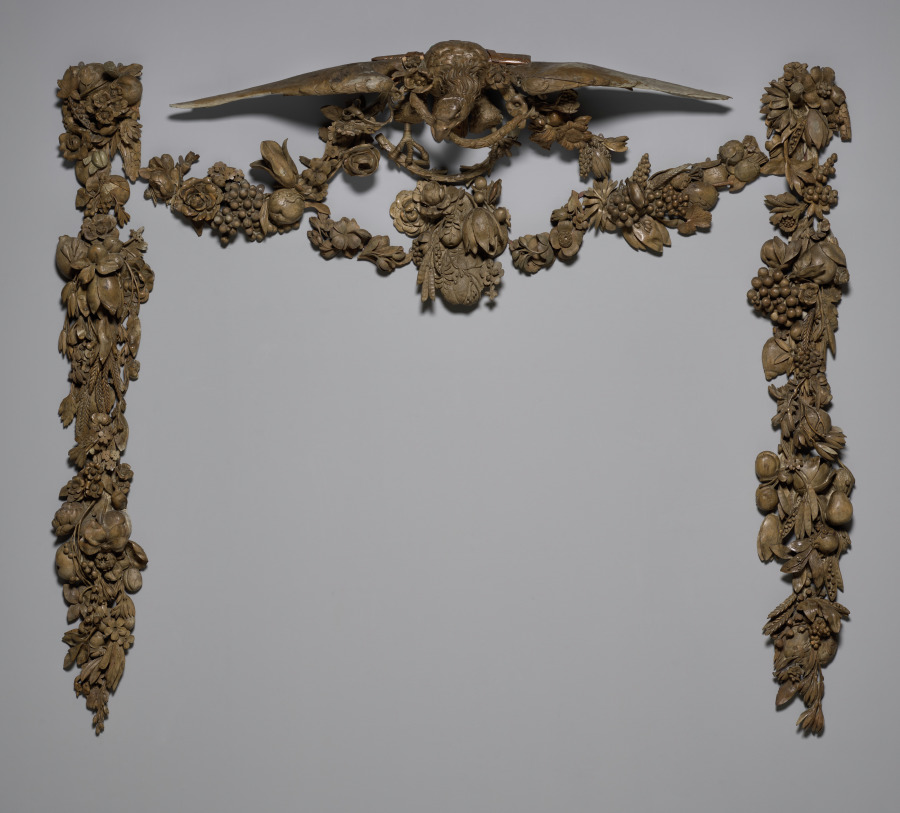
Grinling Gibbons · The Cleveland Museum of Art · Grace Rainey Rogers Fund · CC0
- Name
- Grinling Gibbons
- Born
- 4 April 1648
- Birthplace
- Rotterdam, Dutch Republic
- Died
- 3 August 1721
- Occupation
- Sculptor and wood carver
- Known for
- Works on St Paul's Cathedral
- Nationality
- Dutch Republic
- Movements
- Baroque
VALÉORINE Encyclopedia
VALÉORINE documentary reading
Documentary summary
Grinling Gibbons (4 April 1648 – 3 August 1721) was an Anglo-Dutch sculptor and wood carver known for his work in England, including Windsor Castle, the Royal Hospital Chelsea and Hampton Court Palace, St Paul's Cathedral and other London churches, Petworth House and other country houses, Trinity College, Oxford and Trinity College, Cambridge. Gibbons was born to English parents in Holland, where he was educated. His father was a merchant.
Admitted source layer · organised and presented by VALÉORINE
Note VALÉORINE
Grinling Gibbons (1648–1721) was a Dutch sculptor and wood carver. Born in Rotterdam, the sculptor died in London.
Grinling Gibbons was active in art of sculpture, visual arts and wood carving. The sculptor was associated with Baroque.
Works include Statue of James II. Languages used include English.
Composed from admitted, traceable facts · 27 September 2026
VALÉORINE
Reference Check
Propose documentary evidence for Grinling Gibbons. A contribution is never written directly as fact: identity, source, rights and evidence gates still decide.
Sign in to contribute
World of VALÉORINE
Documentary connections
Only confirmed graph relationships appear here. Images are shown only when their identity and reuse rights both pass the documentary gate.

Documentary evidence
Evidence Panel
not yet certified
- Identity
- resolved
- Independent source families
- 0
- Admitted assertions
- 0
- Open conflicts
- 0
Authority files
bnf · getty · gnd · loc · wikidata · Q610462 · wikipedia · Grinling Gibbons
In this article
Biography
Biography
Gibbons was a member of the Drapers' Company of London; he is widely regarded as the finest wood carver working in England, and the only one whose name is widely known among the general public. Most of his work is in lime (Tilia) wood, especially decorative Baroque garlands made up of still-life elements at about life size, made to frame mirrors and decorate the walls of churches and palaces, but he also produced furniture and small relief plaques with figurative scenes. He also worked in stone, mostly for churches.
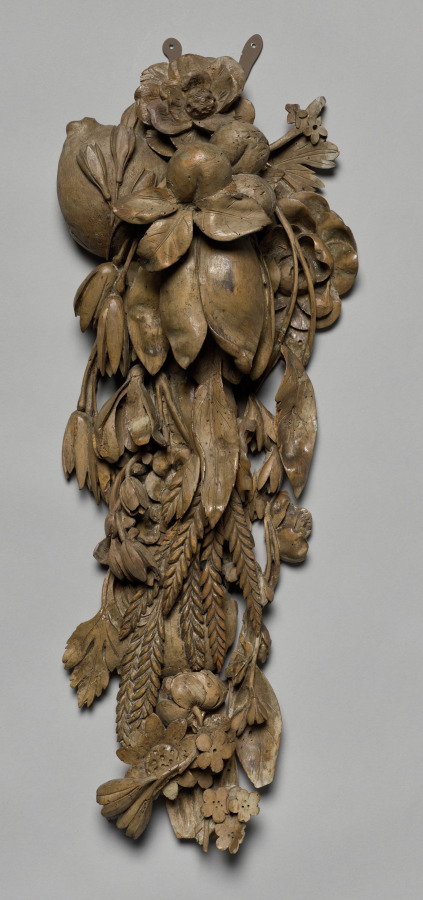
Carving from an Overmantel, c. 1675–1677, by Grinling Gibbons
Grinling Gibbons · The Cleveland Museum of Art · Grace Rainey Rogers Fund
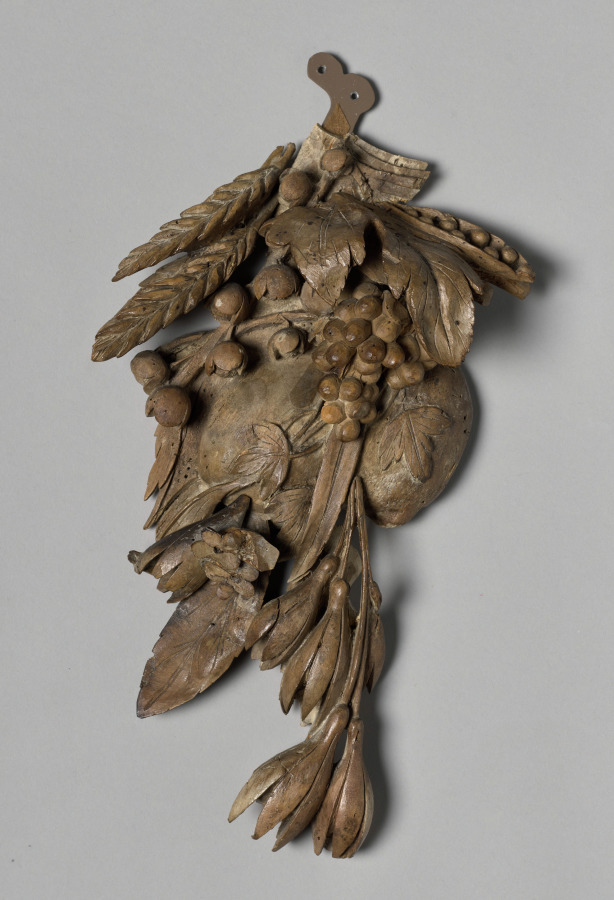
Carving from an Overmantel, c. 1675–1677, by Grinling Gibbons
Grinling Gibbons · The Cleveland Museum of Art · Grace Rainey Rogers Fund
Key facts
Key facts
• Name — Grinling Gibbons • Born — 4 April 1648 • Birthplace — Rotterdam, Dutch Republic • Died — 3 August 1721 • Resting Place — St Paul's, Covent Garden, London • Occupation — Sculptor and wood carver • Known for — Works on St Paul's Cathedral
Life
Life
• Illustration — Detail from Hampton Court Palace Very little is known about his early life. The name Grinling is formed from sections of two family names. He was born in Rotterdam, Netherlands, and it is sometimes thought that his father may have been the Englishman Samuel Gibbons, who worked under Inigo Jones, but even two of his closest acquaintances, the portrait painter Thomas Murray and the diarist John Evelyn, cannot agree on how he came to be introduced to King Charles II. He moved to Deptford, England, around 1667, and by 1693 had accepted commissions from the royal family and had been appointed as a master carver. By 1680 he was already known as the "King's Carver", and carried out exquisite work for St Paul's Cathedral, Windsor Castle, and the Earl of Essex's house at Cassiobury. His carving was so fine that it was said a pot of carved flowers above his house in London would tremble from the motion of passing coaches. • Illustration — Bookcase carvings for the Wren Library at Trinity College, Cambridge The diarist Evelyn first discovered Gibbons' talent by chance in 1671. Evelyn, from whom Gibbons rented a cottage near Evelyn's home in Sayes Court, Deptford (today part of south-east London), wrote the following: "I saw the young man at his carving, by the light of a candle. I saw him to be engaged on a carved representation of Tintoretto's Crucifixion, which he had in a frame of his own making." Later that same evening, Evelyn described what he had seen to Sir Christopher Wren. The ‘Crucifixion’ and frame now hang in the library in Dunham Massey Hall in Cheshire. Wren and Evelyn then introduced him to King Charles II who gave him his first commission – still resting in the dining room of Windsor Castle. Gibbons was a member of the Drapers' Company in London, being admitted by patrimony in 1672 and called to the livery in 1685. He was elected to the court and as a warden and then stood for election to be Master in 1718, 1719, and 1720, losing to an alderman each time. Horace Walpole later wrote about Gibbons: "There is no instance of a man before Gibbons who gave wood the loose and airy lightness of flowers, and chained together the various productions of the elements with the free disorder natural to each species." • Illustration — Plaque below a wreath of limewood in St Paul's Church, Covent Garden Gibbons is buried at St Paul's, Covent Garden, London, along with his wife Elizabeth. They are both buried in the crypt as attested by a plaque in the church below a wreath of limewood, carved by Gibbons and donated by the Dean and Chapter of St Paul's Cathedral in 1965.
Work
Work
• Illustration — Detail from Carved Room, Petworth House Gibbons was employed by Wren to work on St Paul's Cathedral and later was appointed as master carver to George I. He was also commissioned by William III to create carvings, some of which adorn Kensington Palace. An example of his work can be seen in the Presence Chamber above the fireplace, which was originally intended to frame a portrait of Queen Mary II after her death in 1694. Also in the Orangery at Kensington, you can see some his pieces. Many fine examples of his work can still be seen in the churches around London, particularly the choir stalls and organ case of St Paul's Cathedral. Some of the finest Gibbons carvings accessible to the general public are those on display at the National Trust's Petworth House in West Sussex. At Petworth the Carved Room is host to a fine and extensive display of intricate wooden carvings by Gibbons. His work can be seen in the London churches of St Michael Paternoster Royal and St James, Piccadilly, where he carved the wood reredos and marble font. The Anglican dislike of painted altarpieces typically left a large space on the east wall that needed filling, which often gave Grinling's garlands a very prominent position, as here. • Illustration — Monument for Cloudesley Shovell in Westminster Abbey In 1682 King Charles II commissioned Gibbons to carve a panel as a diplomatic gift for his political ally Cosimo III de' Medici, Grand Duke of Tuscany. The Cosimo Panel is an allegory of art triumphing over hatred and turmoil and includes a medallion with a low relief of Pietro da Cortona, Cosimo's favourite painter. The panel is housed in the Palazzo Pitti in Florence. It was displayed in the United Kingdom in the Grinling Gibbons and the Art of Carving exhibition held at the Victoria and Albert Museum from 22 October 1998 until 24 January 1999. Tobias Rustat commissioned three statues of Stuart kings from the workshop of Grinling Gibbons in the 1670s and '80s. These were the standing statue of Charles II at the Royal Hospital Chelsea, an equestrian statue of Charles II in Windsor Castle and the statue of James II, now in Trafalgar Square. The last was commissioned for the Palace of Whitehall, apparently at the same time as the standing Charles II, and the two works might have been intended as pendant pieces. In 1685, the new king James II asked Gibbons to carve a panel for another Italian ally, Francesco II d'Este, Duke of Modena, brother to his second wife Mary of Modena. The Modena Panel is a memento mori for Charles II who died earlier that year and includes a funeral dirge from the play The Contention of Ajax and Ulysses by dramatist James Shirley: "There is no armour against fate; Death lays its icy hand on kings: Sceptre and crown must tumble down". It also features a medallion self-portrait of Gibbons. The panel is displayed in the Galleria Estense in Modena. The Church of St Peter and St Paul, Exton, Rutland, has a fine marble tomb by Gibbons, dating from 1685, showing Baptist Noel, 3rd Viscount Campden with his fourth wife, Elizabeth Bertie, and carvings of his 19 children. • Illustration — Stoning of St Stephen, c. 1680, in the Victoria and Albert Museum Many experienced Flemish sculptors such as Artus Quellinus III, John Nost, Anthony Verhuke, Laurens van der Meulen and Peter van Dievoet also worked in Gibbon's London workshop as "servants", i.e. collaborators. As these Flemish artists were not trainees they were never entered in the Draper's records. In a document dated 1679 van der Meulen, Quellin and Verhuke are referred to as servants of Gibbons. Many of them left London and returned to their home country after the Glorious Revolution of 1688. In the Gibbons workshop these Flemish artists worked on various commissions but the contributions of particular artists active in the workshop are not always identifiable. Laurens van der Meulen and Peter van Dievoet are known to have collaborated on the creation of the statue of King James II during their stay in the workshop of Gibbons. St Michael and All Angels Church, Badminton, has a monument by Gibbons to Henry Somerset, 1st Duke of Beaufort (1629–1700). He was buried alongside his ancestors in the Beaufort Chapel in St George's Chapel, Windsor, but the monument was moved to Badminton in 1878. The monument by Gibbons is now on the north side of the chancel at St Michael and All Angels Church, Badminton, and consists of an effigy of the Duke in Garter robes, reclining on a sarcophagus and a plinth with relief of St George and the Dragon. There are twin Corinthian columns with embossed shafts, acanthus frieze, cornice with flaming urns, and the Duke's arms and supporters. At the top, 25 ft from the ground, is a tasseled cushion supporting a coronet; on the plinth are full-length female figures of Justice and Truth. Above the Duke's effigy, parted curtains show the heavenly host with palms and crowns. The Latin inscription displays the names of his family and the many offices he held. Gibbons made the monument for Admiral Sir Cloudesley Shovell, who was killed in the Scilly naval disaster of 1707. Shovell's large marble monument can be seen in the south choir aisle of Westminster Abbey. Gibbons often carved pea pods in his work. There is a myth that Gibbons carved a closed pea pod at first, and then an open one when the work had been paid for.
List of works
List of works
• Statue of Charles II, Chelsea, London • Memorial to William Windham, St Margaret's Church, Felbrigg, Norfolk • Memorial to Sir Richard Head, 1st Baronet, Rochester Cathedral, Rochester • Statue of King William III, College Green, Dublin
Life and work
Life and work
Grinling Gibbons was born on 4 April 1648 in Rotterdam. Gibbons held the nationality of Dutch Republic. Married to: Elizabeth Gibbons. Gibbons worked as sculptor and wood carver. Gibbons worked in English. Gibbons is placed by the collections within Baroque. Gibbons died on 3 August 1721 in London. Gibbons is buried at St Paul's Church, Covent Garden.
Life and career
Dated record
Life and career
Explore 1648–1721
The full dated record · 9 entries
1648
Grinling Gibbons born at Rotterdam.
1685
Equestrian statue of Charles II is dated 1685.
1686
Statue of James II is dated 1686.
1686
Four Apostles is dated 1686.
1690
Portrait of Grinling Gibbons (1690) is digitised and catalogued by Internet Archive.
1690
Leaf from Aedes Walpolianae mounted with a print and a drawing (a): Portrait of Grinling Gibbons; (b) Chimney to the Parlour, Houghton Hall, Norfolk (1690) is digitised and catalogued by Internet Archive.
1714
Statue of Robert Clayton is dated 1714.
1721
Dies at London.
1721
Grinling Gibbons died at London.
Method of working
Gibbons is believed to have invented the method of building up carvings through separate layers, each layer being nailed to the one beneath. The images below show a modern duplication of the technique.
Paintings, drawings and prints, 1685–1714
Catalogued output
Paintings, drawings and prints, 1685–1714
These are objects catalogued as visual works, each held or recorded by the institution named against it. 6 works carry dates between 1685 and 1714. The 1680s are the densest part of the run, with 4 titles, and that concentration is a fact about what the registers have catalogued rather than a judgement on the work itself. They belong to a run of 7 titles in all, from 1685 to 1714.
The run opens with Equestrian statue of Charles II and closes with Statue of Robert Clayton
Equestrian statue of Charles II
1685
Statue of James II
1686
Four Apostles
1686
A Putto holding the Crown and coat of arms of Ireland
1686
Statue of Charles II
1700
Statue of Robert Clayton
1714
Paintings, drawings and prints without a settled date
Catalogued output
Paintings, drawings and prints without a settled date
1 further work are catalogued under Gibbons's name without a date the collections agree on, which is why they are set apart from the dated run rather than placed in it.
Allegory of friendship between Cosimo III of Tuscany and Charles II of England
Legacy
Gibbons' association with Deptford is commemorated locally: Grinling Gibbons Primary School is in Clyde Street, near the site of Sayes Court in Deptford. Parts of New Cross and Deptford were in the "Grinling Gibbons" council ward from 1978 to 1998.
Primary material
Documents and archives
institutional register
- Bibliothèque nationale de France authority file 13505640j
Unverified · Bibliothèque nationale de France
- FAST authority file 76077
Unverified · FAST
- GND (German National Library) authority file 118976664
Unverified · GND (German National Library)
- IdRef (French universities) authority file 050161091
Unverified · IdRef (French universities)
- ISNI authority file 0000000066787329
Unverified · ISNI
- Library of Congress authority file n81079963
Unverified · Library of Congress
reference work
- “Grinling Gibbons”, English Wikipedia, consulted as further reading
Reputable secondary · Wikipedia
authority record
- Wikidata, structured authority record Q610462: Grinling Gibbons
Unverified · Wikidata
Authority records
Notes from the source article
Cited by Wikipedia
Notes from the source article
These works are cited by the source article, in its own numbering. They are recorded as its citations, not as sources VALÉORINE has verified.
- 1.V&A exhibition information, accessed 18 January 2013
- 2."Grinling Gibbon", Encyclopædia Britannica. Retrieved 30 September 2009.
- 3.national trust
- 4.GIBBONS, Grinling 18383.
- 5.Grinling Gibbons: The Carved Room at Petworth House. HENI Talks.
- 6.Ashley-Smith, Jonathan. The Cosimo Panel. V&A Conservation Journal. 29. 4–6. October 1998. 0967-2273.
- 7.Ward-Jackson, Philip. Public Sculpture of Historic Westminster: Volume 1. Liverpool University Press. 291–3. 2011. 9781846316913.
- 8.Easton, Bob. Grinling Gibbons – Wait, There's More – at Modena.
- 9.World Monuments Fund. TOMB OF VISCOUNT CAMPDEN AT EXTON CHURCH.
- 10.David Esterly, Grinling Gibbons and the Art of Carving, Harry N. Abrams, 30 April 2013, pp. 45, 176, 209, 219-224.
- 11."Gibbons, Grinling", in Oxford Dictionary of National Biography, vol. 22, pp. 29–30 : "The attribution of these works is complicated by the presence of the highly trained Flemish sculptors whom Gibbons had gathered into his workshop by the end of the 1670s. These included Arnold Quellin (the nephew of Artus Quellinus I), John Nost, and Anthony Verhuke, joined in the next decade by, among others, Laurens Vander Meulen and Pierre Van Dievoet. Their experience and skill as makers of statues may have exceeded his own".
- 12.Horace Walpole, Anecdotes of painting in England: with some account of the principal artists; and incidental notes on other arts; collected by the late Mr. George Vertue; and now digested and published from his original MSS. by Mr. Horace Walpole, London, 1765, vol. III, p. 91 : "Gibbons had several disciples and workmen; [...]. Dievot of Brussels, and Laurens of Mechlin were principal journeymen — Vertue says they modelled and cast the statue I have mentioned in the privy-garden". According to David Green, in Grinling Gibbons, his work as carver and statuary (London, 1964), one Smooke said to Vertue that this statue "was modelled and made by Laurence and Devoot (sic)"; George Vertue, Note Books, ed. Walpole Society, Oxford, 1930–1947, vol. I, p. 82 : "Lawrence. Dyvoet. statuarys", and ibidem IV, 50: "Laurens a statuary of Mechlin ... Dievot a statuary of Brussels both these artists were in England and assisted Mr. Gibbons in statuary works in K. Charles 2d. and K. James 2d. time, they left England in the troubles of the Revolution and retird to their own country".
- 13.St George's Chapel, Windsor: The Beaufort Chantry , 19 July 2013
- 14.For the inscription see Ashmole's Berkshire, iii. 163
- 15.St Michael and All Angels, Great Badminton webpage, 19 July 2013.
- 16.Sir Clowdisley Shovell's tomb and memorial in Westminster Abbey.
- 17.Freeman, Laura. What a carve-up! The genius of Grinling Gibbons. The Times. 2021-08-13.
- 18.Today (January 18) in London History – a piece of wood that could pass for lace. London Walks.
- 19.Grinling Gibbons and the Art of Carving p.145, David Esterly, V&A Publications 2000
- 20.London Borough of Lewisham
Bibliography printed in the source article · 4
- The Carved Cartoon: A Picture of the Past, Austin Clare 1873
- The Work of Grinling Gibbons, Geoffrey Beard, John Murray 1989
- Grinling Gibbons and the Art of Carving, David Esterly, V&A Publications 2000
- The Lost Carving by David Esterly, 2012
References
Citations
References
Each reference names the institution holding it, so a reader may go to the document itself.
institutional register
Bibliothèque nationale de France authority file 13505640jBibliothèque nationale de France
Partially resolvedinstitutional register
Partially resolvedinstitutional register
GND (German National Library) authority file 118976664GND (German National Library)
Partially resolvedinstitutional register
IdRef (French universities) authority file 050161091IdRef (French universities)
Partially resolvedinstitutional register
Partially resolvedinstitutional register
Library of Congress authority file n81079963Library of Congress
Partially resolvedinstitutional register
RKDartists authority file 273369RKDartists
Partially resolvedinstitutional register
Union List of Artist Names authority file 500115483Union List of Artist Names
Partially resolved
Every cited source · 11
- 01
Bibliothèque nationale de France authority file 13505640j
institutional register · Unverified · Bibliothèque nationale de France
Consult the source - 02
- 03
GND (German National Library) authority file 118976664
institutional register · Unverified · GND (German National Library)
Consult the source - 04
IdRef (French universities) authority file 050161091
institutional register · Unverified · IdRef (French universities)
Consult the source - 05
- 06
Library of Congress authority file n81079963
institutional register · Unverified · Library of Congress
Consult the source - 07
- 08
Union List of Artist Names authority file 500115483
institutional register · Unverified · Union List of Artist Names
Consult the source - 09
- 10
“Grinling Gibbons”, English Wikipedia, consulted as further reading
reference work · Reputable secondary · Wikipedia
Consult the source - 11
Wikidata, structured authority record Q610462: Grinling Gibbons
authority record · Unverified · Wikidata
Consult the source
Further particulars
Held on the record
Further particulars
Open the remaining particulars
Grinling Gibbons worked in visual arts, wood carving and art of sculpture. His work is associated with Baroque.
Career and activity
Recognition and collections
Work by Grinling Gibbons is
Art Institute of Chicago, Royal Hospital Chelsea, Tesoro dei Granduchi and Victoria and Albert Museum
The Encyclopedia exists whether or not anything is for sale. Corrections are recorded rather than overwritten, and every version of this record is kept. Published 14 August 2026.
Elsewhere in Sculpture
6,174 published records in this field, each with its sources named.
- Gretchen AlbrechtArtist
- Grigorij Danilovič JastrebeneckijArtist
- Grigorios ZeugolesArtist
- Grigoriy MyasoyedovArtist
- Gualtiero BusatoArtist
- Gudmar OlovsonArtist
- Guglielmo AgnelliArtist
- Guglielmo della PortaArtist
Best supported in this field
For owners
Own a work by Grinling Gibbons?
A specialist will read what you send and tell you what the house can establish, what it cannot, and whether the object is suited to sale. There is no charge and no obligation. The object stays with you throughout; nothing is shipped to us unless it is arranged in writing beforehand.