
Giuseppe Maria Mitelli
Giuseppe Maria Mitelli (1634–1718) was an Italian engraver and painter of the Baroque period. He was the son of the prominent quadratura painter Agostino Mitelli. The younger Mitelli was best known for his prolific engravings, in a great variety of subjects, including scenes from grand epics to mundane page boards for games of chance using dice, Tarot cards, and an Iconophor with anthropomorphized alphabets.
Also recorded as Joseph Mitell. · Gioseffo Maria Spanzani Metelli · Giuseppe Maria Mitello · Gioseffo Maria Mitelli
Giuseppe Maria Mitelli
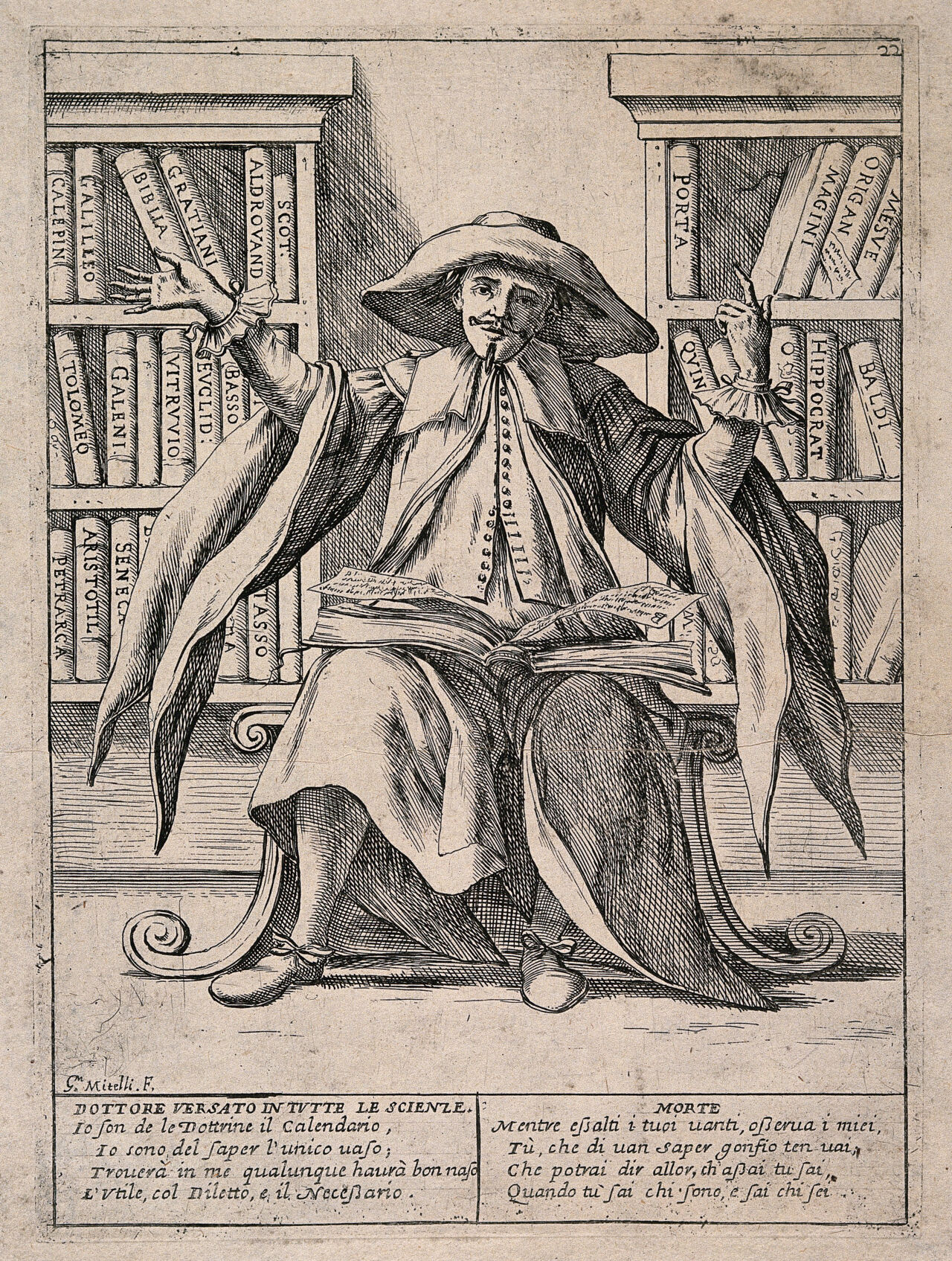
Giuseppe Maria Mitelli · Wellcome Collection, London · Wellcome Collection · Public Domain Mark
- Born
- 1634 · Bologna.
- Died
- 1718 · Bologna.
- Nationality
- Papal States
- Occupation
- engraver · painter · graphic artist
- Fields
- capriccio
- Known for
- Disegni et Abbozzi · L'Arti Per Via · L'Enea Vagante pitture dei Caracci · Mitelli intaglio
- Languages
- Italian
Reference Check
Propose documentary evidence for Giuseppe Maria Mitelli. A contribution is never written directly as fact: identity, source, rights and evidence gates still decide.
Sign in to contribute
World of VALÉORINE
Documentary connections
Only confirmed graph relationships appear here. Images are shown only when their identity and reuse rights both pass the documentary gate.
Documentary evidence
Documentary basis
Authority files
wikidata · Q3108083 · wikipedia · Giuseppe Maria Mitelli
In this article
Engravings of Contemporary Trades
Engravings of Contemporary Trades
He also engraved genre subjects, allegories, moralistic scenes, but even some bizarre cartoons that could be interpreted as sometimes provocatively subversive, or presciently revolutionary, and sometimes imaginatively bizarre. He often depicted dwarfs engaged in buffoonery or satirical depictions of aphorisms, which recalls the Bambocciate di nani or arte pigmeo of genre painter Faustino Bocchi (1659–1742). • Illustration — The Social Classes, all controlled by the Devil • Illustration — An Academy of Dwarf Painters drawing a Hunchback Model. Giuseppe studied or worked under Francesco Albani, Flaminio Torri, Guercino, and Simone Cantarini; he had a long career of over 60 years in Bologna. Mitelli was a flamboyant character who was also a painter and sculptor. He enjoyed a broad set of physical activities including fencing, hunting, fishing, tennis, gymnastics, and acting.
The recorded working language is Italian. Subjects and genres recorded for the work are capriccio. Places of work recorded in the authority are Bologna, Madrid and Rome. Works named in the authority record are Disegni et Abbozzi, L'Arti Per Via, L'Enea Vagante pitture dei Caracci and Mitelli intaglio. Work by Giuseppe Maria Mitelli is recorded in the collections of Museum Boijmans Van Beuningen, Museo del Prado, Art Institute of Chicago, Auckland Art Gallery and Finnish National Gallery.
Giuseppe Maria produced a series of engravings depicting Arts of the Street, published in 1660. This was part II of a book of engravings, in which part I, Diverse Figure, had been engraved by Simon Guillain II, and published in Bologna by Giovanni Atanasio Mosini. The inspiration for these works was either from Annibale Carracci’s drawings, or subsequent engravings by Simon Guillain II. • Illustration — Patent-Medicine Quack Hawking Snakes. The second part, titled The Arts of the Street (Di Bologna. L’Arti per Via) celebrates the tradesmen and workmen who practiced their occupations in the streets of Bologna. A list of the engravings includes: • *Frontispiece, View of Bologna *1. Man Carrying Bread in a Basket *2. Vendor of Fans *3. Vendor of Earthenware Pots *4. Knife Grinder *5. Vendor of Ciambelle (Biscuit Vendor) 126 *6. Fisherman *7. Water Carrier *8. Patent-Medicine Quack Hawking Snakes (see image) *9. Mason *10. Vendor of Cooked Apples and Pears by Moonlight *11. Man Carrying a Barrel of Wine *12. Man Carrying a Butchered Pig *13. Vendor of Dry Goods *14. Porter *15. Mason Going to Whitewash Walls (Imbianchino)(Plasterer) *16. Man Skinning a Lamb *17. Vendor of Ribbons, Lace, and Pins *18. Donkey Driver with his Herd *19. Chimney sweep — *20. Woodcutter *21. Vine Dresser *22. Vendor of Chairs *23. Vendor of Rosaries and Sacred Images *24. Vendor of Sieves *25. Vendor of Chicken Dung *26. Man Driving a Donkey Laden with Pots *27 Onion Seller *28. Vendor of Anisette and a Vendor of Matches Playing Morra *29. Fruit Seller *30. Cheese Vendor *31. Vegetable Vendor *32. Tripe Vendor *33. Vendor of Glassware *34. Two Well Cleaners *35. Vendor of Iron Kitchen Utensils *36. Vendor of Grain Sifters *37. Butcher Boy with Two Cats *38. Vendor of Shoes *39. Hat Vendor *40. Vendor of Chicken Heads and Livers
Tarot of Mitelli
Tarot of Mitelli
• Illustration — Self-portrait of G. M. Mitelli, engraved on the Ace of Coins of his Tarot deck. Around 1660 Giuseppe Maria Mitelli realized for Count Prospero Bentivoglio - a member of a powerful Bolognese family -, a Game of Tarot with a New form of Tarocchini (a variant of the classic Tarot). This artwork consists of 62 cards in typical Baroque style and it is still today considered one of the highest examples of Mitelli's artistic production. Italian art historian Giordano Berti, in his study on Mitelli's life and work has defined the Mitelli's Tarocchino «a jewel of creativity, a flight of fantasy, a perfect stylistic exercise». Mitelli placed his own self-portrait on the Ace of Coins and, to affirm the originality of his masterpiece, he added INV DIS & INT ("Invented, Drawn and Engraved").
Other Images by Mitelli
Other Images by Mitelli
• Illustration — Doctors from various countries minister to the Dying Sultan. He drew an enraged Imre Thököly in oriental garb behind bars (though it is unlikely that Mitelli would ever have seen the Hungarian rebel and Ottoman sympathiser as a prisoner in person). The Ottoman menace was still alive for Christian in this era. In another cartoon, he mocks the assistance that foreign Doctors provide to a dying Ottoman Sultan. The engraving contains the sultans hat under a commode, and a torn Koran. The dying sultan pleads to his parting Vizier to save his realm for Islam (see dying Sultan and doctors). This cartoon highlights the response of the European kingdoms in the signing of the Treaty of Karlowitz of 26 January 1699. He also drew a laborer destroying a classical female statue. In 2010, an exhibition of 250 drawings and engravings were displayed in an exhibition titled Il mondo fantastico nelle incisioni di Giuseppe Maria Mitelli at the Galleria Garisenda (Strada Maggiore 14/a) of Bologna.
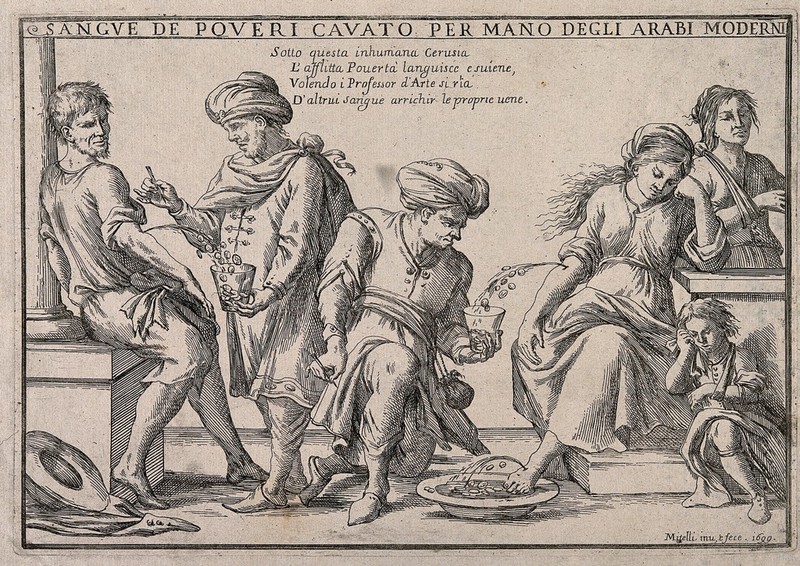
Arabian doctors perform bleeding on poor Italian people; money jets out with the blood; signifying learned Arabs fleecing the poor. Etching by G.M. Mitelli after himself, 1699., 1699, by Giuseppe Maria Mitelli
Giuseppe Maria Mitelli · Wellcome Collection, London · Wellcome Collection
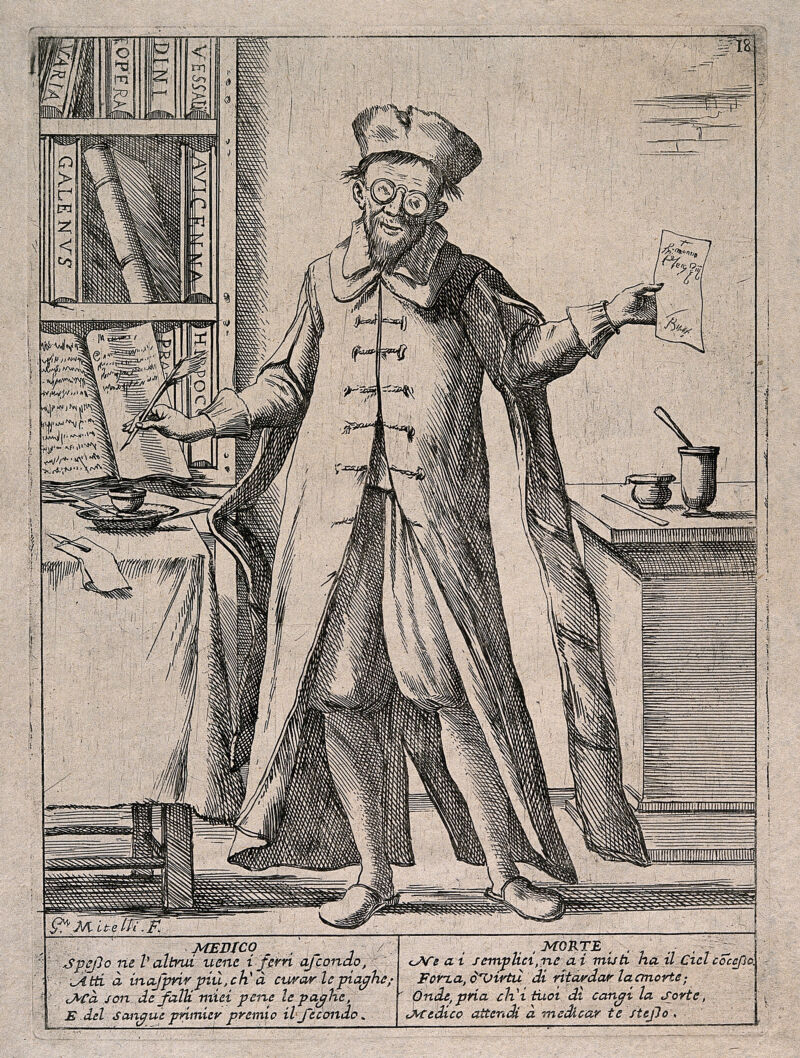
A learned physician with a library of Latin books writes a prescription but cannot save his patients from death. Etching by G.M. Mitelli, c. 1700., by Giuseppe Maria Mitelli
Giuseppe Maria Mitelli · Wellcome Collection, London · Wellcome Collection
Primary material
Documents and archives
reference work
- “Giuseppe Maria Mitelli”, English Wikipedia, consulted as further reading
Reputable secondary · Wikipedia
authority record
- Wikidata, structured authority record Q3108083: Giuseppe Maria Mitelli
General reference · Wikidata
Text attribution
Licensing
Text attribution
Part of the biographical narrative on this page reuses licensed material. Its origin, revision and licence are recorded here.
The biographical narrative on this page is based on the Wikipedia article Giuseppe Maria Mitelli, revision 1365385365 (EN edition), by its contributors. VALÉORINE has edited that text and built its own documentary record around it. The reused material is available under CC BY-SA 4.0, and this page's reuse of it is offered under the same licence. Everything else on this page — the chronology, the holdings, the evidence, the plates and the connections — is VALÉORINE's own record. Sources and licences.
Notes from the source article
Cited by Wikipedia
Notes from the source article
These works are cited by the source article, in its own numbering. They are recorded as its citations, not as sources VALÉORINE has verified.
- 1.See a similar effort by Giovanni Battista Braccelli.
- 2.Lombardia Beni Culturali.
- 3.Italian Art at the Utah Museum of Art: a Guide to the Collection. Ursula M. Brinkman Pimentel, contribution by Madelyn D. Garrett. page 118-122.
- 4.A pupil of both Alessandro Algardi and Ludovico Carracci, Simon Guillain II, was born in Paris, was the son of sculptor and engraver Simon of Cambrai (1581-1658).
- 5.He who from pungent serpents and vipers,/ seeks to make the body anatomy whole,/ only exhibits that his sole true patent/ is the privilege of deceiving the world. or in Italian: Costui, che di angue, e vipere pungenti/ Vuol far de l'anatomico facondo,/ Sol mostra su l'autentiche patenti/ Il privilegio d'ingannare il Mondo.
- 6.Also see engravings published by Gaetano Zompini.
- 7.Engraving at Art Institute of Chicago.
- 8.Giordano Berti, Giuseppe Maria Mitelli and the Tarocchino Bolognese, Araba Fenice, Boves 2017 (english version translated by Vic Berti), page 45.
- 9.Morgan Library drawings: Imre Thököly imprisoned.
- 10.Morgan Library drawings: Man Destroying a Statue with a Hammer.
- 11.Repubblica newspaper of Bologna.
References
Citations
References
Each reference names the institution holding it, so a reader may go to the document itself.
reference work
Secondary witnessauthority record
General reference
The Encyclopedia exists whether or not anything is for sale. Corrections are recorded rather than overwritten, and every version of this record is kept. Published 16 August 2026.
Elsewhere in Prints
4,138 published records in this field, each with its sources named.
- Giuseppe Filippo Liberati MarchiEngraver
- Giuseppe GrandiEngraver
- Giuseppe LonghiEngraver
- Giuseppe Maria AbbiatiEngraver
- Giuseppe Niccolò VicentinoEngraver
- Giuseppe VasiEngraver
- Giuseppe ZauliEngraver
- Giuseppe ZigainaEngraver
Best supported in this field
For owners
Own a work by Giuseppe Maria Mitelli?
A specialist will read what you send and tell you what the house can establish, what it cannot, and whether the object is suited to sale. There is no charge and no obligation. The object stays with you throughout; nothing is shipped to us unless it is arranged in writing beforehand.