
Giuseppe Vasi
Giuseppe Vasi (27 August 1710 – 16 April 1782) was an Italian engraver and architect, best known for his vedute.
Also recorded as Giuseppe Agostino Vasi · Giuseppe Agostino Pietro Vasi · Joseph Vasi · Vassi
Giuseppe Vasi
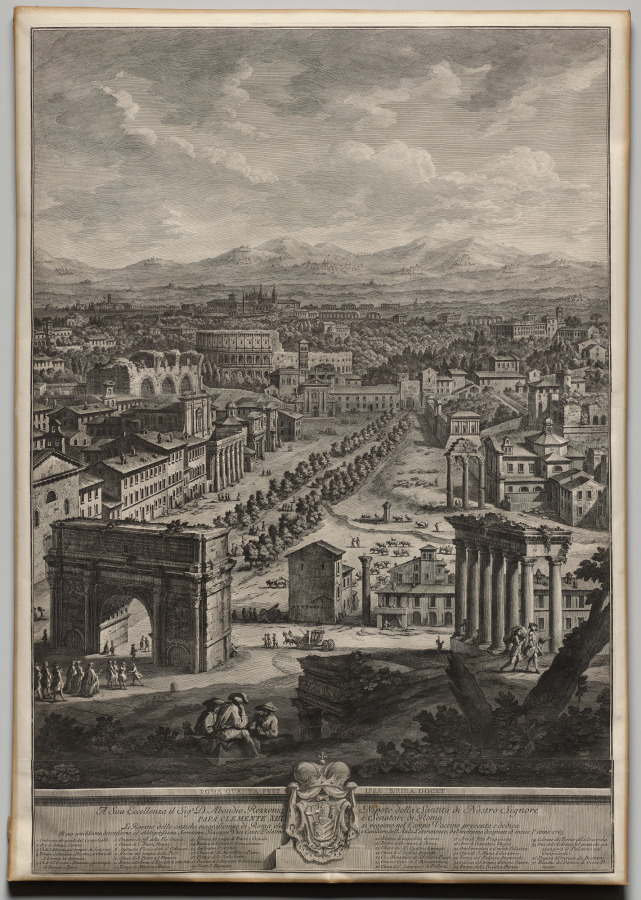
Giuseppe Vasi · The Cleveland Museum of Art · Gift of the family of Mr. and Mrs. Peter M. Hitchcock · CC0
- Born
- 1710.
- Died
- 1782.
- Occupation
- architect, printmaker, painter and graphic artist.
- Fields
- Veduta and landscape painting.
VALÉORINE Encyclopedia
VALÉORINE documentary reading
Documentary summary
Giuseppe Vasi (27 August 1710 – 16 April 1782) was an Italian engraver and architect, best known for his vedute.
Admitted source layer · organised and presented by VALÉORINE
Reference Check
Propose documentary evidence for Giuseppe Vasi. A contribution is never written directly as fact: identity, source, rights and evidence gates still decide.
Sign in to contribute
Documentary evidence
Documentary basis
Authority files
wikidata · Q1348867 · wikipedia · Giuseppe Vasi
In this article
Biography
Biography
He was born in Corleone, Sicily and trained as a printmaker in Palermo. Around 1736, he moved to Rome, where he was patronized by Cardinal Troiano Acquaviva d'Aragona, and made the acquaintance of several prominent artists working in the city, including Sebastiano Conca, Luigi Vanvitelli and Ferdinando Fuga. After a period of intense visits and studies, Vasi started to work as an engraver in the Calcografia Camerale, the main public institution of Rome devoted to engraving and etching, founded some years before by Pope Clement XII. His views for the Calcografia include panoramas of the Trevi Fountain and of the Spanish Steps. Later on Vasi started to work on his own, producing and selling series of his views to a public made principally of grand tourists. The first series of akin consists in the Vedute di Roma sul Tevere, i.e. Views of the Tiber, circa 1743 and later adapted to become part of the Magnificenze di Roma antica e moderna. In these years Vasi also hosted in his workshop for a limited period of time the young Giovanni Battista Piranesi, his major pupil, who shaped here his technique as an engraver. From 1747 to 1761 Vasi published a series of ten volumes including circa 240 engravings of vedute of Rome. He also created 15 tablet engravings of opera scenes designed by Vincenzo Re; some of which are part of the collection at the Victoria and Albert Museum in London. Vasi played a major role as a cartographer and as writer as well. As a cartographer his major work remains the giant map of Rome, published in the early 1760s but conceived at least 20 years before; as an author, Vasi wrote nine out of ten books of the "Magnificenze" (II to X) and the "Itinerario Istruttivo". The "Itinerario", first published in the 1760s as well, turned out to be one of the most successful enterprises akin: translated in French and later in English, it was re-edited, modified and republished up to the mid-18th century.
State of the art
State of the art
Vasi was a famous man and artist up to the 1760s, when Piranesi took definitively his place, making his master's style old and outdated. For over 200 years Vasi was artistically forgotten and his views taken into account only for their topographical and documentary qualities. Things changed in 1981, thanks to the monograph by Luisa Scalabroni and even more in the nineties, mainly thanks to the contributions by Paolo Coen on his catalogue and by Allan Ceen on the maps. Today Giuseppe Vasi is no longer considered Piranesi's defeated rival, but an artist with his own personality and technique. Though far from being a revolutionary, he gave a significant contribution to the Roman school of engraving applied to the "veduta", with a role quite similar to Giovanni Panini's in painting.
Selected modern bibliography
Scalabroni, Luisa (1981). Giuseppe Vasi. Rome: Multigrafica. Coen, Paolo (2006). Le Magnificenze di Roma di Giuseppe Vasi (2nd ed.). Rome: Newton and Compton. Coen, Paolo (2001). "Arte, cultura e mercato in una bottega romana del XVIII secolo: l'impresa calcografica di Giuseppe e Mariano Vasi, fra continuità e rinnovamento". Bollettino d'Arte. 115: 23–74. Retrieved 31 August 2025. "Imago Urbis: Giuseppe Vasi's Grand Tour of Rome". University of Oregon. 2008. Archived from the original on 20 April 2019. James G. Harper & James T. Tice, Giuseppe Vasi's Rome: Lasting Impressions from the Age of the Grand Tour, exh. cat., Jordan Schnitzer Museum of Art & the Princeton University Art Museum 2010 (distributed by the University of Delaware Press), 2010
![The Farnese Hercules from the front and back. Engraving by G. Vasi, 1773., [1773], by Giuseppe Vasi](https://iiif.wellcomecollection.org/image/V0048047/full/800,/0/default.jpg)
The Farnese Hercules from the front and back. Engraving by G. Vasi, 1773., [1773], by Giuseppe Vasi
Giuseppe Vasi · Wellcome Collection, London · Wellcome Collection

Istituto di St. Michele (home for delinquent children), Rome, Italy. Etching by I. Noval after G. Vasi, 1747., 1747, by Giuseppe Vasi
Giuseppe Vasi · Wellcome Collection, London · Wellcome Collection
Notes from the source article
Cited by Wikipedia
Notes from the source article
These works are cited by the source article, in its own numbering. They are recorded as its citations, not as sources VALÉORINE has verified.
References
Citations
References
Each reference names the institution holding it, so a reader may go to the document itself.
reference work
Secondary witnessreference work
Secondary witness
The Encyclopedia exists whether or not anything is for sale. Corrections are recorded rather than overwritten, and every version of this record is kept. Published 14 August 2026.
Elsewhere in Prints
4,138 published records in this field, each with its sources named.
- Giuseppe LonghiEngraver
- Giuseppe Maria AbbiatiEngraver
- Giuseppe Maria MitelliEngraver
- Giuseppe Niccolò VicentinoEngraver
- Giuseppe ZauliEngraver
- Giuseppe ZigainaEngraver
- Giuseppe ZocchiEngraver
- Giuseppe ZucchiEngraver
Best supported in this field
For owners
Own a work by Giuseppe Vasi?
A specialist will read what you send and tell you what the house can establish, what it cannot, and whether the object is suited to sale. There is no charge and no obligation. The object stays with you throughout; nothing is shipped to us unless it is arranged in writing beforehand.